TL;DR
Apple (AAPL:NASDAQ) delivered an exceptionally strong fiscal third quarter, with revenue rising 16%, operating income increasing 27%, and diluted EPS growing 29%. The performance was broad-based: iPhone, Mac, Services, Greater China and every geographic segment recorded growth.
Yet Apple shares fell sharply after the earnings release in post trading. The market was looking beyond the June-quarter strength toward slower forward growth, worsening supply constraints and continued pressure on the company’s premium valuation.
Our probability-weighted fair value is approximately $294 per share. At the initial post-earnings price near $312, Apple has moved closer to fair value but still offers little margin of safety. For a value-oriented investor, the more attractive buying zone is approximately $235–$250, while prices around $220–$230 could represent a fat-pitch opportunity if the underlying business remains intact.
Earnings Recap
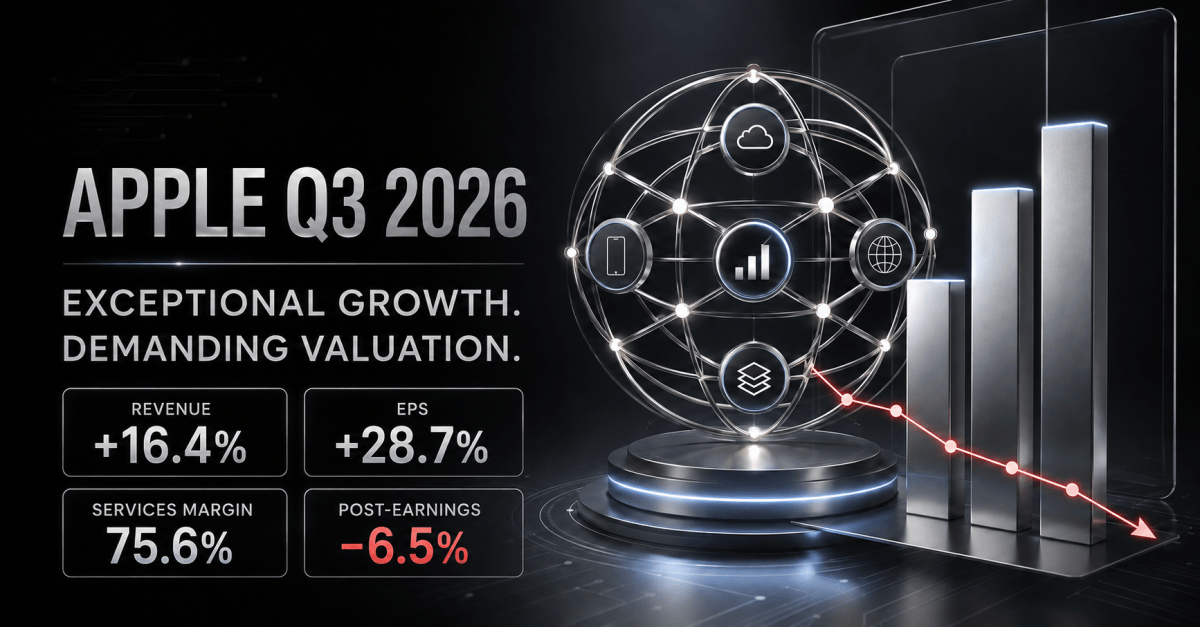
Apple reported revenue of $109.42 billion for the quarter ended June 27, 2026, representing year-over-year growth of 16.4%.
Operating income increased 26.6% to $35.70 billion, while net income rose 27.1% to $29.79 billion. Diluted EPS reached $2.02, an increase of 28.7%.
The reported result included a tariff-refund benefit that added approximately two percentage points to gross margin and $0.11 to diluted EPS. Excluding that disclosed benefit arithmetically, EPS would have been approximately $1.91, still about 22% higher than the prior-year period.
Apple’s operating leverage was impressive. Revenue grew 16%, but gross profit increased 25% and operating income advanced 27%. Operating margin expanded from 30.0% to 32.6%.
The quarter was not driven by one isolated product or region:
- iPhone revenue increased 21.7% to $54.25 billion
- Mac revenue increased 28.7% to $10.35 billion
- Services revenue increased 12.1% to $30.74 billion
- Wearables, Home and Accessories increased 6.5%
- iPad revenue declined 5.9%
- Greater China revenue increased 22.4%
- Every reported geographic segment generated year-over-year growth
Apple also reported a new all-time high for its active-device installed base, with records across all major product categories and geographic segments.
Services Remains Apple’s Economic Anchor
Services generated only 28.1% of quarterly revenue, but contributed 42.4% of total gross profit.
Its gross margin reached 75.6%, compared with 40.1% for Apple’s product businesses. This makes Services disproportionately important to Apple’s long-term earnings quality and valuation.
The installed base gives Apple an expanding platform through which it can sell subscriptions, applications, payments, cloud storage and other digital services. Continued Services growth can make earnings more recurring and less dependent on individual hardware-replacement cycles.
However, Services grew only 12.1%, considerably slower than iPhone and Mac. That is still healthy growth, but it creates an important tension: Apple’s fastest growth this quarter came from hardware, while the company’s highest-margin business expanded more moderately.
If hardware growth normalizes without a corresponding acceleration in Services, Apple’s overall growth rate and margin expansion could slow at the same time.
Why Did Apple Stock Fall?
Apple shares closed the regular session at $333.43 before falling to approximately $311.75 in after-hours trading, a decline of around 6.5%.
The price action initially appeared surprising because the reported quarter was exceptionally strong. External market coverage, reviewed separately from our official-source SWOT analysis, attributed the decline primarily to the forward outlook rather than the June-quarter results.
The principal concerns were:
- September-quarter revenue guidance was below prevailing market expectations.
- Apple warned that supply constraints affecting advanced processors and memory would become significantly more severe.
- Services revenue fell short of consensus expectations despite maintaining double-digit growth.
- Rising memory costs could place further pressure on underlying margins.
- Some investors questioned whether unusually strong hardware demand included purchases brought forward ahead of potential price increases.
- Apple entered earnings at a demanding valuation after a strong share-price run.
The sell-off therefore represented a reassessment of the next quarter and the sustainability of current growth—not a rejection of the reported financial performance.
Apple SWOT Analysis
Strengths
Apple’s greatest strength remains the breadth and quality of its ecosystem. Strong growth across products and regions, combined with a record installed base, reduces dependence on any single market.
The company also continues to demonstrate exceptional profitability and cash generation. During the first nine months of fiscal 2026, Apple generated approximately $117.00 billion in operating cash flow and spent only $6.80 billion on capital expenditure. Operating cash flow less capital expenditure was therefore approximately $110.20 billion.
Apple returned about $73.87 billion through repurchases and dividends. Diluted shares declined 1.6%, providing an additional contribution to per-share earnings growth.
Its balance sheet remains formidable. Apple held approximately $146.52 billion in cash and marketable securities, equivalent to about $62.17 billion after subtracting commercial paper and term debt.
Weaknesses
The reported profitability included a meaningful temporary benefit. Without the tariff refund, gross margin would have been approximately 48.1%, rather than the reported 50.1%.
The underlying result was still strong, but investors should not treat the entire reported margin expansion or EPS growth as recurring.
Apple’s R&D expense also increased 32.3%, approximately twice the rate of revenue growth. The company can comfortably fund this investment, but rising expenditure creates a future monetization requirement.
If higher investment—potentially including AI development—does not generate stronger device demand, customer retention, Services revenue or pricing power, it could eventually reduce operating leverage.
Inventory is another monitoring point. It increased from $5.72 billion at the end of fiscal 2025 to $11.09 billion in June 2026. This may reflect product-cycle preparation or supply-chain management rather than weakening demand, but the increase was substantial enough to warrant attention.
Opportunities
Apple’s largest opportunity is to generate more economic value from each active device.
Because Services carries a 75.6% gross margin, even a modest acceleration could have an outsized effect on consolidated earnings. If Apple can return Services growth to the mid-teens while continuing to expand its installed base, it may sustain attractive EPS growth even after hardware demand normalizes.
AI could also strengthen the ecosystem without requiring Apple to build a large standalone AI business.
The economic value would come from measurable outcomes such as:
- Encouraging device upgrades
- Improving customer retention
- Increasing engagement with paid services
- Strengthening differentiation between Apple and competing ecosystems
- Creating new subscription or developer revenue
At present, Apple does not separately disclose AI revenue. The opportunity should therefore be judged through future changes in product demand, Services growth and profitability—not through product announcements alone.
Greater China offers another opportunity. Revenue increased 22.4% to $18.82 billion, demonstrating that the market does not have to remain a permanent drag on Apple’s growth. The key question is whether this improvement is sustainable or primarily related to product-cycle timing.
Threats
The largest fundamental threat is the normalization of hardware growth.
iPhone revenue increased nearly 22% and Mac revenue almost 29%. These growth rates are unlikely to become permanent baselines for businesses of their scale.
If hardware returns to low- or mid-single-digit growth while Services remains near 12%, Apple’s consolidated growth could decelerate sharply. That could pressure both expected earnings and the valuation multiple investors are willing to pay.
Product concentration also remains significant. iPhone generated approximately 49.6% of quarterly revenue. A weaker replacement cycle would affect not only device sales, but also accessories, installed-base growth and future Services opportunities.
Finally, Apple remains exposed to a potentially unfavorable combination of rising product costs, increasing R&D investment and the disappearance of temporary benefits. These risks are manageable individually, but more consequential if they occur while revenue growth is slowing.
Valuation Scenarios
For valuation purposes, we use normalized trailing EPS of approximately $8.15, after deducting the disclosed $0.11 tariff-refund benefit from the trailing earnings base.
Bear Case: $231
The bear case assumes fiscal 2027 EPS of $8.25 and a fair P/E multiple of 28 times.
In this scenario, hardware growth normalizes sharply, Services remains near low-double-digit growth, and cost pressures limit further margin expansion. Apple remains a high-quality franchise, but investors no longer value it as a durable mid-teens earnings compounder.
Estimated probability: 25%
Base Case: $292
The base case assumes fiscal 2027 EPS of $8.85 and a fair P/E multiple of 33 times.
Hardware growth slows but remains positive. Services continues expanding at approximately a low-double-digit rate, Greater China remains healthier, and share repurchases add modestly to per-share growth. Apple retains a significant premium because of its ecosystem, installed base and exceptional cash generation.
Estimated probability: 50%
Bull Case: $359
The bull case assumes fiscal 2027 EPS of $9.45 and a fair P/E multiple of 38 times.
Strong iPhone demand proves more durable than expected, Services reaccelerates, and AI-related capabilities contribute to upgrades, engagement or monetization. Cost pressures remain manageable, allowing Apple to maintain both strong earnings growth and a premium valuation.
Estimated probability: 25%
Weighting these scenarios produces an estimated fair value of approximately $294 per share.
Is Apple Stock a Buy After the Drop?
At approximately $312, Apple is closer to fair value than it was before the earnings release, but it is not yet a Buffett-style fat pitch.
The stock still trades at approximately 38 times normalized trailing earnings. That valuation requires meaningful earnings growth and continued investor willingness to pay a large premium for Apple’s quality and resilience.
Our indicative risk zones are:
- Above $330: High valuation risk
- $290–$315: Moderate-to-high risk, with little or no margin of safety
- $250–$275: Moderate risk and more reasonable entry territory
- $230–$250: Lower valuation risk with a meaningful margin of safety
- Below $230: Potential fat-pitch territory, provided the business thesis remains intact
SWOTstock Verdict
Apple remains an exceptional business. The quarter demonstrated broad demand, strong operating leverage, excellent cash generation and renewed growth in Greater China.
But business quality and investment attractiveness are not the same thing.
At the initial post-earnings price near $312, investors are still paying for continued earnings growth and a valuation multiple far above the broader market. The upside case requires both strong business execution and continued multiple support, while the downside case could involve simultaneous earnings normalization and multiple compression.
The immediate post-earnings decline has moved Apple from an extremely demanding valuation toward a more reasonable one. It has not yet created a large margin of safety.
SWOTstock fair value estimate: approximately $294
Preferred buying zone: approximately $235–$250
Potential fat-pitch zone: approximately $220–$230
For a value investor, Apple belongs on the watchlist—but patience remains more attractive than chasing the first post-earnings decline.
Financial evidence is based on Apple’s official fiscal Q3 2026 earnings release and consolidated financial statements. External reporting was used only to examine explanations for the immediate market reaction and was kept separate from the fundamental SWOT and valuation analysis.
Disclaimer
This article is for informational and educational purposes only. It does not constitute financial advice, investment advice or a recommendation to buy or sell any security. Valuation estimates and scenario probabilities are based on assumptions that may prove incorrect. Investors should conduct their own research and consider their financial objectives, risk tolerance and circumstances before making investment decisions.