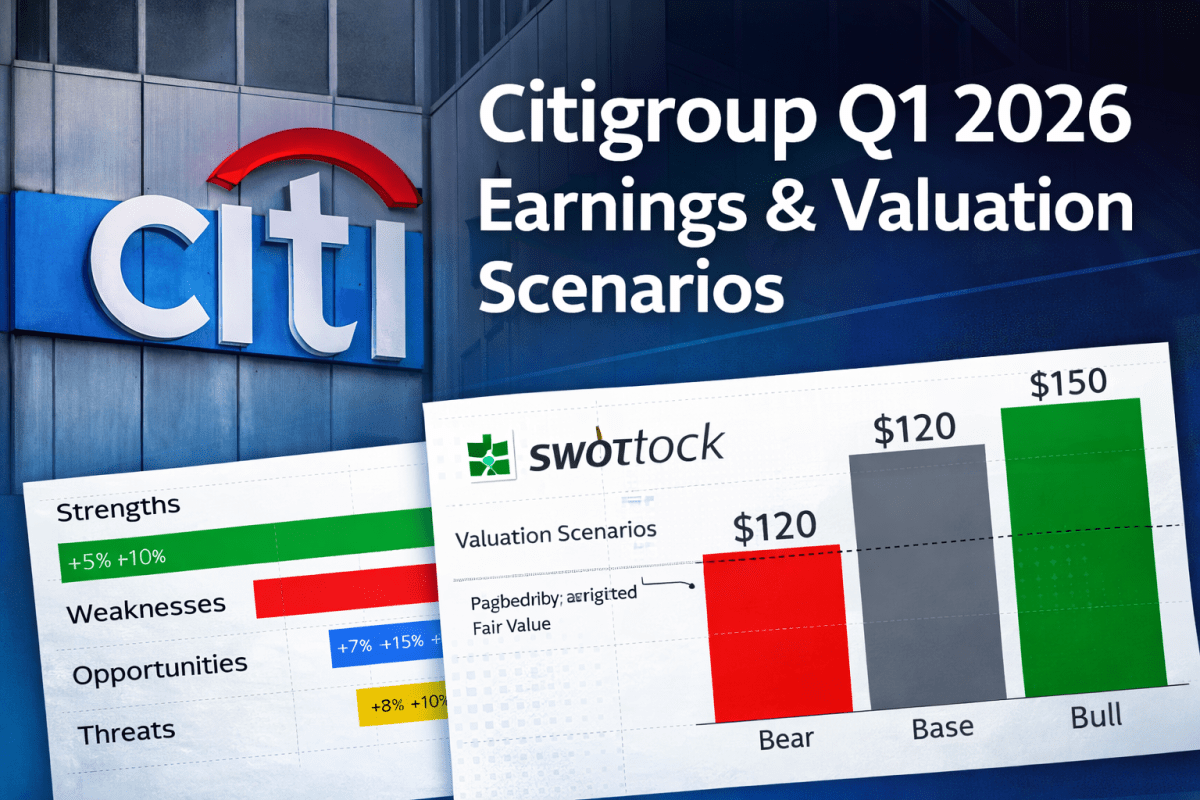
Citigroup Q1 2026 Earnings: The Turnaround Is Showing — But Is the Stock Already There?

TL;DR Summary

Citigroup (C:NYSE) delivered a strong quarter, with revenue up 14% and net income up 42%, showing real progress in its turnaround.

The stock responded positively — but at current levels, much of that improvement may already be priced in.

For value investors, Citi is no longer a deep discount. It’s now an execution story.


Quarter Recap

Citi’s Q1 2026 results were strong across the board, and importantly, not just in one area.

Revenue came in at $24.6 billion, up 14% year-over-year, while net income reached $5.8 billion. Earnings per share hit $3.06, supported by both improved operations and continued buybacks.

The strength was driven by Citi’s core institutional businesses. Services continued to deliver steady growth, while Markets saw a strong rebound, particularly in equities trading. These higher-quality businesses are increasingly shaping the bank’s earnings profile.

At the same time, weaker areas remain. U.S. Consumer Cards saw profits decline, and credit costs are beginning to normalize, which could become a headwind.


Market Reaction

The stock moved from around $126 before earnings to about $129.6 after, a gain of roughly 2.6%. It opened higher, traded up during the day, and held most of those gains into the close.

That kind of price action typically signals that investors not only reacted positively to the results, but also found them credible enough to hold positions rather than sell into strength.


Key Highlights

Citi’s strongest asset remains its Services business, which continues to generate stable growth and high returns.

Markets also delivered a strong quarter, showing Citi can still compete globally in trading, especially during periods of volatility.

Capital return is another key pillar. Citi repurchased $6.3 billion of stock in just one quarter, reinforcing the investment case.

On the other hand, consumer credit remains an area to watch, with declining profits in cards and rising signs of stress in credit metrics.


SWOT Analysis (with Price Impact Ranges)

Citi today sits at an interesting point — the business is clearly improving, but the stock is increasingly reflecting that improvement. The following ranges show how each factor could influence valuation.


Strengths

Citi’s biggest strength is the growing contribution from its higher-quality businesses.

The Services franchise continues to deliver strong, stable returns, and as it becomes a larger part of the mix, it can lift overall profitability. At the same time, aggressive share buybacks are supporting earnings per share and helping anchor the stock. Markets also contributed meaningfully this quarter.

👉 Estimated upside impact: +5% to +10% (Services mix improvement)

👉 +4% to +8% (buybacks support)

👉 +3% to +6% (Markets strength, cyclical)


Weaknesses

Despite the progress, Citi still trails the best-performing banks in terms of overall profitability, which limits how much investors are willing to pay for the stock.

Costs remain elevated due to ongoing transformation efforts, and consumer banking — particularly credit cards — continues to face pressure as credit costs normalize.

👉 Estimated downside impact: -8% to -12% (profitability gap vs peers)

👉 -4% to -7% (cost inefficiency)

👉 -3% to -6% (consumer credit pressure)


Opportunities

The biggest opportunity lies in execution. Citi is nearing the end of its transformation program, and meaningful cost improvements could significantly boost returns.

If Citi can sustain higher returns on equity, the market may be willing to re-rate the stock closer to or above book value. Continued buybacks also provide an additional tailwind.

👉 Estimated upside impact: +10% to +18% (cost transformation)

👉 +8% to +15% (RoTCE expansion and re-rating)

👉 +3% to +6% (balance sheet growth)


Threats

The main risks are tied to the credit cycle and the sustainability of recent performance.

Credit quality is starting to show early signs of deterioration, and Markets revenue — while strong this quarter — can be volatile. There is also ongoing execution risk, as Citi still needs to prove that its turnaround is durable.

👉 Estimated downside impact: -10% to -18% (credit deterioration)

👉 -5% to -9% (Markets normalization)

👉 -6% to -10% (execution risk)
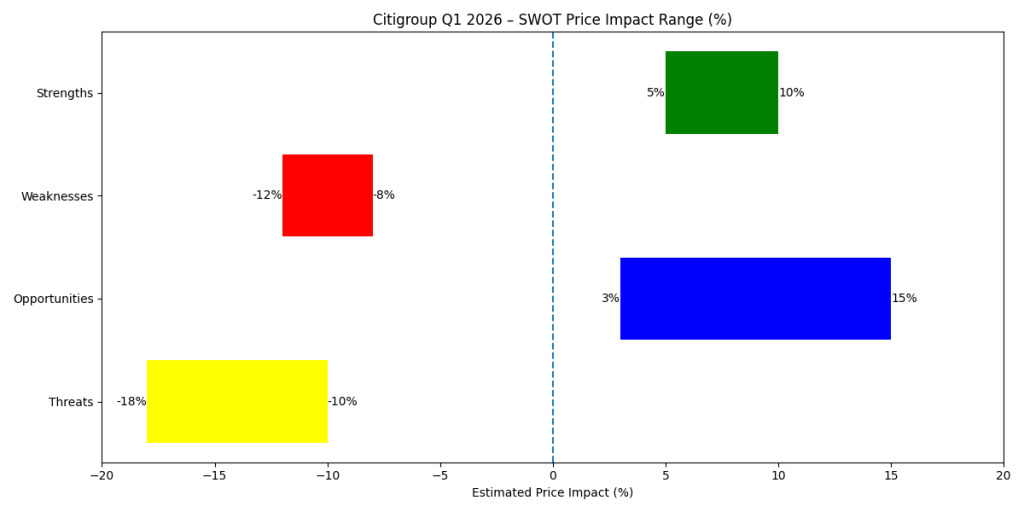
Citigroup Q1 2026 SWOT analysis chart showing estimated stock price impact ranges: strengths (+5% to +10%) and opportunities (+3% to +15%) on the positive side, and weaknesses (−12% to −8%) and threats (−18% to −10%) on the negative side, with a zero reference line.
Citigroup Q1 2026 SWOT analysis: Upside is driven by Services strength and ongoing transformation, while downside risks stem from credit deterioration and earnings volatility in Markets.

Valuation Scenarios

Citi’s valuation still anchors to its tangible book value of around $99 per share. The key variable is how much return the bank can generate on that capital.


Bear Case (30% probability)

In a downside scenario, credit costs rise and Markets normalize, pushing returns closer to ~10%.

In this case, Citi would likely trade below book value, around 0.9x TBV.

👉 Target Price: ~$90


Base Case (50% probability)

In a more balanced scenario, Citi continues to execute steadily, maintaining returns around 11–12% and delivering gradual efficiency improvements.

This would justify a valuation closer to 1.2x TBV.

👉 Target Price: ~$120


Bull Case (20% probability)

In a stronger execution scenario, Citi successfully improves efficiency and sustains higher returns (13–14%+), leading to a re-rating.

This could push valuation toward 1.5x TBV.

👉 Target Price: ~$150


Probability-Weighted Fair Value

Blending these scenarios results in a fair value of approximately:

👉 ~$117 per share
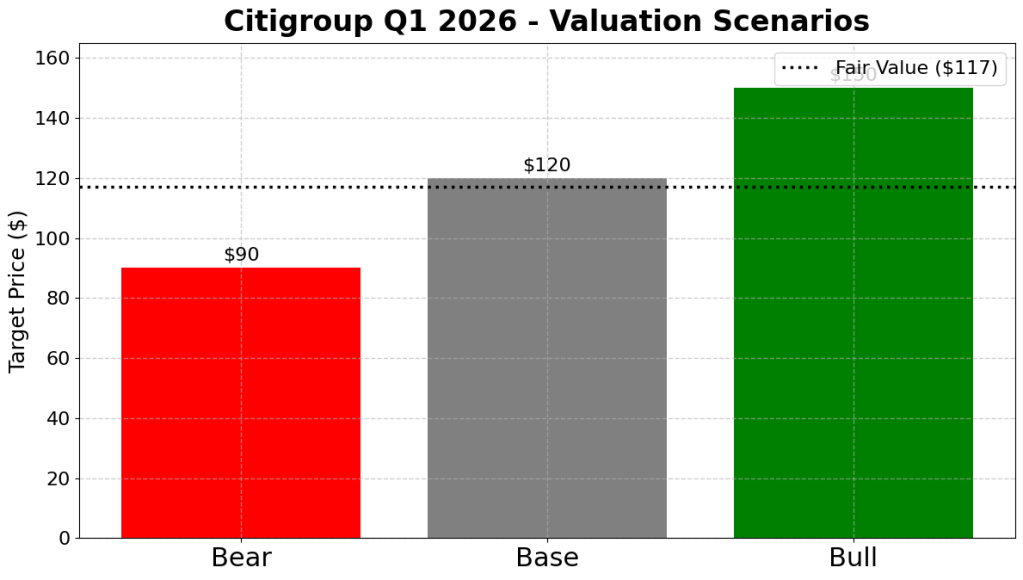
Citigroup Q1 2026 valuation scenarios chart showing bear case at $90, base case at $120, and bull case at $150, with a probability-weighted fair value line at $117.
Citigroup valuation scenarios: The stock’s upside depends on sustained execution, with a base case of $120 and a fair value of $117, suggesting limited margin of safety at current levels.

Verdict

Citi is clearly making progress. The latest results show that the turnaround is real and gaining traction.

But the stock has already moved ahead of that improvement.

At around $130, Citi is trading above what a probability-weighted valuation would suggest. That means investors are no longer buying a discount — they are betting on continued execution.


Call to Action

For value investors, the key question is simple:

👉 Would you buy Citi today, knowing that the upside depends on continued strong execution?

Or would you wait for a pullback to get a better margin of safety?


Disclaimer

This article is for informational purposes only and does not constitute investment advice. All analysis is based on publicly available information from Citigroup’s official financial disclosures. Investors should conduct their own research before making any investment decisions.

Citigroup Q4 2025: Execution Is Improving, But the Valuation Still Depends on Delivery

Citigroup’s Q4 2025 results indicate improvement in core businesses despite profitability challenges due to restructuring costs. While investment banking fees rebounded and net interest income rose, returns on tangible equity remain below targets. The stock, anchored to tangible book value, offers potential upside if management executes consistently, appealing to patient value investors.

TL;DR Summary

Citigroup’s (NYSE: C) Q4 2025 results show real progress in core businesses like Services and Banking, but reported returns are still weighed down by restructuring costs and one-time items. The stock remains anchored to tangible book value, making this a classic execution-driven value story. Upside exists if management delivers on its 10–11% RoTCE target, but patience is required.


Quarter Recap

Citigroup reported Q4 2025 earnings that reflect a bank still in transition. Reported profitability declined year over year due largely to a Russia-related exit charge, but underlying operating trends were more constructive. Revenue held up across key businesses, investment banking activity rebounded sharply, and management emphasized that major geopolitical overhangs are now largely behind the company.


Key Highlights

  • Net income of approximately $2.47 billion, impacted by a sizable one-time Russia exit loss
  • Reported EPS of $1.19, with underlying performance stronger when adjusting for notable items
  • Investment banking fees rose sharply year over year, signaling a recovery in deal activity
  • Net interest income increased year over year, supported by higher average rates
  • CET1 capital ratio of 13.2%, comfortably above regulatory requirements
  • Tangible book value per share of $97.06 provides a clear valuation anchor

SWOT Analysis

Citigroup’s investment case remains centered on whether management can convert improving operating trends into sustainably higher returns on tangible equity. The quarter reinforced both the opportunity and the risks embedded in that thesis.

Strengths

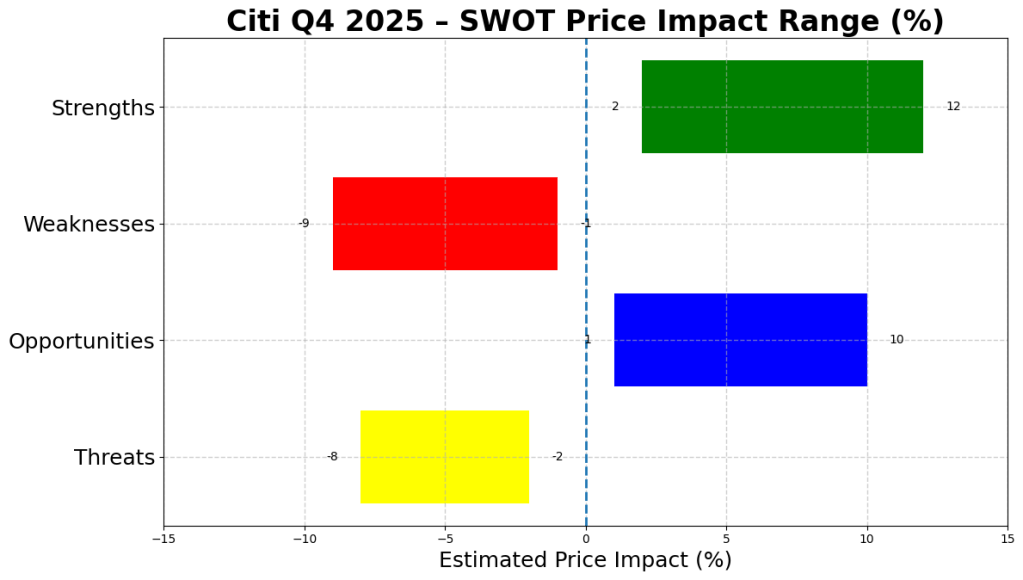
  • Services and institutional businesses continue to scale, improving the quality and durability of earnings (estimated price impact: +4% to +10%)
  • Strong rebound in investment banking fees highlights Citi’s relevance in large, complex transactions (+3% to +8%)
  • Capital strength and ongoing share buybacks provide downside support and optionality (+4% to +9%)
  • Clear tangible book value base gives value investors a concrete reference point (+2% to +6%)

Weaknesses

  • Reported RoTCE remains well below management’s 10–11% target, limiting valuation re-rating (−6% to −12%)
  • Expense growth and a high efficiency ratio continue to pressure near-term profitability (−4% to −10%)
  • Earnings remain vulnerable to one-time items during the restructuring phase (−2% to −6%)

Opportunities

  • Achieving the stated RoTCE target could justify a meaningful re-rating toward tangible book value or above (+8% to +18%)
  • Operating leverage from simplification and productivity initiatives could improve margins over time (+4% to +12%)
  • Excess capital above regulatory requirements supports continued capital return (+3% to +9%)

Threats

  • A turn in the credit cycle could quickly erode earnings and capital flexibility (−6% to −15%)
  • Rate and macro sensitivity remain meaningful, particularly for net interest income (−3% to −10%)
  • Execution risk persists if cost reductions fail to materialize as planned (−5% to −12%)
Citigroup Q4 2025 SWOT price impact chart showing estimated percentage upside and downside from strengths, weaknesses, opportunities, and threats for value investors.
Citigroup Q4 2025 SWOT price impact range. Estimated upside and downside drivers based on management commentary and valuation sensitivity around tangible book value.

Valuation Scenarios

For Citi, valuation is best framed using price-to-tangible book value, as returns on tangible equity are the primary driver of long-term multiple expansion. With TBVPS at $97.06, the range of outcomes depends largely on execution.

Bear Case

  • Assumes sub-par returns persist and credit or expense pressures rise
  • Valuation at ~0.8× tangible book
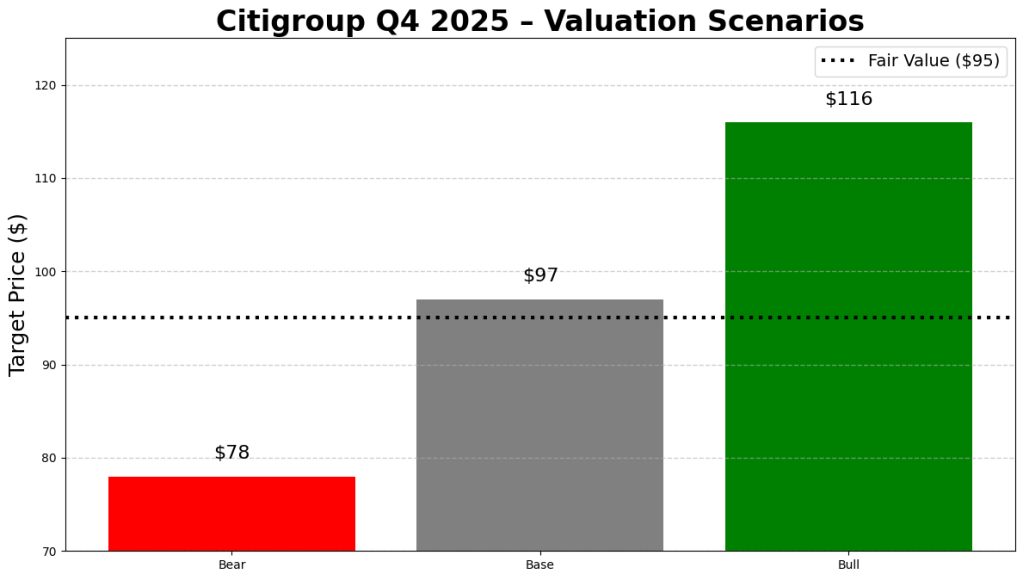
  • Implied value: ~$78

Base Case

  • Assumes steady progress toward management’s RoTCE target without full re-rating
  • Valuation at ~1.0× tangible book
  • Implied value: ~$97

Bull Case

  • Assumes credible delivery of 10–11% RoTCE with visible operating leverage
  • Valuation at ~1.2× tangible book
  • Implied value: ~$116

Probability-weighted fair value: approximately $95

Citigroup Q4 2025 valuation scenarios chart showing bear, base, and bull target prices with a dashed fair value line for value investors.
Citigroup Q4 2025 valuation scenarios. Bear, base, and bull price targets derived from tangible book value multiples and return-on-tangible-equity assumptions, with probability-weighted fair value highlighted.

Verdict

Citigroup remains a value investor’s execution bet. The stock is no longer distressed, but it is not yet priced for success. If management delivers on returns and expense discipline, today’s valuation leaves room for upside. If execution stalls, the stock risks remaining range-bound around tangible book value. For patient investors, Citi offers asymmetry — but not certainty.


Call to Action

If you’re tracking large U.S. banks from a value perspective, follow SWOTstock for earnings-driven breakdowns that focus on fundamentals, valuation discipline, and execution — not hype.


Disclaimer

This article is for informational purposes only and does not constitute investment advice. All analysis is based on publicly available company disclosures and reflects estimates and opinions at the time of writing. Investors should conduct their own research before making investment decisions.


JPMorgan vs. Citigroup: How Q1 Set the Tone for a Pivotal Q2 2025

Featured image displaying JPMorgan and Citi logos side by side on a blue background with “vs.” between them, representing a comparison of their Q1 2025 earnings performance.

TL;DR:
JPMorgan Chase (NYSE: JPM) and Citigroup (NYSE: C) kicked off 2025 with strong Q1 earnings, bolstered by solid trading performance and robust net interest income. But as Q2 earnings approach, both banks face persistent macroeconomic uncertainty, cautious client sentiment, and a potentially slower investment banking environment. Here’s how Q1 played out—and what investors should be watching this July.


Q1 Recap: Momentum With a Hint of Caution

U.S. megabanks are heading into Q2 earnings season on the back of a strong start to 2025. JPMorgan Chase and Citigroup delivered better-than-expected first-quarter results, supported by healthy interest income, strong trading activity, and improved cost discipline. Yet, under the surface, both management teams signaled caution—highlighting inflation, geopolitical risk, and client conservatism as emerging themes.

Let’s break down how each bank performed and what might lie ahead.


JPMorgan: Trading Desk Strength and Rate Tailwinds

JPMorgan reported Q1 net revenue of $46 billion, up 8% year-over-year, and net income of $14.6 billion, with earnings per share at $5.07, beating expectations. The strength came from two key engines:

  • Net interest income, which jumped to $23.4 billion thanks to favorable rate conditions and sustained loan growth.
  • Trading revenues, which surged 21% to $9.7 billion—fueled by a 48% jump in equities trading, a record quarter for that unit.

Investment banking fees rose 12%, signaling resilience in select M&A and debt market deals. However, credit provisions increased to $3.3 billion, suggesting a more conservative stance heading into a potentially rockier second half.

CEO Jamie Dimon struck a familiar note of pragmatism, warning about “considerable turbulence” from inflation, fiscal deficits, and geopolitical instability—even as those same forces have benefited JPM’s market-facing businesses.

Q2 Watchlist for JPM:

  • Can trading continue to outperform amid summer market activity?
  • Will loan growth in consumer and commercial lending remain resilient?
  • Are credit provisions hinting at broader credit concerns?

Citigroup: Cost Discipline and Trading Surprise

Citigroup also posted a solid Q1, with net income of $4.1 billion, up 21% from a year ago, and revenue of $21.6 billion. Earnings per share came in at $1.96, topping consensus. What stood out was the mix of trading performance and improved cost controls.

  • Markets revenue rose 12%, with equities trading jumping 23%.
  • Operating expenses declined 5%, aided by lower FDIC assessments and progress on Citi’s restructuring efforts.
  • RoTCE reached 9.1%, and the bank’s CET1 capital ratio stood at a strong 13.4%.

Still, Citi added $2.7 billion in credit provisions, increasing total reserves to $22.8 billion—a sign that management is not letting its guard down. CEO Jane Fraser struck a constructive tone, citing the U.S. economy’s relative resilience but emphasizing the need to remain cautious amid global uncertainty.

Q2 Watchlist for Citi:

  • Are cost control and digital investments delivering lasting operating leverage?
  • Will interest margins hold up if rates remain steady?
  • Can investment banking recover in a choppy macro environment?

JPMorgan vs. Citi: Diverging Strengths, Common Risks

While both banks had strong first quarters, they are navigating Q2 with different levers of strength.

Table comparing JPMorgan and Citigroup Q1 2025 performance across trading revenue, cost discipline, investment banking activity, and risk management. Highlights JPMorgan’s strength in equities trading and diversified earnings versus Citigroup’s progress in cost control and capital efficiency.

JPMorgan’s scale and diversified earnings base give it an edge in uncertain times, while Citigroup is gaining ground through cost cuts and capital efficiency. But both are facing the same headwinds: tighter client budgets, regulatory pressure, and slowing deal activity.


What to Expect in Q2 2025

Q2 earnings will likely test whether Q1 momentum is sustainable. Trading may stay strong if market volatility persists, but credit costs and weak investment banking pipelines could put pressure on profits.

Key themes to monitor:

  • Credit quality: Are rising reserves signaling trouble ahead?
  • Capital deployment: Will management remain cautious with buybacks and dividends?
  • Tech and efficiency: Are digital investments translating into real operating leverage?

Don’t overlook the earnings call commentary from Jamie Dimon and Jane Fraser—their tone will offer key signals about how megabanks view the second half of the year.


Verdict

JPMorgan remains the more defensive play, with a proven trading engine and diversified model. Citigroup is a potential turnaround story, showing credible progress on efficiency. Both face macro uncertainty, but also opportunity—especially if rate conditions stay supportive and markets remain active.

Retail investors should stay focused on margin resilience, capital trends, and credit provisioning as the next round of earnings unfolds.


Follow SWOTstock for JPMorgan and Citigroup Q2 earnings detail SWOT analysis and valuation scenarios.


Leave a comment