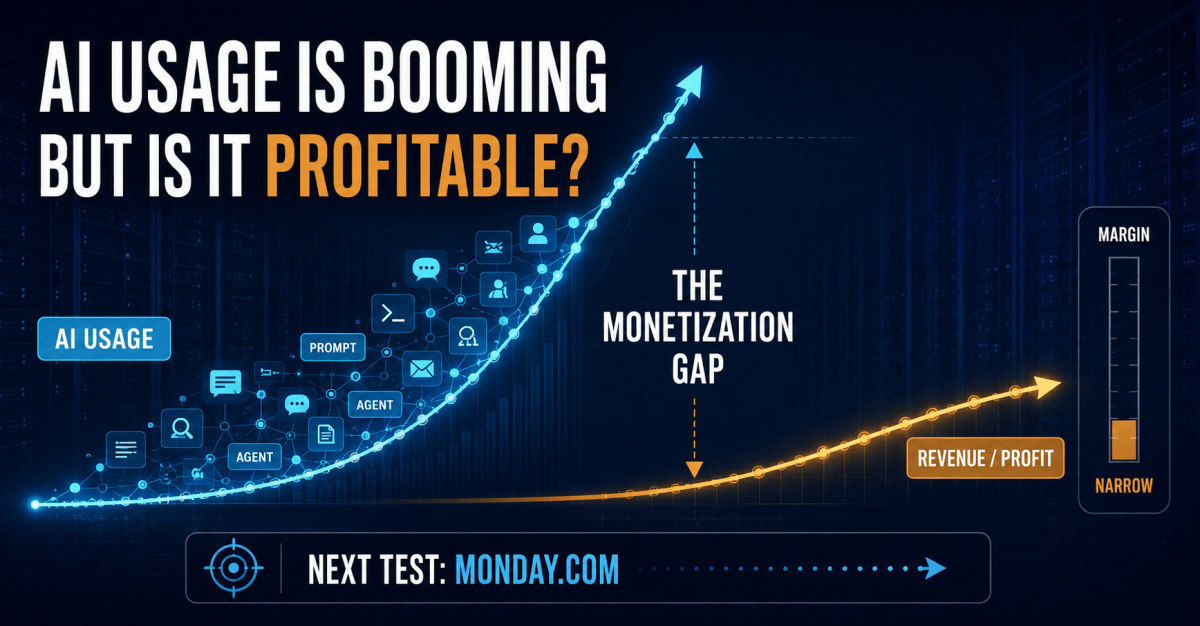
The central economic question surrounding artificial intelligence is no longer whether people will use it.
Usage is growing rapidly across design, marketing, customer support, software development and enterprise workflows. That usage is already translating into demand for GPUs, cloud capacity, electricity and new data centers.
The unresolved question is whether the applications consuming all that infrastructure can make enough money from AI to pay for it.
Recent results from Figma and HubSpot illustrated the concern. Both companies reported substantial AI adoption, but neither provided enough evidence to show that AI usage was producing proportional incremental revenue.
monday.com has now supplied a more encouraging data point. Its AI-product annual recurring revenue doubled sequentially and represented 17% of net-new ARR during the second quarter. Customers are also exhausting their included AI-credit allowances and purchasing additional credits.
That is genuine monetization.
But it does not resolve the economic question. monday.com did not disclose the absolute amount of AI revenue, the growth in AI consumption or the gross margin earned on that revenue.
The evidence is moving from “AI usage without visible revenue” toward “AI revenue without proven profitability.”
For the application-software industry—and ultimately for the massive data-center investment cycle—that distinction matters.
Infrastructure demand arrived before application economics
The AI investment cycle developed in an unusual order.
Normally, profitable applications create demand for the infrastructure needed to support them. With generative AI, infrastructure was built first, based largely on expectations of future demand.
Hyperscalers ordered GPUs, expanded cloud regions and committed billions of dollars to new data centers before most enterprise applications had established durable pricing models.
That sequence was understandable. Compute capacity was scarce, model development was accelerating and no major technology company wanted to risk falling behind.
But the infrastructure ultimately requires an economic buyer.
An AI application must create enough value for customers to pay for it. The resulting revenue must then cover inference, hosting, product development, sales and support. Only after those costs can the application generate an attractive return.
The economic chain therefore looks like this:
Customer productivity must create willingness to pay.
Willingness to pay must become recurring application revenue.
Application revenue must exceed AI delivery and development costs.
Application profitability must sustain demand for cloud and data-center capacity.
AI usage alone completes none of those steps.
What Figma and HubSpot showed
Figma and HubSpot demonstrated that AI can spread quickly when it is embedded within an existing application.
Figma reported that more than 80% of its larger customers were using AI credits weekly. HubSpot said more than 55% of its Professional and Enterprise customers had adopted its Breeze AI capabilities, while agentic actions had more than tripled.
Those are impressive adoption figures. However, the companies did not clearly separate paid AI usage from credits, trials and capabilities included within existing subscriptions.
The financial results also demonstrated why the distinction matters.
Figma’s second-quarter revenue grew 48% to $370.1 million, but its free-cash-flow margin declined from 24% to 14%. HubSpot increased revenue by approximately 20% to $911.7 million and expanded its operating margin, but its non-GAAP gross margin declined by 1.5 percentage points.
Neither result proved that AI caused the margin changes. Other investments, product-mix effects and timing factors were involved.
But they exposed an analytical blind spot: companies were providing increasingly precise information about AI adoption while offering very little information about AI revenue and unit economics.
The market could see the usage. It could not see the profit.
Figma’s official Q2 2026 results
HubSpot’s official Q2 2026 investor presentation
monday.com provides a more encouraging answer
monday.com’s results differ in one important respect: the company provided direct evidence that customers are spending more because of AI.
AI-product ARR doubled sequentially and generated 17% of the net-new ARR added during the quarter.
More importantly, management said customers are reaching the limits of their included AI-consumption allowances and purchasing additional credits. Customers are not simply experimenting with a feature included in their subscription. Some are consuming enough AI to make an incremental purchasing decision.
The company’s seats-plus-credits structure gives it two revenue engines:
Human workers generate seat revenue.
AI workers generate consumption revenue.
Before introducing consumption pricing, monday.com generally needed customers to add employees or deploy the software to more users to expand an account. AI credits potentially allow customer spending to grow even if human headcount remains unchanged—or declines.
This is particularly relevant because one of AI’s proposed benefits is that companies can accomplish more work with fewer employees. Traditional per-seat software pricing becomes vulnerable if that prediction proves correct. Consumption pricing provides a possible way for software vendors to participate in the productivity gains rather than lose revenue because of them.
monday.com therefore offers early evidence that application companies can turn AI execution into a new revenue stream.
Why workflow AI may monetize better
The emerging difference may be between AI that assists and AI that executes.
A general AI assistant can help write an email, summarize a document or generate ideas. Customers may value those functions but still view them as features that should be included within an existing subscription.
The willingness to pay becomes clearer when AI performs a measurable unit of work:
- Resolving a customer-service request
- Qualifying a sales lead
- Updating a CRM record
- Processing an operational workflow
- Building an automation
- Completing a repetitive project-management task
In these cases, the customer can compare the cost of the AI credits with the time or labor saved.
monday.com also benefits from being an incumbent application provider. Its platform already contains customer data, workflows, permissions and integrations. A standalone AI startup may have a capable model, but it must still obtain access to the relevant data and fit itself into the customer’s existing processes.
The incumbent does not need to replace the entire workflow. It can place AI inside it.
This supports a broader conclusion for SAP, Intuit, ServiceNow, Salesforce and other established application companies. Their traditional software businesses may be an advantage rather than a liability. They can distribute AI to existing customers, connect it to trusted business data and experiment with monetization without relying entirely on AI revenue to finance the company.
But 17% of net-new ARR is not 17% of the business
The monday.com evidence must not be overstated.
AI represented 17% of net-new ARR—not 17% of total ARR. The company crossed $1.5 billion in overall ARR during July, while management acknowledged that the absolute AI figure remains small.
During the earnings call, an analyst estimated that AI could represent approximately 1% of total ARR. Management did not confirm that estimate and declined to provide an absolute number.
The 17% figure tells us that AI is becoming a meaningful component of incremental growth. It does not tell us that AI is already a major component of the existing business.
Nor can we compare revenue growth with consumption growth. monday.com described usage patterns as deep and accelerating but did not disclose the number of AI actions, credits consumed or associated computing costs.
We know that some customers are topping up. We do not know how quickly their consumption is growing relative to what they pay.
That relationship determines the economics.
Monetization does not necessarily mean profitability
monday.com’s cost of revenue increased from $31.2 million to $42.7 million, or approximately 37%, while revenue grew 22%.
GAAP gross margin declined from 90% to 88%, while non-GAAP gross margin declined from 90% to 89%.
Adjusted free cash flow also fell from $64.1 million to $52.3 million, and the associated margin declined from 21% to 14%.
These changes cannot be attributed entirely to AI. monday.com did not disclose AI infrastructure costs, and working-capital movements contributed significantly to the cash-flow decline. Currency, product investment and business mix could also have affected gross margin.
At the same time, the company improved its non-GAAP operating margin from 15% to 17%. That demonstrates considerable operating leverage, although much of the improvement came from sales, marketing and administrative efficiency rather than from stronger gross margin.
The result leaves us with an incomplete but important picture:
AI is producing incremental revenue.
The absolute amount remains small.
The gross margin on that revenue is unknown.
Companywide gross margin has moved modestly in the wrong direction.
Operating efficiency elsewhere is currently absorbing the pressure.
This may be commercially viable. But it is not yet proof that AI applications can generate traditional SaaS margins.
monday.com’s official Q2 2026 earnings materials
Why this matters for data-center investment
A dollar of AI application revenue is not automatically equivalent to a dollar of traditional software revenue.
Traditional SaaS products often enjoy high gross margins because the cost of serving an additional customer is relatively small. Generative AI introduces a more direct relationship between usage and expense. Every additional query, generated design, automated workflow or agentic action consumes computing resources.
If application companies cannot charge customers more than the cost of that consumption, increased usage can produce revenue growth without attractive profit growth.
That would not immediately eliminate demand for data centers. Infrastructure spending is supported by multiple sources, including model training, consumer applications, cloud migration, sovereign AI and competition among hyperscalers.
But application profitability matters to the durability of the cycle.
If AI applications struggle to earn acceptable returns, software providers will respond by:
- Limiting included usage
- Raising prices
- Routing simple tasks to smaller models
- Adopting cheaper open-source models
- Moving suitable workloads to devices
- Reducing unnecessary agentic actions
- Negotiating lower cloud and inference prices
- Abandoning AI functions customers will not pay for
These actions would make AI more efficient. They could also reduce the rate at which compute demand grows.
The danger for data-center investors is therefore not necessarily that AI usage suddenly collapses. The more plausible risk is that economic optimization causes compute demand to grow more slowly than infrastructure capacity.
A moderate shortfall matters when investment assumptions require exceptionally high utilization over many years.
monday.com refines rather than rejects the thesis
Figma and HubSpot suggested that impressive AI adoption does not automatically produce visible incremental revenue.
monday.com shows that a consumption-based workflow model can produce genuine paid demand.
Together, the three companies point toward a more nuanced thesis:
AI monetization is likely to be strongest when the application performs measurable work, operates inside an established workflow and charges according to consumption. But whether that revenue can retain traditional software margins remains unproven.
This is more encouraging for incumbent application companies than for standalone AI startups.
An incumbent can support early AI investment with existing subscription revenue. It already possesses customers, workflows, integrations and distribution. A startup dependent entirely on AI usage must recover inference, development and customer-acquisition costs from a new and still uncertain revenue stream.
But the same evidence is less reassuring for the infrastructure investment thesis. The industry has already committed capital as if large-scale, profitable application demand were inevitable. The application layer is only beginning to demonstrate that customers will pay—and has barely begun to disclose what profit remains.
The next evidence we need
The next stage of the AI investment debate should move beyond adoption statistics.
Investors should ask application companies to disclose:
- AI ARR or revenue in absolute dollars
- Paid consumption rather than total usage
- The percentage of customers purchasing additional credits
- Repeat top-up and renewal behavior
- AI revenue growth relative to AI consumption growth
- The gross margin on AI products
- Whether AI spending expands or replaces traditional subscriptions
These figures would allow investors to distinguish commercially valuable AI from expensive engagement.
Salesforce will be particularly important because it already reports both Agentforce ARR and Agentic Work Units. If AI consumption, paid revenue and margins grow together, it would provide stronger evidence that application-layer economics can support the infrastructure cycle.
If consumption grows much faster than revenue—or revenue grows without corresponding gross profit—the concern will become harder to dismiss.
SWOTstock conclusion
monday.com has moved the debate forward.
It has shown that customers will pay for AI consumption when the technology performs identifiable work within an established business platform. Its seats-plus-credits model may offer software companies a way to benefit from AI-driven productivity even if human seat growth slows.
But it has not completed the economic case.
The company has not disclosed how much AI revenue it generates in absolute terms, how quickly consumption is growing or what margin it earns after computing costs. Gross margin and cash conversion have weakened, although the evidence is insufficient to identify AI as the sole cause.
For application software, the result is encouraging.
For the data-center buildout, it is only the beginning of the proof.
AI revenue is becoming real. Whether it becomes profitable enough to justify the infrastructure built around it remains the question that matters most.