TL;DR Summary
NVIDIA (NVDA:NASDAQ) delivered another exceptional quarter. Revenue more than doubled to $96.2 billion, Data Center revenue reached $89.0 billion, and non-GAAP earnings per share increased 120% to $2.22.
Management’s Q3 revenue guidance of $108 billion indicates that demand continues to accelerate even without any assumed China Data Center compute revenue. The strongest signal was not just hyperscaler spending: revenue from AI clouds, industrial companies and enterprise customers grew 25% sequentially and 138% year over year.
The market initially responded enthusiastically. NVIDIA rose 8.7% in the first trading session after earnings, before giving back part of the gain the following day. At the August 28 closing price of $217.55, the shares remained 3.8% above their pre-earnings level.
However, the quarter also revealed a significant evolution in NVIDIA’s risk profile. Supply and capacity commitments jumped from $119 billion to $279 billion. Accounts-receivable days increased from 45 to 60, and NVIDIA is committing capital, cloud capacity and potentially substantial financial guarantees to support the wider AI infrastructure ecosystem.
Our central fair-value estimate is approximately $305 per share, with a reasonable range of $270 to $330. At $217.55, the stock offers attractive upside for a tech-savvy growth investor—but the investment case increasingly depends on whether NVIDIA’s customers can generate enough AI revenue to sustain their infrastructure spending.
Quarter Recap
NVIDIA reported fiscal second-quarter results on August 26, 2026, covering the period ended July 26.
Revenue reached a record $96.2 billion, increasing 18% from the previous quarter and 106% from a year earlier. The company’s growth was once again driven by demand for accelerated computing and AI infrastructure.
GAAP gross margin was 75%, broadly unchanged sequentially and 260 basis points higher than a year earlier. The margin improvement was driven by a more favorable Blackwell Ultra product mix.
GAAP operating income reached $63.7 billion, up 124% year over year, while non-GAAP operating income increased at the same rate to approximately $64.0 billion.
GAAP diluted earnings per share were $2.46, compared with $1.08 a year earlier. Non-GAAP EPS increased 120% to $2.22.
The distinction between GAAP and non-GAAP earnings is important in this quarter. GAAP net income included approximately $7.8 billion of gains from equity securities. Those gains should not be treated as recurring operating earnings, making non-GAAP EPS the more suitable foundation for valuation.
Key Highlights
Data Center revenue more than doubled
Data Center revenue reached $89.0 billion, increasing 18% sequentially and 117% year over year. It now accounts for approximately 92.5% of NVIDIA’s total revenue.
Blackwell Ultra was the primary growth driver. Management said Blackwell represented the vast majority of revenue, while the next-generation Vera Rubin platform had already entered production.
The scale of NVIDIA’s Data Center business is extraordinary. It generated almost twice as much quarterly revenue as the entire company did one year earlier.
AI demand is broadening beyond hyperscalers
Hyperscale revenue reached $48.7 billion, up 13% sequentially and 102% year over year.
More importantly, AI Clouds, Industrial and Enterprise revenue reached $40.3 billion. This category increased 25% sequentially and 138% year over year.
That diversification matters. One of the main concerns surrounding NVIDIA has been that its growth depends on a small number of technology companies continually increasing their capital expenditure. The latest results suggest that demand is spreading to AI-native companies, sovereign customers and traditional enterprises.
This does not eliminate hyperscaler concentration, but it makes the growth thesis broader than it was several quarters ago.
Operating leverage remained exceptional
GAAP operating expenses increased 55% year over year, largely because of higher computing-infrastructure and compensation costs.
That is a substantial increase in absolute terms, but it was far below the 106% growth in revenue. As a result, GAAP operating margin expanded from 60.8% to 66.2%.
NVIDIA is simultaneously funding new processors, networking products, software and AI models while still allowing revenue growth to translate into higher operating profitability.
Q3 guidance points to continued acceleration
Management expects Q3 revenue of approximately $108 billion, plus or minus 2%.
At the midpoint, this represents sequential growth of approximately 12.2%. The guidance assumes no Data Center compute revenue from China, meaning that the next quarter does not require a recovery in that market.
Management expects GAAP and non-GAAP gross margins of approximately 74%, down from 75% in Q2. The decline is manageable, particularly during the transition to increasingly complex rack-scale infrastructure, but future margin direction deserves close attention.
Vera Rubin has entered production
The Vera Rubin platform is ramping into production, with racks running at partners including Microsoft Azure, Google Cloud, Oracle Cloud Infrastructure, CoreWeave and Nebius.
This reduces the risk of a material product-cycle pause between Blackwell and Rubin.
NVIDIA’s annual product cadence is also becoming an important competitive advantage. Customers are not simply buying more accelerators; they are moving through recurring generations of processors, networking and integrated systems.
The principal risk is execution. These rack-scale systems require advanced packaging, memory, networking, cooling and power infrastructure. Supply constraints or integration problems anywhere in the system could affect deployment schedules.
The AI buildout is consuming more of NVIDIA’s balance sheet
The most consequential disclosure was the expansion of NVIDIA’s future commitments.
Supply and capacity commitments increased from $119 billion in the previous quarter to $279 billion, primarily because NVIDIA is securing memory and other components required to meet anticipated demand.
Total disclosed future commitments reached approximately $366 billion, including:
- Supply and manufacturing capacity.
- Cloud-service agreements.
- Data-center leases.
- Equity investments.
- Capital expenditures.
NVIDIA also disclosed $36 billion of AI-cloud agreements under which it may purchase capacity not sold to third-party customers.
Separately, its maximum gross guarantee exposure included $3.5 billion related to certain AI-cloud partners and as much as $105 billion connected to a phased data-center development intended for OpenAI.
These maximum figures are not current losses or immediate liabilities. Many obligations are conditional, phased and spread over several years. Nevertheless, they represent a material change in NVIDIA’s role.
NVIDIA is no longer only supplying the AI infrastructure industry. It is helping secure components, cloud capacity, financing and physical data-center development for that industry.
Cash conversion weakened during the quarter
Operating cash flow was $24.1 billion, up from $15.4 billion a year earlier but down sharply from $50.3 billion in Q1.
Some of the sequential decline reflected cash-tax payments and working-capital requirements. However, accounts receivable increased to $63.1 billion, while days sales outstanding rose from 45 to 60.
NVIDIA attributed the increase to extended payment terms under large, multi-quarter agreements with investment-grade customers.
Inventory also rose from $25.8 billion to $31.6 billion as NVIDIA prepared for Rubin production.
Neither development proves that demand is weakening. Both are consistent with a company preparing for rapid expansion. But they show that more cash is becoming tied up in inventory and customer financing.
SWOT Analysis
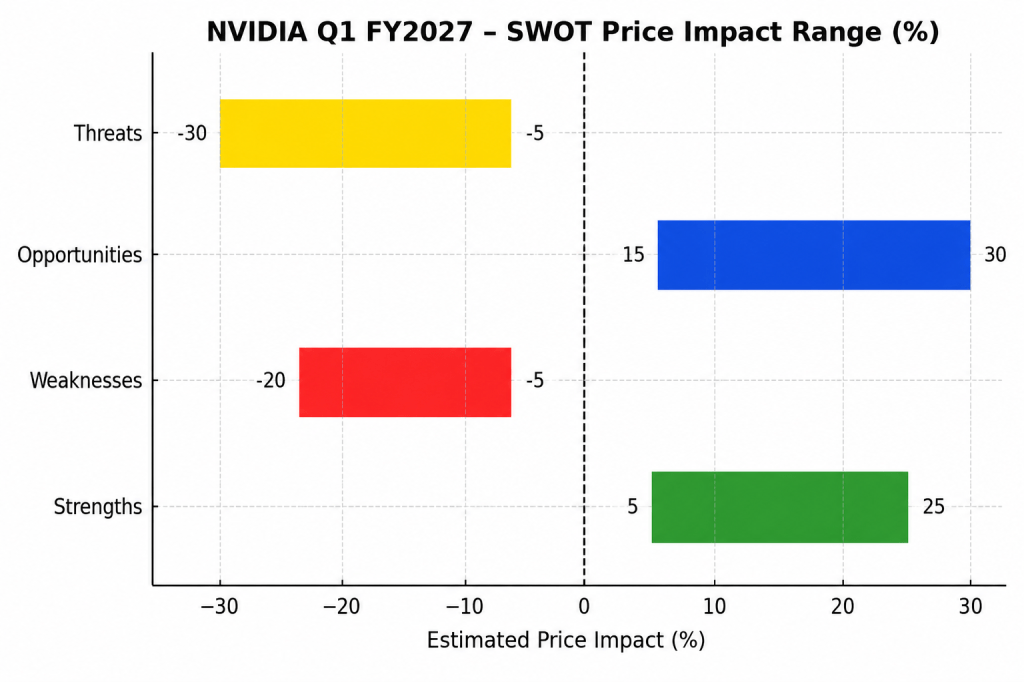
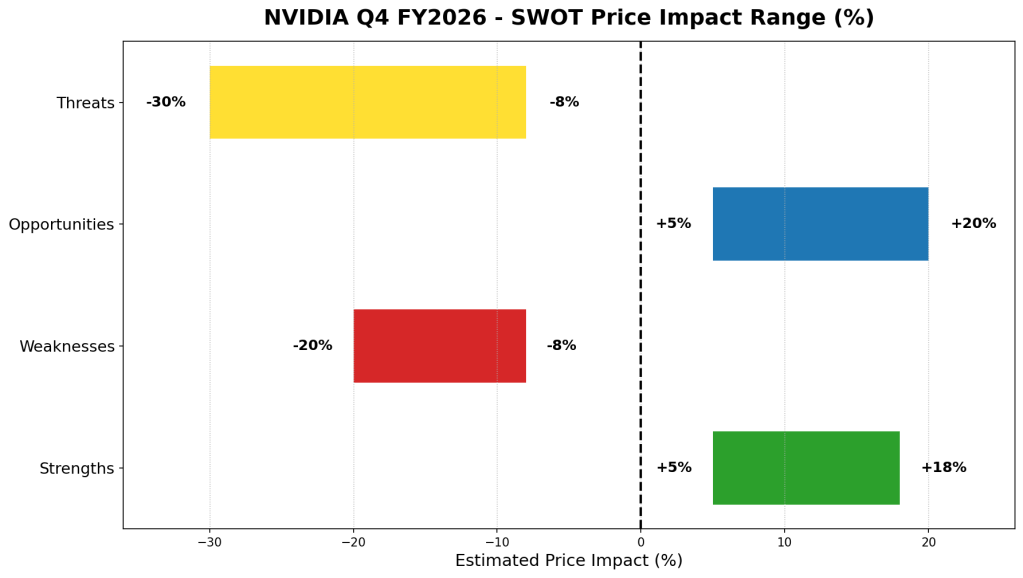
NVIDIA’s operating performance strengthened the growth thesis, but the quarter also widened the range of potential outcomes. The estimated price impacts below are sensitivity ranges rather than additive forecasts.
Strengths
- Exceptional revenue momentum: estimated price impact of +12% to +25%. Revenue increased 106% year over year, while Q3 guidance implies another 12% sequential increase.
- Dominant AI infrastructure platform: +10% to +20%. NVIDIA combines processors, networking, systems and software, making its competitive advantage broader than raw accelerator performance.
- Broadening demand: +8% to +18%. AI Clouds, Industrial and Enterprise revenue grew 138% year over year, indicating that adoption is expanding beyond the largest hyperscalers.
- Strong operating leverage: +8% to +15%. Revenue grew almost twice as quickly as operating expenses, lifting GAAP operating margin to 66.2%.
- Sustained pricing power: +7% to +15%. NVIDIA maintained a 75% gross margin while scaling complex Blackwell Ultra infrastructure.
- Rubin product transition: +8% to +18%. Early production reduces product-cycle risk and creates another reason for customers to expand and upgrade their infrastructure.
- Strong liquidity: +3% to +8%. NVIDIA held $56.6 billion in cash, cash equivalents and marketable debt securities, in addition to $42.8 billion of marketable equity securities.
Weaknesses
- Dependence on Data Center spending: estimated price impact of −12% to −25%. Approximately 92.5% of revenue now comes from Data Center, leaving NVIDIA exposed to any AI capital-spending slowdown.
- Customer concentration: −8% to −18%. One direct customer represented 16% of Q2 revenue, while three customers each represented at least 13% of first-half revenue.
- Longer customer payment terms: −5% to −12%. Days sales outstanding increased from 45 to 60 as NVIDIA extended terms on large customer agreements.
- Weaker cash conversion: −5% to −12%. Quarterly operating cash flow was considerably below reported net income because of taxes and working-capital investment.
- Investment gains inflated GAAP earnings: −3% to −8%. Approximately $7.8 billion of Q2 GAAP earnings came from gains on equity securities.
- Increasing inventory exposure: −4% to −10%. Inventory rose to $31.6 billion ahead of Rubin, increasing the potential cost of forecasting or execution errors.
Opportunities
- Global AI infrastructure expansion: estimated price impact of +15% to +35%. Multiple frontier laboratories, AI clouds, enterprises and sovereign customers are expanding capacity simultaneously.
- Inference and agentic AI demand: +10% to +25%. Reasoning models and AI agents could generate substantially more inference workloads than conventional chat applications.
- Recurring product upgrades: +10% to +22%. The transition from Blackwell to Rubin can make AI infrastructure an ongoing replacement and expansion market.
- Enterprise and sovereign adoption: +8% to +20%. Growth outside hyperscalers could make NVIDIA’s revenue base more diversified and durable.
- Networking and software monetization: +6% to +15%. NVIDIA can capture a larger share of AI-factory spending by selling integrated systems rather than individual chips.
- Potential China recovery: +3% to +10%. Any legally permitted return to the Chinese Data Center market would be incremental because management’s Q3 guidance assumes no China compute revenue.
- Infrastructure partnerships: +5% to +18%. Financing and capacity arrangements could remove obstacles preventing customers from deploying more NVIDIA systems.
Threats
- Unproven customer economics: estimated price impact of −20% to −40%. If AI applications cannot generate sufficient revenue or cost savings, customers may eventually reduce infrastructure spending.
- Commitments and guarantees: −15% to −35%. NVIDIA is accepting more supply, counterparty and infrastructure risk to support the expansion of its ecosystem.
- Circular-demand concerns: −10% to −25%. Investors may assign a lower valuation if more sales depend on NVIDIA investing in customers, committing to their capacity or extending payment terms.
- Margin normalization: −8% to −18%. Higher memory costs, system complexity, tariffs and competition could reduce NVIDIA’s unusually high gross margin.
- Custom accelerators and competing platforms: −12% to −30%. Hyperscalers are developing internal chips, while other semiconductor companies are expanding their accelerator offerings.
- Export restrictions: −6% to −15%. China currently contributes little to Data Center revenue, but continued restrictions remove a large potential market and encourage competing local ecosystems.
- Supply-chain execution: −8% to −20%. NVIDIA depends on advanced packaging, memory, networking, cooling and external manufacturing partners.
- Valuation sensitivity: −10% to −25%. At a market capitalization above $5 trillion, even strong operating results may not prevent a decline if interest rates rise or the market assigns a lower earnings multiple.
Valuation Scenarios
The valuation uses estimated FY2028 earnings, giving NVIDIA approximately 12–18 months to execute beyond the reported quarter.
The analysis begins with estimated FY2027 normalized EPS of approximately $9.10 to $9.20. It excludes unrealized investment gains and uses management’s Q3 revenue, margin, expense and tax guidance.
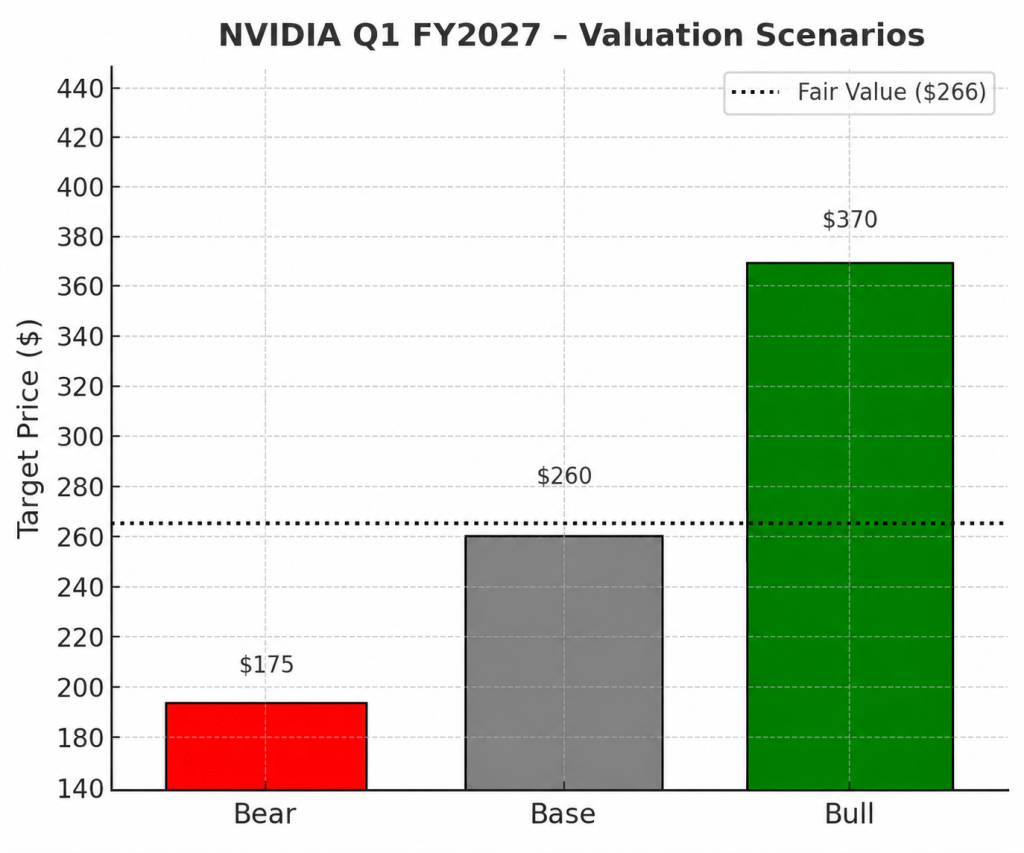
Bear case: $159
The bear case assumes that the AI infrastructure cycle slows sharply after the current order backlog is fulfilled.
- FY2028 revenue reaches approximately $425 billion.
- Revenue growth slows to approximately 5%.
- Non-GAAP net margin falls to 45%.
- EPS is approximately $7.94.
- The market applies a 20-times earnings multiple.
- Estimated value is approximately $159 per share.
- Downside from $217.55 is approximately 27%.
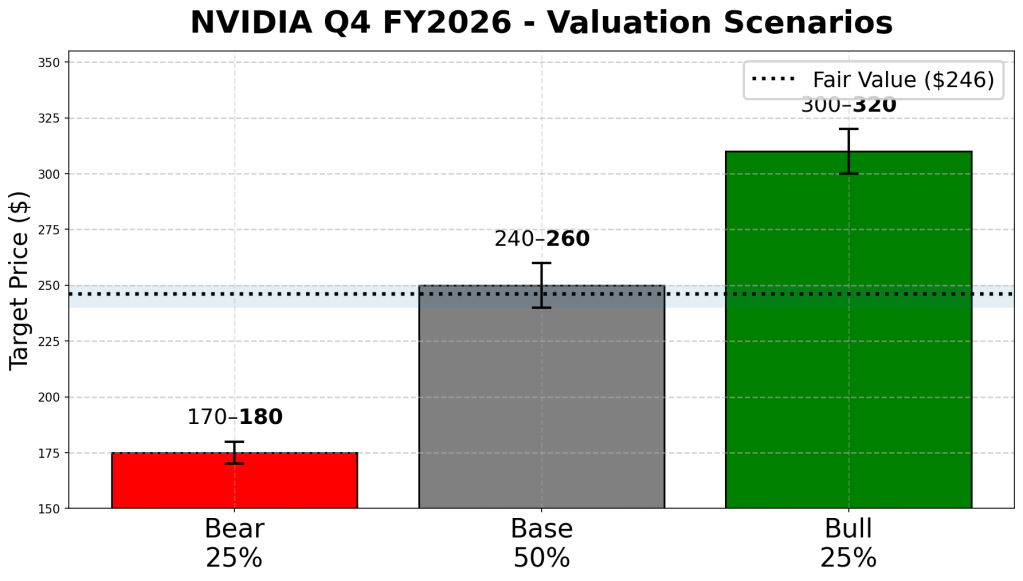
- Assigned probability is 25%.
This scenario does not require NVIDIA to lose its technological leadership. It assumes that customers moderate spending, margins normalize and investors apply a lower multiple because of NVIDIA’s growing commitments and financing exposure.
Base case: $313
The base case assumes that AI demand remains strong but normalizes from its present triple-digit growth rate.
- FY2028 revenue reaches approximately $527 billion.
- Revenue grows approximately 30%.
- Non-GAAP net margin is approximately 51%.
- EPS is approximately $11.19.
- The market applies a 28-times earnings multiple.
- Estimated value is approximately $313 per share.
- Upside from $217.55 is approximately 44%.
- Assigned probability is 55%.
This scenario assumes a successful Rubin ramp, continued enterprise and AI-cloud adoption, modest margin normalization and no material losses from NVIDIA’s commitments or guarantees.
Bull case: $469
The bull case assumes that inference, AI agents, sovereign AI and physical AI create another major acceleration in demand.
- FY2028 revenue reaches approximately $608 billion.
- Revenue grows approximately 50%.
- Non-GAAP net margin remains around 54%.
- EPS reaches approximately $13.78.
- The market applies a 34-times earnings multiple.
- Estimated value is approximately $469 per share.
- Upside from $217.55 is approximately 116%.
- Assigned probability is 20%.
This outcome requires NVIDIA to maintain platform leadership while its customer-support arrangements successfully accelerate genuine third-party demand.
Probability-weighted value
Weighting the three scenarios produces an estimated value of approximately $306 per share.
To avoid false precision, our final central fair-value estimate is $305, with a reasonable range of $270 to $330.
At $217.55:
- The shares trade approximately 29% below the $305 central estimate.
- Appreciation to fair value would be approximately 40%.
- The shares trade approximately 19% below the conservative $270 fair-value boundary.
- Appreciation to $270 would be approximately 24%.
Verdict
NVIDIA’s Q2 FY2027 results provided strong evidence that the AI infrastructure cycle remains intact.
Revenue more than doubled. Data Center demand accelerated. Growth broadened beyond hyperscalers. Blackwell Ultra supported a 75% gross margin, and Rubin entered production without an evident pause in customer demand.
At $217.55, investors do not need NVIDIA to maintain triple-digit growth indefinitely to justify a higher valuation. Our central case assumes approximately 30% FY2028 revenue growth and produces a fair value close to $305.
That makes the risk-reward attractive for a tech growth investor.
However, the quarter also marked a turning point. NVIDIA is increasingly using its balance sheet, supplier commitments, investments, cloud-capacity agreements, extended payment terms and guarantees to support the AI infrastructure ecosystem.
The critical investment question is therefore changing.
It is no longer simply:
Will customers continue buying NVIDIA systems?
The more important question is:
Can those customers generate enough economic value from AI to finance the systems without progressively greater support from NVIDIA?
If the answer is yes, NVIDIA may still be in the early stages of a much larger infrastructure cycle. If the answer is no, the company’s expanded commitments could magnify the eventual slowdown.
Our conclusion is that NVIDIA remains an attractive growth investment near $217.55, but it should not be treated as low risk merely because it trades below estimated fair value. The operating moat is exceptional; the ecosystem’s financial durability is still being tested.
Call to Action
Would you buy NVIDIA at approximately $218, or do its growing infrastructure commitments and customer-financing exposure make you demand a larger margin of safety?
Follow SWOTstock for earnings analysis that separates operating performance, market expectations and valuation risk.
Disclaimer
This article is for informational and educational purposes only and does not constitute investment advice, financial advice or a recommendation to buy or sell any security.
Valuation estimates depend on assumptions about revenue growth, profitability, share count and valuation multiples. Actual results may differ materially. Investors should conduct their own research and consider their objectives, financial circumstances and risk tolerance before making an investment decision.
Official sources include NVIDIA’s Q2 FY2027 earnings release, CFO commentary, Form 10-Q and official earnings webcast.