NVIDIA Q1 FY2027 Earnings: AI Infrastructure King Still Dominates — But Is the Market Starting to Question Sustainability?

NVIDIA reported Q1 FY2027 revenue of $81.6 billion, an 85% year-over-year increase, with Data Center revenue up 92%. Despite strong earnings, the stock fell, indicating investor concerns about sustaining AI infrastructure spending. The company’s strategic shift and ongoing growth suggest a promising future, but geopolitical risks and valuation questions remain.

TL;DR Summary

NVIDIA (NVDA:NASDAQ) delivered another extraordinary quarter, reporting Q1 FY2027 revenue of $81.6 billion, up 85% year over year, with Data Center revenue surging 92% to $75.2 billion. Blackwell deployment appears successful, enterprise AI adoption is broadening, and management continues positioning NVIDIA not merely as a chipmaker, but as the foundational infrastructure layer for the AI economy.

Yet despite the massive earnings beat, the stock declined after earnings. That reaction suggests the market is beginning to shift its focus from short-term growth toward a more difficult question: how sustainable is the current AI infrastructure spending cycle?

Our probability-weighted fair value estimate stands at approximately $266/share, with the market increasingly pricing NVIDIA as a long-duration AI platform rather than a traditional semiconductor company.


Quarter Recap

NVIDIA’s Q1 FY2027 results reinforced why the company remains the central player in the global AI boom.

Revenue reached $81.6 billion, growing 85% year over year and 20% sequentially. The Data Center segment once again dominated results, generating $75.2 billion in revenue, up 92% year over year. Gross margins remained extraordinarily strong at roughly 75%, while management also announced an additional $80 billion share repurchase authorization and raised the quarterly dividend.

Perhaps most importantly, management commentary strongly suggested that the transition from Hopper to Blackwell is progressing successfully. Earlier investor concerns about deployment bottlenecks, power constraints, and customer transition risks did not materialize in the quarter.

CEO Jensen Huang framed the AI buildout as “the largest infrastructure expansion in human history,” emphasizing NVIDIA’s long-term positioning across AI factories, networking, enterprise AI, robotics, and edge computing.

The company also revealed an important strategic shift: hyperscalers now represent roughly half of Data Center revenue, with the remaining demand increasingly coming from enterprise AI, sovereign AI projects, and AI-native cloud providers. That diversification helps reduce one of the major bear concerns surrounding customer concentration.

However, China export restrictions remain a meaningful headwind. NVIDIA disclosed that it had no Hopper shipments into China during the quarter, compared to billions of dollars of China-related revenue a year earlier.


Key Highlights

  • Revenue grew 85% year over year to $81.6 billion
  • Data Center revenue surged 92% to $75.2 billion
  • Blackwell deployment appears to be ramping successfully
  • Gross margins remained near 75%
  • NVIDIA authorized an additional $80 billion buyback
  • Dividend increased substantially
  • Enterprise and sovereign AI demand broadened beyond hyperscalers
  • China export restrictions remain a material geopolitical risk
  • Market reaction after earnings was negative despite strong operational performance

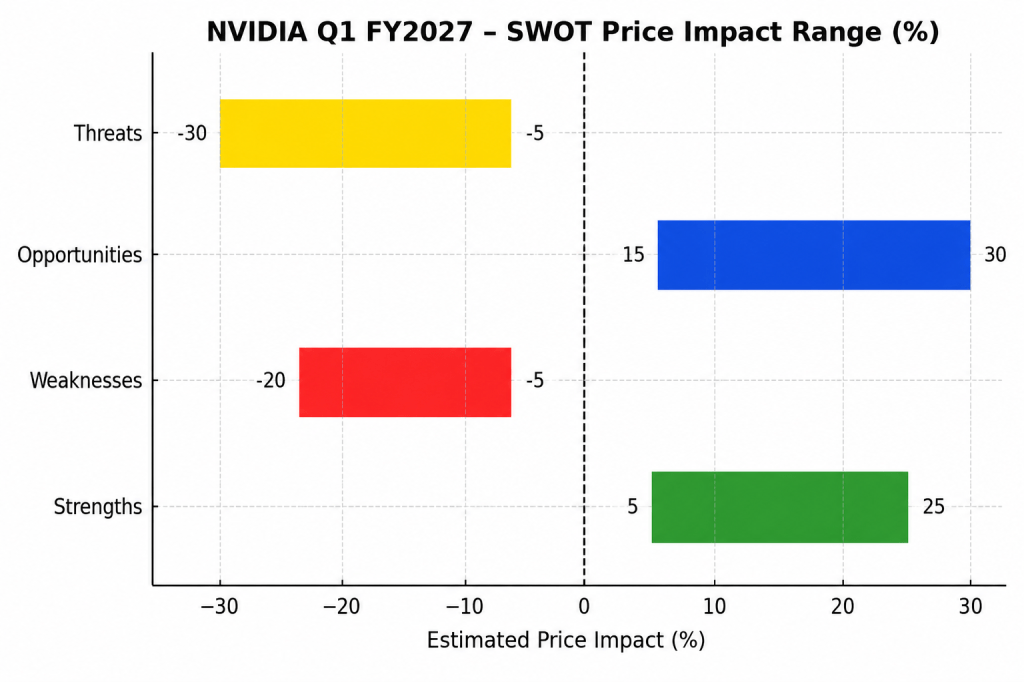
SWOT Analysis

NVIDIA’s latest quarter continues to demonstrate extraordinary operational strength. However, investors are increasingly debating whether the current valuation already assumes years of uninterrupted AI infrastructure expansion.

Strengths

  • NVIDIA remains the dominant AI infrastructure platform globally, supported by CUDA, NVLink, networking, and a deeply integrated ecosystem.
    • Estimated price impact: +15% to +25%
  • Data Center growth remains exceptional, with revenue up 92% year over year despite ongoing China restrictions.
    • Estimated price impact: +10% to +18%
  • Blackwell deployment appears successful, easing prior investor concerns around product transition risks.
    • Estimated price impact: +8% to +15%
  • Gross margins near 75% and enormous cash generation continue to separate NVIDIA from most semiconductor peers.
    • Estimated price impact: +5% to +12%
  • Demand is increasingly diversifying beyond hyperscalers into enterprise AI, sovereign AI, and industrial AI deployments.
    • Estimated price impact: +5% to +10%

Weaknesses

  • NVIDIA’s valuation already reflects extremely high expectations for long-term AI dominance.
    • Estimated price impact: -10% to -20%
  • Current growth remains heavily dependent on sustained AI infrastructure spending globally.
    • Estimated price impact: -8% to -18%
  • Hyperscaler concentration risk, while improving, remains meaningful.
    • Estimated price impact: -5% to -12%
  • The company faces constant pressure to flawlessly execute across Blackwell, Rubin, networking, and software ecosystems.
    • Estimated price impact: -5% to -10%

Opportunities

  • AI inference demand could eventually surpass training demand as enterprise AI agents become mainstream.
    • Estimated price impact: +15% to +30%
  • Robotics, autonomous systems, and physical AI represent potentially massive adjacent growth markets.
    • Estimated price impact: +10% to +25%
  • Enterprise AI adoption still appears to be in the early innings globally.
    • Estimated price impact: +10% to +20%
  • NVIDIA’s evolution into a full-stack AI infrastructure provider could strengthen its competitive moat further.
    • Estimated price impact: +8% to +18%

Threats

  • China export restrictions remain a significant geopolitical and revenue risk.
    • Estimated price impact: -10% to -20%
  • Hyperscalers continue developing custom AI chips that may reduce dependency on NVIDIA over time.
    • Estimated price impact: -8% to -18%
  • AI infrastructure spending could eventually enter a digestion phase after the current deployment boom.
    • Estimated price impact: -15% to -30%
  • Competition and eventual margin normalization may pressure valuation multiples in the future.
    • Estimated price impact: -5% to -15%
NVIDIA Q1 FY2027 SWOT price impact range chart showing strengths, weaknesses, opportunities, and threats with estimated percentage impacts on stock valuation following strong AI infrastructure earnings growth.
NVIDIA Q1 FY2027 SWOT analysis chart illustrating the estimated valuation impact ranges from AI infrastructure leadership, Blackwell deployment, enterprise AI expansion, valuation risks, and geopolitical threats.

Valuation Scenarios

NVIDIA’s valuation increasingly depends on how long the AI infrastructure cycle continues and whether AI ultimately becomes a foundational layer of the global economy.

Bear Scenario

In the bear case, hyperscaler AI spending slows materially over the next several years as customers optimize deployed infrastructure and enterprise ROI proves slower than expected. Growth decelerates sharply, margins normalize lower, and valuation multiples compress.

  • Estimated fair value: $160–$190
  • Probability: 25%

Base Scenario

In the base case, AI infrastructure demand remains structurally strong but gradually moderates into a sustainable multi-year growth cycle. NVIDIA maintains leadership across AI compute, networking, and software ecosystems while enterprise AI adoption continues expanding globally.

  • Estimated fair value: $240–$280
  • Probability: 50%

Bull Scenario

In the bull case, AI evolves into a foundational global infrastructure layer comparable to cloud computing or the internet itself. Inference demand explodes, robotics and physical AI scale rapidly, and NVIDIA successfully becomes the operating platform for global AI infrastructure.

  • Estimated fair value: $320–$420
  • Probability: 25%

Based on these scenarios, our estimated probability-weighted fair value is approximately:

→ $266/share
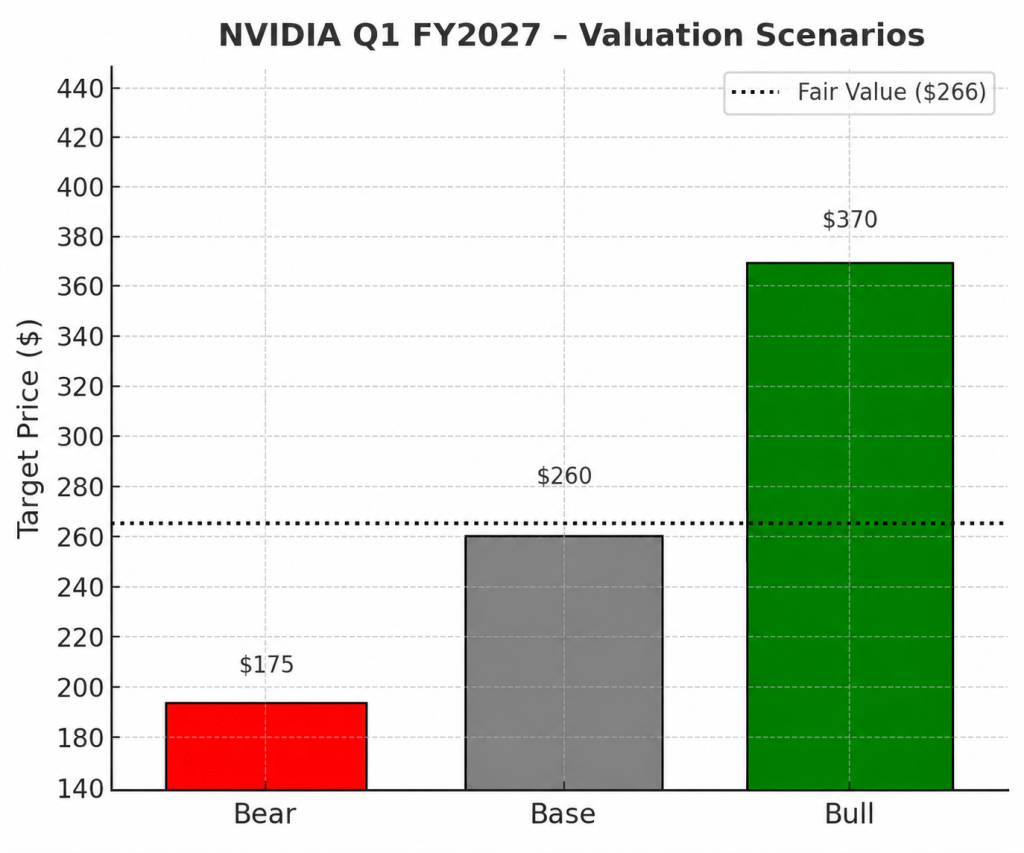
NVIDIA Q1 FY2027 valuation scenarios chart showing bear, base, and bull case target prices with a probability-weighted fair value estimate of $266 per share.
NVIDIA Q1 FY2027 valuation scenario analysis comparing bear, base, and bull case price targets based on AI infrastructure demand sustainability, enterprise AI adoption, and long-term platform dominance potential.

Verdict

Operationally, NVIDIA still looks extraordinarily strong. The company continues to dominate the global AI infrastructure market, margins remain exceptional, and Blackwell deployment appears successful.

The market’s muted post-earnings reaction likely reflects a shift in investor psychology rather than disappointment in the quarter itself. Investors are beginning to ask whether the current pace of AI infrastructure spending can continue for many years and whether NVIDIA’s valuation already prices in near-perfect execution.

For long-term growth investors, NVIDIA still represents one of the highest-quality AI infrastructure companies globally. However, future returns may increasingly depend not only on continued strong growth, but on NVIDIA’s ability to justify its role as a long-duration AI platform rather than merely a cyclical semiconductor leader.


Call to Action

Do you think NVIDIA’s current valuation still underestimates the long-term AI opportunity, or is the market finally becoming more cautious about AI infrastructure sustainability?

Visit SWOTstock for more earnings breakdowns, SWOT analysis, and valuation scenarios focused on helping retail investors better understand the companies shaping the AI economy.


Disclaimer

This article is for informational and educational purposes only and does not constitute investment advice. Investors should conduct their own research and consider their financial situation and risk tolerance before making investment decisions.

Apple Q4 2025 — The Comeback Quarter That Put “Intelligence” Back in Apple

Apple reported 8% revenue growth to $102.5 billion and a record $28.75 billion in Services, signaling a return to growth after a flat trend. The iPhone 17 launch and deeper ecosystem engagement drove this performance. Guidance for the holiday quarter suggests continued growth, aligning with Apple’s AI ambitions. Investors reacted positively, with a 6% share price increase post-announcement.

TL;DR Summary

Apple finally broke its flat-growth streak.
Revenue climbed 8 % y/y to $102.5 billion, EPS reached $1.85 (+9 %), and Services hit a record $28.75 billion.
Guidance for the holiday quarter calls for +10–12 % growth, reigniting belief that Apple Intelligence is more than a buzzword.
For growth investors, this quarter marks Apple’s return to the AI-led expansion narrative.


Quarter Recap

After four quarters of muted growth, Apple delivered what Tim Cook called “our strongest lineup ever.”
The iPhone 17 launch, deeper ecosystem engagement, and record Services revenue lifted results well above expectations.
Gross margin expanded to 47.2 %, net income rose to $24.2 billion, and Apple declared another $0.26 dividend while continuing aggressive buybacks.

Beyond the numbers, the tone of the call signaled confidence: management expects the December quarter to be the best holiday season in Apple’s history.
That optimism—and the 6 % share-price jump that followed—suggests investors finally see Apple’s AI strategy taking shape.


Key Highlights

  • Services: $28.75 B (+15 %) — now 28 % of total revenue and driving margin expansion.
  • iPhone: $49.0 B (+6 %) — AI-capable models leading upgrade cycle.
  • Mac / iPad: Flat to down slightly as users wait for AI refreshes.
  • Geography: Greater China $14.5 B (+3 %) — showing early stabilization.
  • Guidance: Revenue +10–12 %, gross margin 47–48 % next quarter.

(Note: Apple’s 8 % revenue growth trails Microsoft’s +12 % and Google’s +10 %, but represents its strongest acceleration since 2022.)


How Apple Intelligence Actually Creates Value

For now, “Apple Intelligence” isn’t a separate subscription—it’s a device-pull engine.
AI-driven features such as natural-language photo search, cross-app summaries, and on-device personal assistance require the latest hardware chips (A18, M4).
That design forces upgrades and feeds Services usage. Apple plans to layer paid tiers later, turning AI into a recurring revenue lever by FY 2026.


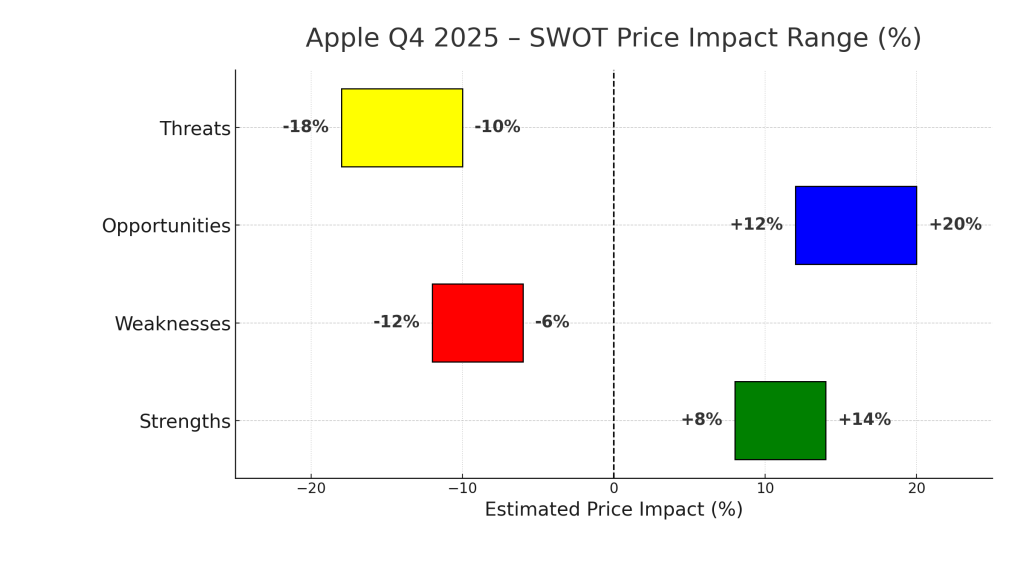
SWOT Analysis — Estimated Price Impact

Strengths (+6 to +12 %)
A 2.2 billion-device installed base and record Services margin growth create durable pricing power.
AI-ready devices expand average selling prices and lift gross margin.
→ + $15 – $30 per share

Weaknesses (–5 to –10 %)
Hardware still ≈ 48 % of sales; tariffs and China competition pressure margins.
AI monetization lag keeps near-term EPS growth modest.
→ – $13 – $26 per share

Opportunities (+10 to +18 %)
AI integration across devices and services bundles can boost ARPU by 5–8 %.
Emerging-market FinTech and subscriptions expand TAM.
→ + $20 – $36 per share

Threats (–8 to –15 %)
Regulation (EU DMA, App Store fees), supply-chain relocation costs, and AI competition remain real headwinds.
→ – $18 – $32 per share

Horizontal SWOT bar chart for Apple Q4 2025 showing the estimated stock-price impact ranges for Strengths, Weaknesses, Opportunities, and Threats. Strengths (green) range from +8% to +14%, Weaknesses (red) from –12% to –6%, Opportunities (blue) from +12% to +20%, and Threats (yellow) from –18% to –10%.

Valuation Scenarios

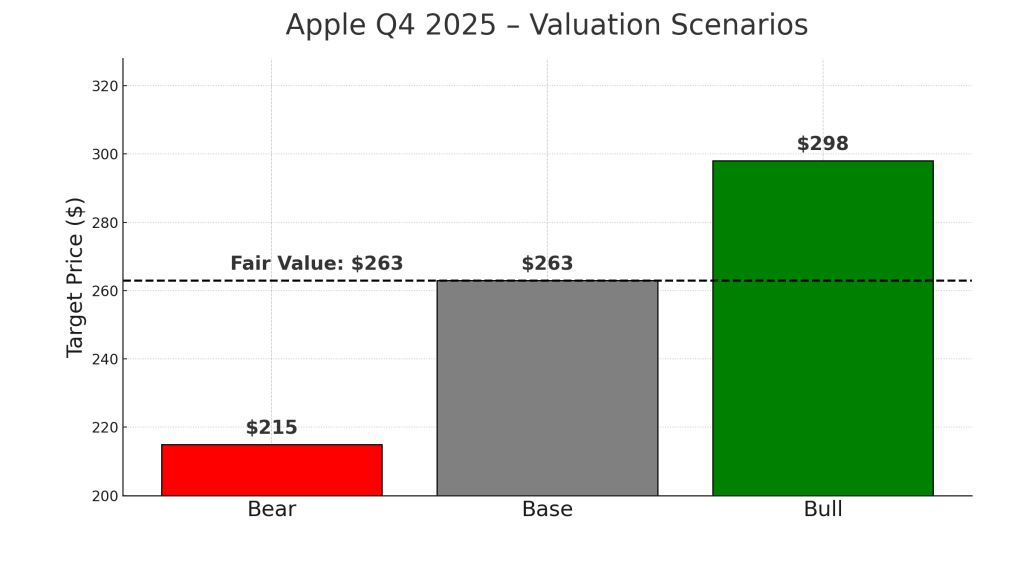
Apple’s fair value clusters around $270, but outcomes vary depending on how quickly its AI ecosystem monetizes.
Here’s how the road ahead could play out:

  • Bull Case ($305, ~30 % probability):
    Apple executes on AI integration, driving 12 % EPS growth and pushing Services beyond 30 % of total revenue.
    The market rewards it with a premium multiple near 32×.
  • Base Case ($270, ~50 % probability):
    EPS grows about 8 % as AI demand builds gradually.
    The stock trades around 29× earnings — roughly where it sits today.
  • Bear Case ($230, ~20 % probability):
    China softness, regulation, and muted AI monetization limit EPS to +3 %.
    Multiple compresses to 25× as investors rotate to faster-growing peers.

➡️ Fair Value Estimate: ≈ $272.5 per share, balancing these three outcomes.

Vertical bar chart for Apple Q4 2025 valuation scenarios showing Bear, Base, and Bull price estimates. Bear scenario (red) is $215, Base (gray) is $263, and Bull (green) is $298. A horizontal dashed line marks Fair Value at $263.

Verdict

At ≈ $270, Apple is fairly valued with a clear path to earnings expansion.
Growth investors should hold core positions and add on dips near $230–240.
The next inflection point arrives mid-2026, when AI features begin contributing revenue and Apple could justify a re-rating to 32–34× P/E ($285–295 target).
If Apple proves that Intelligence sells devices — not just headlines — $300 may come sooner than bears expect.


What to Watch Next

  • Adoption metrics for Apple Intelligence features in real-world use.
  • Services ARPU growth and subscription renewal rates.
  • China unit sales momentum post-holiday quarter.
  • Margin management as $1.4 B tariff cost hits Q1.

(Visual Placeholder #5 – Peer Comparison Table: Apple vs Microsoft vs Alphabet Growth and Margins)


Call to Action

Follow SWOTstock for AI-era earnings analysis of Amazon, Microsoft, and Tesla as we track how AI execution reshapes Big Tech leadership.
Subscribe for alerts when next-quarter AI scorecards drop.


Disclaimer

This analysis uses only Apple Inc.’s official Q4 FY 2025 financial report and earnings call.
It is for informational purposes only and not investment advice.


Cisco Q1 FY 2026 – AI Demand Lifts Guidance, But Valuation Looks Full

Cisco’s fiscal 2026 began strongly, with revenue up 8% to $14.9 billion and non-GAAP EPS up 10% to $1.00. Management raised guidance due to AI orders and Splunk integration. Despite this, Cisco trades above historic valuation levels at $74, making it less attractive for value investors seeking bargains.

🧭 TL;DR Summary

Cisco (CSCO:NASDAQ) delivered a strong start to fiscal 2026: revenue rose 8 % to $14.9 billion and non-GAAP EPS jumped 10 % to $1.00. Management raised full-year guidance on accelerating AI-network orders and early progress integrating Splunk. Yet, after the 6 – 8 % post-earnings surge, Cisco trades well above its historic valuation range. For value investors, it remains a reliable dividend engine—but hardly a bargain at $74.


📅 Quarter Recap

  • Revenue: $14.9 billion (+8 % YoY)
  • GAAP EPS: $0.72 (+6 %)  Non-GAAP EPS: $1.00 (+10 %)
  • Gross Margin: 65.5 % (GAAP) / 68.1 % (non-GAAP)
  • Operating Cash Flow: $3.2 billion (–12 % YoY)
  • Shareholder Returns: $2 billion buybacks + $0.41 dividend
  • Guidance: FY 2026 revenue ≈ $60.6 billion; non-GAAP EPS $4.08 – 4.14

AI-driven switching orders, stronger software renewals, and Splunk integration boosted confidence, while recurring subscription revenue rose to 44 % of total sales—proof that Cisco’s transformation is gaining traction.


🔍 Key Highlights

  • AI Infrastructure Momentum: Backlog > $1 billion in AI network orders.
  • Subscription Strength: Security + observability software sustain recurring growth.
  • Margin Discipline: Gross margins above 65 % despite input inflation.
  • Capital Returns: Consistent buybacks and ~2 % dividend yield signal balance-sheet strength.
  • Execution Watch: Operating cash flow fell 12 %, and analysts seek clearer AI-revenue disclosure before assigning higher multiples.

💪 SWOT Analysis (with estimated price impact ranges)

Strengths (+8 % to +12 %)
Cisco’s expanding recurring-revenue base and tight cost control anchor earnings stability. Its balance sheet is debt-light and supports steady buybacks and dividends—attributes valued by income investors.

Weaknesses (–5 % to –8 %)
Hardware still drives over 40 % of sales, leaving results exposed to ordering cycles. Operating cash flow slid 12 %, reflecting inventory timing and working-capital drag. Without transparent AI-revenue reporting and faster cash-conversion, valuation upside is hard to justify.

Opportunities (+10 % to +15 %)
AI-infrastructure spending offers a fresh growth lane. The Silicon One platform and Splunk integration can unlock new data and security use cases, while Hypershield subscriptions could lift software margins 1 – 2 points. Execution on these fronts may re-rate Cisco toward 15× earnings.

Threats (–7 % to –10 %)
Rivals such as Arista, Palo Alto Networks, and Juniper’s Mist unit are capturing AI-network share faster. Cisco’s portfolio breadth can appear complex to customers seeking simpler cloud-native solutions. Macro slowdown or AI-capex pause would test both hardware and optics segments.

Horizontal bar chart titled ‘Cisco Q1 FY 2026 – SWOT Price Impact Range ($)’. The chart shows estimated price impact ranges for Strengths (+8 to +12, green), Weaknesses (–8 to –5, red), Opportunities (+10 to +15, blue), and Threats (–10 to –7, yellow). Vertical dashed line at zero with horizontal axis from –20 to 20 dollars, representing balanced upside and downside factors.

📈 Valuation Scenarios (Based on FY 2026 Guidance)

Bull Case (~30 % probability)

  • AI network revenue grows +10 %, software margins expand 100 bps.
  • EPS ≈ $4.20, 15× multiple → fair value ≈ $63.
  • Requires strong backlog conversion and clear AI execution proof.

Base Case (~50 %)

  • 6 % steady growth, EPS ≈ $4.10, 14× multiple → fair value ≈ $57.
  • Most probable path given guidance and macro conditions.

Bear Case (~20 %)

  • Flat revenue and AI order delays, EPS ≈ $3.80, 12× multiple → fair value ≈ $46.
  • Reflects execution or macro slippage.

Weighted Fair Value: ≈ $58 per share (~8 % below current $74 price).

Bar chart titled ‘Cisco Q1 FY 2026 – Valuation Scenarios’. The Bear case shows $46 (20 %, red bar), the Base case shows $57 (50 %, gray bar), and the Bull case shows $63 (30 %, green bar). A horizontal dashed line marks the probability-weighted fair value at approximately $56.6, labeled in purple text.

🔭 Forward Checkpoints to Monitor

  • Q2 AI-network bookings growth and conversion rate.
  • Recurring revenue as % of total (45 % target watch).
  • Cash-flow recovery trend and Splunk synergy delivery.
  • Competitive pricing in Ethernet and optics segments.

💡 Verdict

Cisco’s AI story is credible but largely priced in. At ~18× forward earnings, shares sit above their five-year average. Cash generation remains solid and the dividend safe, yet the margin of safety is thin after the rally.

  • Fair Price: ≈ $58 / share
  • Buy-Under Level: ≈ $55
  • Action: Hold for income; wait for a pullback before adding.

📣 Call to Action

Dividend investors should keep Cisco on their watchlist but avoid chasing momentum. Add on weakness below $55 to lock in a better yield and valuation margin.


⚖️ Disclaimer

This analysis is based solely on Cisco Systems’ official Q1 FY 2026 financial report and earnings call materials. It is for informational purposes only and not investment advice. Always verify figures with official sources and consider personal risk tolerance before investing.