Apple Q2 2026 Earnings: Strong Quarter, But At $278, What Are You Really Paying For?

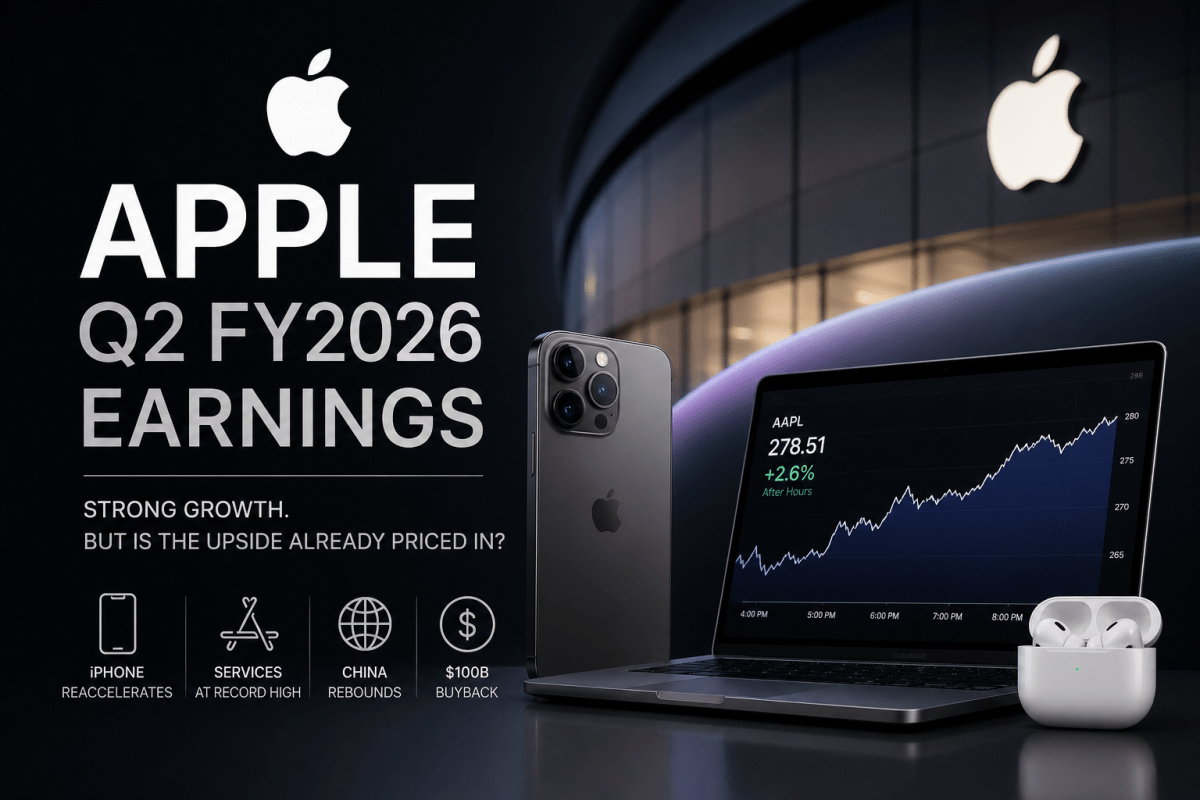
Apple Inc. reported strong quarterly results, with a 17% revenue increase to $111.2B, driven by iPhone demand, Services growth, and a rebound in China. However, the market now questions if this growth justifies Apple’s premium valuation. Investors must consider future expectations, especially regarding AI integration, for their decisions.

TL;DR Summary

Apple Inc. (AAPL:NASDAQ) delivered a strong quarter, with growth driven by iPhone momentum, Services expansion, and a clear rebound in China. The business looks as durable as ever.

But the story is shifting.

At $278.51 after hours, the question is no longer whether Apple is strong—it clearly is. The real question is whether the market is already pricing in the next phase of growth, particularly around AI.

At this level, Apple looks less like a value opportunity and more like a premium-quality stock where execution has to keep up with expectations.


Quarter Recap

Apple’s March quarter reinforced something investors have been debating for the past year: whether the company is slowing down or simply going through a temporary pause.

This quarter leans clearly toward the latter.

Revenue grew 17% year over year to $111.2B, while EPS rose 22% to $2.01, both record levels for a March quarter. More importantly, the growth came from the right places.

iPhone revenue reaccelerated meaningfully, pushing back against the narrative of a mature, flat cycle. Services reached another all-time high, continuing to strengthen the margin profile of the business. And China, which had been a persistent concern, showed a clear rebound.

Taken together, this was not just a “good quarter.” It was a quarter that removed several key risks at once.

At the same time, Apple reinforced its capital return strategy, announcing another $100B buyback authorizationalongside a dividend increase. That continues to anchor the stock as a long-term cash flow compounder.


Key Highlights

If you had to summarize the quarter in one idea, it would be this:

Apple didn’t introduce a new story—it strengthened the existing one.

iPhone demand came in stronger than expected, suggesting that the upgrade cycle still has life. Services continued to scale, providing a structural margin advantage. And China stabilized, reducing one of the biggest downside risks investors had been pricing in.

None of these are new drivers individually. But seeing them all move in the right direction at the same time is what matters.


Market Reaction

The market response was positive but controlled. After-hours trading pushed the stock up about +2.6% to $278.51.

That move is telling.

This wasn’t a euphoric reaction. It was a confirmation move.

Investors are not suddenly discovering Apple’s strength—they already believed in it. What this quarter did was increase confidence in that belief, particularly around iPhone demand and China.

But the limited magnitude of the move also suggests something else:

The market is no longer reacting to Apple as a “surprise growth story.” It is reacting to it as a high-confidence, already-priced-in compounder.


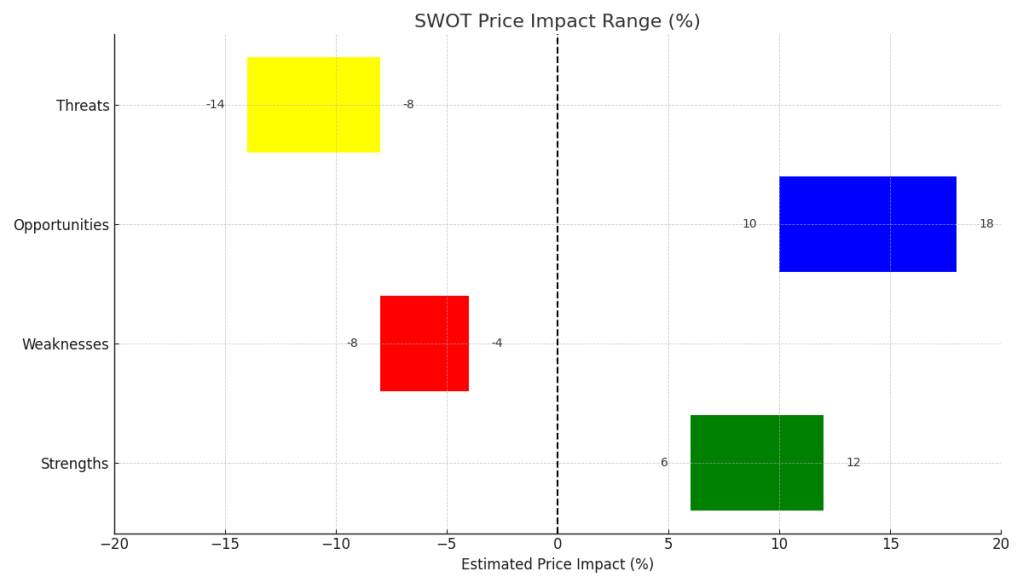
SWOT Analysis (with Price Impact Ranges)

Apple’s investment case now revolves around a different question than it did a few years ago. It is no longer about whether the company can grow—it is about whether that growth can justify the premium investors are already paying.

Strengths

Apple’s biggest strength remains its ecosystem, now reinforced by a reaccelerating iPhone cycle and a rapidly expanding Services business. Together, they create a combination of demand stability and margin durability that very few companies can replicate.

Estimated impact: +4% to +7% (iPhone strength), +3% to +5% (Services), +2% to +4% (capital return)


Weaknesses

At the same time, Apple’s scale is becoming a constraint. With such a large revenue base, even strong execution translates into incremental growth rather than step changes. The continued reliance on iPhone also means the business is still tied to product cycles.

Estimated impact: -3% to -5% (concentration), -2% to -4% (scale limitations)


Opportunities

The most important upside driver is not in the current numbers—it is in what could come next. AI integration across Apple’s ecosystem has the potential to unlock a new narrative, particularly if it leads to monetizable services or device differentiation.

China’s recovery, if sustained, also adds to the upside by reversing a previously negative sentiment driver.

Estimated impact: +5% to +10% (AI), +3% to +6% (China recovery)


Threats

The key risks are tied to normalization. A strong iPhone quarter can be followed by a weaker one if demand was pulled forward. At the same time, regulatory pressure on the App Store and ecosystem could affect the high-margin Services segment.

Estimated impact: -4% to -7% (demand normalization), -3% to -6% (regulation)


Valuation Scenarios

Apple’s valuation today is less about whether it will grow and more about how much of that growth is already reflected in the price.

Using a ~$8.00 EPS run-rate and a reasonable multiple range:

  • In a bear case, where growth normalizes and no new driver emerges, the stock could justify a valuation closer to $192.
  • In a base case, where Apple continues its current trajectory as a stable compounder, fair value sits around $224.
  • In a bull case, where AI meaningfully expands the growth profile, valuation could reach $256.

That leads to a probability-weighted fair value of roughly $220–225.


Verdict

This is where the story changes.

At $278.51, Apple is not just reflecting its current strength—it is reflecting future expectations that have not yet materialized in the numbers.

That doesn’t make it a bad investment. But it does change the nature of the investment.

You are no longer buying Apple because it is undervalued. You are buying it because you believe:

The next layer of growth—most likely AI-driven—will justify today’s premium.

That introduces a different kind of risk. Not execution risk, but expectation risk.

At this level, the setup is no longer balanced. The downside, if expectations don’t materialize, is meaningfully larger than the upside from current fundamentals alone.


Call to Action

Apple remains one of the highest-quality businesses in the market. That hasn’t changed.

What has changed is the price you are being asked to pay.

The key question now is simple:

Are you investing in Apple’s current business—or in what it might become next?

Follow SWOTstock for grounded, investor-focused analysis that connects earnings to real valuation implications—not just headlines.


Disclaimer

This content is for informational purposes only and does not constitute investment advice. All financial data is based on official company disclosures. Valuation estimates are based on assumptions and should not be interpreted as predictions. Always conduct your own research before making investment decisions.
Berkshire Hathaway Q3 2025 — Earnings Strength, Record Cash, and a Market That Shrugged

Berkshire Hathaway reported strong Q3 2025 earnings, with $13.5B in operating profits and a record cash reserve of $381B. Despite excellent insurance gains, the stock’s reaction was muted, reflecting cautious investor sentiment and no share buybacks. The outlook remains stable, but without capital deployment, the stock appears fairly valued.

TL;DR Summary

Berkshire delivered one of its strongest operating quarters in years: $13.5B in operating earnings (+34% YoY)$30.8B in net income, and a record $381B cash pile. Insurance posted exceptional underwriting profits and float grew to $176B. Yet the stock barely reacted on Nov 3 — reflecting Buffett’s continued caution, no buybacks, and heavy cash positioning. Berkshire looks fairly valued, with modest upside if capital deployment improves.


Quarter Recap

Berkshire reported Q3 2025 earnings on Saturday, November 1. The results showcased the strength of its core businesses:

  • Operating earnings surged to $13.485B, driven by rebounding insurance profitability.
  • Net income came in at $30.796B, boosted by mark-to-market investment gains.
  • Insurance underwriting delivered $2.369B in profit — nearly triple YoY.
  • Berkshire Hathaway Energy earned $1.489B; BNSF generated $1.449B.
  • The company ended the quarter with $305B in U.S. Treasury bills and $381.7B in total cash and equivalents — a historic record.

Despite these results, Berkshire again did not repurchase shares and was a net seller of equities during the quarter — a message that did not go unnoticed by the market.


Key Highlights

1. A Massive Cash Wall
Berkshire now holds one of the largest cash positions in its history — a sign of both discipline and a lack of compelling opportunities.

2. Insurance Delivered Its Best Quarter in Years
Underwriting profit and investment income both rose sharply, supported by higher rates and disciplined pricing.

3. Apple Exposure Remains High
Apple continues to dominate the equity portfolio, though Berkshire reduced its position earlier in the year.

4. No Buybacks in 2025
Management chose not to repurchase shares for the first nine months — a strong signal that Buffett does not view Berkshire as undervalued at current levels.

5. Market Reaction Was Muted
On Nov 3 (first trading day after earnings), BRK.B closed near $476, showing almost no reaction to the strong quarter — reflecting cautious investor sentiment and the sense that Berkshire is in a holding pattern.


SWOT Analysis

Strengths (+6% to +12%)

  • Record cash levels
  • Strong underwriting performance
  • Diversified, resilient businesses
  • Significant float growth

Weaknesses (–4% to –8%)

  • Sluggish revenue growth
  • No buybacks YTD
  • Heavy reliance on Apple

Opportunities (+8% to +15%)

  • Capital deployment potential
  • Treasury valuation upside
  • Insurance pricing cycle

Threats (–10% to –18%)

  • Succession transition
  • Market downturn exposure
  • Catastrophe risk
Berkshire Q3 2025 earnings SWOT analysis horizontal bar chart showing Strengths (+6 to +12%), Weaknesses (–8 to –4%), Opportunities (+10 to +18%), and Threats (–14 to –8%) with all labels outside the bars, a vertical dashed zero line, and x-axis from –20 to +20.

Valuation Scenarios (Bull / Base / Bear)

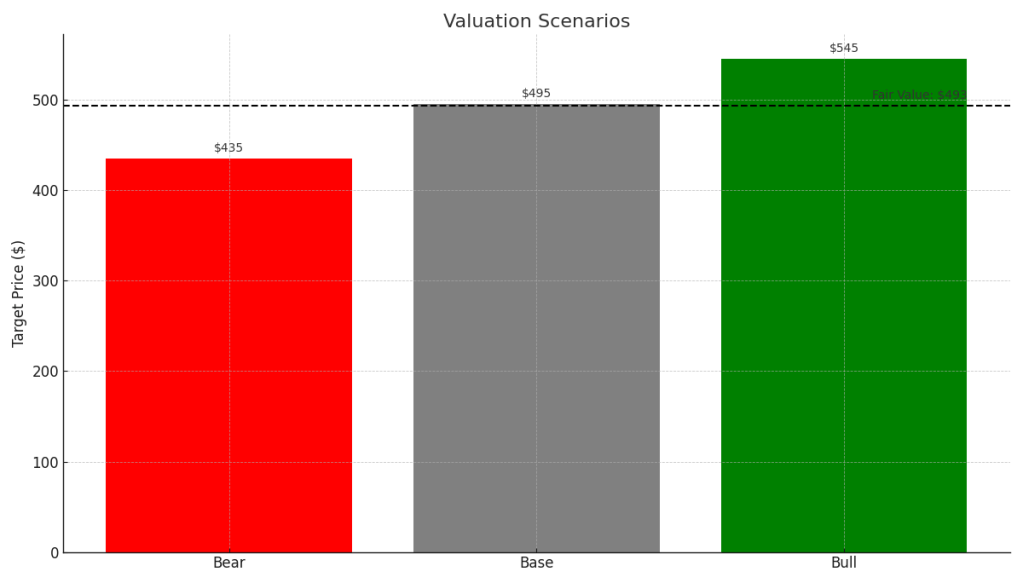
Bear Case — $435 (25%)

  • Uses mid-threat impact
  • No buybacks, leadership uncertainty
  • Market correction risk
    Fair value: $476 × (1 – 9%) ≈ $435

Base Case — $495 (50%)

  • Balanced strengths/weaknesses
  • Stable operating earnings
  • Treasury yield support
    Fair value: $476 × (1 + 4%) ≈ $495

Bull Case — $545 (25%)

  • Strong insurance profitability
  • Opportunistic capital deployment
  • Rate cuts boosting Treasury book
    Fair value: $476 × (1 + 14.5%) ≈ $545

Probability-Weighted Fair Value

= (0.25 × 435) + (0.50 × 495) + (0.25 × 545)
$493

Final Fair Value: $493

≈ 3.6% above current price → Fairly Valued

Valuation scenarios bar chart for Microsoft Q1 FY2026 showing Bear case at $435, Base case at $495, and Bull case at $545, with a dashed Fair Value line at $493 fully visible across the chart.

Verdict

Berkshire remains a fortress — high-quality, resilient, and disciplined. But with such a massive cash position and no buybacks, the market is waiting for a catalyst. Q3 shows strength, but until Berkshire deploys capital or signals undervaluation with buybacks, the stock likely stays range-bound.

For long-term value investors, Berkshire remains a low-risk compounder — but not yet a bargain.


Call to Action

If you found this analysis helpful, follow SWOTstock for more breakdowns of major earnings, fair-value scenarios, and investor-focused research. Share this post with another DIY value investor who follows Berkshire closely.


Disclaimer

This article is for informational and educational purposes only and is not investment advice. All analysis is based solely on Berkshire Hathaway’s official Q3 2025 financial report and management disclosures.


💡 Alphabet Q3 2025 Earnings — A $100 B Quarter that Still Feels Underpriced

Alphabet (GOOGL) achieved over $100 billion in quarterly revenue for the first time, showing 16% year-over-year growth. Key drivers include a strong Cloud business and effective YouTube monetization. Despite CapEx concerns, the company remains cash-rich, positioning itself for long-term growth in AI and other sectors, recommending a hold strategy.

TL;DR Summary

Alphabet (GOOGL:NASDAQ) just passed the $100 billion quarterly revenue mark for the first time — growing 16 % year over year with broad strength across Search, YouTube, and Cloud. Despite record profits, the stock still trades near fair value, offering patient investors a long-term compounding story powered by disciplined AI execution.


Q3 2025 Financial Highlights

  • Revenue: $102.3 B (+16 % YoY)
  • Operating Income: $31.7 B (+23 %)
  • EPS: $2.87 (diluted)
  • Google Cloud: $15.2 B (+34 %), operating margin 9 % (up from 5 %)
  • YouTube Ads: +18 % YoY, Shorts monetization gaining traction
  • Buybacks: $15 B this quarter
  • CapEx: Guidance raised to $91–93 B (from $85 B) to expand AI infrastructure

Management Commentary — The AI Era at Work

CEO Sundar Pichai described the quarter as “a reflection of how AI is transforming every corner of our business.”
He highlighted how Gemini models are now woven across Search, Workspace, and Android, while Google Cloud has become “a foundation for the next wave of AI applications.”

Pichai also drew attention to Waymo’s momentum, noting tens of thousands of fully autonomous rides weekly — a reminder that Alphabet’s portfolio still holds long-term optionality beyond advertising.
CFO Ruth Porat reiterated a focus on “disciplined investment” and sustainable capital returns, ensuring AI expansion doesn’t come at the expense of profitability.


Market Reaction

Shares rose roughly 6 % post-earnings to around $288, as investors applauded Alphabet’s combination of growth and cost control.
Growth investors celebrated the $100 B milestone; value investors noticed something quieter but more powerful — free-cash-flow compounding and balance-sheet strength, with over $100 B in cash and a business model that still prints double-digit operating margins despite surging AI spend.


SWOT Analysis — What’s Driving and Challenging Alphabet

Strengths — The Engine Still Scales

  • Alphabet’s ability to integrate AI across core products has turned efficiency into a margin lever, driving a 23 % jump in operating income.
  • Cloud growth of +34 % confirms enterprise adoption of Google AI and Vertex AI, while YouTube continues to monetize Shorts effectively.
  • A balance sheet boasting $109 B in cash and $80 B in free cash flow gives management the flexibility to invest and repurchase shares without financial strain.
  • These elements together could support a 6 – 12 % upside in valuation, equivalent to +$16–32 per share, if current trends hold.

Weaknesses — Spending Before the Payoff

  • The biggest risk near term is CapEx intensity: management raised 2025 guidance to $91–93 B, pushing short-term margins down to 31 %.
  • Cloud infrastructure build-out and TPU chip development consume cash before incremental revenue arrives.
  • For value investors, this is the “patience tax” — reinvestment that depresses earnings temporarily but is critical to maintain AI leadership. Estimated drag: −6 to −10 % on near-term fair value.

Opportunities — Optionality Beyond Ads

  • The rollout of Gemini-powered experiences across Search and Workspace is still early. If user engagement and monetization scale as expected, Alphabet could open entirely new revenue lines within existing products.
  • Waymo’s commercialization offers an overlooked lever: as autonomous rides expand to new cities, the segment could evolve from cost center to strategic asset.
  • Together, these trends imply +8 to +15 % potential uplift as new businesses begin contributing meaningfully.

Threats — The Unseen Headwinds

  • Alphabet faces regulatory pressure in the U.S. and EU that could reshape how it structures Search partnerships.
  • Rising AI training costs and limited chip supply could inflate unit economics in 2026.
  • Global digital tax initiatives also threaten to trim net margins.
  • These could shave 10 – 18 % off valuation in a downside scenario.
Bar chart showing Alphabet Q3 2025 SWOT price impact ranges: Strengths (+16 to +32 USD, green), Weaknesses (−28 to −17 USD, red), Opportunities (+23 to +40 USD, blue), and Threats (−50 to −28 USD, yellow), with a dashed vertical line at zero indicating estimated stock price effects.

Valuation Scenarios — Fair Value Still Around $284

Bull Case (35 % probability)
If Gemini monetization accelerates and Cloud margins surpass 10 %, EPS could reach $14 in FY 2026. At 22× earnings, that implies a $308 target — driven by full AI adoption and modest multiple expansion.

Base Case (50 % probability)
A more realistic view assumes 12 % revenue growth and modest margin recovery. With EPS near $13 and 20× multiple, fair value sits at $285 — consistent with steady compounding and disciplined reinvestment.

Bear Case (15 % probability)
If regulatory constraints slow Search deals or AI costs balloon, EPS might stall around $12. Applying 17× multiple yields $245 per share.
Even here, Alphabet remains profitable and cash-rich, limiting true downside risk.

Weighted Fair Value: ≈ $284/share — almost identical to where the stock trades now (~$288).
For long-term holders, that suggests limited short-term upside but strong margin of safety given cash reserves and buyback velocity.

Vertical bar chart showing Alphabet Q3 2025 valuation scenarios: Bear case $245 (15%), Base case $285 (50%), and Bull case $308 (35%), with a dashed horizontal line marking fair value at $284 per share.

Verdict — Hold, Accumulate Below $270

Alphabet remains a quiet compounding engine: dominant in AI infrastructure, prudent in spending, and generous in shareholder returns.
At $288, the stock sits near intrinsic value. But below $270, its 3.5 % free-cash-flow yield and recurring revenue make it a compelling long-term hold for patient investors.

For value investors, the strategy is clear: own quality, wait through the CapEx cycle, and let compounding do the work.


What to Watch Next

  • Gemini monetization in Search and YouTube
  • Cloud profitability progression toward 10 %+ margins
  • DOJ antitrust outcomes and global tax rulings
  • Returns from AI infrastructure CapEx and Waymo expansion

Call to Action

Follow SWOTstock for clear, fundamentals-based coverage of high-cash-flow AI compounders like Alphabet, Microsoft, and Amazon.
Subscribe to receive new posts right after each earnings call.


Disclaimer

This analysis is based solely on Alphabet Inc. official Q3 2025 financial report and earnings call transcript.
It is not investment advice. Please conduct independent research before investing.


One response to “💡 Alphabet Q3 2025 Earnings — A $100 B Quarter that Still Feels Underpriced”

Leave a comment