Berkshire Hathaway Q1 2026 Earnings: Strong Results, But Market Signals “No Catalyst”

Berkshire Hathaway reported strong Q1 2026 results with operating earnings up 17% year-over-year. However, a modest market decline indicated investor concern over capital deployment, not fundamentals. The company’s capital allocation remains key, with future upside dependent on decisive actions rather than incremental earnings growth. The stock appears fairly valued at ~$470.

TL;DR Summary

Berkshire Hathaway (BRK.A, BRK.B:NYSE) delivered solid Q1 2026 results, with operating earnings up ~17% year-over-year and continued strength in insurance underwriting. However, because earnings were released on a Saturday, the market reaction came on Monday—where BRK-B closed at $468.52, down 0.95%.

The muted decline suggests not a concern about fundamentals, but a lack of new catalysts—particularly around capital deployment.


Quarter Recap

Berkshire reported Q1 2026 earnings on May 2, 2026.

Key figures from official filings:

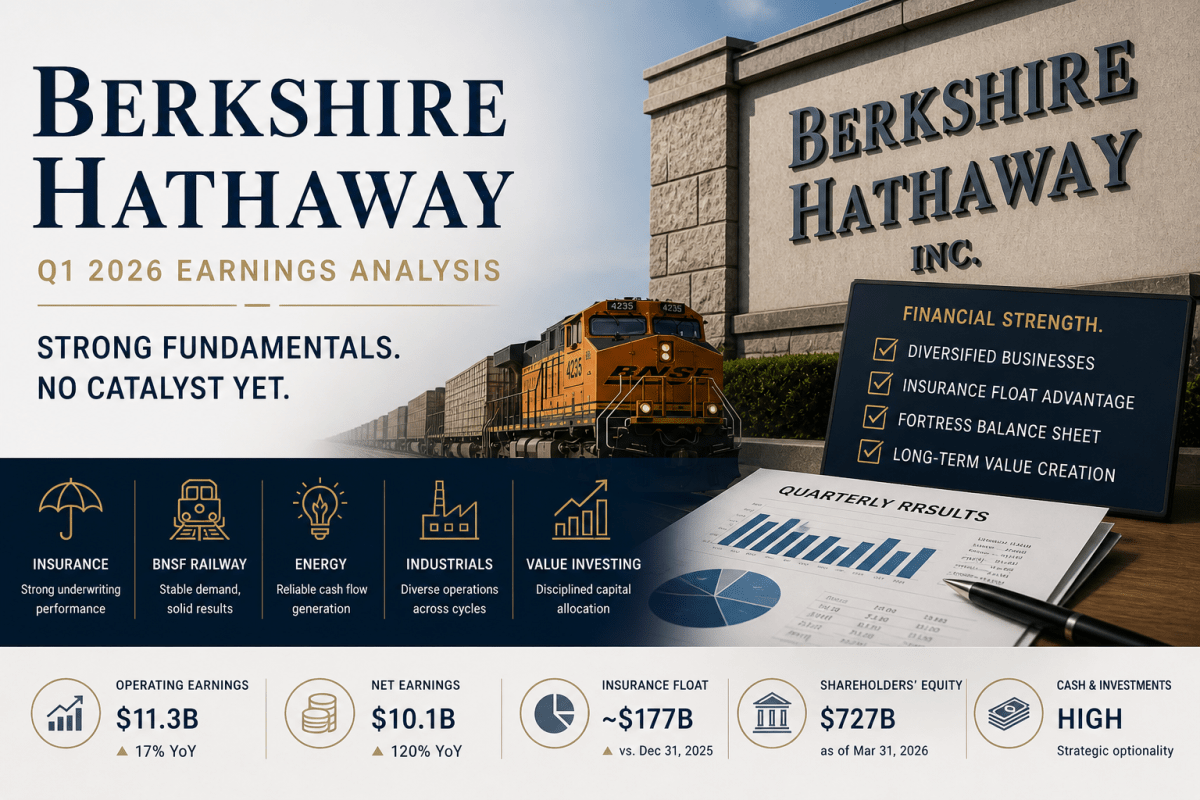
  • Operating earnings: ~$11.3B (vs ~$9.6B last year)
  • Net earnings: ~$10.1B (volatile due to investment swings)
  • Revenue: ~$93.7B

The core story remains consistent:
insurance continues to anchor the business, while rail, energy, and industrial operations provide steady, diversified earnings.


Key Highlights

  • Insurance underwriting improved, reinforcing a favorable cycle
  • Float expanded to approximately $177B, strengthening Berkshire’s capital base
  • BNSF delivered higher earnings, reflecting stable demand
  • Investment income declined slightly, showing rate sensitivity
  • Cash remains elevated, with limited visible deployment

Market Reaction — What Actually Happened

Berkshire released earnings on Saturday, when it closed on Monday (May 4, 2026):

  • BRK-B closed at $468.52
  • Down ~0.95%

What this tells us:

  • The market did not react negatively to the earnings quality
  • Instead, it reacted to what was missing

👉 No major acquisition
👉 No aggressive buyback signal
👉 No shift in capital allocation strategy

In other words:

The market is not questioning Berkshire’s business — it is questioning the next move.


SWOT Analysis

Berkshire is best understood as a capital allocation platform rather than a traditional operating company. Its valuation is driven by how effectively it deploys capital across cycles.

Strengths

  • Insurance float as low-cost leverage (+5% to +10%)
    ~$177B float provides structural funding advantage and enhances long-term returns.
  • Diversified earnings engine (+3% to +6%)
    Insurance, rail, energy, and industrial businesses create resilience across cycles.
  • Proven capital allocation track record (+5% to +8%)
    Long-term value creation is driven by disciplined investment decisions.
  • Fortress balance sheet (+2% to +4%)
    High liquidity provides downside protection and strategic flexibility.

Weaknesses

  • Capital deployment drag (-3% to -6%)
    Large cash reserves dilute returns when not actively deployed.
  • Succession uncertainty (-2% to -5%)
    Future capital allocation quality remains a key unknown.
  • Conglomerate discount (-2% to -4%)
    Structural complexity leads to valuation discount versus sum-of-parts.

Opportunities

  • Large-scale acquisitions in downturns (+5% to +12%)
    Berkshire’s biggest upside comes during market dislocations.
  • Higher interest income on cash (+2% to +4%)
    Elevated rates increase returns on idle capital.
  • Insurance cycle tailwinds (+3% to +6%)
    Strong underwriting conditions can drive outsized profits.

Threats

  • Equity portfolio volatility (-4% to -10%)
    Reported earnings remain sensitive to market movements.
  • Scale limitation (-3% to -7%)
    Berkshire’s size limits high-return opportunities.
  • Catastrophe risk (-3% to -8%)
    Large insurance events can materially impact results.

Valuation Scenarios

Berkshire’s valuation depends less on earnings beats and more on capital deployment and earnings durability.

Bear Case (25%)

  • Limited capital deployment
  • Insurance cycle weakens
  • ~1.3x book multiple

👉 Estimated price: $400–420


Base Case (50%)

  • Stable earnings growth
  • Moderate buybacks
  • No major acquisition

👉 Estimated price: $460–480


Bull Case (25%)

  • Major capital deployment at attractive returns
  • Strong insurance cycle persists
  • Multiple expansion to ~1.7x book

👉 Estimated price: $520–550


Probability-Weighted Fair Value

👉 ~$470


Verdict

Berkshire Hathaway continues to execute exactly as expected:
steady earnings, strong underwriting, and unmatched balance sheet strength.

But the market reaction—a modest -0.95% decline on Monday—reveals the real issue:

This is no longer a story about earnings. It’s a story about capital deployment.

At current levels, the stock appears fairly valued.
The upside will not come from incremental earnings—it will come from decisive capital allocation.


Call to Action

If you’re a long-term investor, Berkshire remains a core holding for stability and compounding.

But if you’re looking for upside:

👉 Watch the cash.
👉 Watch the deals.

That’s where the next move will come from.

Follow SWOTstock for more earnings breakdowns grounded in official filings and real investor thinking.


Disclaimer

This article is for informational purposes only and does not constitute financial advice. Always conduct your own research before making investment decisions.
Autodesk Q1 2026 Earnings: AI Tools Drive Growth—but Is the Upside Already Priced In?

Autodesk (ADSK) beats Q1 FY2026 estimates and raises guidance, but is the stock already priced for perfection? Dive into our AI-focused SWOT analysis, valuation breakdown, and investor verdict.

TL;DR – Solid Beat, Upgraded Guidance, But Market Unmoved

Autodesk (NASDAQ: ADSK) beat expectations in Q1 with 15% revenue growth, expanding margins, and strong free cash flow. Management raised full-year guidance and highlighted its AI platform roadmap. Still, the stock stayed flat—suggesting the optimism may be fully priced in.


Financial Overview – Growth That Converts to Cash

Autodesk reported:

  • Revenue: $1.63B (+15% YoY)
  • EPS (Non-GAAP): $2.29
  • Operating Margin: 37% (+300bps YoY)
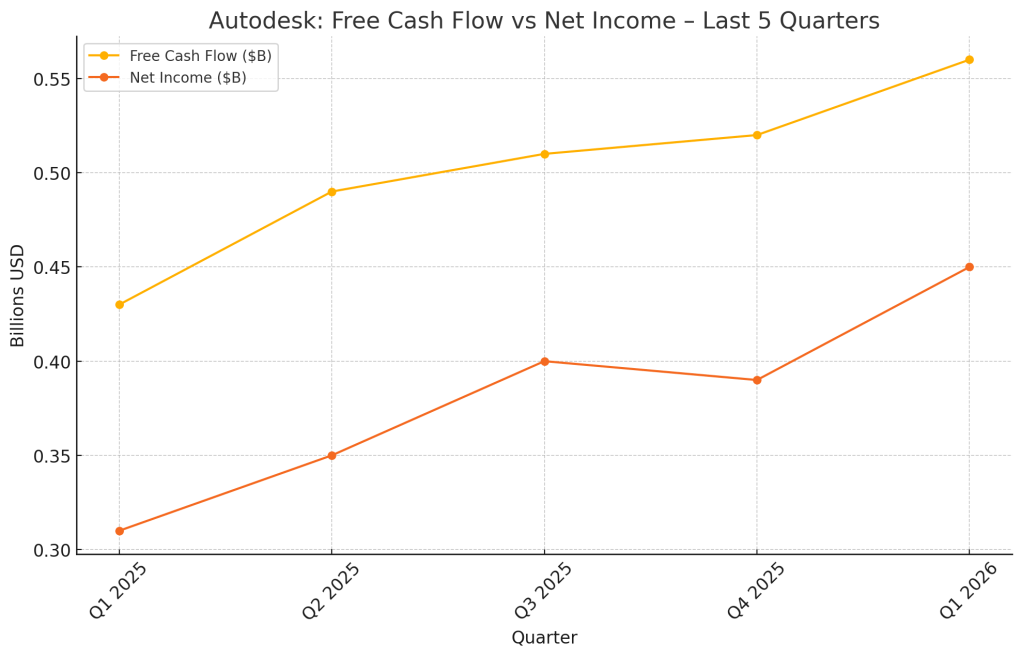
  • Free Cash Flow: $556M (+14%)
  • Billings: $1.43B (+29%)
  • FY2026 guidance raised for revenue and EPS

What sets Autodesk apart isn’t just strong revenue—it’s the ability to consistently convert earnings into cash flow.

Line chart showing Autodesk’s free cash flow and net income over the last five quarters, highlighting consistent growth through Q1 2026.

Where the Growth Is Coming From

Revenue isn’t growing evenly across all business lines. Autodesk’s AEC (architecture, engineering, and construction) segment remains dominant, but Manufacturing and “Others” are catching up.

Bar chart comparing Autodesk’s revenue by segment—AEC, Manufacturing, and Others—between Q1 2025 and Q1 2026.

Also critical is the mix of recurring revenue. Subscription ARR is expanding steadily, which supports long-term valuation multiples.

Line chart showing Autodesk’s total revenue versus quarterly subscription ARR from Q1 2025 to Q1 2026, reflecting recurring revenue growth.

Management’s Outlook – Confidence Backed by Upward Revisions

Autodesk has shown a pattern of raising guidance, reinforcing investor confidence in leadership and execution.

Bar chart illustrating Autodesk’s EPS guidance revisions, showing increases from original to final guidance in FY2025 and FY2026.

SWOT Breakdown – What’s Working, What’s Not, and Where We Go Next

Let’s break it down using SWOT—strengths, weaknesses, opportunities, and threats—with estimated stock price impact for each:

Strengths

  • Revenue and FCF beat expectations
  • AI rollout begins across Revit and Fusion
  • Subscription model fuels predictable growth

Price Impact: +$15 to +$20


Weaknesses

  • Flat stock reaction post-earnings suggests limited short-term upside
  • High R&D spend during platform transition could compress near-term margins

Price Impact: –$5 to –$10


Opportunities

  • Generative design and predictive modeling features gain traction
  • Construction Ops platform and APAC expansion could drive new growth
  • Increased ARR could unlock multiple expansion

Price Impact: +$25 to +$40


Threats

  • Geopolitical and macro headwinds
  • Execution risk with AI and Cloud scale
  • Valuation already rich (~30.7x forward earnings)

Price Impact: –$20 to –$30

SWOT Summary Table

Type Key Points Price Impact
Strengths Revenue & margin beat, AI rollout started +$15 to +$20
Weaknesses Flat stock, platform costs –$5 to –$10
Opportunities Generative design AI, platform growth, APAC expansion +$25 to +$40
Threats Macro risk, AI execution gaps, valuation pressure –$20 to –$30
Horizontal bar chart showing Autodesk’s estimated stock price impact by SWOT element with both endpoints labeled.

Valuation Scenarios – Let’s Do the Math

Despite the strong report, Autodesk’s closing price after earning released ($295.35 as of May 23, 2025) implies a ~30.7x forward P/E. Here’s how that compares to valuation scenarios based on official EPS guidance and fair multiples:

Base Case – Fair Value: $132

  • EPS = $9.62 × P/E 13.7 → $132
  • Reflects steady execution and moderate optimism

Bull Case – Fair Value: $160

  • EPS = $9.73 × P/E 16.5 → $160
  • Assumes strong AI traction and margin expansion

Bear Case – Fair Value: $100

  • EPS = $9.50 × P/E 10.5 → $100
  • Macro pressure + execution delays = multiple compression

Weighted Average Estimate: $132.5

(132×0.6)+(160×0.25)+(100×0.15)=132.5

Bar chart showing Autodesk’s valuation scenarios with weighted average, compared to current stock price.

So Why Is the Market Paying $295?

That’s nearly double our base case. Investors are pricing in:

  • Premium for platform dominance and design ecosystem
  • Long-term AI monetization potential
  • Confidence in 3–5 year growth, not just FY2026

Let’s check historical valuation to see if this premium is new.

Dual-axis chart showing Autodesk’s stock price and trailing P/E ratio over the last five years.

Verdict – Fully Valued. Wait for Dip.

Autodesk’s vision is impressive. The stock is too.
But at current prices, the upside may already be realized—at least in the short term. Long-term investors may want to hold. Opportunists should consider waiting for a pullback below $250 to improve margin of safety.


Call to Action

Want no-hype, investor-friendly breakdowns like this?
Subscribe to SWOTstock to stay ahead of the curve—no fluff, just fundamentals.


Disclaimer

This post is based solely on Autodesk’s official financial report and earnings call transcript. It does not constitute investment advice. Please do your own research.


Leave a comment