TL;DR Summary
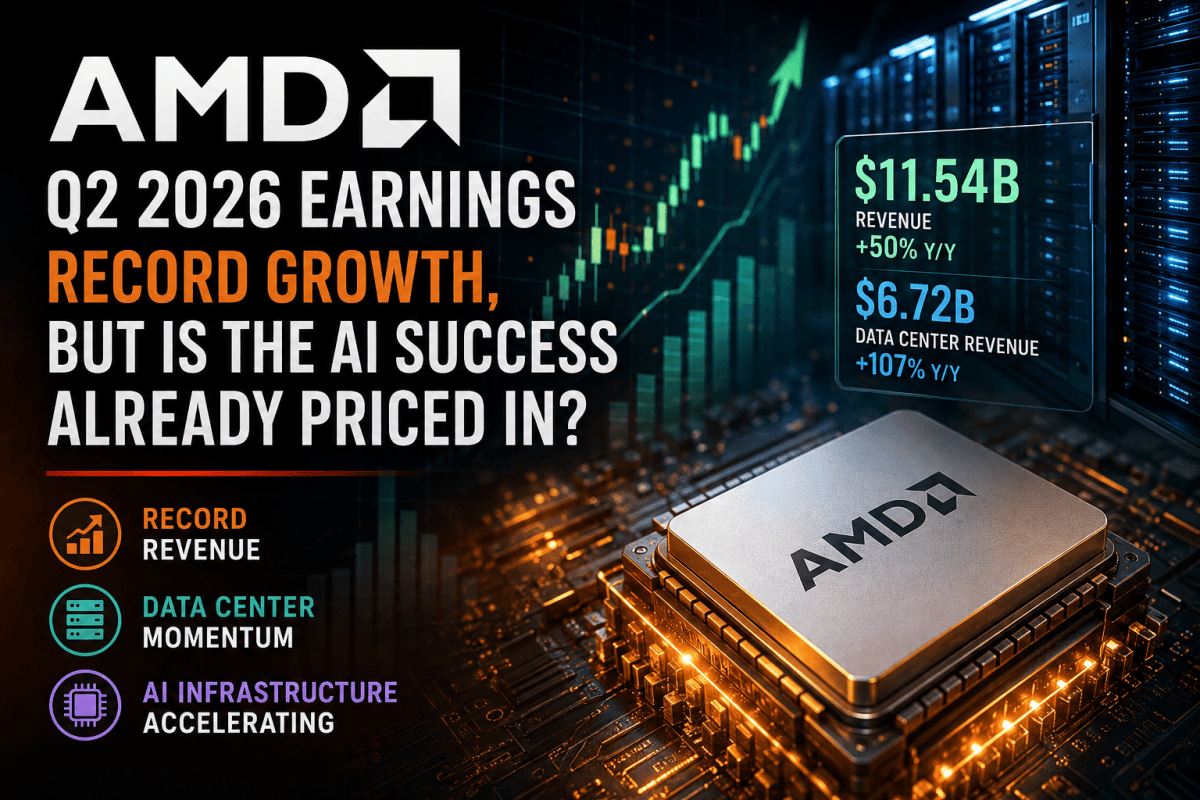
AMD (AMD:NASDAQ) delivered another record quarter, with revenue rising 50% year over year to $11.5 billion and Data Center revenue more than doubling to $6.7 billion. The company also guided for approximately $13.0 billion of revenue in Q3, suggesting that its AI accelerator and EPYC server momentum is continuing rather than peaking.
The earnings report strengthens the case that AMD is becoming a meaningful second platform in AI computing. Data Center now represents approximately 58% of total revenue, operating leverage is emerging, and management expects further acceleration in the second half of 2026.
However, AMD entered the report with extremely high expectations. The shares closed at $518.58 before the results, following a 7% gain during the session, and then fell sharply in after-hours and premarket trading. The market appears to have wanted faster margin expansion and more immediate evidence that AMD can convert its AI partnerships into NVIDIA-like economics.
Our probability-weighted fair value is approximately $400 per share, with a reasonable valuation range of $350 to $450.
At prices around $470 to $520:
- AMD’s business momentum is strong.
- Its long-term AI opportunity is substantial.
- Its valuation risk remains high.
- There is currently little or no margin of safety.
- Further upside increasingly depends on the bull case becoming reality.
The earnings report made AMD’s business more convincing. It did not make the stock inexpensive.
Quarter Recap
AMD reported fiscal Q2 2026 revenue of $11.54 billion, up 50% year over year and 13% sequentially.
The company reported:
- GAAP gross margin of 54%
- GAAP operating income of $1.99 billion
- GAAP operating margin of 17%
- GAAP net income of $2.30 billion
- GAAP diluted EPS of $1.38
- Non-GAAP gross margin of 56%
- Non-GAAP operating income of $3.09 billion
- Non-GAAP operating margin of 27%
- Non-GAAP diluted EPS of $1.66
AMD’s results demonstrate that its growth is no longer based solely on expectations surrounding future AI products. Data Center is already the company’s largest segment and is generating substantial operating profit.
The year-over-year comparison nevertheless requires some caution. Q2 2025 included an approximately $800 million inventory and related charge associated with U.S. export restrictions on MI308 products. The absence of that charge magnified the improvement in operating income and EPS.
Even after adjusting for this comparison effect, the sequential numbers remain strong. Revenue increased approximately 13% from Q1, and management is guiding for another approximately 13% sequential increase in Q3.
For Q3 2026, AMD expects:
- Revenue of approximately $13.0 billion, plus or minus $300 million
- Year-over-year revenue growth of approximately 41% at the midpoint
- Sequential revenue growth of approximately 13%
- Non-GAAP gross margin of approximately 56%
The guidance indicates continued expansion, although the unchanged gross-margin outlook is one reason investors may have found the report less transformative than expected.
Key Highlights
Data Center becomes the centre of the AMD investment thesis
Data Center revenue reached $6.72 billion, representing approximately 58% of total company revenue.
Revenue increased 107% year over year, supported by demand for EPYC server processors and Instinct MI350-series accelerators. Segment operating income reached approximately $2.1 billion, compared with a loss in the prior-year period.
This is the most important change in AMD’s financial profile. The company is no longer primarily a PC and gaming semiconductor business with an emerging AI opportunity. It is increasingly a Data Center company with additional Client, Gaming and Embedded operations.
Continued sequential growth supports the AI thesis
AMD’s approximately 13% sequential revenue growth in Q2 and another approximately 13% increase implied by Q3 guidance suggest that demand is continuing to expand.
Management expects Data Center sales to accelerate during the second half of 2026, supported by:
- Continued EPYC adoption
- Scaling Instinct deployments
- The beginning of the Helios rack-scale platform ramp
- New and expanding customer relationships
- Growing demand for AI inference and general-purpose computing
AMD’s official materials also highlight its broader strategy of combining CPUs, GPUs and adaptive computing through an open ecosystem.
Operating leverage is beginning to appear
AMD’s non-GAAP operating margin reached 27%, while operating expenses declined as a percentage of revenue.
This indicates that revenue is currently growing faster than the underlying expense base. If this continues, earnings could grow materially faster than sales.
That operating leverage is essential to the valuation. Rapid revenue growth alone cannot support the current market capitalisation unless AMD also converts more of each incremental revenue dollar into operating profit and free cash flow.
Cash generation improved significantly
For the first half of 2026, AMD generated approximately $5.3 billion of operating cash flow from continuing operations.
After approximately $1.2 billion of property and equipment purchases, simplified first-half free cash flow was approximately $4.1 billion.
AMD also ended the quarter with approximately $13.1 billion of cash, cash equivalents and short-term investments.
The stronger cash position gives the company flexibility to support product development, secure supply, expand its platform capabilities and pursue strategic investments.
Client growth was strong, but pricing was mixed
Client revenue reached approximately $3.1 billion, up 23% year over year.
Processor unit shipments increased 34%, but average selling prices declined 6% because of a less favourable product mix.
This suggests that AMD gained volume, although the quality of the growth was not as strong as the headline revenue increase alone might imply.
Gaming remains the weakest segment
Gaming revenue fell 31% year over year to approximately $779 million, primarily because of lower semi-custom revenue.
Higher Radeon GPU sales provided some support, but Gaming remains a drag on consolidated growth.
Its declining relative importance limits the damage to the overall investment thesis, but the weakness reduces the diversification benefits of AMD’s portfolio.
SWOT Analysis
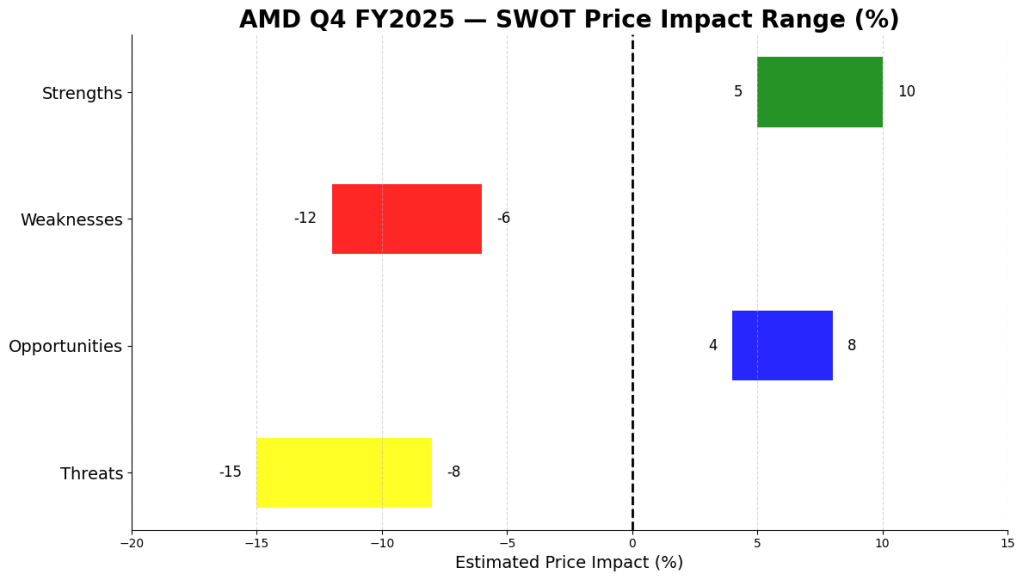
AMD’s Q2 results strengthen the operational case, but the share price already reflects significant expectations surrounding AI accelerators, rack-scale systems and future market-share gains. The following impact ranges estimate how each factor could affect AMD’s fair value. They should not be added mechanically because several factors overlap.
Strengths
- Data Center has reached critical scale: estimated fair-value impact of +20% to +35%Data Center now represents most of AMD’s revenue and is generating substantial segment profit. This provides concrete financial evidence that AMD is participating meaningfully in the AI and server-computing expansion.
- Strong sequential growth and management visibility: +12% to +22%Q2 revenue increased approximately 13% sequentially, while Q3 guidance implies another increase of roughly the same magnitude. This reduces the risk that Q2 was an isolated demand spike.
- Multiple Data Center growth engines: +10% to +20%AMD is not dependent solely on AI accelerators. EPYC server CPUs remain an important source of revenue growth and customer adoption.
- Emerging operating leverage: +10% to +20%Revenue is growing faster than operating expenses. Continued leverage could raise AMD’s sustainable earnings power considerably.
- Broad and open computing ecosystem: +5% to +15%AMD can offer CPUs, GPUs, adaptive computing and rack-scale solutions. Its open-ecosystem positioning may appeal to customers seeking alternatives and less dependence on one proprietary platform.
Weaknesses
- The valuation assumes substantial future success: −25% to −45%At the pre-earnings price, AMD was valued as though a significant portion of its future AI growth and market-share gains were already assured.
- Gross-margin expansion remains limited: −10% to −20%Q3 non-GAAP gross-margin guidance remained at approximately 56%. Investors expecting rapidly improving AI economics received little evidence of near-term margin acceleration.
- Large gap between GAAP and adjusted earnings: −6% to −12%Stock-based compensation, intangible-asset amortisation and acquisition-related items create a meaningful difference between GAAP and non-GAAP profitability.
- Gaming remains in contraction: −3% to −8%Lower semi-custom demand continues to weigh on the segment.
- Client growth was partially volume-led: −3% to −7%Lower average selling prices indicate that Client growth was not accompanied by equivalent pricing or mix improvement.
Opportunities
- Instinct becomes the established second AI accelerator platform: +30% to +60%AMD does not need to overtake NVIDIA to generate significant shareholder value. Establishing a durable position as the clear second supplier could support substantially higher revenue and earnings.
- Helios expands AMD into rack-scale systems: +15% to +30%A successful Helios ramp could increase the value of each deployment and allow AMD to compete with a more complete infrastructure solution.
- EPYC continues gaining server adoption: +10% to +20%Continued CPU gains would provide a more durable and diversified Data Center earnings stream.
- Software improvements lower adoption barriers: +10% to +25%Better ROCm usability, framework support and migration tools could make AMD hardware accessible to more customers and developers.
- AI demand broadens beyond hyperscalers: +8% to +20%Sovereign AI, enterprises, research organisations and specialised cloud providers could expand AMD’s addressable market.
Threats
- NVIDIA’s ecosystem advantage remains durable: −25% to −45%Competitive hardware alone may not be sufficient if customers remain tied to NVIDIA’s software, developer tools and infrastructure ecosystem.
- AI infrastructure spending enters a digestion period: −25% to −50%AMD’s growth is increasingly exposed to continued capital spending by hyperscalers and major AI developers.
- MI400 or Helios execution problems: −15% to −30%Product delays, software shortcomings, inadequate supply or weak deployment performance could cost AMD an important product cycle.
- Export controls and China uncertainty: −5% to −15%Regulatory restrictions can reduce AMD’s addressable market and create inventory, tariff and licensing risks.
- Supply commitments exceed actual demand: −8% to −20%AMD must secure significant capacity to support growth. Those commitments could become burdensome if demand or customer deployments are delayed.
Valuation Scenarios
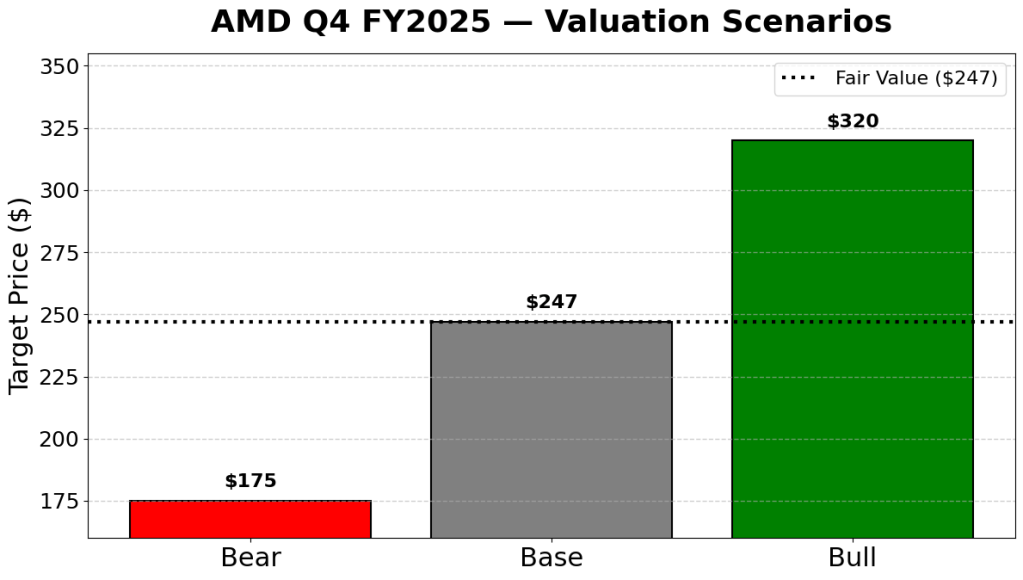
AMD does not provide sufficiently detailed long-term guidance to calculate intrinsic value directly. The scenarios below therefore begin with the company’s Q2 financials and Q3 guidance, then apply SWOTstock assumptions for sustainable revenue, margins and valuation multiples.
These are not AMD management forecasts.
Bear Scenario — $210 per share
The bear case does not assume business failure. It assumes that AMD continues growing but captures less AI-platform value than the current share price expects.
Assumptions:
- Sustainable annual revenue of approximately $55 billion
- Sustainable net margin of approximately 18%
- Net income of approximately $9.9 billion
- Diluted share count of approximately 1.63 billion
- Earnings per share of approximately $6.07
- Valuation multiple of 35 times earnings
Calculation:
- $55 billion revenue multiplied by an 18% net margin produces approximately $9.9 billion of net income.
- $9.9 billion divided by 1.63 billion shares produces approximately $6.07 of EPS.
- $6.07 multiplied by 35 produces approximately $212 per share.
Rounded bear-case value: $210
This outcome could result from:
- Slower AI spending growth
- Limited gross-margin expansion
- Gradual Helios adoption
- Continued NVIDIA ecosystem dominance
- AMD remaining a secondary supplier without capturing platform-level economics
- Valuation compression as revenue growth normalises
Base Scenario — $385 per share
The base case assumes substantial operational success, but not NVIDIA-like economics.
Assumptions:
- Sustainable annual revenue of approximately $65 billion
- Sustainable net margin of approximately 23%
- Net income of approximately $14.95 billion
- Diluted share count of approximately 1.63 billion
- Earnings per share of approximately $9.17
- Valuation multiple of 42 times earnings
Calculation:
- $65 billion multiplied by a 23% net margin produces approximately $14.95 billion of net income.
- $14.95 billion divided by 1.63 billion shares produces approximately $9.17 of EPS.
- $9.17 multiplied by 42 produces approximately $385 per share.
Base-case value: $385
This outcome assumes:
- Data Center remains AMD’s primary growth engine
- Instinct becomes a credible second accelerator platform
- EPYC continues gaining adoption
- Helios ramps without major delays
- Operating margins improve gradually
- AMD retains a premium growth valuation
Bull Scenario — $620 per share
The bull case assumes AMD captures a meaningful share of the expanding AI-compute market and converts that scale into materially higher profitability.
Assumptions:
- Sustainable annual revenue of approximately $75 billion
- Sustainable net margin of approximately 27%
- Net income of approximately $20.25 billion
- Diluted share count of approximately 1.63 billion
- Earnings per share of approximately $12.42
- Valuation multiple of 50 times earnings
Calculation:
- $75 billion multiplied by a 27% net margin produces approximately $20.25 billion of net income.
- $20.25 billion divided by 1.63 billion shares produces approximately $12.42 of EPS.
- $12.42 multiplied by 50 produces approximately $621 per share.
Rounded bull-case value: $620
This outcome requires:
- Broad Instinct and Helios adoption
- Significant hyperscaler deployments
- Major improvements in software usability
- Continued EPYC growth
- Meaningful gross- and operating-margin expansion
- Investor confidence that AMD can retain a durable share of AI-platform economics
Probability-Weighted Fair Value
We assign:
- Bear case: 25% probability
- Base case: 50% probability
- Bull case: 25% probability
Calculation:
- $210 multiplied by 25% equals $52.50.
- $385 multiplied by 50% equals $192.50.
- $620 multiplied by 25% equals $155.00.
The combined probability-weighted value is approximately:
$400 per share
Because AMD’s outcome is highly sensitive to competitive execution and future AI infrastructure spending, a reasonable fair-value range is $350 to $450.
Verdict
AMD delivered an objectively strong quarter.
Data Center revenue more than doubled, the segment became the majority of company revenue, operating leverage improved and Q3 guidance indicated continued sequential expansion.
The results strengthen several important conclusions:
- AMD is becoming a meaningful participant in AI infrastructure.
- Its opportunity extends beyond AI accelerators to EPYC processors and rack-scale systems.
- The company has started converting AI expectations into reported revenue and profit.
- Its financial momentum is no longer merely theoretical.
The market’s negative initial reaction does not mean that the quarter was poor.
AMD closed at $518.58 before the report after rising 7% during the session, then fell approximately 9% in premarket trading. The decline appears to reflect the difference between strong results and the extraordinary level of success already incorporated into the share price.
Investors appear to have wanted:
- Faster near-term AI revenue acceleration
- Expanding gross margins
- Stronger evidence of immediate Helios contribution
- More proof that AMD is narrowing NVIDIA’s ecosystem advantage
- A larger upward revision to future earnings expectations
At approximately $400, AMD would be priced closer to a reasonable base case.
At approximately $350 or below, a modest margin of safety begins to appear, assuming the Data Center thesis remains intact.
At prices above $500, investors are paying in advance for a significant portion of the bull case.
Our assessment is therefore:
- Business momentum: Strong
- Long-term AI opportunity: Substantial
- Competitive risk: High
- Execution risk: High
- Valuation risk above $500: High
- Probability-weighted fair value: Approximately $400
- Reasonable fair-value range: $350 to $450
- Margin of safety near the post-earnings price: Low
AMD may eventually grow into or exceed its current valuation. But at the present price, the investment requires confidence that AMD will become much more than a rapidly growing alternative supplier.
It must become a durable, highly profitable second AI-compute platform.
Call to Action
Would you buy AMD after the post-earnings decline, or does the current valuation still assume too much future AI success?
Follow SWOTstock for independent earnings analysis based primarily on company-reported financials, management commentary and scenario-based valuation.
Disclaimer
This article is for informational and educational purposes only and does not constitute financial, investment, tax or legal advice.
The valuation scenarios and fair-value estimates are based on assumptions and independent interpretation of publicly available company information. They are not company guidance and should not be treated as precise predictions of future share prices.
Stock prices can fluctuate significantly, and investors may lose some or all of their invested capital. Always conduct your own research and consider your financial situation, objectives and risk tolerance before making an investment decision.