NVIDIA Q4 FY2026 Earnings: AI Dominance Intact — Is the Stock Still Underpricing the Cycle?

TL;DR Summary

NVIDIA (NVDA:NASDAQ) delivered another explosive quarter, with Q4 revenue up 73% year-over-year and Data Center revenue surging 75%. Gross margins remain near 75%, and management guided to $78B in next-quarter revenue — even excluding China data center compute revenue.

The AI infrastructure cycle is clearly not over.

Based on official financials and management guidance, fair value lands around $240–$250, versus the current price near $150. For growth investors, the debate is no longer whether NVIDIA is dominant — it’s whether the AI cycle can extend long enough to justify sustained premium valuation.


Quarter Recap

NVIDIA reported Q4 FY2026 revenue of $68.1B, up 73% year-over-year and 20% sequentially. The real engine remains Data Center, which generated $62.3B, growing 75% YoY.

Gross margins held near 75%, confirming that pricing power remains intact despite scale. Full-year FY2026 revenue reached $215.9B, up 65% from the prior year.

Management guided Q1 FY2027 revenue to $78B ±2%, notably excluding China data center compute revenue. That implies the core AI demand machine remains strong even under export constraints.


Key Highlights

• Data Center revenue continues to scale at hyperscale velocity

• Blackwell ramp is underway, supporting next-gen demand

• Gross margin durability near 75% signals structural advantage

• China revenue excluded from guidance, reducing forward visibility but also lowering expectation risk

• $41.1B returned to shareholders in FY2026 through buybacks and dividends


SWOT Analysis

NVIDIA is no longer being valued as a chipmaker. It is being valued as the foundational AI infrastructure layer. The sustainability of that thesis depends on ecosystem dominance, demand durability, and competitive containment.

Strengths

• AI infrastructure leadership with 75% YoY Data Center growth

Estimated price impact: +10% to +18%

• CUDA + NVLink ecosystem lock-in creating high switching costs

Estimated price impact: +8% to +15%

• Sustained gross margin near 75% demonstrating pricing power

Estimated price impact: +5% to +10%

• Visible product roadmap (Blackwell, Rubin) reducing cycle uncertainty

Estimated price impact: +6% to +12%


Weaknesses

• Heavy revenue concentration in Data Center

Estimated price impact: -8% to -15%

• Premium valuation near ~45x earnings requires near-flawless execution

Estimated price impact: -10% to -20%


Opportunities

• Inference demand expansion beyond training workloads

Estimated price impact: +10% to +20%

• Sovereign AI and enterprise adoption wave

Estimated price impact: +8% to +15%

• Software monetization and services layer expansion

Estimated price impact: +5% to +12%


Threats

• China export restrictions tightening further

Estimated price impact: -8% to -18%

• Hyperscaler custom silicon (ASICs) long-term margin risk

Estimated price impact: -10% to -20%

• AI capex digestion cycle if hyperscalers pause

Estimated price impact: -15% to -30%
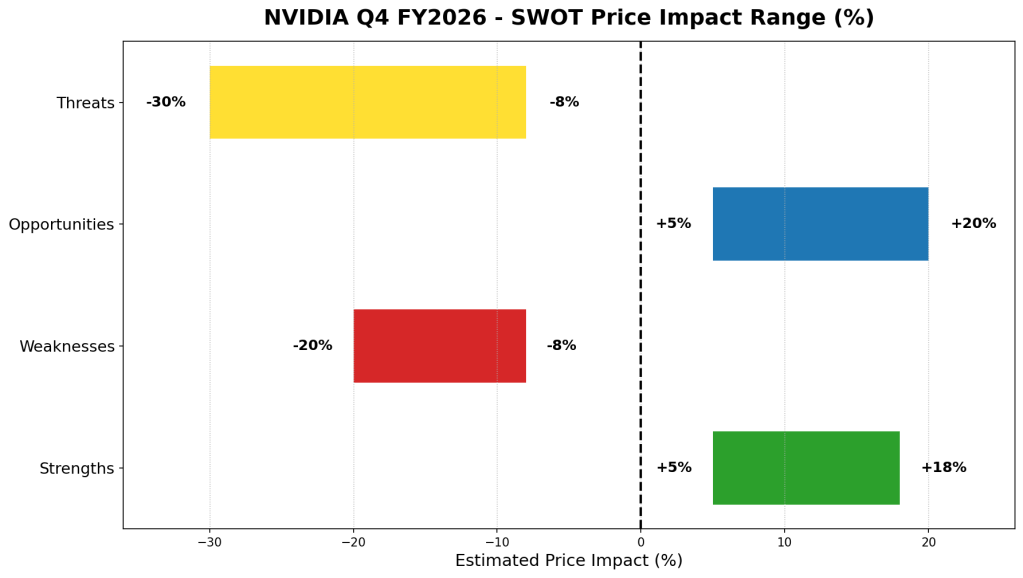
NVIDIA Q4 FY2026 SWOT price impact range chart showing Strengths (+5% to +18%), Weaknesses (-20% to -8%), Opportunities (+5% to +20%), and Threats (-30% to -8%) with a zero reference line.
NVIDIA Q4 FY2026 SWOT price impact analysis. Strengths and Opportunities suggest upside potential of up to +20%, while Weaknesses and Threats indicate downside risk reaching -30%, highlighting both AI leadership momentum and valuation sensitivity.

Valuation Scenarios

Bear Case — AI Growth Moderates

Assumptions:

• EPS slows to ~$6.00

• Multiple compresses to ~30x

Target price: $170–$180

Probability: 25%


Base Case — Strong but Moderating Growth

Assumptions:

• EPS ~$6.50

• Multiple stabilizes ~40x

Target price: $240–$260

Probability: 50%


Bull Case — AI Cycle Extends Multi-Year

Assumptions:

• EPS ~$7.00+

• Multiple holds 45–50x

Target price: $300–$320

Probability: 25%


Probability-Weighted Fair Value

Weighted fair value: ~$246

Fair value range based strictly on official financials:

$240–$250
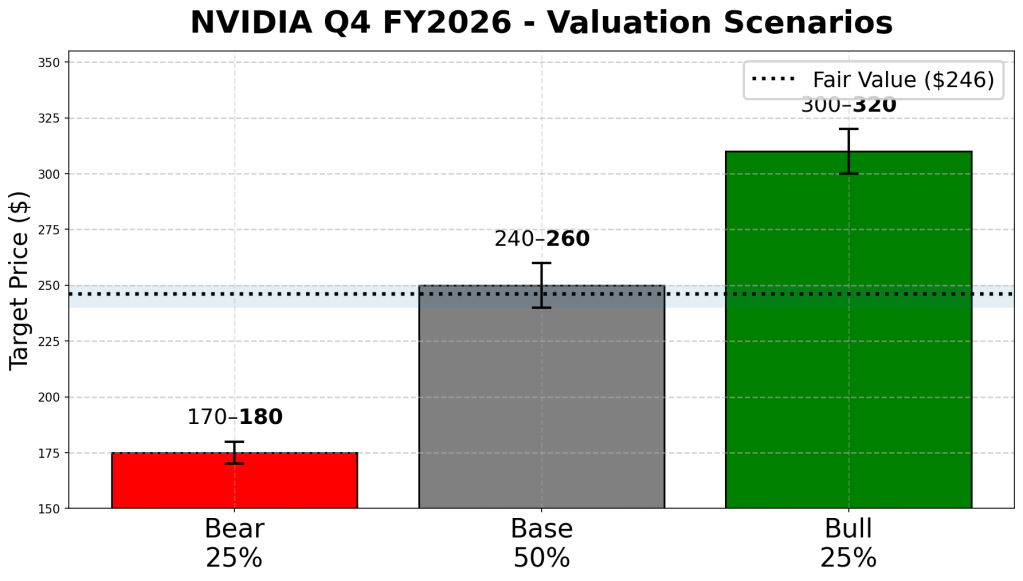
NVIDIA Q4 FY2026 valuation scenarios chart showing Bear case $170–$180 (25%), Base case $240–$260 (50%), and Bull case $300–$320 (25%) with a probability-weighted fair value of $246.
NVIDIA Q4 FY2026 valuation scenarios. The Base case ($240–$260) carries the highest probability at 50%, while the Bull case extends toward $320 if the AI cycle persists. The probability-weighted fair value stands near $246, with a $240–$250 range based strictly on official financials.

Verdict

For Type 1 growth investors, NVIDIA remains the clearest AI infrastructure winner. The numbers show no structural slowdown yet. Gross margins remain elite. Guidance implies continued scale.

The real risk is not weak demand — it’s cycle compression. If AI capex pauses, the stock will re-rate quickly. But as long as hyperscaler demand persists, NVIDIA remains structurally advantaged.

This is no longer an early-stage AI bet. It is an AI cycle duration bet.


Call to Action

If you follow AI infrastructure leaders, subscribe to SWOTstock for structured earnings breakdowns, price-impact SWOT analysis, and scenario-based valuation models built for growth investors.


Disclaimer

This analysis is for informational purposes only and does not constitute investment advice. Always conduct your own due diligence and consult a licensed financial advisor before making investment decisions.


Berkshire’s Quiet Bet on Alphabet Reinforces the Value Case Behind the $100 B Quarter

Berkshire Hathaway revealed a US $4.3 billion investment in Alphabet Inc. during Q3 2025, buying approximately 17.8 million shares. This strategic move occurred as Alphabet achieved its first US $100 billion revenue quarter. Berkshire’s purchase reflects a value-focused approach amid a tech market rotation, emphasizing Alphabet’s solid fundamentals and growth potential.

Berkshire Hathaway has disclosed a new US $4.3 billion position in Alphabet Inc. (GOOGL), confirming that Warren Buffett’s conglomerate entered the stock during the third quarter of 2025 — the same period in which Alphabet reported its first-ever US $100 billion revenue quarter.

According to Berkshire’s latest 13-F filing, the company purchased roughly 17.8 million shares of Alphabet, making it one of Berkshire’s ten largest equity holdings. The move surprised market watchers who have long associated Berkshire’s tech exposure primarily with Apple, which the firm trimmed in the same quarter.


A Contrarian Entry at a Trillion-Dollar Scale

Berkshire’s timing stands out. Alphabet shares were trading around US $270 – 280 during Q3 2025 — only modestly above their estimated intrinsic value range. While other institutional investors were rotating out of mega-cap tech after two years of outperformance, Berkshire appears to have treated Alphabet as a value compounder rather than a momentum play.

For Buffett followers, the purchase echoes a familiar pattern: buying into a cash-rich franchise once its growth narrative collides with valuation discipline. Alphabet fits that mold neatly — a business generating more than US $80 billion in free cash flow annually, returning US $15 billion in quarterly buybacks, and maintaining over US $100 billion in cash reserves.


Fundamentals Back the Move

Alphabet’s Q3 2025 report, released October 29, underscored that growth and prudence can coexist in Big Tech.

  • Revenue: US $102.3 billion (+16 % YoY)
  • Operating Income: US $31.7 billion (+23 %)
  • EPS: US $2.87
  • Google Cloud: +34 % YoY, margin rising to 9 %
  • CapEx: Raised to US $91 – 93 billion for AI data-center expansion

CEO Sundar Pichai described the period as “a reflection of how AI is transforming every corner of our business,” while CFO Ruth Porat stressed “disciplined long-term investment.”

Those remarks align closely with Buffett’s own playbook — durable cash flow, reinvestment discipline, and capital allocation guided by intrinsic value rather than quarterly optics.


Reinforcing the “Still Underpriced” Thesis

Our prior SWOTstock analysis of Alphabet’s Q3 results placed fair value near US $284 per share, with the market trading just above that level post-earnings. Berkshire’s purchase suggests that even at these prices, long-term investors still see a margin of safety — particularly as Alphabet’s AI infrastructure spending begins to translate into productivity and monetization gains across Search, YouTube, and Cloud.

For value-oriented readers, the implication is clear: when Berkshire buys into a trillion-dollar tech name after a record quarter, it’s not chasing growth — it’s buying durability.


Market Reaction

The disclosure briefly lifted Alphabet shares in after-hours trading on Friday, as investors digested the significance of Berkshire’s first new mega-cap tech stake in years. Analysts now expect fresh comparisons between Alphabet’s AI capital discipline and Apple’s maturing growth profile, which Berkshire has been gradually reducing.

As of mid-November 2025, Alphabet trades around US $277, giving the stake a paper value near its initial cost — a rare instance where Buffett’s patience and Alphabet’s execution appear perfectly aligned.


Disclosure: This article is based on public filings and Alphabet’s official Q3 2025 financial results. It does not constitute investment advice.


Related Post

Cisco Q1 FY 2026 – AI Demand Lifts Guidance, But Valuation Looks Full

Cisco’s fiscal 2026 began strongly, with revenue up 8% to $14.9 billion and non-GAAP EPS up 10% to $1.00. Management raised guidance due to AI orders and Splunk integration. Despite this, Cisco trades above historic valuation levels at $74, making it less attractive for value investors seeking bargains.

🧭 TL;DR Summary

Cisco (CSCO:NASDAQ) delivered a strong start to fiscal 2026: revenue rose 8 % to $14.9 billion and non-GAAP EPS jumped 10 % to $1.00. Management raised full-year guidance on accelerating AI-network orders and early progress integrating Splunk. Yet, after the 6 – 8 % post-earnings surge, Cisco trades well above its historic valuation range. For value investors, it remains a reliable dividend engine—but hardly a bargain at $74.


📅 Quarter Recap

  • Revenue: $14.9 billion (+8 % YoY)
  • GAAP EPS: $0.72 (+6 %)  Non-GAAP EPS: $1.00 (+10 %)
  • Gross Margin: 65.5 % (GAAP) / 68.1 % (non-GAAP)
  • Operating Cash Flow: $3.2 billion (–12 % YoY)
  • Shareholder Returns: $2 billion buybacks + $0.41 dividend
  • Guidance: FY 2026 revenue ≈ $60.6 billion; non-GAAP EPS $4.08 – 4.14

AI-driven switching orders, stronger software renewals, and Splunk integration boosted confidence, while recurring subscription revenue rose to 44 % of total sales—proof that Cisco’s transformation is gaining traction.


🔍 Key Highlights

  • AI Infrastructure Momentum: Backlog > $1 billion in AI network orders.
  • Subscription Strength: Security + observability software sustain recurring growth.
  • Margin Discipline: Gross margins above 65 % despite input inflation.
  • Capital Returns: Consistent buybacks and ~2 % dividend yield signal balance-sheet strength.
  • Execution Watch: Operating cash flow fell 12 %, and analysts seek clearer AI-revenue disclosure before assigning higher multiples.

💪 SWOT Analysis (with estimated price impact ranges)

Strengths (+8 % to +12 %)
Cisco’s expanding recurring-revenue base and tight cost control anchor earnings stability. Its balance sheet is debt-light and supports steady buybacks and dividends—attributes valued by income investors.

Weaknesses (–5 % to –8 %)
Hardware still drives over 40 % of sales, leaving results exposed to ordering cycles. Operating cash flow slid 12 %, reflecting inventory timing and working-capital drag. Without transparent AI-revenue reporting and faster cash-conversion, valuation upside is hard to justify.

Opportunities (+10 % to +15 %)
AI-infrastructure spending offers a fresh growth lane. The Silicon One platform and Splunk integration can unlock new data and security use cases, while Hypershield subscriptions could lift software margins 1 – 2 points. Execution on these fronts may re-rate Cisco toward 15× earnings.

Threats (–7 % to –10 %)
Rivals such as Arista, Palo Alto Networks, and Juniper’s Mist unit are capturing AI-network share faster. Cisco’s portfolio breadth can appear complex to customers seeking simpler cloud-native solutions. Macro slowdown or AI-capex pause would test both hardware and optics segments.

Horizontal bar chart titled ‘Cisco Q1 FY 2026 – SWOT Price Impact Range ($)’. The chart shows estimated price impact ranges for Strengths (+8 to +12, green), Weaknesses (–8 to –5, red), Opportunities (+10 to +15, blue), and Threats (–10 to –7, yellow). Vertical dashed line at zero with horizontal axis from –20 to 20 dollars, representing balanced upside and downside factors.

📈 Valuation Scenarios (Based on FY 2026 Guidance)

Bull Case (~30 % probability)

  • AI network revenue grows +10 %, software margins expand 100 bps.
  • EPS ≈ $4.20, 15× multiple → fair value ≈ $63.
  • Requires strong backlog conversion and clear AI execution proof.

Base Case (~50 %)

  • 6 % steady growth, EPS ≈ $4.10, 14× multiple → fair value ≈ $57.
  • Most probable path given guidance and macro conditions.

Bear Case (~20 %)

  • Flat revenue and AI order delays, EPS ≈ $3.80, 12× multiple → fair value ≈ $46.
  • Reflects execution or macro slippage.

Weighted Fair Value: ≈ $58 per share (~8 % below current $74 price).

Bar chart titled ‘Cisco Q1 FY 2026 – Valuation Scenarios’. The Bear case shows $46 (20 %, red bar), the Base case shows $57 (50 %, gray bar), and the Bull case shows $63 (30 %, green bar). A horizontal dashed line marks the probability-weighted fair value at approximately $56.6, labeled in purple text.

🔭 Forward Checkpoints to Monitor

  • Q2 AI-network bookings growth and conversion rate.
  • Recurring revenue as % of total (45 % target watch).
  • Cash-flow recovery trend and Splunk synergy delivery.
  • Competitive pricing in Ethernet and optics segments.

💡 Verdict

Cisco’s AI story is credible but largely priced in. At ~18× forward earnings, shares sit above their five-year average. Cash generation remains solid and the dividend safe, yet the margin of safety is thin after the rally.

  • Fair Price: ≈ $58 / share
  • Buy-Under Level: ≈ $55
  • Action: Hold for income; wait for a pullback before adding.

📣 Call to Action

Dividend investors should keep Cisco on their watchlist but avoid chasing momentum. Add on weakness below $55 to lock in a better yield and valuation margin.


⚖️ Disclaimer

This analysis is based solely on Cisco Systems’ official Q1 FY 2026 financial report and earnings call materials. It is for informational purposes only and not investment advice. Always verify figures with official sources and consider personal risk tolerance before investing.