Microsoft Q1 FY2026 — AI Demand Outruns Supply as Azure Surges 29%

Microsoft’s Q1 FY2026 results highlight strong performance, including a 15% revenue growth to $65.7 billion and a 29% surge in Azure, driven by AI adoption. Operating income rose 18%, emphasizing margin strength despite high capex. The stock increased by over 4%, reflecting confidence in Microsoft’s enterprise AI leadership with a fair value estimate of $453 per share.

TL;DR Summary

Microsoft (MSFT:NASDAQ) delivered another powerful AI-driven quarter, with Azure accelerating to 29% growth and Copilot adoption scaling across enterprise workloads. Operating income rose faster than revenue, confirming strong margin leverage even amid elevated AI datacenter spending. The stock jumped over 4% after earnings, reflecting confidence that Microsoft remains the most durable platform for enterprise AI. Our fair value estimate is $453 per share, slightly above current levels.


Quarter Recap

Microsoft’s Q1 FY2026 results showcased a company benefitting from the early waves of enterprise AI adoption while managing the heavy capex load required to stay ahead of demand. Revenue grew 15% to $65.7 billion, supported by broad-based strength across cloud, productivity, and personal computing. Azure was the standout, accelerating to 29% YoY growth as AI workloads—training, inference, and agent-based tasks—continue to scale. Operating income rose 18% to $28.3 billion, showing that Microsoft is leveraging its size and product mix to offset surging datacenter investments. Earnings per share came in at $3.05, ahead of expectations, driven by robust cloud profitability and disciplined spending.


Key Highlights

  • Azure +29% YoY, driven by AI infrastructure and inference workloads
  • Copilot adoption accelerating across Office, GitHub, and Dynamics
  • Operating income +18% YoY, showing durable profitability
  • Management reiterated: “AI demand continues to exceed supply”
  • Datacenter and GPU capex remains elevated through FY2026
  • Stock jumped +4.4% after Q1 results

SWOT Analysis

Microsoft’s Q1 FY2026 results reinforced its position as the leading enterprise AI ecosystem. Azure’s accelerating growth, combined with expanding Copilot monetization, offers a unique blend of scale, stickiness, and margin durability. Yet, high AI capex and growing competition across cloud and AI infrastructure remain key risks to monitor.

Strengths (+6% to +12%)

  • AI infrastructure leadership with Azure +29% YoY
  • Rapid Copilot monetization across Microsoft 365, GitHub, and Dynamics
  • High enterprise switching costs and long-term retention
  • Operating income growing faster than revenue

Weaknesses (–4% to –8%)

  • Heavy, multi-year datacenter and GPU capex
  • Strategic dependence on OpenAI technology stack
  • Enterprise budget pressure from rising AI software costs
  • Ongoing regulatory scrutiny in the US and EU

Opportunities (+10% to +18%)

  • Copilot becoming the default enterprise AI agent
  • Azure gaining share as AWS growth slows
  • AI PC upgrade cycle expected in 2026
  • Higher-tier subscriptions in security and developer tools

Threats (–8% to –14%)

  • Risk of AI capacity oversupply compressing hyperscaler margins
  • Cloud and AI competition from AWS, Google Cloud, Oracle
  • Rising adoption of open-source AI models
  • Geopolitical tech restrictions affecting supply chains
Microsoft Q1 2026 SWOT analysis chart showing estimated stock price impact ranges for strengths, weaknesses, opportunities, and threats, with a horizontal bar layout and x-axis starting from –20.

Valuation Scenarios

Our valuation framework incorporates Microsoft’s AI momentum, Azure growth trajectory, and margin durability to model a Bear, Base, and Bull scenario. Each scenario includes explicit growth and margin assumptions tied to EPS and forward multiples.

Bear Case — $385 (25%)

  • Azure growth slows to mid-20%
  • AI monetization ramps slower than expected
  • Margins compressed by elevated capex
  • Valuation: 25× forward EPS of ~$15.40 → $385

Base Case — $455 (50%)

  • Azure steady at ~27–29%
  • Strong enterprise AI adoption
  • Stable operating margins
  • Valuation: 29× forward EPS of ~$15.70 → $455

Bull Case — $515 (25%)

  • Azure growth surpasses 30%
  • Copilot becomes core enterprise AI layer
  • Higher-margin subscription mix expands
  • Valuation: 32× forward EPS of ~$16.10 → $515

Probability-Weighted Fair Value

→ $453 per share

Microsoft Q1 2026 valuation scenarios chart showing Bear, Base, and Bull price targets with a dashed fair value line at $453, displayed in red, gray, and green vertical bars.

Verdict

Microsoft remains the most structurally advantaged enterprise AI platform. Azure’s acceleration to 29% growth validates the demand narrative, and early Copilot adoption shows enterprises are already willing to pay for AI productivity gains. The biggest risk remains the scale of AI-related capex, but so far profitability is holding up strongly. With a probability-weighted fair value of $453, Microsoft remains slightly undervalued for long-term AI-focused investors.


Call to Action

If you found this analysis helpful, follow SWOTstock for more AI-focused quarterly breakdowns of the world’s most important companies. We cover earnings, valuation scenarios, and management commentary in a simple, investor-friendly format.


Disclaimer

This analysis is for informational and educational purposes only and does not constitute financial advice. Investing involves risk, including potential loss of principal. Please conduct your own research or consult a qualified financial professional before making investment decisions.

Apple Q4 2025 — The Comeback Quarter That Put “Intelligence” Back in Apple

Apple reported 8% revenue growth to $102.5 billion and a record $28.75 billion in Services, signaling a return to growth after a flat trend. The iPhone 17 launch and deeper ecosystem engagement drove this performance. Guidance for the holiday quarter suggests continued growth, aligning with Apple’s AI ambitions. Investors reacted positively, with a 6% share price increase post-announcement.

TL;DR Summary

Apple finally broke its flat-growth streak.
Revenue climbed 8 % y/y to $102.5 billion, EPS reached $1.85 (+9 %), and Services hit a record $28.75 billion.
Guidance for the holiday quarter calls for +10–12 % growth, reigniting belief that Apple Intelligence is more than a buzzword.
For growth investors, this quarter marks Apple’s return to the AI-led expansion narrative.


Quarter Recap

After four quarters of muted growth, Apple delivered what Tim Cook called “our strongest lineup ever.”
The iPhone 17 launch, deeper ecosystem engagement, and record Services revenue lifted results well above expectations.
Gross margin expanded to 47.2 %, net income rose to $24.2 billion, and Apple declared another $0.26 dividend while continuing aggressive buybacks.

Beyond the numbers, the tone of the call signaled confidence: management expects the December quarter to be the best holiday season in Apple’s history.
That optimism—and the 6 % share-price jump that followed—suggests investors finally see Apple’s AI strategy taking shape.


Key Highlights

  • Services: $28.75 B (+15 %) — now 28 % of total revenue and driving margin expansion.
  • iPhone: $49.0 B (+6 %) — AI-capable models leading upgrade cycle.
  • Mac / iPad: Flat to down slightly as users wait for AI refreshes.
  • Geography: Greater China $14.5 B (+3 %) — showing early stabilization.
  • Guidance: Revenue +10–12 %, gross margin 47–48 % next quarter.

(Note: Apple’s 8 % revenue growth trails Microsoft’s +12 % and Google’s +10 %, but represents its strongest acceleration since 2022.)


How Apple Intelligence Actually Creates Value

For now, “Apple Intelligence” isn’t a separate subscription—it’s a device-pull engine.
AI-driven features such as natural-language photo search, cross-app summaries, and on-device personal assistance require the latest hardware chips (A18, M4).
That design forces upgrades and feeds Services usage. Apple plans to layer paid tiers later, turning AI into a recurring revenue lever by FY 2026.


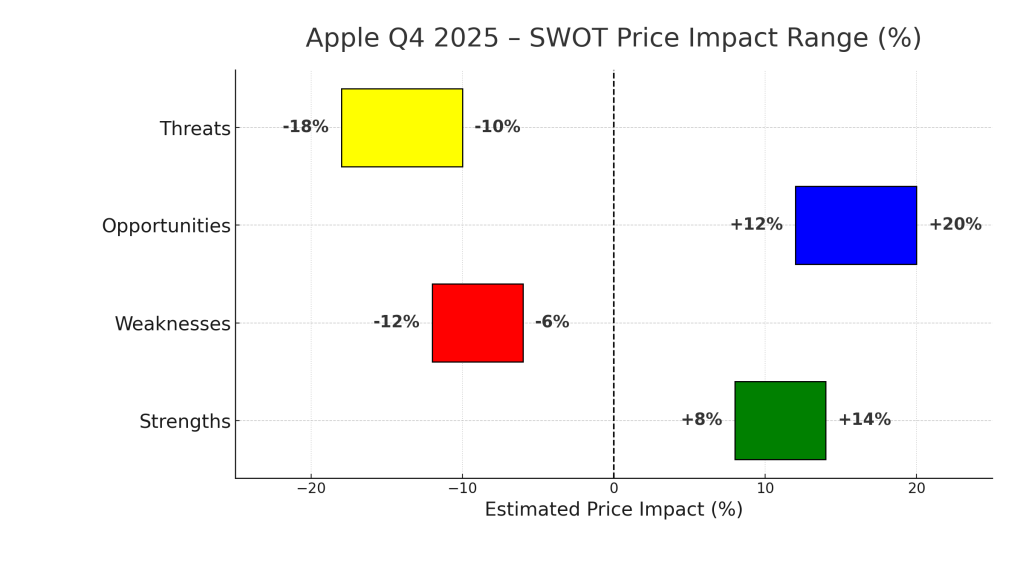
SWOT Analysis — Estimated Price Impact

Strengths (+6 to +12 %)
A 2.2 billion-device installed base and record Services margin growth create durable pricing power.
AI-ready devices expand average selling prices and lift gross margin.
→ + $15 – $30 per share

Weaknesses (–5 to –10 %)
Hardware still ≈ 48 % of sales; tariffs and China competition pressure margins.
AI monetization lag keeps near-term EPS growth modest.
→ – $13 – $26 per share

Opportunities (+10 to +18 %)
AI integration across devices and services bundles can boost ARPU by 5–8 %.
Emerging-market FinTech and subscriptions expand TAM.
→ + $20 – $36 per share

Threats (–8 to –15 %)
Regulation (EU DMA, App Store fees), supply-chain relocation costs, and AI competition remain real headwinds.
→ – $18 – $32 per share

Horizontal SWOT bar chart for Apple Q4 2025 showing the estimated stock-price impact ranges for Strengths, Weaknesses, Opportunities, and Threats. Strengths (green) range from +8% to +14%, Weaknesses (red) from –12% to –6%, Opportunities (blue) from +12% to +20%, and Threats (yellow) from –18% to –10%.

Valuation Scenarios

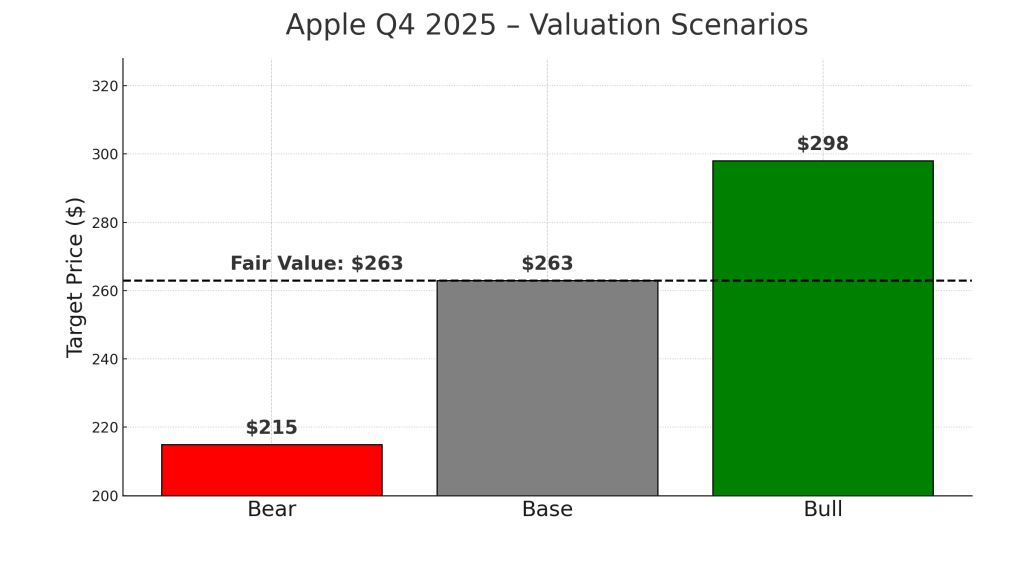
Apple’s fair value clusters around $270, but outcomes vary depending on how quickly its AI ecosystem monetizes.
Here’s how the road ahead could play out:

  • Bull Case ($305, ~30 % probability):
    Apple executes on AI integration, driving 12 % EPS growth and pushing Services beyond 30 % of total revenue.
    The market rewards it with a premium multiple near 32×.
  • Base Case ($270, ~50 % probability):
    EPS grows about 8 % as AI demand builds gradually.
    The stock trades around 29× earnings — roughly where it sits today.
  • Bear Case ($230, ~20 % probability):
    China softness, regulation, and muted AI monetization limit EPS to +3 %.
    Multiple compresses to 25× as investors rotate to faster-growing peers.

➡️ Fair Value Estimate: ≈ $272.5 per share, balancing these three outcomes.

Vertical bar chart for Apple Q4 2025 valuation scenarios showing Bear, Base, and Bull price estimates. Bear scenario (red) is $215, Base (gray) is $263, and Bull (green) is $298. A horizontal dashed line marks Fair Value at $263.

Verdict

At ≈ $270, Apple is fairly valued with a clear path to earnings expansion.
Growth investors should hold core positions and add on dips near $230–240.
The next inflection point arrives mid-2026, when AI features begin contributing revenue and Apple could justify a re-rating to 32–34× P/E ($285–295 target).
If Apple proves that Intelligence sells devices — not just headlines — $300 may come sooner than bears expect.


What to Watch Next

  • Adoption metrics for Apple Intelligence features in real-world use.
  • Services ARPU growth and subscription renewal rates.
  • China unit sales momentum post-holiday quarter.
  • Margin management as $1.4 B tariff cost hits Q1.

(Visual Placeholder #5 – Peer Comparison Table: Apple vs Microsoft vs Alphabet Growth and Margins)


Call to Action

Follow SWOTstock for AI-era earnings analysis of Amazon, Microsoft, and Tesla as we track how AI execution reshapes Big Tech leadership.
Subscribe for alerts when next-quarter AI scorecards drop.


Disclaimer

This analysis uses only Apple Inc.’s official Q4 FY 2025 financial report and earnings call.
It is for informational purposes only and not investment advice.


Berkshire’s Quiet Bet on Alphabet Reinforces the Value Case Behind the $100 B Quarter

Berkshire Hathaway revealed a US $4.3 billion investment in Alphabet Inc. during Q3 2025, buying approximately 17.8 million shares. This strategic move occurred as Alphabet achieved its first US $100 billion revenue quarter. Berkshire’s purchase reflects a value-focused approach amid a tech market rotation, emphasizing Alphabet’s solid fundamentals and growth potential.

Berkshire Hathaway has disclosed a new US $4.3 billion position in Alphabet Inc. (GOOGL), confirming that Warren Buffett’s conglomerate entered the stock during the third quarter of 2025 — the same period in which Alphabet reported its first-ever US $100 billion revenue quarter.

According to Berkshire’s latest 13-F filing, the company purchased roughly 17.8 million shares of Alphabet, making it one of Berkshire’s ten largest equity holdings. The move surprised market watchers who have long associated Berkshire’s tech exposure primarily with Apple, which the firm trimmed in the same quarter.


A Contrarian Entry at a Trillion-Dollar Scale

Berkshire’s timing stands out. Alphabet shares were trading around US $270 – 280 during Q3 2025 — only modestly above their estimated intrinsic value range. While other institutional investors were rotating out of mega-cap tech after two years of outperformance, Berkshire appears to have treated Alphabet as a value compounder rather than a momentum play.

For Buffett followers, the purchase echoes a familiar pattern: buying into a cash-rich franchise once its growth narrative collides with valuation discipline. Alphabet fits that mold neatly — a business generating more than US $80 billion in free cash flow annually, returning US $15 billion in quarterly buybacks, and maintaining over US $100 billion in cash reserves.


Fundamentals Back the Move

Alphabet’s Q3 2025 report, released October 29, underscored that growth and prudence can coexist in Big Tech.

  • Revenue: US $102.3 billion (+16 % YoY)
  • Operating Income: US $31.7 billion (+23 %)
  • EPS: US $2.87
  • Google Cloud: +34 % YoY, margin rising to 9 %
  • CapEx: Raised to US $91 – 93 billion for AI data-center expansion

CEO Sundar Pichai described the period as “a reflection of how AI is transforming every corner of our business,” while CFO Ruth Porat stressed “disciplined long-term investment.”

Those remarks align closely with Buffett’s own playbook — durable cash flow, reinvestment discipline, and capital allocation guided by intrinsic value rather than quarterly optics.


Reinforcing the “Still Underpriced” Thesis

Our prior SWOTstock analysis of Alphabet’s Q3 results placed fair value near US $284 per share, with the market trading just above that level post-earnings. Berkshire’s purchase suggests that even at these prices, long-term investors still see a margin of safety — particularly as Alphabet’s AI infrastructure spending begins to translate into productivity and monetization gains across Search, YouTube, and Cloud.

For value-oriented readers, the implication is clear: when Berkshire buys into a trillion-dollar tech name after a record quarter, it’s not chasing growth — it’s buying durability.


Market Reaction

The disclosure briefly lifted Alphabet shares in after-hours trading on Friday, as investors digested the significance of Berkshire’s first new mega-cap tech stake in years. Analysts now expect fresh comparisons between Alphabet’s AI capital discipline and Apple’s maturing growth profile, which Berkshire has been gradually reducing.

As of mid-November 2025, Alphabet trades around US $277, giving the stake a paper value near its initial cost — a rare instance where Buffett’s patience and Alphabet’s execution appear perfectly aligned.


Disclosure: This article is based on public filings and Alphabet’s official Q3 2025 financial results. It does not constitute investment advice.


Related Post