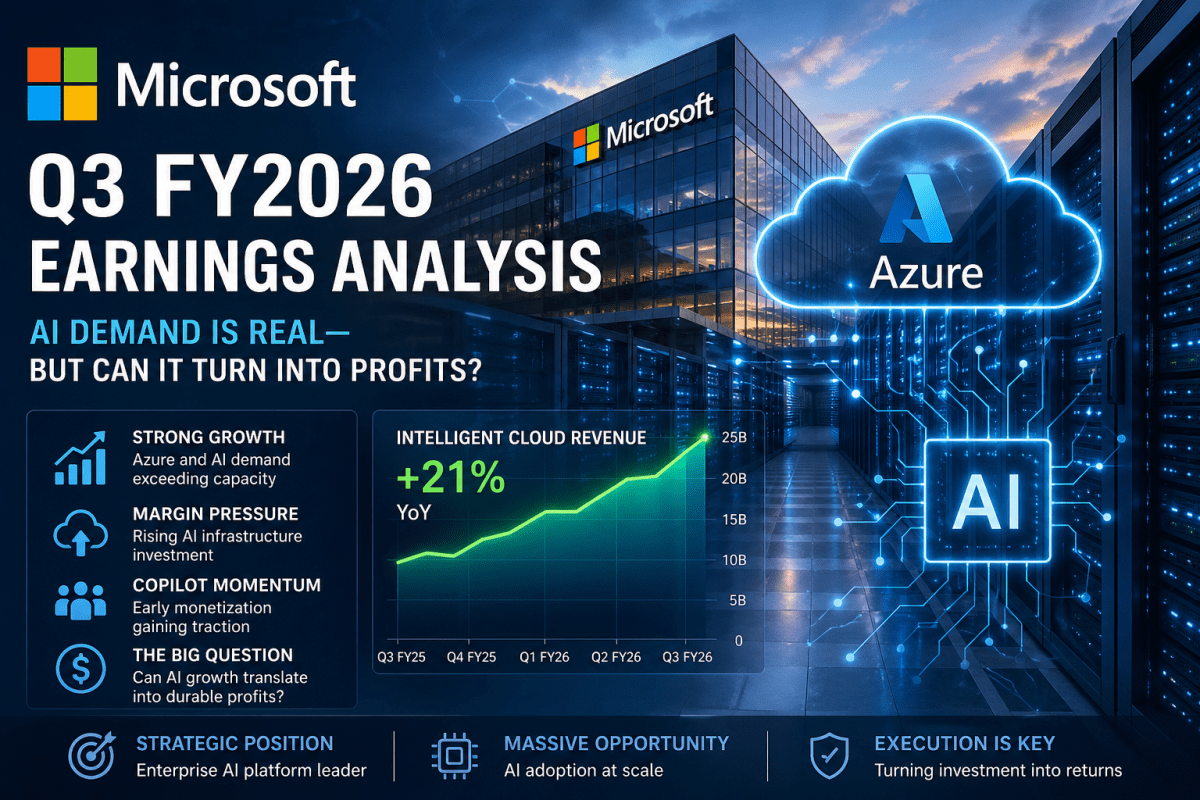
Microsoft Q3 FY2026 Earnings: AI Demand Is Real—But Can It Turn Into Profits?

Microsoft reported strong Q3 FY2026 results, primarily driven by AI and Azure demand. While investors are focused on AI’s profitability, the business faces rising costs due to infrastructure investments. The stock, priced around $425, reflects growth confidence but highlights uncertainty on margins, making future success dependent on effective execution and monetization strategies.

TL;DR Summary

Microsoft (MSFT:NASDAQ) delivered another strong quarter, driven by Azure and AI demand. The key signal—AI demand exceeding capacity—confirms real enterprise adoption.

But the story is shifting. Investors are no longer asking “Is AI real?” but rather “How profitable is AI?”

At ~$425, the stock reflects confidence in growth, but not full certainty on margins. That leaves Microsoft in a high-quality, fairly valued zone—with upside tied to execution, not hype.


Quarter Recap

Microsoft’s Q3 FY2026 results reinforce a consistent pattern: strong growth driven by cloud and AI, paired with rising investment intensity.

Revenue growth remained robust, supported by Azure and AI services. Management highlighted that demand for AI continues to outstrip available capacity, signaling strong forward visibility. This is one of the clearest indicators that AI is not theoretical—it is already being deployed at scale.

However, the cost side of the equation is becoming more visible. Continued investment in AI infrastructure—data centers, GPUs, and networking—has started to weigh on margins. This is not a sign of weakness, but it introduces a timing gap between investment and return.

The business mix continues to shift toward Intelligent Cloud and AI-driven services, while legacy segments remain stable but secondary.


Key Highlights

Microsoft’s performance this quarter can be summarized in one sentence:
AI demand is accelerating faster than the infrastructure supporting it.

Azure remains the core growth engine, increasingly tied to AI workloads. At the same time, early monetization signals from Copilot suggest Microsoft is successfully embedding AI into enterprise workflows.

Yet the trade-off is clear. Growth is strong—but it is capital-intensive.


Market Reaction

The market response was measured rather than dramatic. After-hours trading showed a slight gain of about +0.34%, bringing the stock to around $425.89.

This tells us something important.

Investors are not reacting to short-term margin pressure. Instead, they are focusing on long-term positioning. The slight positive move suggests confidence that AI investments will eventually translate into meaningful returns.

In other words, the market is currently willing to tolerate lower margins in exchange for future growth.


SWOT Analysis (with Price Impact Ranges)

Microsoft’s investment case now hinges on one central question:
Can AI demand be converted into durable, high-margin revenue?

Strengths

Microsoft’s strongest advantage is its position as the default enterprise AI platform. With Azure, Copilot, and deep integration into enterprise workflows, it has a clear monetization pathway that competitors struggle to replicate.

Estimated Impact: +8% to +12%


Weaknesses

The main constraint is capital intensity. AI requires sustained investment in infrastructure, creating near-term pressure on margins and delaying free cash flow realization.

Estimated Impact: -4% to -6%


Opportunities

The upside lies in scaling monetization. If AI usage translates into recurring, high-margin services—especially through Copilot and Azure—Microsoft could see both revenue acceleration and multiple expansion.

Estimated Impact: +6% to +10%


Threats

The biggest risk is economic efficiency. If AI remains expensive to operate or fails to deliver clear ROI for customers, growth could continue without corresponding profitability gains.

Estimated Impact: -5% to -8%

CategoryDriverPrice Impact
StrengthsAI demand + platform dominance+8% to +12%
WeaknessesCapex + margin pressure-4% to -6%
OpportunitiesAI monetization scaling+6% to +10%
ThreatsAI economics + ROI uncertainty-5% to -8%

Valuation Scenarios

Microsoft’s valuation now depends less on growth and more on how efficiently that growth converts into profit.

Base Case — Gradual Monetization

AI adoption continues steadily, with margins recovering over time.

Price Range: $430 – $470


Bull Case — Strong Monetization

AI becomes deeply embedded in enterprise workflows, driving high-margin recurring revenue.

Price Range: $500 – $560


Bear Case — Growth Without Leverage

AI demand remains strong, but profitability lags due to sustained high costs.

Price Range: $340 – $380


Probability-Weighted Fair Value

Estimated fair value: ~$456


Verdict

Microsoft remains one of the strongest structural winners in AI. Its platform positioning, enterprise distribution, and early monetization signals are all real advantages.

However, at current levels, the stock already reflects much of that optimism.

The investment case is no longer about whether Microsoft will grow—it is about whether it can convert that growth into efficient, high-margin returns.

At ~$425, the stock sits in a balanced zone:

Strong business, but limited margin of safety.


Call to Action

If you’re tracking AI leaders, Microsoft should remain on your core watchlist.

The key signals to monitor next:

  • Copilot adoption and pricing power
  • Azure AI workload monetization
  • Margin trajectory as AI scales

Follow SWOTstock for grounded, investor-focused analysis based on official company disclosures—not headlines.


Disclaimer

This content is for informational purposes only and does not constitute investment advice. Always conduct your own research before making investment decisions.

Microsoft Q1 FY2026 — AI Demand Outruns Supply as Azure Surges 29%

Microsoft’s Q1 FY2026 results highlight strong performance, including a 15% revenue growth to $65.7 billion and a 29% surge in Azure, driven by AI adoption. Operating income rose 18%, emphasizing margin strength despite high capex. The stock increased by over 4%, reflecting confidence in Microsoft’s enterprise AI leadership with a fair value estimate of $453 per share.

TL;DR Summary

Microsoft (MSFT:NASDAQ) delivered another powerful AI-driven quarter, with Azure accelerating to 29% growth and Copilot adoption scaling across enterprise workloads. Operating income rose faster than revenue, confirming strong margin leverage even amid elevated AI datacenter spending. The stock jumped over 4% after earnings, reflecting confidence that Microsoft remains the most durable platform for enterprise AI. Our fair value estimate is $453 per share, slightly above current levels.


Quarter Recap

Microsoft’s Q1 FY2026 results showcased a company benefitting from the early waves of enterprise AI adoption while managing the heavy capex load required to stay ahead of demand. Revenue grew 15% to $65.7 billion, supported by broad-based strength across cloud, productivity, and personal computing. Azure was the standout, accelerating to 29% YoY growth as AI workloads—training, inference, and agent-based tasks—continue to scale. Operating income rose 18% to $28.3 billion, showing that Microsoft is leveraging its size and product mix to offset surging datacenter investments. Earnings per share came in at $3.05, ahead of expectations, driven by robust cloud profitability and disciplined spending.


Key Highlights

  • Azure +29% YoY, driven by AI infrastructure and inference workloads
  • Copilot adoption accelerating across Office, GitHub, and Dynamics
  • Operating income +18% YoY, showing durable profitability
  • Management reiterated: “AI demand continues to exceed supply”
  • Datacenter and GPU capex remains elevated through FY2026
  • Stock jumped +4.4% after Q1 results

SWOT Analysis

Microsoft’s Q1 FY2026 results reinforced its position as the leading enterprise AI ecosystem. Azure’s accelerating growth, combined with expanding Copilot monetization, offers a unique blend of scale, stickiness, and margin durability. Yet, high AI capex and growing competition across cloud and AI infrastructure remain key risks to monitor.

Strengths (+6% to +12%)

  • AI infrastructure leadership with Azure +29% YoY
  • Rapid Copilot monetization across Microsoft 365, GitHub, and Dynamics
  • High enterprise switching costs and long-term retention
  • Operating income growing faster than revenue

Weaknesses (–4% to –8%)

  • Heavy, multi-year datacenter and GPU capex
  • Strategic dependence on OpenAI technology stack
  • Enterprise budget pressure from rising AI software costs
  • Ongoing regulatory scrutiny in the US and EU

Opportunities (+10% to +18%)

  • Copilot becoming the default enterprise AI agent
  • Azure gaining share as AWS growth slows
  • AI PC upgrade cycle expected in 2026
  • Higher-tier subscriptions in security and developer tools

Threats (–8% to –14%)

  • Risk of AI capacity oversupply compressing hyperscaler margins
  • Cloud and AI competition from AWS, Google Cloud, Oracle
  • Rising adoption of open-source AI models
  • Geopolitical tech restrictions affecting supply chains
Microsoft Q1 2026 SWOT analysis chart showing estimated stock price impact ranges for strengths, weaknesses, opportunities, and threats, with a horizontal bar layout and x-axis starting from –20.

Valuation Scenarios

Our valuation framework incorporates Microsoft’s AI momentum, Azure growth trajectory, and margin durability to model a Bear, Base, and Bull scenario. Each scenario includes explicit growth and margin assumptions tied to EPS and forward multiples.

Bear Case — $385 (25%)

  • Azure growth slows to mid-20%
  • AI monetization ramps slower than expected
  • Margins compressed by elevated capex
  • Valuation: 25× forward EPS of ~$15.40 → $385

Base Case — $455 (50%)

  • Azure steady at ~27–29%
  • Strong enterprise AI adoption
  • Stable operating margins
  • Valuation: 29× forward EPS of ~$15.70 → $455

Bull Case — $515 (25%)

  • Azure growth surpasses 30%
  • Copilot becomes core enterprise AI layer
  • Higher-margin subscription mix expands
  • Valuation: 32× forward EPS of ~$16.10 → $515

Probability-Weighted Fair Value

→ $453 per share

Microsoft Q1 2026 valuation scenarios chart showing Bear, Base, and Bull price targets with a dashed fair value line at $453, displayed in red, gray, and green vertical bars.

Verdict

Microsoft remains the most structurally advantaged enterprise AI platform. Azure’s acceleration to 29% growth validates the demand narrative, and early Copilot adoption shows enterprises are already willing to pay for AI productivity gains. The biggest risk remains the scale of AI-related capex, but so far profitability is holding up strongly. With a probability-weighted fair value of $453, Microsoft remains slightly undervalued for long-term AI-focused investors.


Call to Action

If you found this analysis helpful, follow SWOTstock for more AI-focused quarterly breakdowns of the world’s most important companies. We cover earnings, valuation scenarios, and management commentary in a simple, investor-friendly format.


Disclaimer

This analysis is for informational and educational purposes only and does not constitute financial advice. Investing involves risk, including potential loss of principal. Please conduct your own research or consult a qualified financial professional before making investment decisions.