⚙️ CoreWeave (Q3 2025) — From Hyper-Growth to High-Leverage AI Utility

CoreWeave’s Q3 report showcases significant growth with revenue doubling to $1.36 billion and a backlog of $55.6 billion. However, the company’s $8 billion debt and $310 million in quarterly interest illustrate financial strain. Priced at $105, the stock reflects optimistic outcomes, while fair value is estimated at $90 per share.

TL;DR Summary

CoreWeave (CRWE:NASDAQ) third-quarter report confirms explosive growth—but also exposes a balance sheet running hot.
Revenue doubled year-on-year to $1.36 billion, backlog swelled to $55.6 billion, and adjusted EBITDA hit $838 million(61 % margin).
Yet the company is now carrying $8.7 billion in debt and paying $310 million in quarterly interest, revealing that CoreWeave has become a capital-heavy AI-infrastructure utility rather than a lightweight cloud startup.
At $CRWV ≈ $105, the stock already prices in a near-bull scenario; our fair-value model centers near $90 per share.


Quarter Recap

For the quarter ended September 30 2025:

  • Revenue: $1.364 billion (+134 % YoY)
  • Adj. EBITDA: $838 million (61 % margin)
  • Net loss: $110 million (–$0.22 EPS)
  • Interest expense: $310 million
  • CapEx: $1.85 billion
  • Backlog: $55.6 billion (+271 % YoY)

Management reiterated that “demand for CoreWeave’s platform continues to exceed available capacity,” but acknowledged construction delays at a third-party facility that could push revenue into Q1 2026.


Key Highlights

  • 💾 Scale: 590 MW active / 2.9 GW contracted capacity
  • 🤝 Clients: OpenAI, Meta, Anthropic—anchor AI tenants
  • 💰 Financing: ≈ $14 billion secured debt + equity to date
  • 🏗️ CapEx run-rate: ≈ $7 billion annualized
  • 📊 Backlog visibility: multi-year revenue coverage through 2027

Updated SWOT Analysis & Price Impact

🧠 Updated SWOT

Strengths (+10 – 20 %)

  • Massive $55 B backlog, 61 % EBITDA margin, and first-mover advantage in AI-optimized cloud.

Weaknesses (–15 – 25 %)

  • $8 B debt load and $300 M quarterly interest burn.
  • Persistent capex drag limits near-term free cash flow.

Opportunities (+20 – 35 %)

  • Secular AI-compute demand and long-term contracts with OpenAI, Meta, and Anthropic.
  • Potential shift from training spikes to recurring inference workloads.

Threats (–20 – 30 %)

  • Execution risk from data-center delays.
  • Refinancing or rate exposure.
  • Hyperscaler competition as NVIDIA supply normalizes.

Overall, CoreWeave remains the purest listed proxy for AI-compute demand, but its financial structure now demands operational precision rather than just growth.


Horizontal bar chart titled CoreWeave Q3 2025 – SWOT Price Impact Range (%) showing four color-coded categories: Strengths (+10% to +20%, green), Weaknesses (–25% to –15%, red), Opportunities (+20% to +35%, blue), and Threats (–30% to –20%, yellow). A dashed vertical line at zero marks neutral price impact.

⚖️ The investment picture

At around $105 per share, $CRWV trades near 11 times enterprise value to sales — a premium multiple that assumes smooth execution and sustained GPU scarcity.
Based on confirmed data and realistic assumptions:

  • In a bull case, where demand stays hot and margins expand, the stock could approach $135 a share.
  • In a base case, assuming balanced growth and slower capex, fair value sits around $90 a share.
  • In a bear case, where delays and refinancing pressure bite, the price could compress toward $50 a share.

Our probability-weighted fair value lands near $90 per share, suggesting the stock is already priced for near-best-case outcomes.

Vertical bar chart titled CoreWeave Q3 2025 – Valuation Scenarios comparing three cases: Bear ($48), Base ($88), and Bull ($138). Bars are colored red, gray, and green respectively, with a dashed horizontal line marking the probability-weighted fair value near $90 per share.”

Verdict

CoreWeave has evolved from a nimble startup into a capital-intensive AI utility—and markets are treating it as such.
The company’s operating performance is stellar, but $8 B of debt and $300 M per-quarter interest make flawless execution non-negotiable.
At $105, CRWV is already priced for near-bull outcomes; our base-case fair value around $90 suggests a balanced risk/reward rather than deep undervaluation.
Upside to $130 requires both smooth facility ramp-up and sustained AI compute scarcity through 2026.


Call to Action

Growth-oriented investors should monitor:

  1. Q4 delivery timelines for the delayed data centers.
  2. Refinancing terms & interest coverage as rates stay high.
  3. Utilization rates > 90 % as the key profitability signal.

For indirect exposure, consider NVIDIAVertiv, or Super Micro Computer as liquid public proxies for the AI-infrastructure theme.


Disclaimer

This analysis uses only CoreWeave’s official Q3 2025 financial release, filings, and management commentary.
It is not investment advice and is for educational purposes only.
All price targets and valuations are illustrative and subject to change as new data emerges.

ASML’s Q3 Performance: Steady Growth Amid Challenges

ASML posted a solid Q3 with €7.5 billion in sales and €2.1 billion in net income, leading to a positive stock reaction. Despite a projected decline in Chinese demand for 2026, management remains optimistic, maintaining a fair valuation of approximately $1,190 per share, indicating significant growth potential driven by AI advancements.

🔎 TL;DR Summary

ASML (AMSL:NASDAQ) just delivered another steady quarter: €7.5 billion in sales, €2.1 billion net income, and margins holding above 51 %. The stock reacted positively in pre-market, climbing ~3 %, as investors looked beyond a cautious China outlook to renewed confidence in ASML’s long-term AI-driven roadmap. Our fair-value model points to ~ $1,190 per share, ≈ 25 % upside.


🧭 Quarter Recap

Management called Q3 “in line with guidance.” Bookings hit €5.4 billion, supported by continued momentum in EUV and early shipments of High-NA EUV systems. The company also highlighted its new AI partnership with Mistral AI, aiming to embed machine-learning control into yield and productivity.

The only dark cloud: ASML expects a “significant decline in China demand in 2026.” Still, management does not foresee overall sales falling below 2025 levels — a sign of resilience amid geopolitical shifts.


💡 Key Highlights

  • Net sales: €7.52 billion | Gross margin: 51.6 %
  • Net income: €2.13 billion | EPS: €5.49
  • Bookings: €5.4 billion | Service revenue: €1.96 billion
  • Guidance: Q4 sales €9.2 – €9.8 billion | Full-year +15 % growth

🧩 SWOT Analysis (Q3 2025)

Strengths (+8 to +12 %) Technological monopoly in EUV and upcoming High-NA tools sustain >50 % gross margin and high visibility.

Weaknesses (−4 to −7 %) Cap-ex cycles and €1.2 billion quarterly R&D keep cash flows volatile.

Opportunities (+10 to +18 %) AI lithography, Mistral AI integration, and High-NA adoption expand ASML’s total addressable market through 2028.

Threats (−8 to −12 %) China sales normalization and export controls could trim €1.5 – 2 billion from 2026 revenue.

Net SWOT bias: +5 % to +9 % upside.

A graph illustrating the SWOT analysis of ASML for Q3 2025, showing estimated price impact ranges for strengths, weaknesses, opportunities, and threats in percentage.
SWOT analysis chart highlighting ASML’s strengths, weaknesses, opportunities, and threats for Q3 2025.

📊 Valuation Scenarios

• Bull Case: ASML’s High-NA EUV rollout and AI-driven lithography adoption accelerate revenue growth above 20 % annually through 2027. → Estimated EPS 2026: €27 | P/E 45× | Fair Value ≈ $1,310 (+44 %).

• Base Case: Steady 15 % growth and margin stability around 52 %. → Estimated EPS 2026: €25 | P/E 40× | Fair Value ≈ $1,080 (+14 %).

• Bear Case: China demand softens (-15 % revenue in 2026) and margins slip to 49 %. → Estimated EPS 2026: €22 | P/E 35× | Fair Value ≈ $830 (-13 %).

🎯 Weighted Fair Value:$1,190 per share (+25 % upside)


Bar chart depicting ASML's valuation scenarios for Q3 2025, with 'Bear' case at $830, 'Base' case at $1080, and 'Bull' case at $1310, along with a dashed line indicating the fair value at $1099.
ASML Q3 2025 Valuation Scenarios: Target prices under Bear, Base, and Bull cases.

🧠 Verdict

ASML remains the “picks-and-shovels” play for the AI era. Even as near-term demand wobbles, its EUV and High-NA roadmap locks in a multi-year growth path few companies can match. For tech-savvy growth investors, the setup still favours accumulation on dips.


💬 Investor Takeaway

Market reaction shows confidence in ASML’s long-term story: from chipmaker orders to AI co-design tools, it continues to define the semiconductor future. Short-term noise aside, the firm’s monopoly position and AI-linked flywheel justify a premium valuation — and our $1,190 fair price reflects that potential.


Disclaimer: This post is for informational purposes only and not financial advice. Please do your own research before investing.

Why Oracle Soared While Adobe Slipped: What Diverging Stock Reactions Reveal About Investor Confidence in AI

Oracle and Adobe both beat earnings expectations, but their stocks moved in opposite directions. Discover why Oracle soared while Adobe slipped—and what it reveals about investor confidence in AI execution vs. hype.

Two enterprise tech giants—Oracle and Adobe—both reported strong quarterly results this past week. Each beat Wall Street expectations and highlighted their advancements in artificial intelligence. But the stock market reaction couldn’t have been more different:

  • Oracle stock surged +13%
  • Adobe stock declined –7%

At SWOTstock, we examined the earnings reports, management commentary, and investor sentiment. What we found illustrates a growing gap in how the market values AI strategy: it’s not about who talks the loudest—it’s about who delivers results.

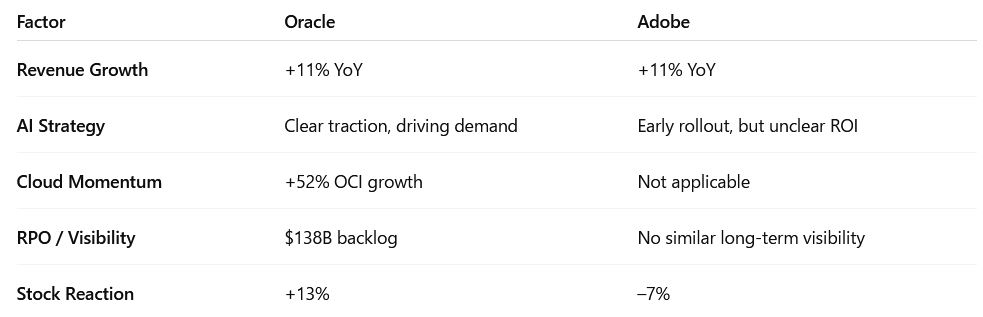
Visual comparison chart of Oracle and Adobe's Q2 FY2025 earnings and AI strategies. The chart contrasts both companies across key metrics: revenue growth (+11% each), AI strategy (Oracle monetizing, Adobe uncertain), cloud momentum (Oracle’s OCI +52%), revenue visibility ($138B RPO for Oracle), and stock reaction (+13% vs. –7%). Highlights Oracle's strong execution versus Adobe’s investor skepticism.

Oracle: AI Execution Drives Confidence and Capital

Oracle’s Q4 FY2025 earnings confirmed the company’s transformation from legacy enterprise vendor to cloud-first AI infrastructure provider. Revenue climbed 11% YoY, while Oracle Cloud Infrastructure (OCI) accelerated an impressive 52%.

What truly stood out was Oracle’s $138 billion in remaining performance obligations (RPO), offering investors forward-looking visibility. With high-profile partnerships (NVIDIA, Cohere) and GenAI workloads already in production, Oracle isn’t pitching an AI future—it’s reporting on AI present.

SWOTstock Takeaway
Oracle’s strength lies in its ability to turn AI demand into revenue now—not years from now.

Key Strengths:

  • Cloud Infrastructure (OCI) grew +52% YoY
  • AI partnerships with NVIDIA and Cohere are already monetizing
  • $138B RPO provides long-term visibility and stability

Risks to Watch:

  • Continued competition from AWS, Microsoft, and Google
  • Legacy on-premise business still weighs on blended growth
Oracle SWOT analysis chart with four quadrants:

    Strengths: Strong OCI momentum, deep enterprise relationships

    Weaknesses: Slow AI service adoption, legacy business drag

    Opportunities: Expanding AI workload footprint, growing infrastructure demand

    Threats: Cloud competition from hyperscalers, changing enterprise IT spending trends

Adobe: Solid Results, But Investors Want AI ROI

Adobe’s Q2 FY2025 results were strong on the surface: 11% revenue growth, earnings beat, and raised guidance. Yet investors responded with skepticism, sending the stock down 7%.

The issue? Despite promoting new AI tools like Firefly, GenStudio, and Acrobat AI, Adobe has yet to show how these innovations will contribute meaningful revenue in the short term. Investor patience is wearing thin.

Meanwhile, competition is heating up. Canva is gaining ground in design, while OpenAI and Google are introducing productivity tools that threaten Adobe’s document business. In this environment, a premium pricing model without clear AI-driven ARR growth becomes difficult to defend.

SWOTstock Takeaway
Adobe’s innovation story is still credible, but without visible monetization, the stock is vulnerable.

Key Strengths:

  • Industry-leading suite across Creative, Document, and Experience Cloud
  • Rapid rollout of AI-powered features

Risks to Watch:

  • No clear monetization path from AI features
  • Growing threats from Canva, OpenAI, and Google
  • Pressure on margins and customer retention
SWOT analysis chart of Adobe featuring the company logo at the center. The four quadrants highlight:

    Strengths: Leading creative software suite, growing AI capabilities

    Weaknesses: High valuation concerns, reliance on Creative Cloud

    Opportunities: Expansion into diverse AI applications, enterprise software potential

    Threats: Economic uncertainty, increasing competition in creative software market

Why the Divergence?

Despite similar top-line growth, the market saw Oracle and Adobe very differently:

Table comparing Oracle and Adobe’s Q2 FY2025 earnings and market reactions. Oracle delivered +11% revenue growth, +52% OCI growth, and a $138B RPO backlog, leading to a +13% stock surge. Adobe also posted +11% revenue growth but lacked visible AI monetization and competitive defense, resulting in a –7% stock drop.

Oracle showed the market what execution looks like. Adobe reminded investors that potential alone is no longer enough.


What to Watch in the Next 6–12 Months

🔮 Oracle Outlook:
Expect continued strength if cloud growth persists and GenAI partnerships scale. RPO offers downside protection in case of macro softness.

⚠️ Adobe Outlook:
Needs to prove that AI tools are driving ARR and enterprise wins. Without that, competitive pressures may accelerate valuation compression.


Final Thoughts: AI Is Entering the Show-Me Phase

This earnings season proves that we’re past the AI hype cycle. The market is now demanding proof—measurable, monetizable traction.

At SWOTstock, we’ll keep tracking this shift as it plays out in earnings calls, product roadmaps, and valuation resets.

👉 Follow us for AI-enhanced stock insights built for growth-minded and DIY value investors.


⚠️ Disclaimer

This analysis is based on publicly available company financials, earnings call commentary, and official press releases as of June 2025. It is intended for informational purposes only and does not constitute investment advice. Always perform your own due diligence.


Leave a comment