Citigroup Q4 2025: Execution Is Improving, But the Valuation Still Depends on Delivery

Citigroup’s Q4 2025 results indicate improvement in core businesses despite profitability challenges due to restructuring costs. While investment banking fees rebounded and net interest income rose, returns on tangible equity remain below targets. The stock, anchored to tangible book value, offers potential upside if management executes consistently, appealing to patient value investors.

TL;DR Summary

Citigroup’s (NYSE: C) Q4 2025 results show real progress in core businesses like Services and Banking, but reported returns are still weighed down by restructuring costs and one-time items. The stock remains anchored to tangible book value, making this a classic execution-driven value story. Upside exists if management delivers on its 10–11% RoTCE target, but patience is required.


Quarter Recap

Citigroup reported Q4 2025 earnings that reflect a bank still in transition. Reported profitability declined year over year due largely to a Russia-related exit charge, but underlying operating trends were more constructive. Revenue held up across key businesses, investment banking activity rebounded sharply, and management emphasized that major geopolitical overhangs are now largely behind the company.


Key Highlights

  • Net income of approximately $2.47 billion, impacted by a sizable one-time Russia exit loss
  • Reported EPS of $1.19, with underlying performance stronger when adjusting for notable items
  • Investment banking fees rose sharply year over year, signaling a recovery in deal activity
  • Net interest income increased year over year, supported by higher average rates
  • CET1 capital ratio of 13.2%, comfortably above regulatory requirements
  • Tangible book value per share of $97.06 provides a clear valuation anchor

SWOT Analysis

Citigroup’s investment case remains centered on whether management can convert improving operating trends into sustainably higher returns on tangible equity. The quarter reinforced both the opportunity and the risks embedded in that thesis.

Strengths

  • Services and institutional businesses continue to scale, improving the quality and durability of earnings (estimated price impact: +4% to +10%)
  • Strong rebound in investment banking fees highlights Citi’s relevance in large, complex transactions (+3% to +8%)
  • Capital strength and ongoing share buybacks provide downside support and optionality (+4% to +9%)
  • Clear tangible book value base gives value investors a concrete reference point (+2% to +6%)

Weaknesses

  • Reported RoTCE remains well below management’s 10–11% target, limiting valuation re-rating (−6% to −12%)
  • Expense growth and a high efficiency ratio continue to pressure near-term profitability (−4% to −10%)
  • Earnings remain vulnerable to one-time items during the restructuring phase (−2% to −6%)

Opportunities

  • Achieving the stated RoTCE target could justify a meaningful re-rating toward tangible book value or above (+8% to +18%)
  • Operating leverage from simplification and productivity initiatives could improve margins over time (+4% to +12%)
  • Excess capital above regulatory requirements supports continued capital return (+3% to +9%)

Threats

  • A turn in the credit cycle could quickly erode earnings and capital flexibility (−6% to −15%)
  • Rate and macro sensitivity remain meaningful, particularly for net interest income (−3% to −10%)
  • Execution risk persists if cost reductions fail to materialize as planned (−5% to −12%)
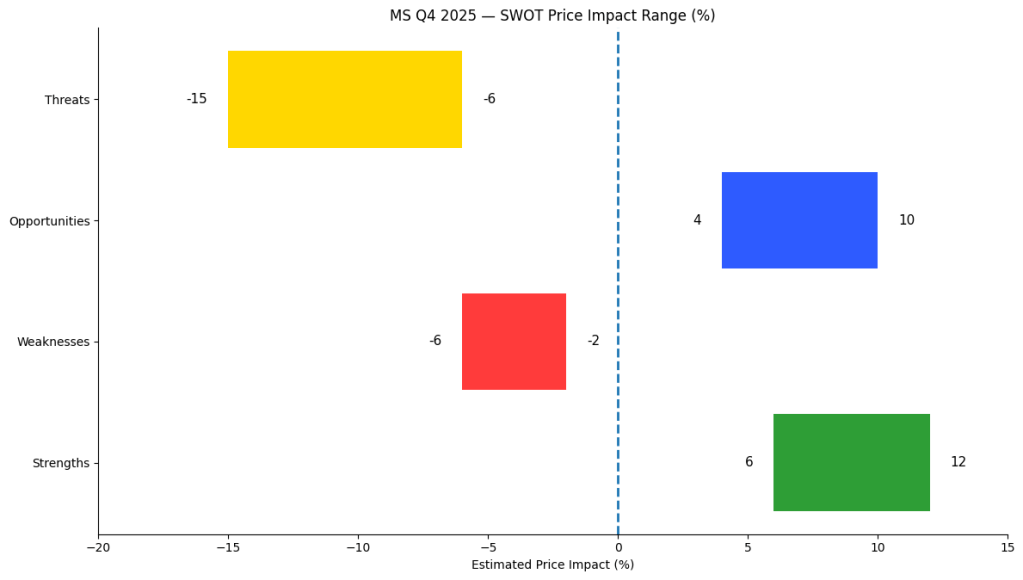
Citigroup Q4 2025 SWOT price impact chart showing estimated percentage upside and downside from strengths, weaknesses, opportunities, and threats for value investors.
Citigroup Q4 2025 SWOT price impact range. Estimated upside and downside drivers based on management commentary and valuation sensitivity around tangible book value.

Valuation Scenarios

For Citi, valuation is best framed using price-to-tangible book value, as returns on tangible equity are the primary driver of long-term multiple expansion. With TBVPS at $97.06, the range of outcomes depends largely on execution.

Bear Case

  • Assumes sub-par returns persist and credit or expense pressures rise
  • Valuation at ~0.8× tangible book
  • Implied value: ~$78

Base Case

  • Assumes steady progress toward management’s RoTCE target without full re-rating
  • Valuation at ~1.0× tangible book
  • Implied value: ~$97

Bull Case

  • Assumes credible delivery of 10–11% RoTCE with visible operating leverage
  • Valuation at ~1.2× tangible book
  • Implied value: ~$116

Probability-weighted fair value: approximately $95

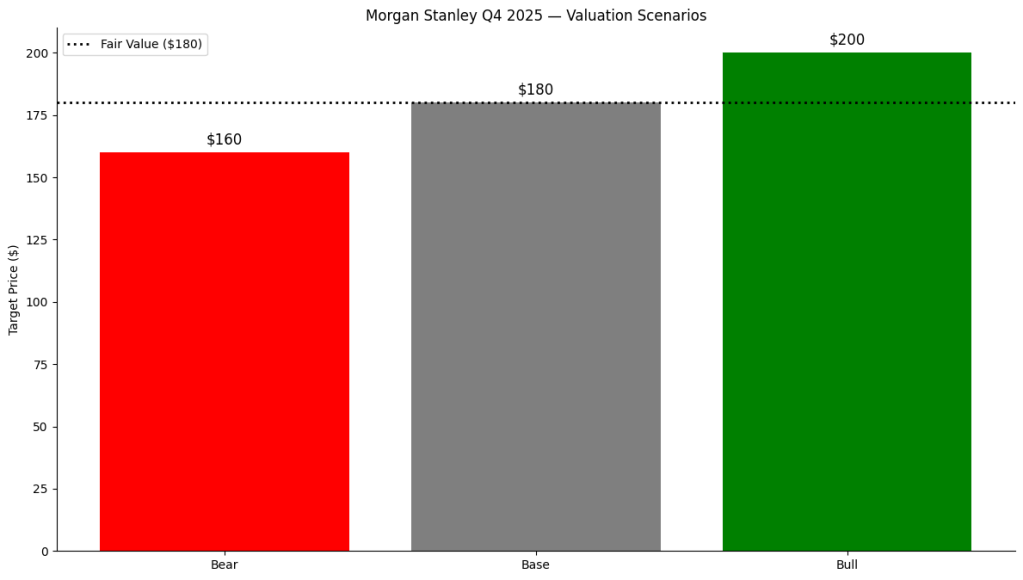
Citigroup Q4 2025 valuation scenarios chart showing bear, base, and bull target prices with a dashed fair value line for value investors.
Citigroup Q4 2025 valuation scenarios. Bear, base, and bull price targets derived from tangible book value multiples and return-on-tangible-equity assumptions, with probability-weighted fair value highlighted.

Verdict

Citigroup remains a value investor’s execution bet. The stock is no longer distressed, but it is not yet priced for success. If management delivers on returns and expense discipline, today’s valuation leaves room for upside. If execution stalls, the stock risks remaining range-bound around tangible book value. For patient investors, Citi offers asymmetry — but not certainty.


Call to Action

If you’re tracking large U.S. banks from a value perspective, follow SWOTstock for earnings-driven breakdowns that focus on fundamentals, valuation discipline, and execution — not hype.


Disclaimer

This article is for informational purposes only and does not constitute investment advice. All analysis is based on publicly available company disclosures and reflects estimates and opinions at the time of writing. Investors should conduct their own research before making investment decisions.


Accenture Q1 FY2026 Earnings: A Wonderful Business, Still Waiting for Growth

Accenture reported strong fiscal Q1 2026 results, exceeding revenue and earnings expectations while managing margins and generating cash. However, growth remains cautious with low-single-digit revenue increases. AI demand is emphasized as crucial for long-term growth, yet short-term challenges persist. The stock is viewed as fairly valued at approximately $270.

TL;DR

Accenture  (ACN:NYSE) delivered another quarter of solid execution, beating expectations on revenue and earnings while maintaining margins and strong cash generation. AI demand continues to build, but management remains cautious on near-term revenue acceleration. At around $270, ACN appears fairly valued, with upside dependent on whether AI-led reinvention can meaningfully lift topline growth.


Quarter Recap

  • Fiscal Q1 2026 revenue came in at the high end of guidance, reflecting resilient enterprise demand despite a cautious macro environment.
  • Adjusted earnings grew faster than revenue, supported by disciplined cost control and modest operating leverage.
  • New bookings remained healthy, including continued momentum in AI-related transformation programs.
  • Management reiterated a cautious full-year outlook, emphasizing execution and long-term positioning rather than near-term acceleration.

Key Highlights

  • Revenue growth remained in the low- to mid-single-digit range, consistent with guidance.
  • Adjusted operating margins expanded modestly year over year.
  • Free cash flow supported ongoing dividends and share repurchases.
  • AI was framed as a core component of multi-year reinvention programs, not a standalone growth spike.
  • U.S. federal-related work continued to weigh on near-term growth visibility.

SWOT Analysis

Accenture’s investment profile reflects a balance between durable execution strength and a growth trajectory that remains steady rather than accelerating. The ranges below translate qualitative factors into estimated stock price impact.

Strengths

  • Deep enterprise relationships and recurring transformation demand (+8% to +12%)
  • AI embedded into large-scale reinvention programs, supporting long-term monetization (+6% to +10%)
  • Strong cash flow, balance sheet discipline, and shareholder returns (+4% to +6%)

Strengths — overall impact: +18% to +28%


Weaknesses

  • Low-single-digit organic revenue growth profile (–6% to –10%)
  • Continued softness in U.S. federal business (–4% to –7%)
  • Premium valuation leaves limited margin for disappointment (–5% to –8%)

Weaknesses — overall impact: –15% to –25%


Opportunities

  • Scaling AI-led reinvention programs across global enterprises (+10% to +18%)
  • Operating leverage if demand gradually normalizes (+6% to +10%)
  • Leadership role as an enterprise AI orchestrator across platforms and models (+5% to +8%)

Opportunities — overall impact: +21% to +36%


Threats

  • Prolonged enterprise budget caution delaying large transformation decisions (–10% to –15%)
  • Investor narrative around AI commoditization compressing consulting multiples (–8% to –12%)
  • Competitive pricing pressure from smaller firms and in-house teams (–5% to –8%)

Threats — overall impact: –23% to –35%

Accenture Q1 FY2026 SWOT price impact chart showing estimated stock impact ranges: strengths +18% to +28%, weaknesses −15% to −25%, opportunities +21% to +36%, and threats −23% to −35%, with a dashed zero reference line.

Valuation Scenarios

Accenture’s valuation outcome hinges less on margin execution—which remains strong—and more on whether AI-driven reinvention can re-accelerate revenue growth.

Using $270 as the current price anchor:

Bear Case

  • Revenue growth remains around 2–3%
  • Federal weakness persists and AI monetization is slower than expected
  • Valuation multiple compresses toward the lower end of historical ranges
  • Implied price: ~$209 (–22.5%)

Base Case

  • Revenue growth stabilizes around 4–5%
  • AI bookings convert gradually into revenue
  • Margins expand modestly, supporting high-single-digit EPS growth
  • Implied price: ~$290 (+7.5%)

Bull Case

  • AI-led reinvention drives sustained revenue acceleration above 6%
  • Enterprise spending cycle improves
  • Operating leverage supports double-digit EPS growth with modest multiple expansion
  • Implied price: ~$351 (+30%)

Fair Value Assessment

Applying a probability-weighted approach:

  • Bear: 25%
  • Base: 50%
  • Bull: 25%

This results in a probability-weighted fair value of approximately $285, or about 5–6% upside from current levels.

Accenture valuation scenarios chart based on Q1 FY2026 earnings, showing bear case price target of $209, base case $290, bull case $351, and a probability-weighted fair value of $285.

Verdict

Accenture remains a high-quality compounder with durable client relationships, strong execution, and disciplined capital returns. At around $270, the stock looks fairly valued rather than cheap. Downside is cushioned by cash flow and margins, but meaningful upside will require clearer evidence that AI-led reinvention can translate into sustained topline acceleration.


Call to Action

If you’re tracking enterprise AI adoption beyond the hype, follow SWOTstock for earnings-driven analysis that focuses on what actually moves stock prices.


Disclaimer

This article is for informational purposes only and does not constitute investment advice. All analysis is based on publicly available, official company disclosures and earnings call commentary. Investors should conduct their own research or consult a financial professional before making investment decisions.

Adobe Q4 FY2025 — AI Adoption Strengthens, ARR Hits New Highs, and The Stock Barely Moves

Adobe reported a solid Q4 FY2025, with revenue rising 10% YoY to $6.19 billion and surpassing $25 billion in ARR. Despite strong financials, the stock slipped 0.8% post-results, reflecting high investor expectations around AI monetization. The company remains a robust subscription model with a fair value around $520 per share.

TL;DR Summary

Adobe (NASDQ: ADBE) closed FY2025 with another strong quarter: revenue rose 10% YoY to $6.19B, ARR surpassed $25B, and AI features across Creative Cloud and Document Cloud continued driving higher engagement. Yet the stock slipped just –0.8% after hours, reflecting investor expectations for stronger AI monetization and cautious sentiment around the $1.9B Semrush acquisition. Adobe remains a premium-quality subscription business, and our fair value stands at $520, supported by durable ARR growth, strong free cash flow, and early—but accelerating—AI upside.


Quarter Recap

Adobe reported its Q4 FY2025 results on December 11, highlighting a company that continues to compound ARR while transitioning deeper into AI-enhanced creative and productivity workflows. Revenue grew 10% YoY to $6.19B, beating expectations, and non-GAAP EPS came in at $5.50. Digital Media ARR and Document Cloud momentum remained strong, and Experience Cloud delivered stable growth ahead of planned integration with Semrush. Free cash flow reached $3.16B for the quarter and over $10B for the full year.

Despite the strong numbers, Adobe’s share price slipped approximately 0.8% after hours. This muted reaction was driven by high expectations, the need for clearer AI monetization signals, and continued caution around software multiples during a volatile macro backdrop.


Key Highlights

  • Revenue of $6.19B, up ~10% YoY; above consensus.
  • Non-GAAP EPS of $5.50; exceeded analyst expectations.
  • Digital Media and Document Cloud ARR both saw solid double-digit growth.
  • Free cash flow reached $10B+ for FY25 — reinforcing balance sheet strength.
  • AI adoption continued accelerating across Creative Cloud and Acrobat.
  • Announced $1.9B acquisition of Semrush to deepen Experience Cloud capabilities.
  • FY2026 guidance targets ~10%+ ARR growth, with expanding AI-driven workflows.

SWOT Analysis

Adobe enters FY2026 with solid momentum, supported by durable ARR, growing AI adoption, and strong cash generation. Still, the market remains cautious as it weighs valuation, competition, and the pace of AI monetization. Below is a clear, investor-ready SWOT with quantitative price impacts.

Strengths (+6% to +12%)

  • Record ARR growth across Creative Cloud, Document Cloud, and Experience Cloud reinforces subscription durability.
  • AI tools such as Firefly and Acrobat AI Assistant deepen product engagement and increase switching costs.
  • Robust free cash flow provides flexibility for buybacks and acquisitions.
  • Consistent revenue and EPS beats reflect disciplined execution.

Weaknesses (–3% to –7%)

  • Premium valuation multiples make the stock sensitive to any growth deceleration.
  • AI monetization still lacks explicit revenue attribution, creating uncertainty.
  • Experience Cloud faces rising competition in enterprise marketing and analytics.
  • Muted stock reaction shows investor expectations were already high.

Opportunities (+8% to +15%)

  • Monetization of Firefly and enterprise AI workflows can drive incremental ARR.
  • Acrobat AI Assistant is positioned to become a major enterprise productivity catalyst.
  • Semrush integration offers new cross-sell and retention opportunities in Experience Cloud.
  • AI-driven automation may support future price increases and margin expansion.

Threats (–10% to –18%)

  • Competitive pressure from Canva, Figma, and emerging AI-native design tools.
  • Slowing enterprise budgets could affect Experience Cloud bookings.
  • Regulatory scrutiny around AI training and creative rights could create material risk.
  • If AI momentum does not translate into revenue, valuation multiples may compress.
SWOT price impact range chart for Adobe Q4 FY2025 showing strengths, weaknesses, opportunities, and threats with estimated stock price impact from –25% to +25%.

Valuation Scenarios

Adobe’s valuation hinges on ARR durability, AI monetization success, and execution in Experience Cloud. Here are the scenario-based outcomes and how each target is derived.

Bear Case — $455 (25% probability)

  • ARR growth slows below 10%.
  • AI engagement does not translate into meaningful pricing expansion.
  • Experience Cloud bookings lag amid cautious enterprise spending.
  • EPS multiple contracts toward ~18× forward earnings.

Base Case — $525 (50% probability)

  • ARR grows ~10%+ inline with FY26 guidance.
  • AI features deliver moderate, steady uplift to engagement and retention.
  • Semrush integration supports Experience Cloud without margin drag.
  • EPS multiple stabilizes around ~20–22×.

Bull Case — $580 (25% probability)

  • Firefly, Acrobat AI Assistant, and enterprise workflows accelerate AI monetization.
  • Creative Cloud pricing power increases with minimal churn.
  • Semrush drives stronger-than-expected Experience Cloud expansion.
  • EPS multiple expands toward ~24–25×.

Probability-Weighted Fair Value

= (0.25 × 455) + (0.50 × 525) + (0.25 × 580)

~$520 per share

Valuation scenarios chart for Adobe Q4 FY2025 showing bear, base, and bull price targets with probability weights and a dashed fair value line at $520.

Verdict

Adobe’s Q4 results reaffirm the strength of its subscription engine and show that AI adoption is meaningfully increasing engagement. Yet investors are demanding clearer proof of monetization before rewarding the stock with higher multiples. For Type 1 tech-savvy growth investors, Adobe remains a high-quality compounder with manageable execution risk, strong cash flow, and emerging AI tailwinds. At around $520 fair value, the stock appears reasonably priced relative to forward fundamentals.


Call to Action

If you want deeper earnings-season insights, follow SWOTstock for clear, fact-based analysis built directly from official reports and transcripts. No noise, no hype — just the truths that matter for long-term investors.


Disclaimer

This analysis is for informational purposes only and is not financial advice. All conclusions are based solely on Adobe’s official filings and earnings call commentary.