🧠 Adobe Q2 FY2025: AI Gains Momentum, But Wall Street Lags Behind

Adobe reported strong Q2 FY2025 results with $5.87 billion in revenue and raised its full-year guidance, driven by accelerating AI adoption. Despite this, the stock fell slightly, possibly due to unmet investor expectations for detailed AI revenue. Analysts see potential upside, making it an attractive long-term investment opportunity.

🚨 TL;DR — The Market Isn’t Rewarding This Beat (Yet)

Adobe (NASDAQ: ADBE) delivered double-digit growth, accelerating AI adoption, and raised full-year guidance. Yet the market response was muted. With fundamentals clearly improving and AI monetization tracking ahead of schedule, this gap presents an opportunity for long-term investors.


📆 A Strong Quarter Powered by AI and Recurring Revenue

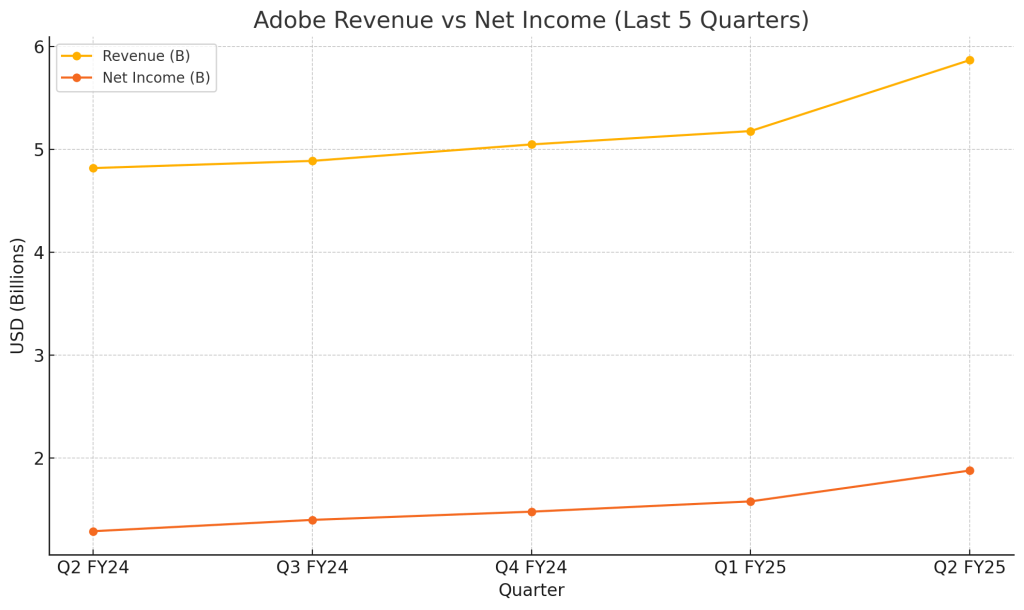
Adobe posted another record quarter with $5.87 billion in revenue (up 11% YoY) and $5.06 in non-GAAP EPS (up 13%). Management raised full-year revenue and EPS guidance, reflecting confidence in the AI product suite and its impact on customer value.

Line chart showing Adobe’s revenue and net income trends over the past five quarters, highlighting Q2 FY2025 record performance.

✨ Q2 FY2025 Highlights at a Glance

  • Revenue: $5.87B (+11% YoY)
  • Non-GAAP EPS: $5.06 (+13%)
  • Operating Income: $2.67B (non-GAAP)
  • Digital Media ARR: $18.09B (+12.1%)
  • Business Pros & Consumers: $1.6B revenue (+15%)
  • MAUs: 700M+ across Acrobat & Express (+25%)
  • AI monetization on track to surpass $250M ARR
  • Operating Cash Flow: $2.19B
  • Shares Repurchased: 8.6M
  • FY2025 Guidance Raised: Revenue to $23.5–23.6B; EPS to $20.50–$20.70

🚀 What’s Driving Growth: Firefly, Acrobat AI, GenStudio

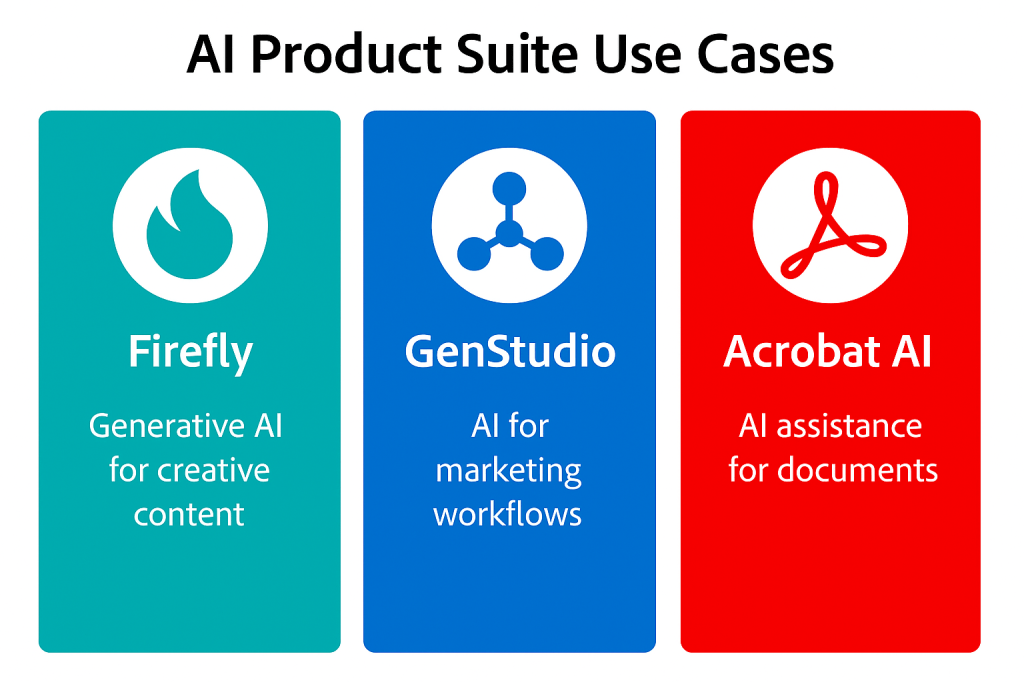
CEO Shantanu Narayen confirmed that Firefly, Acrobat AI Assistant, and GenStudio are central to Adobe’s AI push. Adoption of these tools is growing across both creative pros and new user groups, such as business professionals and educators. While Adobe doesn’t break out revenue by product, they reiterated that AI-driven ARR is already contributing “billions” and tracking ahead of plan.


📉 Why the Stock Fell Despite the Beat

Adobe’s stock dipped around 1% in after-hours trading — a familiar pattern for growth names with high expectations. Although Adobe raised guidance and showed real AI traction, investors may have been hoping for more granular AI revenue breakdowns or a clearer timeline for when this monetization becomes a larger part of total ARR.

Additionally, macro uncertainty and the strong YTD performance likely triggered some profit-taking. But CFO Dan Durn also noted that demand rebounded in Q2, a sign that macro pressures may be easing.


🧩 SWOT Analysis: What’s Driving the Price Range?

Adobe’s own financial data and management commentary give us a clear view of its strengths and risks. Among the positives: accelerating AI monetization, strong margins, a growing base of non-creative users, and consistent free cash flow. These fundamentals could justify a price range of $455 to $475 — representing 10–15% upside.

On the flip side, investors may be disappointed by the lack of specific AI revenue detail. Combined with cautious buyback disclosures, these introduce a near-term downside risk of 3–5%. Macroeconomic pressure or poor execution on AI could also push the stock toward the $385–$390 level.

Horizontal bar chart visualizing Adobe’s SWOT analysis with estimated stock price impact ranges for Strengths, Weaknesses, Opportunities, and Threats.

📊 SWOT Summary Table

Table summarizing Adobe’s Q2 FY2025 SWOT analysis with estimated stock price impact ranges for strengths, weaknesses, opportunities, and threats.

🔮 What’s Adobe Worth? Valuing the Stock Based on Official Guidance

Using Adobe’s internal EPS guidance and valuation history, we mapped out three scenarios:

  • Bull Case: AI monetization exceeds expectations and Adobe reclaims a premium P/E multiple (30×).
    → $20.70 EPS × 30 = $621
  • Base Case: Adobe delivers its guidance and trades at 24×, slightly below its historical average.
    → $20.60 × 24 = $494
  • Bear Case: AI monetization stalls and valuation contracts to 19×.
    → $20.50 × 19 = $389
Bar chart comparing Adobe’s bear, base, and bull case valuation targets with a dashed line indicating the current share price and a dotted line for fair value.

Weighting these scenarios (20% bull, 60% base, 20% bear), our fair value estimate is $498.40 — roughly 20% above the current price of $413.


🏁 Our Take: Mispricing Creates Opportunity

Adobe’s raised guidance, strong recurring revenue growth, and accelerating AI adoption all point to a business gaining momentum. Even more compelling: our fair value estimate of $498 closely mirrors the average analyst target of ~$497, reinforcing the case for upside.

Management noted that demand improved sequentially in Q2, a sign that macro headwinds may be easing. While competition in generative AI is heating up across creative tools, Adobe is positioning itself well by embedding AI across its full product suite.

For long-term investors with a focus on high-quality, cash-generative, AI-leveraged software businesses, the post-earnings dip appears to be a gift.


💬 Like This Analysis? Get More on SWOTstock

At SWOTstock, we distill earnings calls, official filings, and executive strategy into investor-ready breakdowns — backed by data and free from noise. Please subscribe to stay on top.


⚠️ Disclaimer

This post is based entirely on Adobe’s official financial statements and earnings call from Q2 FY2025. It is not financial advice.


Leave a comment


🧠 Oracle Q4 FY2025: Cloud Growth Surges, But Is the AI Premium Fully Priced In?

Oracle’s Q4 FY2025 earnings revealed explosive cloud growth and bold AI infrastructure plans. Our analysis breaks down the market reaction, SWOT insights, and valuation scenarios for tech-savvy investors. Is $190 justified — or overextended?

💡 TL;DR – Oracle’s AI Engine is Revving, But Is the Price Already Peaked?

Oracle (NYSE: ORCL) delivered a blockbuster Q4 with cloud revenue up 27% and Infrastructure-as-a-Service (OCI) growing 52%. Management forecasts even stronger acceleration in FY2026 — with 70%+ OCI growth and a $25 billion capex plan focused on GenAI. Investors loved it, bidding up the stock nearly 8% after hours. But with Oracle now trading around $190, the key question is whether the AI-fueled upside is already fully priced in.


📅 Oracle’s Cloud Pivot Is Real — and It’s Speeding Up

Oracle’s fiscal Q4 FY2025 results (for the quarter ending May 31) showcased a company in transition — and perhaps finally hitting escape velocity from its legacy roots. Total revenue rose 11% YoY to $15.9 billion, fueled by explosive growth in cloud services. Cloud now accounts for over 42% of Oracle’s total revenue base, with the Infrastructure business leading the charge.

Cloud Infrastructure (OCI) revenue surged 52% year-over-year to $3.0 billion. While that slightly missed some analyst whisper numbers, it still handily beat consensus and helped the company deliver a non-GAAP EPS of $1.70. More importantly, management struck an unusually aggressive tone for FY2026, projecting OCI growth of over 70% and overall cloud growth north of 40%.

Investors immediately rewarded the shift in tone — and trajectory. Oracle shares surged from $176.50 to nearly $190 in after-hours trading, reflecting a vote of confidence in the company’s AI roadmap.


🌟 Key Highlights from the Call

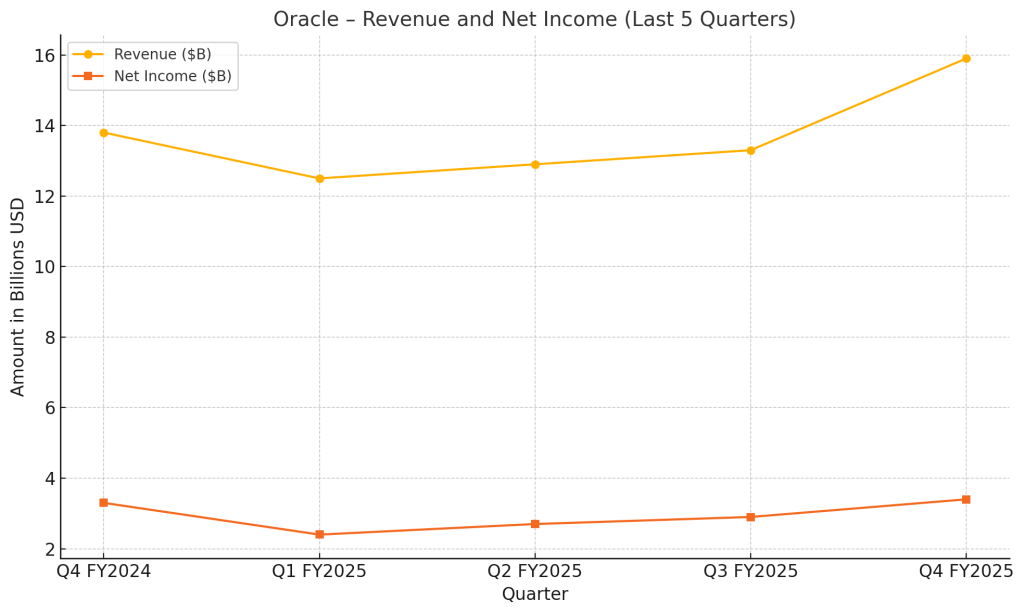
Line chart showing Oracle's revenue and net income over the past five quarters, highlighting a strong Q4 FY2025 performance with revenue reaching $15.9B and net income at $3.4B.
  • Cloud Infrastructure (OCI) revenue grew 52%, and management expects >70% in FY2026.
  • Multicloud partnerships (AWS, Azure, Google) driving 115% YoY database growth.
  • AI infrastructure: NVIDIA GPU clusters fully sold out; Oracle now trains large LLMs.
  • Operating cash flow for the year was $20.8B (+12% YoY).
  • Legacy business drag continues, with hardware down 6% and license support up just 3%.

🔍 What Oracle’s Execs Just Told Us (and Why It Matters)

CEO Safra Catz called FY2025 a “very good year,” but made clear the company sees FY2026 as an inflection point. That’s not just talk — Oracle is backing its vision with capital, planning to invest $25 billion into AI-focused infrastructure, including NVIDIA GPU clusters and new datacenters.

Larry Ellison emphasized that Oracle now trains large-scale language models on OCI superclusters and highlighted that OCI’s AI capacity is already fully sold out. He also touted 115% year-over-year growth in multi-cloud database revenue from hyperscaler partners like Microsoft, Google, and AWS. That stat alone turns heads — and signals that Oracle is more than just a slow-moving enterprise giant.

At the same time, Oracle’s legacy businesses continue to lag. Hardware revenue was down 6%, and traditional license support only grew 3%. But it’s clear where the company’s energy — and investor attention — is going.


🧠 Oracle’s AI Trajectory: What Could Go Right (or Very Wrong)

Bar chart showing Oracle’s SWOT analysis for Q4 FY2025 with estimated share price impact ranges: Strengths (+15 to +30) in green, Weaknesses (–10 to –5) in red, Opportunities (+10 to +25) in blue, and Threats (–20 to –10) in yellow, labeled at both ends of each bar.

✅ Strengths (+15 to +30 USD/share)

Oracle’s biggest asset right now is momentum. The company isn’t just talking about AI infrastructure — it’s actively deploying it. With OCI consumption revenue up 62% and GPU demand outpacing supply, the company’s pivot into AI cloud infrastructure is both real and scalable. If Oracle delivers on its >70% growth target, investors could reward it with a premium multiple, adding as much as $30/share in upside.

❌ Weaknesses (–5 to –10 USD/share)

Still, legacy Oracle hasn’t disappeared. Low-growth segments like license support and hardware continue to weigh on consolidated performance. Margins remain under pressure, and part of the recent EPS growth came from share buybacks and tax adjustments, not pure operating leverage.

🌱 Opportunities (+10 to +25 USD/share)

Oracle’s MultiCloud strategy — deploying services across AWS, Azure, and Google Cloud — is opening new frontiers. Government workloads, healthcare, and sovereign cloud deployments are becoming high-growth areas. This isn’t just a defensive move; it’s Oracle expanding its addressable market at precisely the right time.

⚠️ Threats (–10 to –20 USD/share)

Of course, scaling infrastructure this aggressively brings risk. The company is committing $25 billion in capex, and any delay in deployment, cost overruns, or demand shortfall could damage margins. On top of that, the competitive threat from hyperscalers like AWS and Microsoft remains fierce.


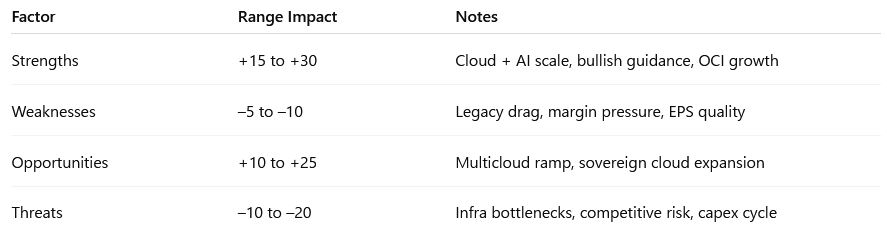
📊 SWOT Summary Table

Table summarizing Oracle’s Q4 FY2025 SWOT analysis with estimated share price impacts: Strengths (+15 to +30 USD) driven by cloud and AI growth; Weaknesses (–5 to –10 USD) from legacy drag and margin pressure; Opportunities (+10 to +25 USD) from multicloud and sovereign cloud expansion; Threats (–10 to –20 USD) from execution risks and competition.

💰 Oracle’s Future by the Numbers — How Far Can It Run?

To evaluate Oracle’s investment case, we modeled three potential futures based entirely on official guidance and internal execution assumptions.

Bar chart showing Oracle’s Q4 FY2025 valuation scenarios: Bear Case at $160 (red), Base Case at $185 (gray), Bull Case at $210 (green), and Current Price at $190 (black), with a dotted blue line indicating the fair value of $187.50.

Bull Case – $210 (25%)

In the bull case, Oracle delivers on everything. GPU constraints ease, datacenters ramp up smoothly, and OCI’s explosive growth becomes the new norm. FY2026 EPS could reach $8.40, and if the market assigns a 25x multiple, we get a $210/share valuation. That would reflect Oracle’s full transformation into an enterprise AI infrastructure leader. We assign a 25% probability to this outcome.

Base Case – $185 (60%)

The base case, our most likely scenario (60%), assumes that execution remains strong, but not flawless. Some datacenter bottlenecks persist, but cloud revenues grow consistently. EPS lands around $7.40, which supports a $185/share valuation under a stable 25x multiple. This scenario reflects healthy, disciplined growth and is likely already reflected in current investor expectations.

Bear Case – $160 (15%)

In the bear case, execution lags. Capex pressures margins, and OCI growth slows to below expectations. If EPS only reaches $6.40, and multiples remain steady, we get a $160/share valuation. We think the chance of this outcome is about 15%.

Taken together, these scenarios point to a weighted fair value of $187.50/share, which is just about where Oracle is trading after earning released.

🎯 Weighted Fair Value Calculation

(0.25×210)+(0.60×185)+(0.15×160)=52.5+111+24=187.5

📌 Estimated Fair Value = $187.50/share


🎯 Should You Buy Oracle Now — or Wait for the Dip?

There’s no question Oracle is no longer the conservative enterprise holdout it once was. Its Q4 results and aggressive AI roadmap show that it’s pushing hard to become a core infrastructure layer for the AI economy. If you believe in that future, it may still have room to run — but likely at a steadier pace than the post-earnings rally suggests.

With the stock already trading near our fair value estimate, we think the best move now depends on your position. If you’re a long-term holder, this quarter reinforced your thesis. But if you’re still on the sidelines, a pullback toward $175 may offer a better risk-adjusted entry.


📣 Call to Action

Looking for clear, data-driven earnings insights that cut through the noise?
🟢 Subscribe to SWOTstock for no-hype analysis that follows the money, not the buzzwords.


⚠️ Disclaimer

This article is for informational purposes only and does not constitute financial advice. All data and commentary are based solely on Oracle’s official Q4 FY2025 earnings release and management statements.


Leave a comment


Why Goldman Is Backing Baidu: AI Cloud Momentum Meets Policy Tailwinds

Baidu is experiencing substantial growth in its AI cloud services, with a 42% increase despite a 6% decline in advertising revenue, leading to decreased earnings. Goldman Sachs maintains a Buy rating, citing strategic investments. However, risks include U.S. chip restrictions and regulatory changes. Baidu’s valuation suggests potential upside if AI monetization improves.

TL;DR: Baidu’s AI Cloud Is Booming, But Ad Weakness Lingers

Goldman Sachs reaffirmed its Buy rating on Baidu despite trimming its price target. Beneath the drag of declining ad revenue lies a fast-growing AI cloud engine and deep integration into China’s AI strategy. In Q1 2025, Baidu’s cloud grew over 40%, outpacing peers like Alibaba and Tencent. While earnings dipped, strategic investments in ERNIE AI and Apollo Go are gaining traction. At ~$84, Baidu trades at a 20–25% discount to its estimated fair value.

Clean infographic summarizing Baidu’s Q1 2025: +42% AI Cloud growth, –6% ad revenue decline, investments in Ernie AI and Apollo Go, and a 20–25% valuation discount, with no footer text.

Quick Risk Snapshot

Top 3 Risks at a Glance

  • Export Controls: U.S. chip curbs may limit Baidu’s model training capabilities
  • Regulatory Crackdown: Surprise data or AI rules in China could cut valuations overnight
  • Monetization Gap: ERNIE is technically impressive—but where’s the revenue?

Q1 2025 Recap: AI is Surging, but Ads Still Weigh on Profitability

Baidu delivered a mixed but forward-looking quarter. Revenue rose 3% YoY to ¥32.45 billion, beating expectations, driven by a 42% jump in AI Cloud services. However, its core advertising revenue declined 6%, pulling EPS down by 7%.

Management emphasized that Baidu is no longer just an ad business. CFO Junjie He called AI Cloud a “structural growth engine,” with new pricing strategies designed to build market share quickly.

Why it matters: This quarter signals that Baidu is chasing scale and infrastructure leadership—not just short-term margins.

Bar chart comparing Baidu’s Q1 2025 segment revenue: AI Cloud at ¥9.4B and Ad Revenue at ¥16.0B, highlighting the company’s growing cloud business versus its declining ad segment.

Key Highlights

  • Revenue: ¥32.45B (+3% YoY)
  • Adjusted EPS: ¥18.54 (–7% YoY)
  • AI Cloud: ¥9.4B (+42% YoY)
  • Ad Revenue: ¥16.0B (–6%)
  • ERNIE AI: Free-tier and Turbo upgrades launched
  • Apollo Go: Overseas ops launched in UAE and Switzerland
  • Buybacks: $445M in Q1; $2.1B total
  • Ratings: Goldman, Benchmark maintain Buy
Line chart comparing Baidu’s revenue and net income over the last five quarters (Q1 2024 to Q1 2025), showing consistent revenue near ¥32–34B and rising net income peaking at ¥7.72B in Q1 2025.

SWOT Analysis: A High-Potential Pivot With Limited Room for Error

Let’s break it down using the SWOT framework—what’s working, what’s not, where upside lies, and what could derail the story.

Strengths

  • AI Cloud Outperformance: 42% growth beats Alibaba (+18%) and Tencent (+5%)—suggests Baidu’s architecture is gaining real-world adoption.
  • ERNIE Model Pipeline: Free, open-access models with advanced reasoning (X1) and multimodal capability (4.5) aim to build developer lock-in.
  • Backed by Big Names: Goldman and Benchmark keeping Buy ratings provides institutional cover.

+ Price Impact: +$15 to +30

Weaknesses

  • Ad Revenue Shrinkage: 6% drop in core advertising weakens cash flow reliability.
  • Earnings Pressure: Margin compression from free tools, price cuts, and rising AI compute costs.
  • Transparency: Baidu’s upbeat tone feels disconnected from profitability trends—investors may question reporting quality.

– Price Impact: –$10 to –20

Opportunities

  • China AI Policy Tailwinds: Backed by a ¥60B national AI fund, Baidu is well-positioned as a state-aligned infrastructure play.
  • Apollo Go Global: Early mover in robotaxis beyond China borders—may attract sovereign or enterprise partnerships.
  • AI Monetization Path: If Baidu can convert ERNIE from R&D to revenue via enterprise tools or cloud inference APIs, re-rating likely.

+ Price Impact: +$10 to +25

Threats

  • Tech Export Curbs: U.S. chip bans on Nvidia/AMD AI hardware limit model training capacity.
  • Rising Domestic Competition: Alibaba’s Tongyi Qianwen and Tencent’s Hunyuan are growing fast with commercial APIs.
  • Delisting/Regulatory Risk: ADR structure, CCP data controls, or surprise regulation could drastically change valuation environment.
  • Currency Volatility: RMB depreciation adds an FX layer to Baidu’s dollar-denominated shares.

– Price Impact: –$15 to –30

Factor Range Impact Notes
Strengths +15 to +30 Cloud & ERNIE momentum
Weaknesses –10 to –20 Ad reliance, earnings fade
Opportunities +10 to +25 Policy & mobility tailwinds
Threats –15 to –30 Geopolitical and regulatory

Implied Range: $69 – $114 vs current price ~$84

Horizontal SWOT chart showing Baidu’s Q1 2025 stock price impact estimates, with fixed x-axis from –40 to +40: Threats (–30 to –15), Opportunities (+10 to +25), Weaknesses (–20 to –10), Strengths (+15 to +30), and a vertical dashed baseline at $0.

Valuation Scenarios: How It Could Play Out

Valuation = EPS forward ​× P/E

Base Case – 7.00 × 15 = $105

Cloud keeps scaling, ads stabilize
Probability: 60%

Bull Case – 7.75 × 18 = $140

Enterprise AI lands, Apollo Go JV, margin gains
Probability: 25%

Bear Case – 5.00 × 15 = $75

AI stalls, chip blocks hit hard, new China policy drop
Probability: 15%

Weighted Average Estimate: $106.25 → +26% upside

(105×0.6)+(140×0.25)+(75×0.15)=106.25

Chart comparing Baidu’s Q1 2025 valuation scenarios: Bear Case ($75), Base Case ($105), Bull Case ($140), alongside current price ($84) and a dotted fair value line at $106.25.

Verdict: Cautiously Optimistic, AI-Led Rerating Is Possible

Baidu’s execution is improving, even as its earnings lag. AI Cloud is clearly working. ERNIE shows potential. Apollo Go is going international. Still, transparency, monetization, and policy remain wildcards.

If you believe China is serious about tech independence, Baidu is its AI bet. The risk/reward is no longer binary—but still asymmetric.

Our Take: Slightly undervalued. Buy/accumulate with a long-term AI view.


What Would Change Our View?

Upside Triggers

  • AI monetization evidence (cloud APIs, enterprise adoption)
  • Positive shift in U.S.-China chip policy
  • Robotaxi revenue in H2

Downside Red Flags

  • Surprise AI regulation in China
  • Margin compression without revenue pickup
  • Negative audit news or delisting pressure

Call to Action

Want more AI-powered investment breakdowns—without the hype? Follow @SWOTstock and get the next big move before the headlines hit.


Disclaimer

This post is based solely on Baidu’s official financial report, earnings call, and verified analyst commentary. It is not investment advice. Please do your own research.


Leave a comment