
AI Revenue Is Appearing. But Does It Justify the Data-Center Boom?

The debate on AI’s economic viability focuses on its rapid adoption across industries versus its ability to generate sufficient revenue. While monday.com shows promise with increased AI revenue, questions about profitability and gross margins remain. The industry’s future hinges on proving that AI can deliver sustainable financial returns to justify heavy infrastructure investments.

The central economic question surrounding artificial intelligence is no longer whether people will use it.

Usage is growing rapidly across design, marketing, customer support, software development and enterprise workflows. That usage is already translating into demand for GPUs, cloud capacity, electricity and new data centers.

The unresolved question is whether the applications consuming all that infrastructure can make enough money from AI to pay for it.

Recent results from Figma and HubSpot illustrated the concern. Both companies reported substantial AI adoption, but neither provided enough evidence to show that AI usage was producing proportional incremental revenue.

monday.com has now supplied a more encouraging data point. Its AI-product annual recurring revenue doubled sequentially and represented 17% of net-new ARR during the second quarter. Customers are also exhausting their included AI-credit allowances and purchasing additional credits.

That is genuine monetization.

But it does not resolve the economic question. monday.com did not disclose the absolute amount of AI revenue, the growth in AI consumption or the gross margin earned on that revenue.

The evidence is moving from “AI usage without visible revenue” toward “AI revenue without proven profitability.”

For the application-software industry—and ultimately for the massive data-center investment cycle—that distinction matters.

Infrastructure demand arrived before application economics

The AI investment cycle developed in an unusual order.

Normally, profitable applications create demand for the infrastructure needed to support them. With generative AI, infrastructure was built first, based largely on expectations of future demand.

Hyperscalers ordered GPUs, expanded cloud regions and committed billions of dollars to new data centers before most enterprise applications had established durable pricing models.

That sequence was understandable. Compute capacity was scarce, model development was accelerating and no major technology company wanted to risk falling behind.

But the infrastructure ultimately requires an economic buyer.

An AI application must create enough value for customers to pay for it. The resulting revenue must then cover inference, hosting, product development, sales and support. Only after those costs can the application generate an attractive return.

The economic chain therefore looks like this:

Customer productivity must create willingness to pay.

Willingness to pay must become recurring application revenue.

Application revenue must exceed AI delivery and development costs.

Application profitability must sustain demand for cloud and data-center capacity.

AI usage alone completes none of those steps.

What Figma and HubSpot showed

Figma and HubSpot demonstrated that AI can spread quickly when it is embedded within an existing application.

Figma reported that more than 80% of its larger customers were using AI credits weekly. HubSpot said more than 55% of its Professional and Enterprise customers had adopted its Breeze AI capabilities, while agentic actions had more than tripled.

Those are impressive adoption figures. However, the companies did not clearly separate paid AI usage from credits, trials and capabilities included within existing subscriptions.

The financial results also demonstrated why the distinction matters.

Figma’s second-quarter revenue grew 48% to $370.1 million, but its free-cash-flow margin declined from 24% to 14%. HubSpot increased revenue by approximately 20% to $911.7 million and expanded its operating margin, but its non-GAAP gross margin declined by 1.5 percentage points.

Neither result proved that AI caused the margin changes. Other investments, product-mix effects and timing factors were involved.

But they exposed an analytical blind spot: companies were providing increasingly precise information about AI adoption while offering very little information about AI revenue and unit economics.

The market could see the usage. It could not see the profit.

Figma’s official Q2 2026 results

HubSpot’s official Q2 2026 investor presentation

monday.com provides a more encouraging answer

monday.com’s results differ in one important respect: the company provided direct evidence that customers are spending more because of AI.

AI-product ARR doubled sequentially and generated 17% of the net-new ARR added during the quarter.

More importantly, management said customers are reaching the limits of their included AI-consumption allowances and purchasing additional credits. Customers are not simply experimenting with a feature included in their subscription. Some are consuming enough AI to make an incremental purchasing decision.

The company’s seats-plus-credits structure gives it two revenue engines:

Human workers generate seat revenue.

AI workers generate consumption revenue.

Before introducing consumption pricing, monday.com generally needed customers to add employees or deploy the software to more users to expand an account. AI credits potentially allow customer spending to grow even if human headcount remains unchanged—or declines.

This is particularly relevant because one of AI’s proposed benefits is that companies can accomplish more work with fewer employees. Traditional per-seat software pricing becomes vulnerable if that prediction proves correct. Consumption pricing provides a possible way for software vendors to participate in the productivity gains rather than lose revenue because of them.

monday.com therefore offers early evidence that application companies can turn AI execution into a new revenue stream.

Why workflow AI may monetize better

The emerging difference may be between AI that assists and AI that executes.

A general AI assistant can help write an email, summarize a document or generate ideas. Customers may value those functions but still view them as features that should be included within an existing subscription.

The willingness to pay becomes clearer when AI performs a measurable unit of work:

  • Resolving a customer-service request
  • Qualifying a sales lead
  • Updating a CRM record
  • Processing an operational workflow
  • Building an automation
  • Completing a repetitive project-management task

In these cases, the customer can compare the cost of the AI credits with the time or labor saved.

monday.com also benefits from being an incumbent application provider. Its platform already contains customer data, workflows, permissions and integrations. A standalone AI startup may have a capable model, but it must still obtain access to the relevant data and fit itself into the customer’s existing processes.

The incumbent does not need to replace the entire workflow. It can place AI inside it.

This supports a broader conclusion for SAP, Intuit, ServiceNow, Salesforce and other established application companies. Their traditional software businesses may be an advantage rather than a liability. They can distribute AI to existing customers, connect it to trusted business data and experiment with monetization without relying entirely on AI revenue to finance the company.

But 17% of net-new ARR is not 17% of the business

The monday.com evidence must not be overstated.

AI represented 17% of net-new ARR—not 17% of total ARR. The company crossed $1.5 billion in overall ARR during July, while management acknowledged that the absolute AI figure remains small.

During the earnings call, an analyst estimated that AI could represent approximately 1% of total ARR. Management did not confirm that estimate and declined to provide an absolute number.

The 17% figure tells us that AI is becoming a meaningful component of incremental growth. It does not tell us that AI is already a major component of the existing business.

Nor can we compare revenue growth with consumption growth. monday.com described usage patterns as deep and accelerating but did not disclose the number of AI actions, credits consumed or associated computing costs.

We know that some customers are topping up. We do not know how quickly their consumption is growing relative to what they pay.

That relationship determines the economics.

Monetization does not necessarily mean profitability

monday.com’s cost of revenue increased from $31.2 million to $42.7 million, or approximately 37%, while revenue grew 22%.

GAAP gross margin declined from 90% to 88%, while non-GAAP gross margin declined from 90% to 89%.

Adjusted free cash flow also fell from $64.1 million to $52.3 million, and the associated margin declined from 21% to 14%.

These changes cannot be attributed entirely to AI. monday.com did not disclose AI infrastructure costs, and working-capital movements contributed significantly to the cash-flow decline. Currency, product investment and business mix could also have affected gross margin.

At the same time, the company improved its non-GAAP operating margin from 15% to 17%. That demonstrates considerable operating leverage, although much of the improvement came from sales, marketing and administrative efficiency rather than from stronger gross margin.

The result leaves us with an incomplete but important picture:

AI is producing incremental revenue.

The absolute amount remains small.

The gross margin on that revenue is unknown.

Companywide gross margin has moved modestly in the wrong direction.

Operating efficiency elsewhere is currently absorbing the pressure.

This may be commercially viable. But it is not yet proof that AI applications can generate traditional SaaS margins.

monday.com’s official Q2 2026 earnings materials

Why this matters for data-center investment

A dollar of AI application revenue is not automatically equivalent to a dollar of traditional software revenue.

Traditional SaaS products often enjoy high gross margins because the cost of serving an additional customer is relatively small. Generative AI introduces a more direct relationship between usage and expense. Every additional query, generated design, automated workflow or agentic action consumes computing resources.

If application companies cannot charge customers more than the cost of that consumption, increased usage can produce revenue growth without attractive profit growth.

That would not immediately eliminate demand for data centers. Infrastructure spending is supported by multiple sources, including model training, consumer applications, cloud migration, sovereign AI and competition among hyperscalers.

But application profitability matters to the durability of the cycle.

If AI applications struggle to earn acceptable returns, software providers will respond by:

  • Limiting included usage
  • Raising prices
  • Routing simple tasks to smaller models
  • Adopting cheaper open-source models
  • Moving suitable workloads to devices
  • Reducing unnecessary agentic actions
  • Negotiating lower cloud and inference prices
  • Abandoning AI functions customers will not pay for

These actions would make AI more efficient. They could also reduce the rate at which compute demand grows.

The danger for data-center investors is therefore not necessarily that AI usage suddenly collapses. The more plausible risk is that economic optimization causes compute demand to grow more slowly than infrastructure capacity.

A moderate shortfall matters when investment assumptions require exceptionally high utilization over many years.

monday.com refines rather than rejects the thesis

Figma and HubSpot suggested that impressive AI adoption does not automatically produce visible incremental revenue.

monday.com shows that a consumption-based workflow model can produce genuine paid demand.

Together, the three companies point toward a more nuanced thesis:

AI monetization is likely to be strongest when the application performs measurable work, operates inside an established workflow and charges according to consumption. But whether that revenue can retain traditional software margins remains unproven.

This is more encouraging for incumbent application companies than for standalone AI startups.

An incumbent can support early AI investment with existing subscription revenue. It already possesses customers, workflows, integrations and distribution. A startup dependent entirely on AI usage must recover inference, development and customer-acquisition costs from a new and still uncertain revenue stream.

But the same evidence is less reassuring for the infrastructure investment thesis. The industry has already committed capital as if large-scale, profitable application demand were inevitable. The application layer is only beginning to demonstrate that customers will pay—and has barely begun to disclose what profit remains.

The next evidence we need

The next stage of the AI investment debate should move beyond adoption statistics.

Investors should ask application companies to disclose:

  • AI ARR or revenue in absolute dollars
  • Paid consumption rather than total usage
  • The percentage of customers purchasing additional credits
  • Repeat top-up and renewal behavior
  • AI revenue growth relative to AI consumption growth
  • The gross margin on AI products
  • Whether AI spending expands or replaces traditional subscriptions

These figures would allow investors to distinguish commercially valuable AI from expensive engagement.

Salesforce will be particularly important because it already reports both Agentforce ARR and Agentic Work Units. If AI consumption, paid revenue and margins grow together, it would provide stronger evidence that application-layer economics can support the infrastructure cycle.

If consumption grows much faster than revenue—or revenue grows without corresponding gross profit—the concern will become harder to dismiss.

SWOTstock conclusion

monday.com has moved the debate forward.

It has shown that customers will pay for AI consumption when the technology performs identifiable work within an established business platform. Its seats-plus-credits model may offer software companies a way to benefit from AI-driven productivity even if human seat growth slows.

But it has not completed the economic case.

The company has not disclosed how much AI revenue it generates in absolute terms, how quickly consumption is growing or what margin it earns after computing costs. Gross margin and cash conversion have weakened, although the evidence is insufficient to identify AI as the sole cause.

For application software, the result is encouraging.

For the data-center buildout, it is only the beginning of the proof.

AI revenue is becoming real. Whether it becomes profitable enough to justify the infrastructure built around it remains the question that matters most.
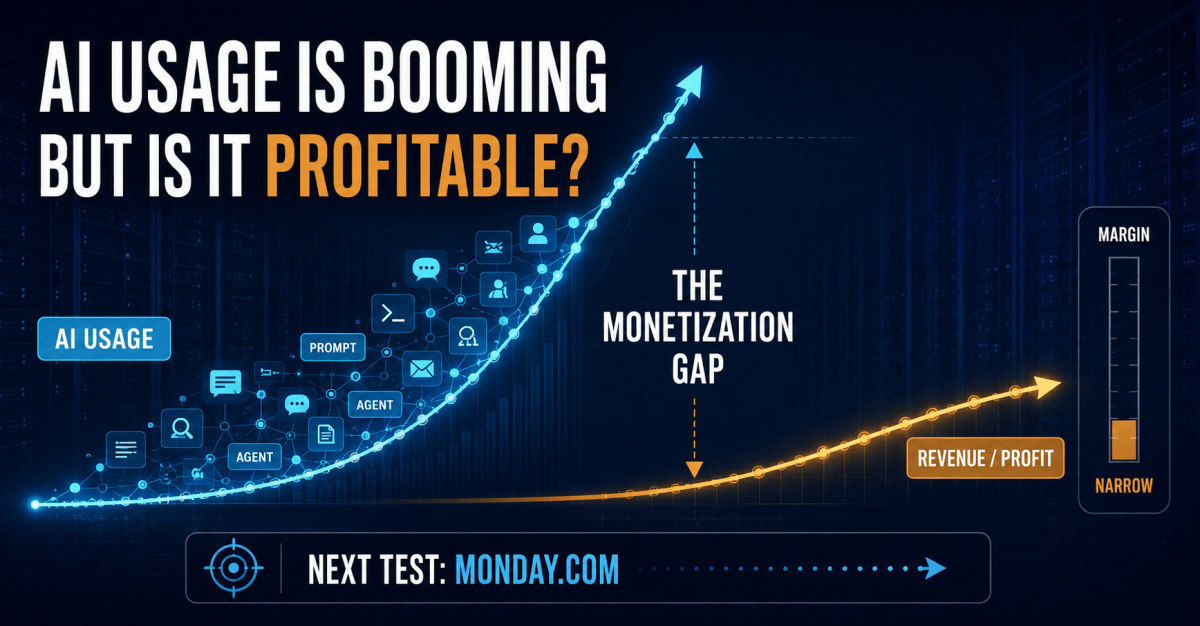
AI Usage Is Booming. But Is Anyone Making Enough Money From It?

Figma and HubSpot illustrate a gap between AI adoption and profitable monetization. While both companies show strong customer engagement with AI, their financial metrics reveal challenges in converting usage into profits. Upcoming results from monday.com will further test whether this trend is widespread or isolated, impacting future infrastructure demand.

Figma and HubSpot reveal an emerging gap between AI adoption and profitable monetization. monday.com will provide the next important test.

The artificial-intelligence investment thesis has largely rested on one reassuring fact: demand for computing capacity continues to exceed supply.

Applications are generating more images, code, reports, customer-service responses and autonomous actions. Cloud providers need more GPUs, data centres and electricity to serve that usage. As long as consumption continues rising, the enormous AI infrastructure build-out appears justified.

But this argument may be missing one crucial question:

Are the applications generating that demand making enough money from it?

Recent results from Figma (FIG:NYSE) and HubSpot (HUBG:NASDAQ) suggest that AI usage can grow much faster than profitable AI revenue. Customers clearly want AI capabilities, but their willingness to pay may not keep pace with the cost of supplying them.

This does not mean AI demand is artificial or that the data-centre boom is about to collapse. It does, however, raise a more subtle risk: today’s usage may be real without being economically sustainable at today’s infrastructure growth rate.

monday.com’s next earnings report could provide an important third data point.

Figma: Strong AI Adoption, Weaker Cash-Flow Conversion

Figma’s second-quarter results appeared impressive on the surface.

Revenue increased 48% year over year to $370.1 million, accelerating for a third consecutive quarter. Net dollar retention remained strong at 136%, while more than 80% of customers generating over $10,000 in annual recurring revenue were consuming AI credits weekly.

Figma also reported that more than half of these larger customers were using the Figma agent weekly by the end of July.

This is not evidence of weak demand. Customers are actively incorporating AI into their design, prototyping and development workflows.

Figma has also begun monetizing that usage. Its AI-credit system combines monthly allowances with paid credit packages, giving customers the option to purchase additional consumption.

Yet the financial cost of delivering that growth is becoming visible.

Figma’s free cash flow declined to $53.2 million, while its free-cash-flow margin fell from 24% a year earlier to 14%. Non-GAAP operating margin was only 10%, and the company recorded a GAAP operating loss of $117.3 million.

Management also acknowledged that continued investment in AI products could cause gross margins to fluctuate, particularly while newer AI features are not yet fully monetized.

The problem is not that Figma lacks AI users. The problem is that each generative action—creating a design, prototype, image, video or code layer—requires additional computing resources.

Traditional software can serve another user at very low incremental cost. Generative software incurs a new inference cost whenever a user asks the system to create something.

Figma therefore presents an important warning:

AI can accelerate revenue and strengthen customer engagement while still weakening the profitability of each additional dollar of growth.

That distinction matters far beyond Figma. Figma Q2 2026 results

HubSpot: Usage Is Rising Faster Than Proven Monetization

HubSpot provides a second—and in some ways more revealing—example.

Its AI agents are gaining real traction:

  • More than 55% of HubSpot’s Pro+ customers use Breeze Assistant or its agents.
  • Agent adoption increased from the high-single digits to the high teens by July.
  • Monthly agentic actions increased more than threefold during 2026.
  • Data Agent reached more than 16,000 activated customers.
  • Prospecting Agent reached almost 17,000.
  • Customer Agent was being used by more than 10,000 customers during the quarter.
  • Customer Agent resolved approximately 72% of support tickets without human escalation.

These figures suggest customers are progressing beyond experimentation. HubSpot’s agents are increasingly performing meaningful work.

But the monetization evidence is much less convincing.

During the quarter, HubSpot lowered the entry prices for several agents, introduced free trials and shifted toward outcome-based pricing. Management explained that customers wanted proof of value before purchasing AI products and greater predictability over their costs.

This is a critical signal.

Even when an AI product delivers measurable outcomes, customers may resist open-ended token or consumption bills. They want limits, spending controls and a clearer relationship between what they pay and the business value they receive.

HubSpot’s pricing changes encouraged adoption, but they also created a near-term headwind to credit expansion and net revenue retention.

The most revealing moment came when an analyst asked management how much AI-credit consumption came from paid usage rather than bundled allowances or free trials.

Management did not provide the split.

Instead, it emphasized customer reach, depth of usage, agentic actions and business outcomes. Those indicators are positive, but they do not answer the financial question.

If agentic actions have tripled, how much incremental paid revenue did they generate? More importantly, how much gross profit remained after paying the model and infrastructure costs required to perform those actions?

HubSpot does not yet disclose:

  • AI-credit revenue;
  • paid AI customers;
  • paid versus bundled credit consumption;
  • inference cost per credit;
  • AI gross profit;
  • gross margin by agent.

Without these figures, investors cannot determine whether rapid agent adoption is creating a profitable new revenue stream or an increasingly expensive feature that HubSpot must provide to keep its platform competitive.

The company’s margin results offer a partial clue.

HubSpot’s non-GAAP gross margin declined by 1.5 percentage points to 84%, with gross profit growing more slowly than revenue. HubSpot did not attribute the entire decline to AI, so it would be inappropriate to treat this as definitive proof of inference-cost pressure.

However, the direction is consistent with what Figma reported: AI usage is accelerating while gross-margin economics become more challenging.

Unlike Figma, HubSpot successfully offset this pressure elsewhere. Non-GAAP operating margin expanded from 17% to 20.3%, while free cash flow increased 44% to $167.9 million.

HubSpot is reorganizing teams, increasing internal productivity and controlling operating expenses. These efficiencies are currently more than enough to absorb the pressure at the gross-margin level.

That makes HubSpot financially stronger—but it does not prove that its AI products are independently profitable.

HubSpot may be funding its AI transformation through savings from the established software business while waiting for AI monetization to mature. That strategy is sustainable for some time, but it cannot permanently replace attractive AI unit economics. HubSpot Q2 2026 resultsHubSpot Q2 earnings materials

Real Usage Is Not the Same as Sustainable Demand

Figma and HubSpot demonstrate why the AI infrastructure debate cannot be resolved by measuring usage alone.

For cloud providers, every additional AI action generates immediate demand for computing capacity. Whether the application making the request earns a profit is initially irrelevant. The cloud provider receives revenue whenever the application consumes resources.

But application companies cannot indefinitely purchase compute that they cannot profitably resell.

They can temporarily absorb the cost through:

  • existing software profits;
  • venture funding;
  • free trials;
  • bundled AI allowances;
  • lower operating expenses;
  • strategic subsidies;
  • expectations of future monetization.

Eventually, however, applications must generate enough revenue to cover their inference costs and still produce an acceptable return.

If customers resist higher prices, application providers will have several options:

  • restrict free usage;
  • reduce included credits;
  • route simpler tasks to cheaper models;
  • use smaller specialized models;
  • replace AI with conventional automation where possible;
  • introduce spending thresholds;
  • charge only for successful outcomes;
  • negotiate lower cloud and model prices.

All these responses improve application economics. But they may also weaken the assumption that every additional AI interaction requires permanently rising amounts of expensive computing capacity.

AI usage could continue growing while the compute required for each action falls.

This creates a potential break between the two trends:

Application usage may continue rising without infrastructure spending continuing to rise at the same rate.

Why This Matters for the Data-Centre Build-Out

The current data-centre boom assumes that rapidly expanding AI consumption will eventually support massive long-term infrastructure investment.

Figma and HubSpot do not disprove that assumption. Two companies are not enough to establish an industry-wide trend, and both companies continue to grow.

But they expose the part of the investment chain that deserves closer scrutiny.

The economic sequence is supposed to work as follows:

AI infrastructure enables applications. Applications create customer value. Customers pay for that value. Application companies earn attractive margins. Those profits support greater cloud consumption. Cloud providers then invest in additional infrastructure.

Figma and HubSpot suggest a possible weakness in the middle of that chain.

Customers are using the products. The applications are delivering outcomes. But pricing remains difficult, free or bundled consumption remains important, and the profitability of AI-specific revenue remains unclear.

If this pattern becomes widespread, the infrastructure boom could eventually encounter a demand-quality problem.

The issue would not be a lack of activity. It would be a lack of economically sustainable activity.

monday.com Is the Next Test

monday.com is scheduled to report second-quarter results on August 10.

The company increasingly presents itself not merely as work-management software but as an AI work platform where agents can automate workflows and perform tasks for customers.

This makes monday.com a useful third test because its workloads differ from those of Figma and HubSpot.

Figma represents generative design and development.

HubSpot represents marketing, sales and customer-service agents.

monday.com represents general workflow automation and work agents.

If monday.com reports rapidly increasing agent usage while maintaining strong gross margins and generating identifiable incremental revenue, it would suggest that the problem is product-specific. Creative generation may be unusually compute-intensive, while structured workflow agents may produce better economics.

But the warning would become much stronger if monday.com reports:

  • rapid growth in agent activations or actions;
  • no separately identifiable AI revenue;
  • extensive bundled or trial usage;
  • lower agent prices;
  • weak conversion from usage to paid credits;
  • cost of revenue growing faster than revenue;
  • deterioration from its historically high gross margin;
  • strong engagement without corresponding improvement in retention or customer expansion.

The decisive relationship will be whether AI revenue and gross profit rise alongside AI actions.

If usage accelerates much faster than monetization while gross margins decline, monday.com would become a third application-layer example of the same emerging pattern.

Three companies would still not prove that the entire software industry faces uneconomic AI adoption. But the evidence would become difficult to dismiss as a company-specific issue.

monday.com Q2 earnings announcement

The SWOTstock View

The AI infrastructure thesis should not be judged only by whether data centres are full today.

Current demand can remain exceptionally strong while the financial returns of the applications generating that demand remain uncertain.

Figma shows that AI can accelerate revenue while weakening cash-flow conversion.

HubSpot shows that AI actions can grow more than threefold while the company lowers prices, expands trials and declines to separate paid consumption from bundled usage.

Neither result proves that AI applications are fundamentally unprofitable. Both companies have strong existing platforms, growing customer adoption and multiple ways to improve efficiency and monetization.

But together they raise a legitimate question:

What happens to long-term infrastructure demand if AI applications generate enormous usage but only modest incremental profit?

The immediate answer is probably very little. Existing data-centre projects, hardware orders and customer commitments will continue.

The longer-term answer depends on whether application companies can convert adoption into profitable revenue before the next major infrastructure investment cycle begins.

If they cannot, applications will optimize, restrict and cheapen their AI consumption. Infrastructure demand may continue growing, but much more slowly than raw usage statistics imply.

That is why monday.com’s report matters.

The next stage of the AI investment debate will not be decided by another record number of prompts, tokens or agent actions. It will be decided by whether those actions produce enough revenue and gross profit to pay for the infrastructure behind them.

For investors, usage is no longer the final proof point.

Profitable usage is.

ServiceNow Q2 2026: AI Momentum Strengthens, but Organic Growth Still Needs Scrutiny

TL;DR Summary

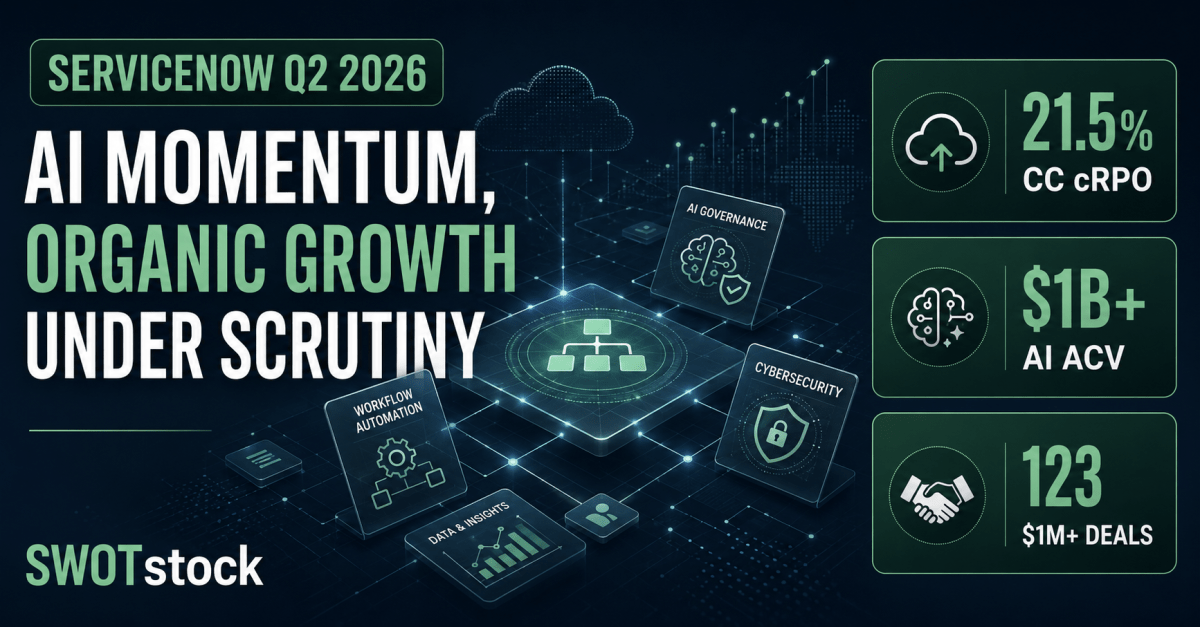
ServiceNow (NOW:NYSE) delivered a stronger-than-expected second quarter, supported by 21.5% constant-currency cRPO growth, accelerating large transactions and AI annual contract value exceeding $1 billion. The report materially weakened the most bearish argument that artificial intelligence is already eroding ServiceNow’s competitive position.

The results were not unambiguously bullish, however. Acquisitions contributed meaningfully to reported growth, part of the revenue outperformance came from business moving forward from Q3, and AI infrastructure costs pressured gross-margin guidance.

Using dilution-adjusted owner earnings and three valuation scenarios, SWOTstock estimates ServiceNow’s probability-weighted fair value at approximately $113 per share. Against the pre-earnings closing price of $95.46, the shares appeared moderately undervalued—but without a large margin of safety.

Quarter Recap

ServiceNow reported Q2 2026 subscription revenue of $3.877 billion, increasing 24.5% as reported and 23% in constant currency. Total revenue reached $3.987 billion, representing 24% reported growth and 22.5% constant-currency growth.

The more important forward-looking indicator was current remaining performance obligations, or cRPO. ServiceNow ended the quarter with $13.20 billion of cRPO, up 21% as reported and 21.5% in constant currency. This exceeded management’s previous 19.5% constant-currency guidance by approximately 200 basis points.

Approximately 125 basis points of Q2 cRPO growth came from Armis. Subtracting that disclosed contribution produces an estimated ex-Armis growth rate of approximately 20.25%. This is not a complete organic-growth calculation because ServiceNow did not separately disclose the contribution from every acquisition, but it suggests that the underlying platform remained healthy during the quarter.

ServiceNow also reported $29 billion of total remaining performance obligations, up 22% in constant currency, while its subscription renewal rate remained 98%.

Key Highlights

The quarter provided stronger commercial evidence than a simple revenue beat. Large contracts increased, AI adoption became more measurable and operating profitability exceeded guidance.

  • ServiceNow completed 123 transactions above $1 million in net-new annual contract value, nearly 40% more than last year.
  • The company ended the quarter with 658 customers generating more than $5 million in ACV, approximately 23% more than a year earlier.
  • ServiceNow AI crossed $1 billion in ACV and remained on track to exceed $1.5 billion by the end of 2026.
  • Management reported that million-dollar AI transactions approximately tripled, while customers operating agentic AI in production increased ninefold over nine months.
  • Approximately 50% of net-new business is now generated through non-seat-based models, helping reduce ServiceNow’s dependence on the number of human software users.
  • Non-GAAP operating margin reached 29.5%, 300 basis points above guidance.
  • ServiceNow maintained its full-year non-GAAP operating-margin target of 31.5% and free-cash-flow margin target of 35%.

There were also important qualifications.

  • Management said approximately half the Q2 revenue outperformance came from strong federal demand that moved some on-premise subscription revenue from Q3 into Q2.
  • Full-year subscription-revenue guidance was increased only modestly to $15.760–$15.780 billion.
  • Subscription gross-margin guidance was reduced from 81.5% to 81%, reflecting greater hyperscaler usage and accelerating AI consumption.
  • Q3 cRPO guidance is 20% in constant currency, including approximately 150 basis points from Armis. The estimated Q3 growth rate excluding Armis is therefore closer to 18.5%.

The quarter was fundamentally bullish, but it did not prove that ServiceNow’s organic growth is reaccelerating beyond 20%.

SWOT Analysis

The following price-impact ranges estimate how individual developments could affect ServiceNow’s shares over approximately 12–18 months. They are scenario sensitivities and should not be added together mechanically.

Strengths

ServiceNow’s core strengths remain its high customer retention, deeply embedded workflows and ability to expand relationships across multiple enterprise functions.

  • Strong contracted demand: potential price impact of +8% to +15%. Constant-currency cRPO growth reached 21.5%, while the estimated result excluding Armis remained approximately 20.25%.
  • Large-deal momentum: potential price impact of +5% to +10%. Transactions exceeding $1 million in net-new ACV increased nearly 40%, supporting the quality of the cRPO result.
  • Measurable AI monetization: potential price impact of +8% to +18%. AI ACV exceeded $1 billion, large AI transactions increased and more customers moved agentic applications into production.
  • Durable customer relationships: potential price impact of +5% to +10%. The 98% renewal rate indicates that customers are not broadly replacing ServiceNow with standalone AI platforms.
  • Strong operating leverage: potential price impact of +5% to +12%. The operating-margin beat and maintained full-year FCF-margin target demonstrate continued financial discipline.

Weaknesses

ServiceNow’s weaknesses center on the quality of reported growth, the difference between GAAP and non-GAAP profitability, and the economic cost of employee compensation.

  • Acquisition-supported growth: potential price impact of −8% to −15%. Estimated Q3 cRPO growth falls from 20% to approximately 18.5% after removing the disclosed Armis contribution.
  • Limited guidance increase: potential price impact of −4% to −8%. The small full-year revenue increase suggests management is not extrapolating the entire Q2 outperformance.
  • Gross-margin pressure: potential price impact of −5% to −10%. AI adoption is increasing hyperscaler and consumption expenses before the full revenue benefit is visible.
  • High stock-based compensation: potential price impact of −10% to −18%. Q2 SBC reached $655 million, while management expects it to represent approximately 15% of full-year revenue.
  • Low GAAP operating margin: potential price impact of −5% to −12%. ServiceNow’s 4% GAAP operating margin was substantially below its 29.5% non-GAAP result.

Opportunities

ServiceNow’s principal opportunity is to become the governance and execution layer through which enterprises operate AI agents across different models, applications and infrastructure providers.

  • AI ACV exceeding $1.5 billion: potential price impact of +10% to +20%. Achieving this target would strengthen the case that AI is becoming a durable incremental revenue stream.
  • AI reaching 30% of total ACV by 2030: potential price impact of +20% to +35%. This would transform ServiceNow’s positioning from an incumbent adding AI features into a major enterprise AI platform.
  • Security expansion: potential price impact of +10% to +20%. The combination of AI Control Tower, Armis and Veza could establish a differentiated security, identity and connected-asset platform.
  • Non-seat-based monetization: potential price impact of +8% to +15%. Usage- and outcome-based revenue could offset slower growth in human software seats.
  • CRM and employee-workflow expansion: potential price impact of +8% to +18%. ServiceNow can increase its share of customer spending by expanding beyond its established IT workflow position.

Threats

The largest long-term threat is not necessarily immediate replacement by an AI model. It is the possibility that AI reduces human software usage while increasing ServiceNow’s delivery costs faster than new AI products generate revenue.

  • AI-driven seat compression: potential price impact of −20% to −35%. Fewer human users could weaken traditional subscription revenue before alternative pricing models become sufficiently large.
  • Organic growth falling below 15%: potential price impact of −20% to −30%. The current valuation still requires sustained double-digit owner-earnings growth.
  • Acquisition-integration problems: potential price impact of −15% to −25%. ServiceNow spent approximately $8.8 billion on acquisitions during the first half, increasing goodwill, acquired intangibles and debt.
  • AI costs rising faster than monetization: potential price impact of −10% to −20%. Continued gross-margin pressure would reduce the value of otherwise impressive AI ACV growth.
  • Growth-stock multiple compression: potential price impact of −15% to −25%. ServiceNow remains sensitive to discount rates and changes in investor appetite for enterprise software.

Valuation Scenarios

The valuation begins with ServiceNow’s official full-year guidance. Subscription revenue is expected to reach approximately $15.77 billion at the midpoint, while total revenue should be approximately $16.2 billion after including professional services.

A 35% non-GAAP FCF margin implies approximately $5.7 billion of reported free cash flow. However, stock-based compensation remains a genuine economic cost. Deducting estimated SBC produces normalized owner earnings of approximately $3.2–$3.3 billion, or around $3.10–$3.20 per diluted share.

Bear Scenario — $60

The bear scenario assumes that acquisition-adjusted growth moves toward the low teens, AI monetization does not fully offset seat pressure and ServiceNow receives a lower valuation multiple.

  • Starting owner earnings: approximately $3.0 billion
  • First five years’ growth: 10%
  • Following five years’ growth: 5%
  • Discount rate: 10%
  • Terminal growth: 3%
  • Probability: 20%
  • Estimated value: $60 per share

This represents approximately 37% downside from the $95.46 reference price.

Base Scenario — $105

The base scenario assumes that ServiceNow sustains mid-teens owner-earnings growth, AI becomes incrementally profitable and the company successfully integrates its acquisitions.

  • Starting owner earnings: approximately $3.25 billion
  • First five years’ growth: 15%
  • Following five years’ growth: 8%
  • Discount rate: 9%
  • Terminal growth: 3%
  • Probability: 50%
  • Estimated value: $105 per share

This represents approximately 10% upside from the reference price.

Bull Scenario — $163

The bull scenario assumes that ServiceNow sustains growth close to 20%, successfully monetizes AI at attractive margins and establishes its platform as the governance and action layer for enterprise AI.

  • Starting owner earnings: approximately $3.5 billion
  • First five years’ growth: 18%
  • Following five years’ growth: 10%
  • Discount rate: 8.5%
  • Terminal growth: 3.5%
  • Probability: 30%
  • Estimated value: $163 per share

This represents approximately 71% upside from the reference price.

Applying the assigned probabilities produces a probability-weighted fair value of approximately $113 per share.

Verdict

ServiceNow’s Q2 report materially improved the investment thesis. Contracted growth remained strong, large transactions accelerated and AI adoption produced measurable ACV rather than only product announcements or pilot activity.

The evidence also challenges the strongest version of the enterprise-software pessimism. Customers are not broadly leaving ServiceNow, the renewal rate remains high, and AI appears to be generating additional products and use cases. The company’s movement toward non-seat-based pricing also gives it a potential mechanism to monetize work performed by AI agents.

Nevertheless, the report did not remove every concern. Acquisitions contributed meaningfully to growth, underlying Q3 cRPO may remain in the high teens, AI is pressuring gross margin and SBC continues to absorb a significant portion of the economic value generated by the business.

At $95.46, ServiceNow appeared moderately undervalued, with approximately 18% potential appreciation to the $113 probability-weighted fair value. The corresponding margin of safety was approximately 16%.

That is sufficient to make the stock more interesting, but it is not yet a clear fat pitch. A price near $90 would offer approximately a 20% margin of safety, while a price around $79 would provide approximately 30%.

The appropriate conclusion is therefore:

ServiceNow remains a high-quality growth company whose Q2 results weakened the AI-disruption thesis. The valuation has become reasonable, but the stock still requires successful AI monetization and acquisition integration to generate substantial long-term upside.

Call to Action

Do you believe ServiceNow’s $1 billion of AI ACV proves that established enterprise-software platforms can benefit from AI, or does acquisition-supported growth still make the underlying picture too difficult to judge?

Share your view in the comments, and follow SWOTstock for independent, evidence-based earnings analysis.

Disclaimer

This article is for informational and educational purposes only and does not constitute investment advice, a recommendation or an offer to buy or sell securities. The valuation scenarios and estimated price impacts reflect judgment based on ServiceNow’s publicly available company materials and may not occur. Investors should conduct their own research and consider their financial circumstances, investment objectives and risk tolerance before making investment decisions.