
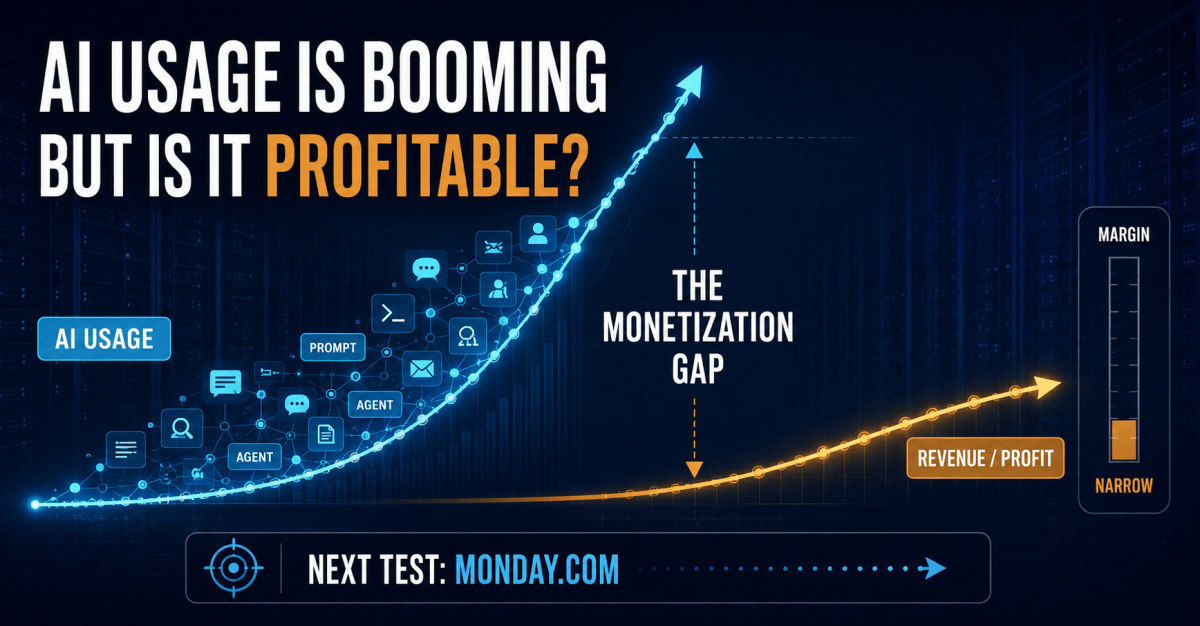
Figma and HubSpot reveal an emerging gap between AI adoption and profitable monetization. monday.com will provide the next important test.
The artificial-intelligence investment thesis has largely rested on one reassuring fact: demand for computing capacity continues to exceed supply.
Applications are generating more images, code, reports, customer-service responses and autonomous actions. Cloud providers need more GPUs, data centres and electricity to serve that usage. As long as consumption continues rising, the enormous AI infrastructure build-out appears justified.
But this argument may be missing one crucial question:
Are the applications generating that demand making enough money from it?
Recent results from Figma (FIG:NYSE) and HubSpot (HUBG:NASDAQ) suggest that AI usage can grow much faster than profitable AI revenue. Customers clearly want AI capabilities, but their willingness to pay may not keep pace with the cost of supplying them.
This does not mean AI demand is artificial or that the data-centre boom is about to collapse. It does, however, raise a more subtle risk: today’s usage may be real without being economically sustainable at today’s infrastructure growth rate.
monday.com’s next earnings report could provide an important third data point.
Figma: Strong AI Adoption, Weaker Cash-Flow Conversion
Figma’s second-quarter results appeared impressive on the surface.
Revenue increased 48% year over year to $370.1 million, accelerating for a third consecutive quarter. Net dollar retention remained strong at 136%, while more than 80% of customers generating over $10,000 in annual recurring revenue were consuming AI credits weekly.
Figma also reported that more than half of these larger customers were using the Figma agent weekly by the end of July.
This is not evidence of weak demand. Customers are actively incorporating AI into their design, prototyping and development workflows.
Figma has also begun monetizing that usage. Its AI-credit system combines monthly allowances with paid credit packages, giving customers the option to purchase additional consumption.
Yet the financial cost of delivering that growth is becoming visible.
Figma’s free cash flow declined to $53.2 million, while its free-cash-flow margin fell from 24% a year earlier to 14%. Non-GAAP operating margin was only 10%, and the company recorded a GAAP operating loss of $117.3 million.
Management also acknowledged that continued investment in AI products could cause gross margins to fluctuate, particularly while newer AI features are not yet fully monetized.
The problem is not that Figma lacks AI users. The problem is that each generative action—creating a design, prototype, image, video or code layer—requires additional computing resources.
Traditional software can serve another user at very low incremental cost. Generative software incurs a new inference cost whenever a user asks the system to create something.
Figma therefore presents an important warning:
AI can accelerate revenue and strengthen customer engagement while still weakening the profitability of each additional dollar of growth.
That distinction matters far beyond Figma. Figma Q2 2026 results
HubSpot: Usage Is Rising Faster Than Proven Monetization
HubSpot provides a second—and in some ways more revealing—example.
Its AI agents are gaining real traction:
- More than 55% of HubSpot’s Pro+ customers use Breeze Assistant or its agents.
- Agent adoption increased from the high-single digits to the high teens by July.
- Monthly agentic actions increased more than threefold during 2026.
- Data Agent reached more than 16,000 activated customers.
- Prospecting Agent reached almost 17,000.
- Customer Agent was being used by more than 10,000 customers during the quarter.
- Customer Agent resolved approximately 72% of support tickets without human escalation.
These figures suggest customers are progressing beyond experimentation. HubSpot’s agents are increasingly performing meaningful work.
But the monetization evidence is much less convincing.
During the quarter, HubSpot lowered the entry prices for several agents, introduced free trials and shifted toward outcome-based pricing. Management explained that customers wanted proof of value before purchasing AI products and greater predictability over their costs.
This is a critical signal.
Even when an AI product delivers measurable outcomes, customers may resist open-ended token or consumption bills. They want limits, spending controls and a clearer relationship between what they pay and the business value they receive.
HubSpot’s pricing changes encouraged adoption, but they also created a near-term headwind to credit expansion and net revenue retention.
The most revealing moment came when an analyst asked management how much AI-credit consumption came from paid usage rather than bundled allowances or free trials.
Management did not provide the split.
Instead, it emphasized customer reach, depth of usage, agentic actions and business outcomes. Those indicators are positive, but they do not answer the financial question.
If agentic actions have tripled, how much incremental paid revenue did they generate? More importantly, how much gross profit remained after paying the model and infrastructure costs required to perform those actions?
HubSpot does not yet disclose:
- AI-credit revenue;
- paid AI customers;
- paid versus bundled credit consumption;
- inference cost per credit;
- AI gross profit;
- gross margin by agent.
Without these figures, investors cannot determine whether rapid agent adoption is creating a profitable new revenue stream or an increasingly expensive feature that HubSpot must provide to keep its platform competitive.
The company’s margin results offer a partial clue.
HubSpot’s non-GAAP gross margin declined by 1.5 percentage points to 84%, with gross profit growing more slowly than revenue. HubSpot did not attribute the entire decline to AI, so it would be inappropriate to treat this as definitive proof of inference-cost pressure.
However, the direction is consistent with what Figma reported: AI usage is accelerating while gross-margin economics become more challenging.
Unlike Figma, HubSpot successfully offset this pressure elsewhere. Non-GAAP operating margin expanded from 17% to 20.3%, while free cash flow increased 44% to $167.9 million.
HubSpot is reorganizing teams, increasing internal productivity and controlling operating expenses. These efficiencies are currently more than enough to absorb the pressure at the gross-margin level.
That makes HubSpot financially stronger—but it does not prove that its AI products are independently profitable.
HubSpot may be funding its AI transformation through savings from the established software business while waiting for AI monetization to mature. That strategy is sustainable for some time, but it cannot permanently replace attractive AI unit economics. HubSpot Q2 2026 results, HubSpot Q2 earnings materials
Real Usage Is Not the Same as Sustainable Demand
Figma and HubSpot demonstrate why the AI infrastructure debate cannot be resolved by measuring usage alone.
For cloud providers, every additional AI action generates immediate demand for computing capacity. Whether the application making the request earns a profit is initially irrelevant. The cloud provider receives revenue whenever the application consumes resources.
But application companies cannot indefinitely purchase compute that they cannot profitably resell.
They can temporarily absorb the cost through:
- existing software profits;
- venture funding;
- free trials;
- bundled AI allowances;
- lower operating expenses;
- strategic subsidies;
- expectations of future monetization.
Eventually, however, applications must generate enough revenue to cover their inference costs and still produce an acceptable return.
If customers resist higher prices, application providers will have several options:
- restrict free usage;
- reduce included credits;
- route simpler tasks to cheaper models;
- use smaller specialized models;
- replace AI with conventional automation where possible;
- introduce spending thresholds;
- charge only for successful outcomes;
- negotiate lower cloud and model prices.
All these responses improve application economics. But they may also weaken the assumption that every additional AI interaction requires permanently rising amounts of expensive computing capacity.
AI usage could continue growing while the compute required for each action falls.
This creates a potential break between the two trends:
Application usage may continue rising without infrastructure spending continuing to rise at the same rate.
Why This Matters for the Data-Centre Build-Out
The current data-centre boom assumes that rapidly expanding AI consumption will eventually support massive long-term infrastructure investment.
Figma and HubSpot do not disprove that assumption. Two companies are not enough to establish an industry-wide trend, and both companies continue to grow.
But they expose the part of the investment chain that deserves closer scrutiny.
The economic sequence is supposed to work as follows:
AI infrastructure enables applications. Applications create customer value. Customers pay for that value. Application companies earn attractive margins. Those profits support greater cloud consumption. Cloud providers then invest in additional infrastructure.
Figma and HubSpot suggest a possible weakness in the middle of that chain.
Customers are using the products. The applications are delivering outcomes. But pricing remains difficult, free or bundled consumption remains important, and the profitability of AI-specific revenue remains unclear.
If this pattern becomes widespread, the infrastructure boom could eventually encounter a demand-quality problem.
The issue would not be a lack of activity. It would be a lack of economically sustainable activity.
monday.com Is the Next Test
monday.com is scheduled to report second-quarter results on August 10.
The company increasingly presents itself not merely as work-management software but as an AI work platform where agents can automate workflows and perform tasks for customers.
This makes monday.com a useful third test because its workloads differ from those of Figma and HubSpot.
Figma represents generative design and development.
HubSpot represents marketing, sales and customer-service agents.
monday.com represents general workflow automation and work agents.
If monday.com reports rapidly increasing agent usage while maintaining strong gross margins and generating identifiable incremental revenue, it would suggest that the problem is product-specific. Creative generation may be unusually compute-intensive, while structured workflow agents may produce better economics.
But the warning would become much stronger if monday.com reports:
- rapid growth in agent activations or actions;
- no separately identifiable AI revenue;
- extensive bundled or trial usage;
- lower agent prices;
- weak conversion from usage to paid credits;
- cost of revenue growing faster than revenue;
- deterioration from its historically high gross margin;
- strong engagement without corresponding improvement in retention or customer expansion.
The decisive relationship will be whether AI revenue and gross profit rise alongside AI actions.
If usage accelerates much faster than monetization while gross margins decline, monday.com would become a third application-layer example of the same emerging pattern.
Three companies would still not prove that the entire software industry faces uneconomic AI adoption. But the evidence would become difficult to dismiss as a company-specific issue.
monday.com Q2 earnings announcement
The SWOTstock View
The AI infrastructure thesis should not be judged only by whether data centres are full today.
Current demand can remain exceptionally strong while the financial returns of the applications generating that demand remain uncertain.
Figma shows that AI can accelerate revenue while weakening cash-flow conversion.
HubSpot shows that AI actions can grow more than threefold while the company lowers prices, expands trials and declines to separate paid consumption from bundled usage.
Neither result proves that AI applications are fundamentally unprofitable. Both companies have strong existing platforms, growing customer adoption and multiple ways to improve efficiency and monetization.
But together they raise a legitimate question:
What happens to long-term infrastructure demand if AI applications generate enormous usage but only modest incremental profit?
The immediate answer is probably very little. Existing data-centre projects, hardware orders and customer commitments will continue.
The longer-term answer depends on whether application companies can convert adoption into profitable revenue before the next major infrastructure investment cycle begins.
If they cannot, applications will optimize, restrict and cheapen their AI consumption. Infrastructure demand may continue growing, but much more slowly than raw usage statistics imply.
That is why monday.com’s report matters.
The next stage of the AI investment debate will not be decided by another record number of prompts, tokens or agent actions. It will be decided by whether those actions produce enough revenue and gross profit to pay for the infrastructure behind them.
For investors, usage is no longer the final proof point.
Profitable usage is.

