💳 American Express Q2 2025: Still Premium, But Fairly Valued?

American Express (AXP) Q2 2025 earnings analysis: record revenue, 3.1M new cards, and strong fee growth offset by rising costs. SWOT analysis, valuation scenarios, and price outlook for value investors.

TL;DR Summary

American Express (AXP) posted record revenue and beat EPS expectations, yet shares dipped slightly as investors digested rising costs and macro risk. Despite strong cardholder engagement and new card growth, the current valuation leaves little margin of safety. AXP looks like a “Hold” — with better buying potential under $290.


Q2 2025 Recap: Resilient Premium Growth, Margin Watch

AXP reported $17.9B in revenue (+9% YoY) and EPS of $4.08, beating consensus estimates. Spending in premium categories stayed strong, with +10% in business-class travel and +9% in luxury lodging. The company added 3.1 million new cards, a majority in fee-paying tiers.

Despite strong revenue, expenses grew 14% YoY, primarily due to investments in the Platinum platform, Centurion Lounge expansion, and digital infrastructure. Management reaffirmed full-year guidance and expressed confidence in monetizing these investments starting Q4.


Key Highlights

  • Record revenue: $17.9B (+9% YoY)
  • EPS: $4.08 (vs. $3.87 est.)
  • Fee revenue: +20% YoY
  • Luxury spend: +10% (biz class), +9% (lodging > $5K)
  • New cards: 3.1M (majority fee-based)
  • Expenses: +14% YoY
  • Guidance reaffirmed: EPS $15.0–15.5 for FY25

📈 Revenue vs Net Income (Past 5 Quarters)

Line chart showing American Express revenue and net income trends over the past five quarters from Q2 2024 to Q2 2025

SWOT Analysis

In Q2 2025, American Express showed strong fundamentals with growing revenue and customer engagement, but rising expenses and macro uncertainty created a more balanced risk-reward profile.

Strengths

  • Consistent top-line growth
  • Strong brand and pricing power
  • EPS beat and stable credit metrics
  • High-spend user base remains sticky
    → Impact: +$10 to +$15

Weaknesses

  • Operating costs growing faster than revenue
  • Near-term margin pressure
    → Impact: –$5 to –$10

Opportunities

  • Upside from monetizing Platinum & lounges
  • Rising NII and strong card acquisition
    → Impact: +$8 to +$12

Threats

  • Valuation premium (~21× P/E)
  • Macro risk: spending could slow
    → Impact: –$10 to –$15
SWOT table summarizing price impact estimates for American Express Q2 2025 including Strengths, Weaknesses, Opportunities, and Threats

📊 SWOT Price Impact Chart

Bar chart showing estimated price impacts of Strengths, Weaknesses, Opportunities, and Threats for American Express

Valuation Scenarios

To gauge where American Express stock could head next, we modeled three valuation scenarios based on management’s full-year EPS guidance and current market conditions. These scenarios—bull, base, and bear—reflect different assumptions about earnings performance and valuation multiples. By assigning probabilities to each case, we arrive at a fair value estimate to help long-term investors assess risk and reward more objectively.

Valuation scenarios table showing bull, base, and bear cases for American Express Q2 2025 with price targets and EPS assumptions

🎯 Fair Value = $307 (probability-weighted)

Visual 3: 📐 Valuation Scenario Chart

Vertical bar chart comparing bull, base, bear valuation targets and current price of AXP

Peer Comparison: How Does AXP Stack Up?

Before deciding whether to hold or accumulate more shares, it’s helpful to see how American Express stacks up against similar financial giants. While AXP excels in card fee growth and premium customer acquisition, competitors like Visaand Capital One offer different strengths—whether it’s higher scale or better short-term valuation. Here’s a snapshot comparing key financial metrics from Q2 2025 across the three companies:

Table comparing American Express to Visa and Capital One on EPS growth, revenue growth, operating expenses, dividend yield, and forward P/E ratio in Q2 2025

Verdict: Hold For Now — But Watch That $290 Line

American Express is still executing at a high level, but the stock looks fully priced for now. With fair value near $307, the market isn’t offering a discount. For long-term investors, a dip to the $280–290 range could create a more attractive setup.

📌 Current View: Hold
📉 Buy Zone: Under $290
📈 Re-evaluate: Over $325


Call to Action

Enjoying SWOTstock’s clean, earnings-driven breakdowns?
Follow us for investor-focused insights on earnings season.
No hype. Just data, discipline, and decisions that work.


Disclaimer

This analysis is for informational purposes only and does not constitute investment advice. All data is sourced from American Express’s official Q2 2025 earnings release and call transcript.
Leave a comment


Goldman Sachs and Morgan Stanley: A High-Stakes Earnings Season for Wall Street’s Finest

Preview the upcoming Q2 2025 earnings for Goldman Sachs and Morgan Stanley. Explore key themes, strategic differences, and what investors should watch as Wall Street’s top banks report.

TL;DR – Two Different Engines, One Market Test

As Goldman Sachs and Morgan Stanley prepare to report their second-quarter results, investors are watching closely to see how two of Wall Street’s most iconic firms are navigating a shifting macro environment. While Morgan Stanley has leaned into wealth management as its long-term growth pillar, Goldman continues to reposition itself after a retreat from consumer banking and a volatile stretch in investment banking. The upcoming earnings will offer a fresh look at which model is winning in 2025—and whether either name is undervalued relative to its forward potential.


Q1 Recap: Strategic Divergence on Full Display

In the first quarter of 2025, the divergence in strategy between these two institutions became increasingly evident. Goldman Sachs delivered better-than-expected results, driven largely by strength in its global markets division—particularly fixed income and commodities trading. While investment banking revenues remained muted, the firm’s Asset and Wealth Management segment showed encouraging growth, quietly contributing to earnings stability amid broader volatility.

Morgan Stanley, in contrast, leaned into its now-dominant wealth management franchise, which continues to anchor its earnings with more predictable, fee-based income. Trading revenues were healthy, though less volatile than Goldman’s, and investment banking activity remained sluggish. The integration of E*TRADE and Eaton Vance appears to be progressing, but margins continue to be scrutinized by analysts who want to see more operating leverage.

Both stocks have tracked broader market gains this year, aided by rising investor sentiment and increased risk appetite. However, the strong run-up in equity markets sets a higher bar for Q2 performance—and makes any shortfall more likely to trigger a valuation reset.


Q2 2025 Preview: Key Themes to Watch

📈 1. Investment Banking Activity and the M&A Pipeline

The long-awaited recovery in deal activity has been uneven, but early signs point to a modest thaw in M&A and equity underwriting markets. Investors will want to see whether either bank is capturing greater wallet share as clients cautiously return to the table. Goldman, with its deep advisory bench, may be positioned to benefit from any early rebound.

💼 2. Wealth Management Profitability and Scale

Morgan Stanley’s wealth business, now a cornerstone of its strategy, remains in focus—particularly operating margins and net new assets. Investors will look for signs that scale advantages from prior acquisitions are beginning to deliver incremental earnings leverage. Conversely, any slip in cost discipline or fee compression could raise concerns about future growth.

📊 3. Trading Performance and Market Volatility

With macro volatility subsiding somewhat in Q2, trading desks may face tougher year-over-year comps. Goldman’s exposure to fixed income and commodities could give it an edge in any remaining dislocations. Morgan Stanley’s more balanced exposure may serve it well in calmer markets, but could also limit upside if activity is muted.

🏦 4. Strategic Repositioning at Goldman

Goldman’s exit from its consumer ventures continues to unfold, and the second quarter may offer further updates on its plans to streamline operations and refocus capital. While these efforts have weighed on sentiment in the past, clarity and discipline in execution could turn the narrative more constructive.

💰 5. Capital Return and CET1 Management

Both firms are expected to comment on their capital return strategies following the latest Fed stress test results. Goldman has historically been more aggressive with buybacks, while Morgan Stanley may emphasize stability and capital preservation. Investors will weigh these decisions against current payout ratios and the firms’ risk-weighted asset profiles.


SWOT Analysis: Comparing Strategic Profiles

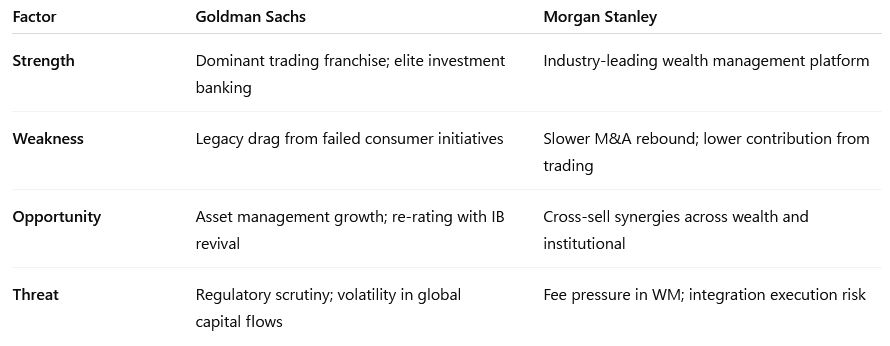
SWOT analysis table comparing Goldman Sachs and Morgan Stanley ahead of Q2 2025 earnings, highlighting strengths, weaknesses, opportunities, and threats for each firm.

Valuation in Context: Discounted for Uncertainty

From a valuation perspective, both firms trade at a discount to their historical averages, reflecting persistent questions around the pace of recovery in core businesses.

  • Goldman Sachs (GS) is currently trading at approximately 11.2x forward earnings, a discount that arguably reflects both the overhang from its consumer pivot and cyclical risk in trading and advisory.
  • Morgan Stanley (MS) commands a higher multiple, at around 13.3x forward earnings, underpinned by the predictability of its wealth franchise and a more balanced revenue base.

However, if investment banking activity accelerates meaningfully in the second half of the year, Goldman may be poised for a multiple re-rating. Conversely, if market volatility diminishes further, Morgan Stanley’s stable income streams may prove more defensive.


Bottom Line: Different Models, Same Market Test

As both firms head into Q2 earnings, the contrast between Goldman’s capital markets orientation and Morgan Stanley’s wealth-driven stability will once again be on full display. Investors will be looking not only for solid headline numbers, but for forward guidance that supports each firm’s strategic trajectory. Whether it’s Goldman’s return to its core strengths or Morgan Stanley’s steady ascent in fee-based income, the upcoming results could significantly shift investor sentiment—and relative valuations—for the rest of the year.


Stay Ahead of the Curve

📩 Subscribe to SWOTstock.com for full earnings recaps, updated SWOT profiles, and revised valuation scenarios for both Goldman Sachs and Morgan Stanley—posted immediately after earnings are released.


Disclaimer

This article is for informational purposes only and does not constitute financial advice or a recommendation to buy or sell any securities. Always perform your own due diligence or consult a licensed financial advisor before making investment decisions.


Leave a comment


Broadcom Q2 FY2025: AI Momentum Drives Record Revenue—Is the Market Undervaluing This Infrastructure Giant?

Broadcom’s Q2 2025 earnings reveal strong AI chip growth and VMware integration. See our SWOT and fair value estimate showing 17% upside potential.

💡 TL;DR – Pullback Presents Opportunity in a Structurally Strong Business

Broadcom (NASDAQ: AVGO) posted a record-breaking quarter, driven by surging AI demand and expanding software margins, yet the stock declined due to high expectations already priced in. With solid free cash flow, growing custom AI deployments, and a credible software growth engine, our fair value estimate points to +17% upside. This may be one of those rare “buy-the-dip” chances in a business executing on multiple growth vectors.


📊 Quarter Recap – Strong Execution Meets High Expectations

Broadcom delivered a strong Q2 FY2025, with $15.0 billion in revenue, up 43% YoY. The AI semiconductor segment grew 46% YoY to $4.4 billion, marking the ninth consecutive quarter of AI-led growth. On the software side, VMware and VCF added $6.6 billion, a 25% YoY gain.

Margins remained exceptional: 79.4% gross margin, $6.4 billion in free cash flow (43% of revenue). Yet the market response was muted. The stock pulled back ~5% post-report as guidance aligned with expectations, not exceeding them.

Line chart showing Broadcom’s quarterly revenue and net income from Q2 2024 to Q2 2025, highlighting a sharp increase in Q2 2025 driven by AI and software growth.

🔑 Management Commentary – Scaling AI, Monetizing Software

Broadcom reaffirmed its bullish stance on AI growth. Management guided for 60% YoY growth in AI chip revenue in Q3 and reiterated their target of AI comprising 35% of total revenue by year-end.

CEO Hock Tan emphasized:

“We’re in the early stages of a multi-year infrastructure buildout. Our custom AI accelerators are now in production with three hyperscalers and being evaluated by several more.”

To support hyperscaler workloads, Broadcom also launched the Tomahawk 6 switch, offering 102.4 Tbps bandwidth—a key enabler of ultra-dense AI clusters.

Meanwhile, VMware integration continued as planned. Management highlighted strong ARR and price leverage in its infrastructure software offerings, further enhancing Broadcom’s blended margin profile.


🧠 SWOT Analysis – Strategy and Market Sensitivity

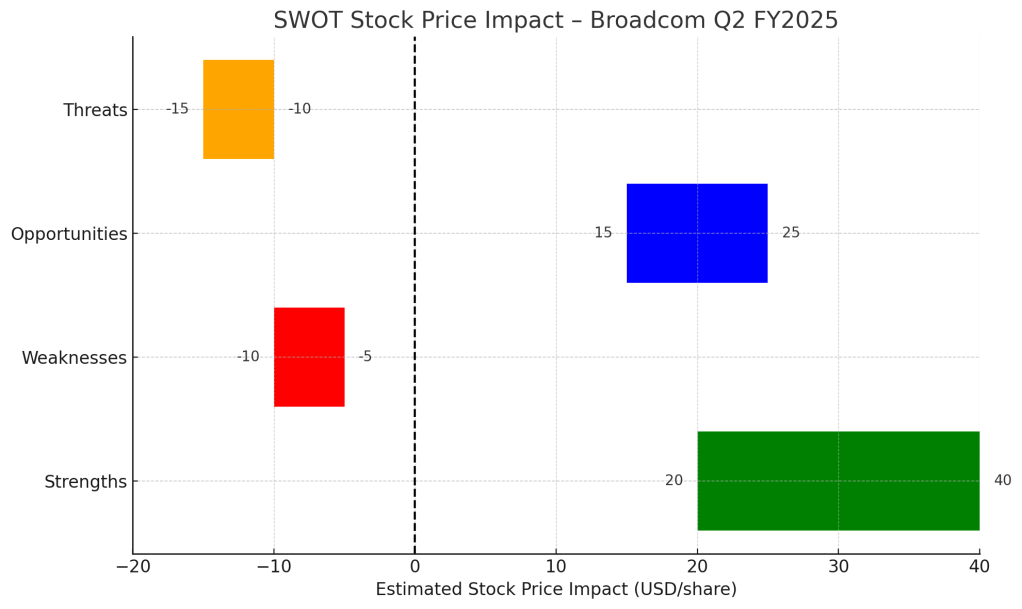
Horizontal bar chart for Broadcom Q2 2025 showing stock price impact ranges by SWOT element: Strengths (+20 to +40), Opportunities (+15 to +25), Weaknesses (–10 to –5), and Threats (–15 to –10) in USD.

✅ Strengths (+20 to +40 USD/share)

Dual revenue engines—custom AI chips and recurring software—set Broadcom apart. Gross margins and free cash flow generation remain world-class. Management visibility into multi-quarter AI demand de-risks execution.

❌ Weaknesses (-5 to -10 USD/share)

Legacy semiconductor segments like broadband and storage connectivity remain under pressure. VMware integration, though progressing, adds near-term complexity.

🚀 Opportunities (+15 to +25 USD/share)

The hyperscaler pipeline is expanding, and each deployment carries material revenue potential. If even one new customer finalizes deployment by year-end, upside to AI projections may materialize early. Software bundling (hardware + VCF) could also open a new monetization layer.

⚠️ Threats (-10 to -15 USD/share)

Investor expectations are high. A single quarter of missed growth or a slower ramp from a hyperscaler could compress multiples quickly. Integration drag or logistical ramp issues also remain execution risks.


📋 SWOT Summary Table


💰 Valuation Scenarios – Grounded Upside Based on Execution

We modeled three outcomes based strictly on Broadcom’s own forward guidance and commentary.

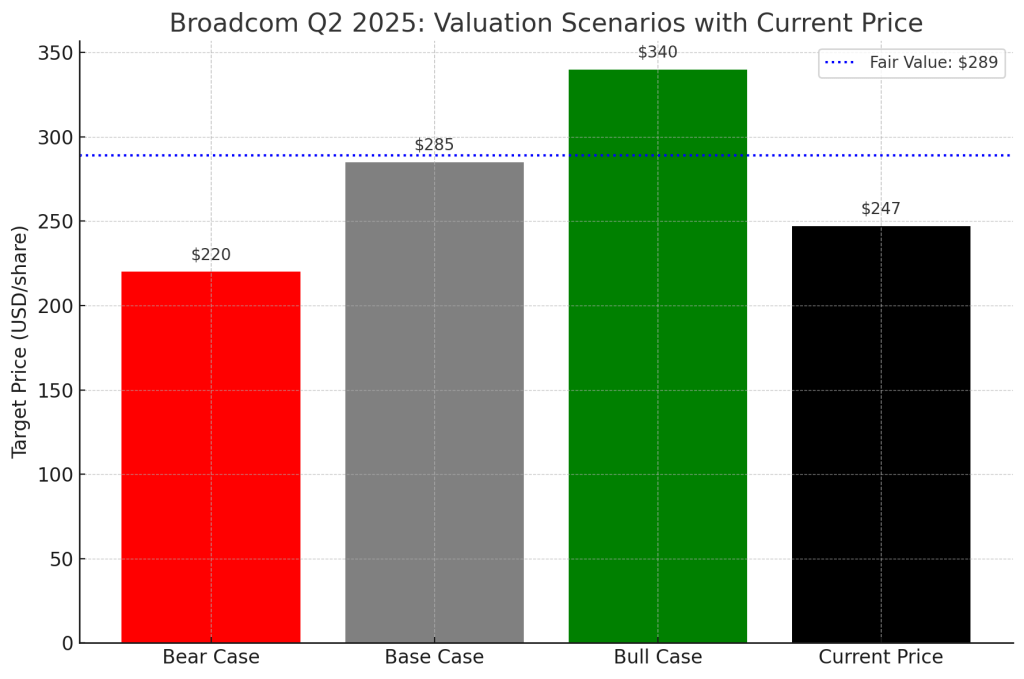
Bar chart of Broadcom Q2 2025 valuation scenarios showing Bear Case ($220), Base Case ($285), Bull Case ($340), and a separate bar for Current Price ($247), with a dotted line marking fair value at $289.

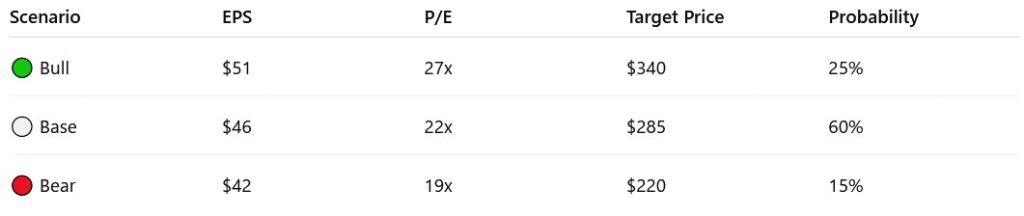
🟢 Bull Case – $340/share (25%)

If Broadcom successfully scales to 5+ hyperscaler customers and executes VMware integration smoothly, EPS could rise to $51, supported by a 27x P/E.

⚪ Base Case – $285/share (60%)

The most probable path: strong, steady AI growth and normalized software contribution. EPS reaches $46, with a 22x multiple.

🔴 Bear Case – $220/share (15%)

Execution delays or margin pressure reduce EPS to $42, and a 19x multiple results in $220/share.


🧮 Weighted Fair Value Calculation

(0.25×340)+(0.60×285)+(0.15×220)=289.00

📌 Fair Value: $289/share
📉 Current Price: $247/share (as of June 6, 2025)
📈 Upside Potential: +17%


🏁 Verdict – Quality Name With Re-Rating Potential

The short-term pullback seems more about timing than fundamentals. Investors may have front-loaded expectations ahead of earnings, creating a mismatch. Yet Broadcom’s long-term visibility, growing software margins, and accelerating AI scale-ups suggest the story remains intact.

📉 Technical note: The stock is approaching prior support near $235–245, which also aligns with March consolidation levels—an area long-term investors may be watching.


📢 Call to Action

Broadcom represents a high-quality, cash-generating, AI-fueled compounder. If you’re looking for a name with both infrastructure exposure and durable software margins, the current setup may offer an attractive entry. Bookmark or share this post as Broadcom rolls into the second half of FY2025.


⚠️ Disclaimer

All analysis in this post is based exclusively on Broadcom’s official Q2 FY2025 financial disclosures and earnings call commentary. This is not investment advice.


Leave a comment