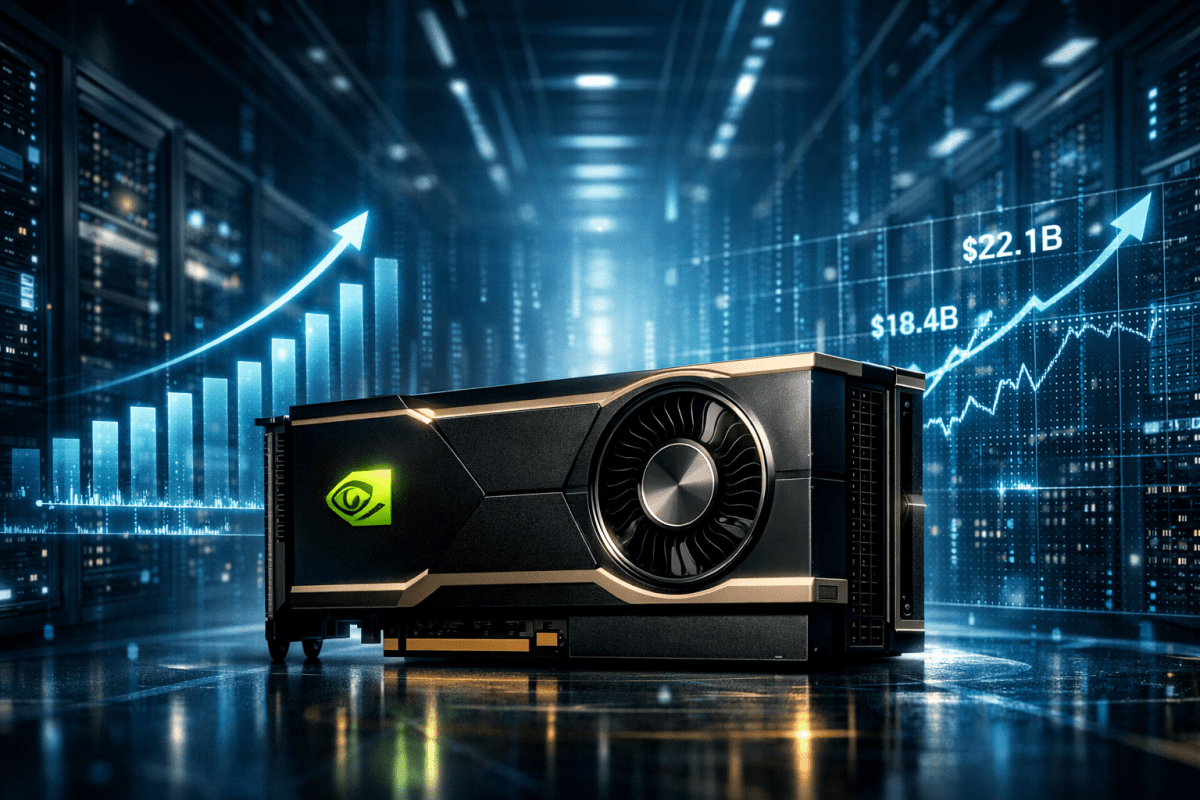
NVIDIA Q4 FY2026 Earnings: AI Dominance Intact — Is the Stock Still Underpricing the Cycle?

TL;DR Summary

NVIDIA (NVDA:NASDAQ) delivered another explosive quarter, with Q4 revenue up 73% year-over-year and Data Center revenue surging 75%. Gross margins remain near 75%, and management guided to $78B in next-quarter revenue — even excluding China data center compute revenue.

The AI infrastructure cycle is clearly not over.

Based on official financials and management guidance, fair value lands around $240–$250, versus the current price near $150. For growth investors, the debate is no longer whether NVIDIA is dominant — it’s whether the AI cycle can extend long enough to justify sustained premium valuation.


Quarter Recap

NVIDIA reported Q4 FY2026 revenue of $68.1B, up 73% year-over-year and 20% sequentially. The real engine remains Data Center, which generated $62.3B, growing 75% YoY.

Gross margins held near 75%, confirming that pricing power remains intact despite scale. Full-year FY2026 revenue reached $215.9B, up 65% from the prior year.

Management guided Q1 FY2027 revenue to $78B ±2%, notably excluding China data center compute revenue. That implies the core AI demand machine remains strong even under export constraints.


Key Highlights

• Data Center revenue continues to scale at hyperscale velocity

• Blackwell ramp is underway, supporting next-gen demand

• Gross margin durability near 75% signals structural advantage

• China revenue excluded from guidance, reducing forward visibility but also lowering expectation risk

• $41.1B returned to shareholders in FY2026 through buybacks and dividends


SWOT Analysis

NVIDIA is no longer being valued as a chipmaker. It is being valued as the foundational AI infrastructure layer. The sustainability of that thesis depends on ecosystem dominance, demand durability, and competitive containment.

Strengths

• AI infrastructure leadership with 75% YoY Data Center growth

Estimated price impact: +10% to +18%

• CUDA + NVLink ecosystem lock-in creating high switching costs

Estimated price impact: +8% to +15%

• Sustained gross margin near 75% demonstrating pricing power

Estimated price impact: +5% to +10%

• Visible product roadmap (Blackwell, Rubin) reducing cycle uncertainty

Estimated price impact: +6% to +12%


Weaknesses

• Heavy revenue concentration in Data Center

Estimated price impact: -8% to -15%

• Premium valuation near ~45x earnings requires near-flawless execution

Estimated price impact: -10% to -20%


Opportunities

• Inference demand expansion beyond training workloads

Estimated price impact: +10% to +20%

• Sovereign AI and enterprise adoption wave

Estimated price impact: +8% to +15%

• Software monetization and services layer expansion

Estimated price impact: +5% to +12%


Threats

• China export restrictions tightening further

Estimated price impact: -8% to -18%

• Hyperscaler custom silicon (ASICs) long-term margin risk

Estimated price impact: -10% to -20%

• AI capex digestion cycle if hyperscalers pause

Estimated price impact: -15% to -30%
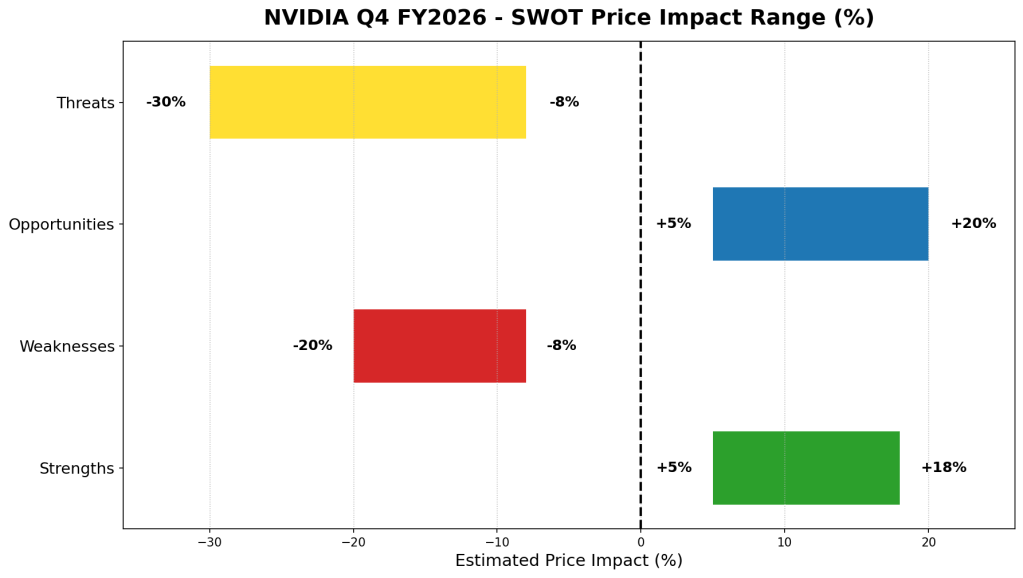
NVIDIA Q4 FY2026 SWOT price impact range chart showing Strengths (+5% to +18%), Weaknesses (-20% to -8%), Opportunities (+5% to +20%), and Threats (-30% to -8%) with a zero reference line.
NVIDIA Q4 FY2026 SWOT price impact analysis. Strengths and Opportunities suggest upside potential of up to +20%, while Weaknesses and Threats indicate downside risk reaching -30%, highlighting both AI leadership momentum and valuation sensitivity.

Valuation Scenarios

Bear Case — AI Growth Moderates

Assumptions:

• EPS slows to ~$6.00

• Multiple compresses to ~30x

Target price: $170–$180

Probability: 25%


Base Case — Strong but Moderating Growth

Assumptions:

• EPS ~$6.50

• Multiple stabilizes ~40x

Target price: $240–$260

Probability: 50%


Bull Case — AI Cycle Extends Multi-Year

Assumptions:

• EPS ~$7.00+

• Multiple holds 45–50x

Target price: $300–$320

Probability: 25%


Probability-Weighted Fair Value

Weighted fair value: ~$246

Fair value range based strictly on official financials:

$240–$250
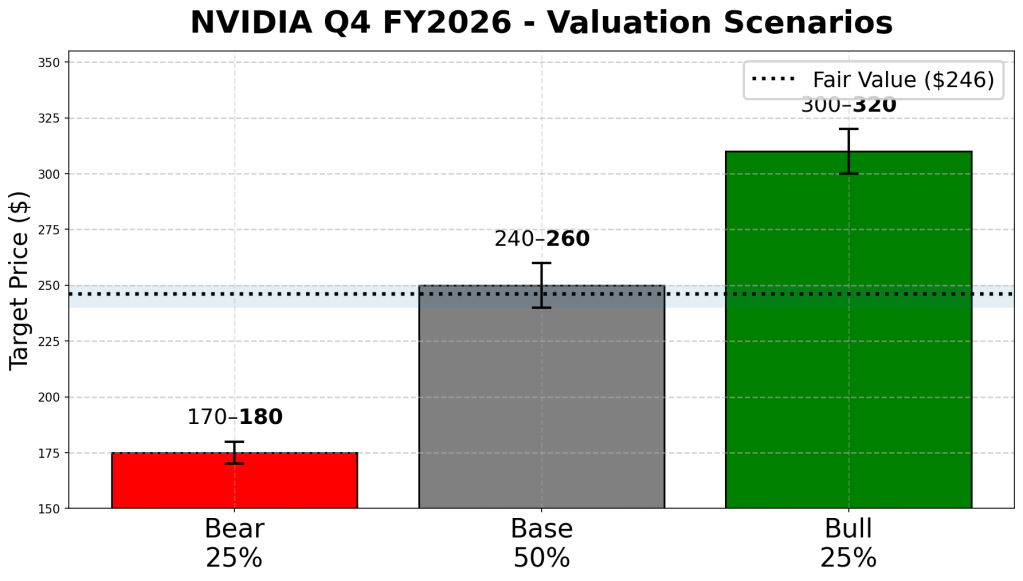
NVIDIA Q4 FY2026 valuation scenarios chart showing Bear case $170–$180 (25%), Base case $240–$260 (50%), and Bull case $300–$320 (25%) with a probability-weighted fair value of $246.
NVIDIA Q4 FY2026 valuation scenarios. The Base case ($240–$260) carries the highest probability at 50%, while the Bull case extends toward $320 if the AI cycle persists. The probability-weighted fair value stands near $246, with a $240–$250 range based strictly on official financials.

Verdict

For Type 1 growth investors, NVIDIA remains the clearest AI infrastructure winner. The numbers show no structural slowdown yet. Gross margins remain elite. Guidance implies continued scale.

The real risk is not weak demand — it’s cycle compression. If AI capex pauses, the stock will re-rate quickly. But as long as hyperscaler demand persists, NVIDIA remains structurally advantaged.

This is no longer an early-stage AI bet. It is an AI cycle duration bet.


Call to Action

If you follow AI infrastructure leaders, subscribe to SWOTstock for structured earnings breakdowns, price-impact SWOT analysis, and scenario-based valuation models built for growth investors.


Disclaimer

This analysis is for informational purposes only and does not constitute investment advice. Always conduct your own due diligence and consult a licensed financial advisor before making investment decisions.

NVIDIA Q3 FY2026 Earnings — Is the AI Supercycle Still Accelerating?

NVIDIA achieved record Q3 FY2026 revenue of $57 billion, a 62% increase year-over-year, driven by strong demand for data center GPUs. The company expects Q4 revenue to reach $65 billion, indicating sustained AI infrastructure demand. However, concerns about supply constraints and competition remain, affecting future growth potential.

TL;DR Summary

NVIDIA delivered another explosive quarter, with Q3 FY2026 revenue hitting $57.0 billion, up 62% year-over-year and 22% sequentially, fueled by a massive surge in demand for Blackwell-based data center GPUs. Gross margins held at 73.4%, and management guided Q4 revenue to $65 billion, signaling confidence that AI infrastructure demand continues to rise faster than supply. The key question for investors is whether this momentum is sustainable — or if the supercycle is nearing a peak.


Quarter Recap

NVIDIA posted a record quarter driven overwhelmingly by its data center franchise. Revenue came in at $57.0 billion, up sharply from last year, with the data center business alone contributing $51.2 billion. Growth remained broad and robust across cloud providers, enterprise customers, and AI platform deployments. Gross margins stayed very strong at 73.4%, reflecting favorable product mix and pricing power.

GAAP diluted EPS was $1.30, supported by scale efficiency and tight expense control. During the earnings call, management noted that demand for the new Blackwell architecture remains “off the charts,” with cloud GPU capacity effectively sold out. NVIDIA also emphasized that its Q3 results and Q4 guidance exclude shipments of the H20 GPU to China, meaning the company is operating at record levels without one of its formerly significant regions.


Key Highlights

  • Record Revenue: $57.0B (+62% YoY, +22% QoQ)
  • Data Center Strength: $51.2B (+66% YoY, +25% QoQ)
  • Margins: GAAP gross margin of 73.4%
  • EPS: GAAP diluted EPS of $1.30
  • Guidance: Q4 revenue expected at $65.0B ± 2%
  • Demand Update: Blackwell GPUs remain supply-constrained
  • China: No H20 shipments included in guidance; China remains upside optionality

SWOT Analysis

Strengths (+12% to +22%)

NVIDIA’s leadership in AI infrastructure was reinforced by the rapid adoption of Blackwell, which pushed data center revenue to new highs. Margins remain exceptional, and demand continues to exceed supply.

Weaknesses (–8% to –14%)

Revenue is heavily concentrated in the data center segment, increasing sensitivity to a slowdown. Supply constraints and regulatory uncertainties around China limit near-term visibility.

Opportunities (+15% to +28%)

Guidance for Q4 implies another major step-up in revenue. Any resumption of shipments to China, as well as expansion into new AI computing platforms, provides further upside.

Threats (–12% to –20%)

Export controls remain a material risk. Competition from custom silicon and hyperscaler in-house chips could eventually pressure margins. NVIDIA’s premium valuation makes the stock more vulnerable to sharp reactions if growth moderates.


SWOT Table

Strengths: +12% to +22%
Weaknesses: –8% to –14%
Opportunities: +15% to +28%
Threats: –12% to –20%

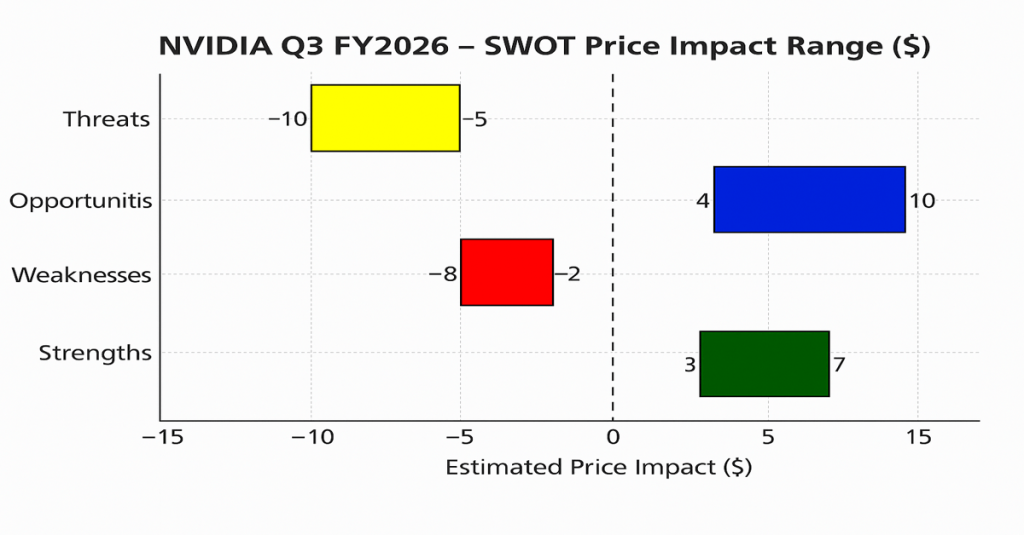
SWOT price impact chart for NVIDIA Q3 FY2026 showing estimated dollar impact ranges: Strengths (+3 to +7), Weaknesses (–8 to –2), Opportunities (+4 to +10), and Threats (–10 to –5), displayed as horizontal colored bars with a dashed zero line.

Valuation Scenarios

Using only NVIDIA’s Q3 FY2026 report and Q4 guidance:

Bull Case — $450 (30% probability)

  • Q4 revenue lands above the top end of guidance
  • Margins track toward the high end of expectations
  • Some China shipments resume
  • Forward EPS: ~$6.00
  • P/E: 75×

Base Case — $325 (50% probability)

  • Q4 meets the midpoint of guidance
  • Margins remain stable near Q3 levels
  • No China upside
  • Forward EPS: ~$5.40
  • P/E: 60×

Bear Case — $215 (20% probability)

  • Q4 hits the lower end of guidance
  • Supply bottlenecks linger
  • Export restrictions tighten
  • Forward EPS: ~$4.80
  • P/E: 45×

Probability-Weighted Fair Value

$340–$345 per share

Valuation scenarios chart for NVIDIA Q3 FY2026 showing Bear ($215, 20%), Base ($325, 50%), and Bull ($450, 30%) price targets as colored bars, with a dashed line indicating a fair value of about $345.

Verdict

NVIDIA’s Q3 results confirm that the AI infrastructure cycle is still extending, not slowing. The company continues to execute exceptionally well, with demand for Blackwell far outstripping supply and Q4 shaping up to be another record quarter.

For growth-oriented investors, the setup remains compelling: official guidance alone justifies a fair value well above the current trading price. However, the stock’s trajectory will remain sensitive to export-control developments and any sign that hyperscalers may shift more workloads to in-house silicon.


Call to Action

If you’re a long-term growth investor who believes the AI compute buildout remains in its early stages, NVIDIA still represents one of the clearest large-cap plays on that trend. Use earnings revisions, regulatory headlines, and market volatility to your advantage — and consider staging entries rather than chasing peaks.


Disclaimer

This analysis is for informational purposes only and is based solely on NVIDIA’s official Q3 FY2026 earnings release, earnings call transcript, and management commentary. It is not investment advice. Please conduct your own research or consult a financial professional before making investment decisions.


⚙️ CoreWeave (Q3 2025) — From Hyper-Growth to High-Leverage AI Utility

CoreWeave’s Q3 report showcases significant growth with revenue doubling to $1.36 billion and a backlog of $55.6 billion. However, the company’s $8 billion debt and $310 million in quarterly interest illustrate financial strain. Priced at $105, the stock reflects optimistic outcomes, while fair value is estimated at $90 per share.

TL;DR Summary

CoreWeave (CRWE:NASDAQ) third-quarter report confirms explosive growth—but also exposes a balance sheet running hot.
Revenue doubled year-on-year to $1.36 billion, backlog swelled to $55.6 billion, and adjusted EBITDA hit $838 million(61 % margin).
Yet the company is now carrying $8.7 billion in debt and paying $310 million in quarterly interest, revealing that CoreWeave has become a capital-heavy AI-infrastructure utility rather than a lightweight cloud startup.
At $CRWV ≈ $105, the stock already prices in a near-bull scenario; our fair-value model centers near $90 per share.


Quarter Recap

For the quarter ended September 30 2025:

  • Revenue: $1.364 billion (+134 % YoY)
  • Adj. EBITDA: $838 million (61 % margin)
  • Net loss: $110 million (–$0.22 EPS)
  • Interest expense: $310 million
  • CapEx: $1.85 billion
  • Backlog: $55.6 billion (+271 % YoY)

Management reiterated that “demand for CoreWeave’s platform continues to exceed available capacity,” but acknowledged construction delays at a third-party facility that could push revenue into Q1 2026.


Key Highlights

  • 💾 Scale: 590 MW active / 2.9 GW contracted capacity
  • 🤝 Clients: OpenAI, Meta, Anthropic—anchor AI tenants
  • 💰 Financing: ≈ $14 billion secured debt + equity to date
  • 🏗️ CapEx run-rate: ≈ $7 billion annualized
  • 📊 Backlog visibility: multi-year revenue coverage through 2027

Updated SWOT Analysis & Price Impact

🧠 Updated SWOT

Strengths (+10 – 20 %)

  • Massive $55 B backlog, 61 % EBITDA margin, and first-mover advantage in AI-optimized cloud.

Weaknesses (–15 – 25 %)

  • $8 B debt load and $300 M quarterly interest burn.
  • Persistent capex drag limits near-term free cash flow.

Opportunities (+20 – 35 %)

  • Secular AI-compute demand and long-term contracts with OpenAI, Meta, and Anthropic.
  • Potential shift from training spikes to recurring inference workloads.

Threats (–20 – 30 %)

  • Execution risk from data-center delays.
  • Refinancing or rate exposure.
  • Hyperscaler competition as NVIDIA supply normalizes.

Overall, CoreWeave remains the purest listed proxy for AI-compute demand, but its financial structure now demands operational precision rather than just growth.


Horizontal bar chart titled CoreWeave Q3 2025 – SWOT Price Impact Range (%) showing four color-coded categories: Strengths (+10% to +20%, green), Weaknesses (–25% to –15%, red), Opportunities (+20% to +35%, blue), and Threats (–30% to –20%, yellow). A dashed vertical line at zero marks neutral price impact.

⚖️ The investment picture

At around $105 per share, $CRWV trades near 11 times enterprise value to sales — a premium multiple that assumes smooth execution and sustained GPU scarcity.
Based on confirmed data and realistic assumptions:

  • In a bull case, where demand stays hot and margins expand, the stock could approach $135 a share.
  • In a base case, assuming balanced growth and slower capex, fair value sits around $90 a share.
  • In a bear case, where delays and refinancing pressure bite, the price could compress toward $50 a share.

Our probability-weighted fair value lands near $90 per share, suggesting the stock is already priced for near-best-case outcomes.

Vertical bar chart titled CoreWeave Q3 2025 – Valuation Scenarios comparing three cases: Bear ($48), Base ($88), and Bull ($138). Bars are colored red, gray, and green respectively, with a dashed horizontal line marking the probability-weighted fair value near $90 per share.”

Verdict

CoreWeave has evolved from a nimble startup into a capital-intensive AI utility—and markets are treating it as such.
The company’s operating performance is stellar, but $8 B of debt and $300 M per-quarter interest make flawless execution non-negotiable.
At $105, CRWV is already priced for near-bull outcomes; our base-case fair value around $90 suggests a balanced risk/reward rather than deep undervaluation.
Upside to $130 requires both smooth facility ramp-up and sustained AI compute scarcity through 2026.


Call to Action

Growth-oriented investors should monitor:

  1. Q4 delivery timelines for the delayed data centers.
  2. Refinancing terms & interest coverage as rates stay high.
  3. Utilization rates > 90 % as the key profitability signal.

For indirect exposure, consider NVIDIAVertiv, or Super Micro Computer as liquid public proxies for the AI-infrastructure theme.


Disclaimer

This analysis uses only CoreWeave’s official Q3 2025 financial release, filings, and management commentary.
It is not investment advice and is for educational purposes only.
All price targets and valuations are illustrative and subject to change as new data emerges.