Berkshire Hathaway Q2 2025: Fortress Balance Sheet, Capital Inaction, and the Buffett‑to‑Abel Transition

Berkshire Hathaway’s Q2 2025 results show a cautious approach, with operating earnings of $11.16B down 4% YoY and a significant net income drop of 59% due to a Kraft Heinz writedown. Despite strong cash reserves of $344B, no buybacks occurred, raising investor concerns over capital deployment ahead of Buffett’s leadership transition to Greg Abel.

📌 TL;DR Summary:

Berkshire Hathaway reported Q2 2025 operating earnings of $11.16 B (–4% YoY) and a $3.8 B writedown on Kraft Heinz, dragging net income down 59%. Cash remains enormous at $344 B, but no buybacks were executed, leaving investors questioning capital deployment. Book value per share grew 6% YoY, but the stock trades near 1.45× book — above Buffett’s historical repurchase thresholds. For value investors, Berkshire remains a fortress‑like hold, but not an obvious bargain as the leadership transition to Greg Abel approaches.


🧾 Quarter Recap:

Berkshire Hathaway’s Q2 2025 earnings reflect disciplined caution with limited offensive moves.

  • Operating earnings: $11.16 B (–4% YoY).
  • Net income: $12.37 B (–59% YoY) due to a $3.8 B Kraft Heinz impairment.
  • Cash: $344 B, slightly down from Q1 but still near record highs.
  • Book value per share~$262, up 6% YoY and ~1% sequentially.
  • No share repurchases, for the second consecutive quarter.
  • Equity activity: Net seller of ~$3 B in stock.
  • Buffett’s discipline holds: As he wrote in the 2023 letter, “We only repurchase shares when we believe they are selling at a meaningful discount to intrinsic value.”

In Q1, we observed:

“Berkshire is signaling caution, not conviction — sitting on cash, avoiding buybacks, and waiting for real value to emerge.”

Q2 results confirm this stance — cash is stockpiled, but deployment remains elusive.


📌 Key Highlights:

  • BNSF Railway: Operating profit up ~19% to $1.47 B on freight volume growth.
  • Geico: Underwriting profit ~$1.8 B, with ~16.5% margin.
  • Insurance (reinsurance & P/C): Underwriting income declined 12%, with P&C reinsurance premiums down ~10%. Float rose to ~$174 B.
  • Consumer goods: Revenue fell ~5%, impacted by tariffs and slowing demand for brands like Fruit of the Loom.
  • FX losses: ~$877 M, pressuring underwriting results.
Line chart showing Berkshire Hathaway’s revenue and net income over the last five quarters: revenue remains relatively stable between $92B and $97B, while net income declines from about $30B in Q2 2024 to $12.37B in Q2 2025.

📈 Book Value & Valuation Context:

  • Book value per share: ~$262, up 6% YoY.
  • Price-to-book: ~1.45×, slightly below the 10‑year average of 1.5×.
  • Historical buyback threshold: Buffett previously authorized buybacks when shares traded under 1.2× book. At current levels (~1.45×), Berkshire remains above that range, which explains the lack of repurchases.

Value investor insight: Berkshire’s market price suggests it’s fully valued by Buffett’s own conservative yardstick.


🧠 SWOT Analysis with Price Impact Estimates:

Strengths (+$15 – $25/share)

  • Fortress balance sheet: $344 B in cash and $174 B in insurance float.
  • Operational resilience: BNSF and Geico continue to deliver.
  • Diversified revenue streams: Core industrials and energy shield against sector shocks.

Weaknesses (–$10 – $20/share)

  • Kraft Heinz writedown exposes underperforming legacy investments.
  • No share buybacks, signaling management sees limited margin of safety at current levels.
  • Underwriting softness and FX headwinds pressure insurance results.

Opportunities (+$10 – $20/share)

  • Capital deployment: $344 B cash can be deployed for opportunistic M&A or buybacks if valuations fall.
  • Rail consolidation: BNSF may benefit from strategic M&A moves in the sector.
  • Insurance cycle hardening: Potential for improved pricing in future quarters.

Threats (–$10 – $15/share)

  • Leadership transition: Buffett‑to‑Abel handoff raises uncertainty about future capital allocation.
  • Macro risks: Tariffs and FX volatility weigh on consumer and manufacturing units.
  • Equity portfolio volatility: GAAP fair‑value swings distort net income.

📊 SWOT Summary Table

SWOT summary table for Berkshire Hathaway Q2 2025 showing strengths, weaknesses, opportunities, and threats with estimated price impacts
Horizontal bar chart showing Berkshire Hathaway Q2 2025 SWOT price impact: Threats at approximately –12.5, Opportunities at +15, Weaknesses at –15, and Strengths at +20, with a vertical dashed line at zero.

💸 Valuation Scenarios:

We apply sum‑of‑parts (subsidiary cash flows + equity portfolio) and P/B benchmarking:
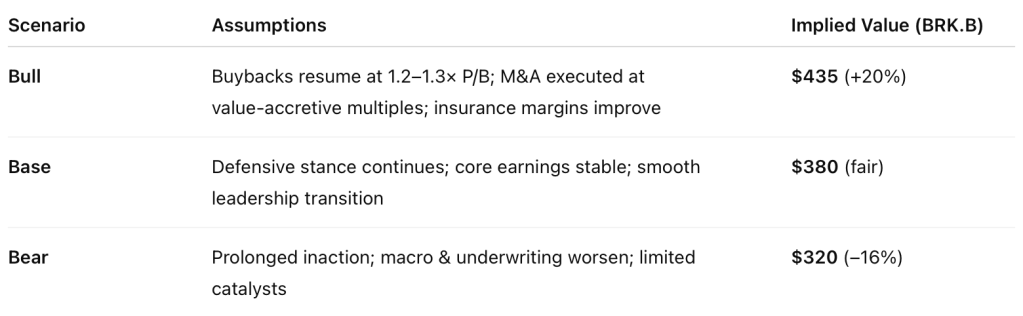
Valuation scenarios table for Berkshire Hathaway Q2 2025 showing bull, base, and bear cases with assumptions and implied BRK.B share prices

Probability‑Weighted Fair Value = (0.25 × 435) + (0.5 × 380) + (0.25 × 320) = $378.75/share.
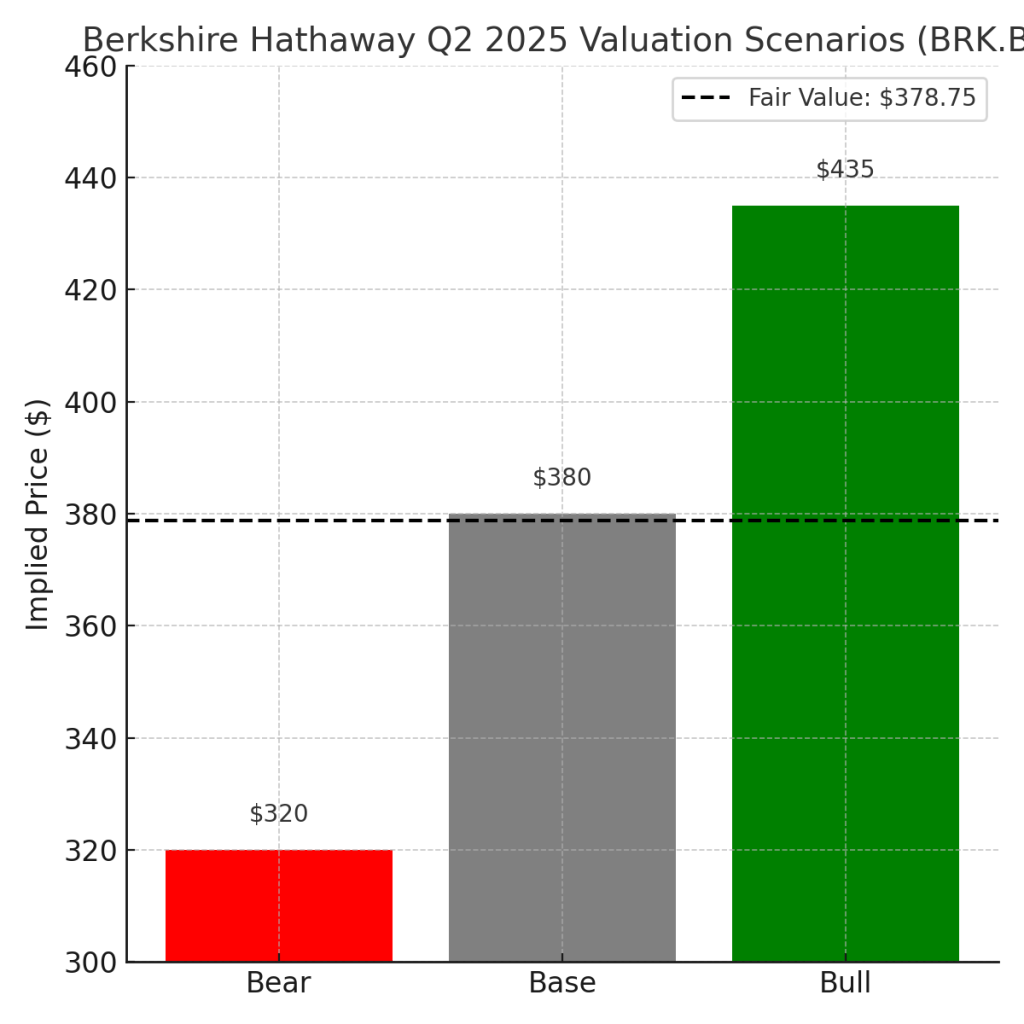
Vertical bar chart showing Berkshire Hathaway Q2 2025 valuation scenarios: Bear case at $320, Base case at $380, and Bull case at $435, with a horizontal dashed line indicating the probability-weighted fair value of approximately $378.75.

📊 Peer Comparison Insight:


Berkshire Hathaway’s P/B ratio of 1.45 positions it above Markel (1.2) but far below the S&P 500 average of 4.2, reinforcing its standing as a value‑oriented conglomerate rather than a growth‑priced index constituent. Its ROE of 10% trails the S&P 500’s 14%, reflecting Berkshire’s conservative leverage and capital deployment posture, yet it still outpaces Markel’s 8%. The YTD return of 4% lags the S&P 500’s 6%, highlighting market skepticism about near‑term catalysts amid Buffett’s upcoming transition and limited capital actions. For DIY value investors, this underscores Berkshire’s role as a steady compounding hold rather than a momentum‑driven outperformer.

Horizontal bar chart comparing Berkshire Hathaway, Markel, and the S&P 500 in Q2 2025: Berkshire shows a P/B ratio of 1.45, ROE of 10%, and YTD return of 4%; Markel shows a P/B ratio of 1.2, ROE of 8%, and YTD return of 6%; S&P 500 shows a P/B ratio of 4.2, ROE of 14%, and YTD return of 6%.

🔑 Catalysts for Re‑rating and Market Reaction

Berkshire’s stock continues to trade like the fortress it is — steady but unspectacular — with a year‑to‑date gain of about 4%, trailing the S&P 500’s roughly 6% advance. The muted market response to Q2 earnings suggests that investors see the quarter as “business as usual”: strong balance sheet, reliable operating results, but little in the way of near‑term excitement. For the stock to re‑rate higher, investors are watching for clearer capital deployment signals — whether that’s buybacks at higher price‑to‑book levels, opportunistic large‑scale acquisitions, or a more aggressive investment approach under Greg Abel’s leadership once the Buffett transition is complete. A significant market downturn, which would give Berkshire the chance to deploy its $344 B cash pile into undervalued opportunities, also remains a potential catalyst for a re‑rating. Until then, the shares are likely to trade within a range that reflects their defensive compounding profile rather than breakout growth.


🧠 Verdict:

For value investors, Berkshire remains a defensive cornerstone: diversified, cash‑rich, and well‑positioned for opportunistic moves. But at ~1.45× book, shares are not trading at a margin of safety by Buffett’s standards. Until buybacks resume, M&A materializes, or valuations reset lower, this is a hold for long‑term compounding — not a bargain entry point.


📣 Call to Action:

Stay ahead of Berkshire’s next moves — from buybacks to the post‑Buffett era.
Subscribe to SWOTstock for deep‑dive analyses that cut through the headlines.


⚠️ Disclaimer:

This analysis is based solely on Berkshire Hathaway’s Q2 2025 public filings (Form 10‑Q, earnings release). It does not constitute financial advice. Perform your own due diligence or consult a licensed advisor before making investment decisions.


Leave a comment


BioNTech Oncology Pivot: What the BMS Deal Tells Us About the Next Growth Phase (a SWOT update)

BioNTech’s $11B oncology deal with Bristol Myers marks a major pivot from COVID vaccines to cancer therapeutics. Explore SWOT analysis, valuation scenarios, and what investors should watch next.

TL;DR – BioNTech’s Story Is No Longer Just About COVID

BioNTech (NASDAQ: BNTX) newly announced global partnership with Bristol Myers Squibb marks a major milestone in its shift from pandemic-era vaccine leader to a diversified oncology innovator. The multi-billion-dollar agreement, centered around the bispecific antibody BNT327, gives BioNTech both near-term cash flow and long-term upside potential in solid tumor treatments. While risk remains around trial outcomes and execution, this partnership may help reset the company’s valuation narrative and attract long-term biotech investors looking beyond COVID normalization.


🧬Quarter Recap – Revenue Resilience and Oncology Focus Take Center Stage

Line chart showing BioNTech’s quarterly revenue and net income trend from Q2 2024 to Q2 2025, highlighting consistent revenue above $1B and narrowing profit.

BioNTech’s second quarter showcased steady financial execution, supported by ongoing COVID-19 vaccine revenue that continues to fund its aggressive R&D strategy. The company reported revenue of approximately $1.2 billion, reflecting sustained contributions from Comirnaty while vaccine demand tapers. However, the real story this quarter was not the top line—it was the strategic clarity around BioNTech’s future.

With research and development expenses rising 15% quarter-over-quarter, the company is clearly leaning into its oncology ambitions. Management emphasized its commitment to advancing next-generation immunotherapies, most notably BNT327, a bispecific antibody targeting PD-L1 and VEGF-A. The asset, acquired via the Biotheus transaction in 2024, is now in Phase 3 trials for multiple solid tumors including ES-SCLC and NSCLC. A Phase 3 study in triple-negative breast cancer is also expected by year-end, setting up key catalysts for 2026.


🌟 Key Developments – The Strategic Weight of the BMS Deal

The standout event this quarter was the announcement of a global partnership with Bristol Myers Squibb to co-develop and co-commercialize BNT327. The agreement provides BioNTech with a $1.5 billion upfront payment, additional guaranteed payments over the next several years, and significant potential milestone payouts. Importantly, the economics are structured as a 50:50 global profit-sharing arrangement, signaling Bristol’s confidence in the asset’s commercial viability.

For BioNTech, this collaboration serves multiple purposes. First, it de-risks the development of a key oncology pipeline candidate by sharing costs and leveraging BMS’s global reach and regulatory infrastructure. Second, it reinforces investor confidence that BioNTech’s pipeline can attract marquee partners—not just in mRNA but also in antibody-based modalities. Finally, it offers a non-dilutive capital infusion that enhances balance sheet flexibility without issuing equity or adding debt.


🧠 SWOT Analysis – Where BioNTech Stands After the BMS Deal

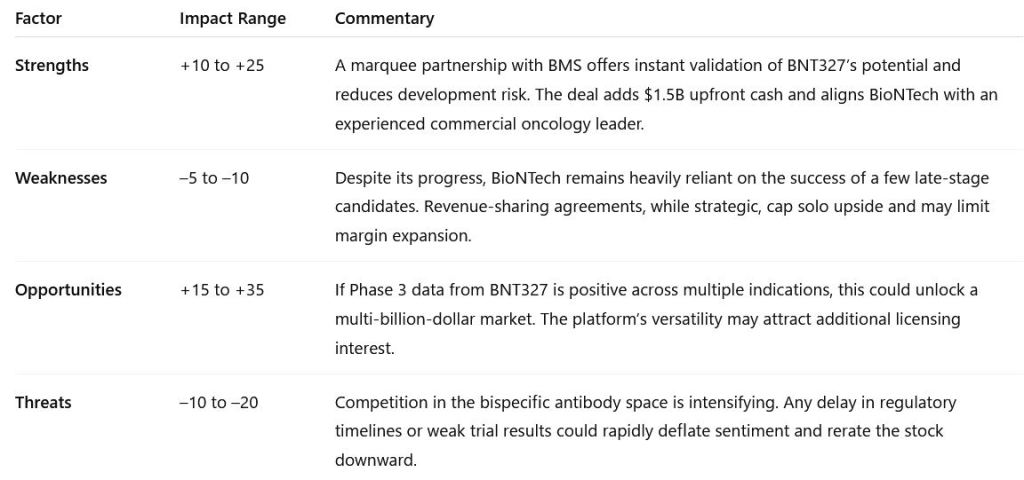
BioNTech SWOT analysis chart showing estimated stock price impact ranges by category in June 2025. Strengths in green, weaknesses in red, opportunities in blue, and threats in yellow.

✅ Strengths (+10 to +25 USD/share impact)

BioNTech’s landmark partnership with Bristol Myers Squibb is a major credibility boost, both clinically and financially. The $1.5 billion upfront payment plus future milestone opportunities significantly de-risk the development of BNT327. More importantly, the 50:50 global profit-sharing structure means BioNTech now has a world-class commercial partner helping carry the execution load. For investors, this translates into greater confidence and visibility—potentially adding $10 to $25 per share in upside as development progresses and market confidence grows.

⚠️ Weaknesses (–5 to –10 USD/share impact)

Despite the strong partnership, BioNTech remains concentrated around a few key assets, particularly BNT327. This pipeline dependency raises risk if any major candidate stumbles. Additionally, while the profit-sharing model is strategic, it also caps BioNTech’s solo upside potential. The company also lacks a fully developed commercial infrastructure, especially in oncology, which could limit its leverage even with good data. These factors could weigh on valuation by $5 to $10 per share, especially in periods of uncertainty.

🚀 Opportunities (+15 to +35 USD/share impact)

If BNT327 delivers in Phase 3 trials, BioNTech could establish itself as a leader in solid tumor therapeutics. The indications in development—lung cancers and triple-negative breast cancer—represent multi-billion-dollar global markets. Strong data could not only drive rapid adoption but also open doors for more licensing deals or companion therapies. With expanding capabilities across mRNA, ADCs, and bispecifics, the company’s platform is increasingly credible. All told, this opportunity could lift the stock by $15 to $35 per share over the next 12–24 months.

🧨 Threats (–10 to –20 USD/share impact)

Competition in oncology is fierce. Several major pharma companies are investing heavily in bispecific antibodies and related immunotherapies. Clinical or regulatory setbacks—whether from safety signals, suboptimal efficacy, or trial delays—could hurt BioNTech’s momentum. Moreover, pricing pressure or shifting standards of care could impact long-term commercialization potential. If investor sentiment turns negative on the BNT327 story, it could drag the stock down by $10 to $20 per share in a bear-case scenario.


📊 Valuation Scenarios – A New Lens Post-Partnership

Under our updated outlook following the Bristol Myers Squibb partnership, BioNTech’s valuation potential can be framed across three core scenarios—bull, base, and bear—each reflecting different assumptions around BNT327’s success, pipeline execution, and competitive dynamics.

Bar chart of BioNTech valuation scenarios in June 2025 with target prices for bull, base, and bear cases, a black bar for the current stock price, and a blue dotted line for estimated fair value at $198.

💰 What’s BioNTech Worth After the BMS Deal?

To value BioNTech post-Bristol Myers Squibb partnership, we consider three realistic outcomes for its oncology pipeline—each reflecting different degrees of clinical success and commercial impact.

🟢 Bull Case – $300/share (25% probability)

In the most optimistic scenario, BNT327 shows strong efficacy in late-stage trials and secures fast-track regulatory approval across multiple cancer types. Broad clinical adoption follows, boosting earnings to around $10 per share. Applying a 30x P/E ratio, the stock could be worth $300 per share. While aggressive, this scenario reflects the kind of breakout success biotech investors target—and we assign it a 25% probability.

⚪ Base Case – $180/share (60% probability)

The base case assumes steady but not spectacular execution. BNT327 gets approved and launches successfully, but uptake is gradual. Meanwhile, BioNTech’s other pipeline assets add modest support to revenue. Under this model, we forecast earnings of $7.50 and a valuation multiple of 24x, pointing to a target price of $180. Given current fundamentals and the BMS partnership, we assign this a 60% probability.

🔴 Bear Case – $100/share (15% probability)

In a downside scenario, BNT327 underwhelms in clinical trials or faces regulatory delays. Competitive pressure from other antibody platforms increases, and investor sentiment cools. If earnings slip to $5.00 and the stock trades down to a 20x multiple, we could see a revaluation to $100 per share. While less likely, we assign this outcome a 15% probability.

Table showing BioNTech's valuation scenarios as of June 2025, including bull, base, and bear cases with estimated EPS, P/E multiples, target prices, and assigned probabilities for each scenario.

📊 Fair Value Estimate: $198

Weighted across all three scenarios, we estimate BioNTech’s fair value at $198 per share—well above its current trading level of ~$113 (as of June 2025). That implies ~75% upside if execution continues and trial results are even moderately positive.

📌 Probability-Weighted Fair Value:

(0.25×300)+(0.60×180)+(0.15×100)=198.00

Current Price (as of June 2, 2025): ~$113
Implied Upside: ~75%


✅ Verdict – This Is More Than a Deal; It’s a Strategic Signal

The Bristol Myers Squibb deal is more than just financial. It reflects institutional confidence in BioNTech’s shift toward long-term oncology growth. For investors, this partnership offers near-term visibility and long-term optionality. BNT327’s clinical readouts over the next 12–18 months will be pivotal, but the alignment with BMS significantly enhances BioNTech’s execution potential and credibility with both regulators and the market.

While the post-COVID revenue decline is no longer new news, BioNTech’s ability to refill its growth pipeline—and do so through strategic, non-dilutive partnerships—could make it one of the better-positioned mid-cap biotech stories heading into 2026.


📣 Call to Action

If you’re looking for exposure to immuno-oncology without the early-stage binary risk of preclinical names, BioNTech offers a compelling mid-cycle entry point. Follow trial updates closely, especially from the BNT327 Phase 3 programs, and watch for signs of further pipeline monetization or additional deals that validate the broader platform.


⚠️ Disclaimer

This analysis is based on publicly available company financials, earnings call commentary, and official press releases as of June 2025. It is intended for informational purposes only and does not constitute investment advice. Always perform your own due diligence.


Leave a comment


Autodesk Q1 2026 Earnings: AI Tools Drive Growth—but Is the Upside Already Priced In?

Autodesk (ADSK) beats Q1 FY2026 estimates and raises guidance, but is the stock already priced for perfection? Dive into our AI-focused SWOT analysis, valuation breakdown, and investor verdict.

TL;DR – Solid Beat, Upgraded Guidance, But Market Unmoved

Autodesk (NASDAQ: ADSK) beat expectations in Q1 with 15% revenue growth, expanding margins, and strong free cash flow. Management raised full-year guidance and highlighted its AI platform roadmap. Still, the stock stayed flat—suggesting the optimism may be fully priced in.


Financial Overview – Growth That Converts to Cash

Autodesk reported:

  • Revenue: $1.63B (+15% YoY)
  • EPS (Non-GAAP): $2.29
  • Operating Margin: 37% (+300bps YoY)
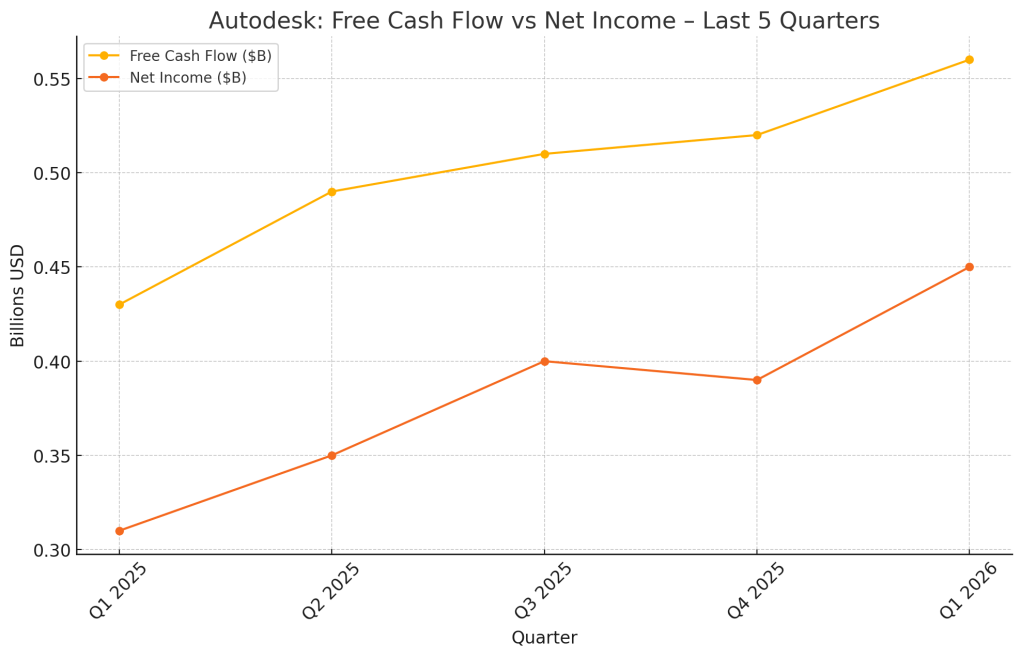
  • Free Cash Flow: $556M (+14%)
  • Billings: $1.43B (+29%)
  • FY2026 guidance raised for revenue and EPS

What sets Autodesk apart isn’t just strong revenue—it’s the ability to consistently convert earnings into cash flow.

Line chart showing Autodesk’s free cash flow and net income over the last five quarters, highlighting consistent growth through Q1 2026.

Where the Growth Is Coming From

Revenue isn’t growing evenly across all business lines. Autodesk’s AEC (architecture, engineering, and construction) segment remains dominant, but Manufacturing and “Others” are catching up.

Bar chart comparing Autodesk’s revenue by segment—AEC, Manufacturing, and Others—between Q1 2025 and Q1 2026.

Also critical is the mix of recurring revenue. Subscription ARR is expanding steadily, which supports long-term valuation multiples.

Line chart showing Autodesk’s total revenue versus quarterly subscription ARR from Q1 2025 to Q1 2026, reflecting recurring revenue growth.

Management’s Outlook – Confidence Backed by Upward Revisions

Autodesk has shown a pattern of raising guidance, reinforcing investor confidence in leadership and execution.

Bar chart illustrating Autodesk’s EPS guidance revisions, showing increases from original to final guidance in FY2025 and FY2026.

SWOT Breakdown – What’s Working, What’s Not, and Where We Go Next

Let’s break it down using SWOT—strengths, weaknesses, opportunities, and threats—with estimated stock price impact for each:

Strengths

  • Revenue and FCF beat expectations
  • AI rollout begins across Revit and Fusion
  • Subscription model fuels predictable growth

Price Impact: +$15 to +$20


Weaknesses

  • Flat stock reaction post-earnings suggests limited short-term upside
  • High R&D spend during platform transition could compress near-term margins

Price Impact: –$5 to –$10


Opportunities

  • Generative design and predictive modeling features gain traction
  • Construction Ops platform and APAC expansion could drive new growth
  • Increased ARR could unlock multiple expansion

Price Impact: +$25 to +$40


Threats

  • Geopolitical and macro headwinds
  • Execution risk with AI and Cloud scale
  • Valuation already rich (~30.7x forward earnings)

Price Impact: –$20 to –$30

SWOT Summary Table

Type Key Points Price Impact
Strengths Revenue & margin beat, AI rollout started +$15 to +$20
Weaknesses Flat stock, platform costs –$5 to –$10
Opportunities Generative design AI, platform growth, APAC expansion +$25 to +$40
Threats Macro risk, AI execution gaps, valuation pressure –$20 to –$30
Horizontal bar chart showing Autodesk’s estimated stock price impact by SWOT element with both endpoints labeled.

Valuation Scenarios – Let’s Do the Math

Despite the strong report, Autodesk’s closing price after earning released ($295.35 as of May 23, 2025) implies a ~30.7x forward P/E. Here’s how that compares to valuation scenarios based on official EPS guidance and fair multiples:

Base Case – Fair Value: $132

  • EPS = $9.62 × P/E 13.7 → $132
  • Reflects steady execution and moderate optimism

Bull Case – Fair Value: $160

  • EPS = $9.73 × P/E 16.5 → $160
  • Assumes strong AI traction and margin expansion

Bear Case – Fair Value: $100

  • EPS = $9.50 × P/E 10.5 → $100
  • Macro pressure + execution delays = multiple compression

Weighted Average Estimate: $132.5

(132×0.6)+(160×0.25)+(100×0.15)=132.5

Bar chart showing Autodesk’s valuation scenarios with weighted average, compared to current stock price.

So Why Is the Market Paying $295?

That’s nearly double our base case. Investors are pricing in:

  • Premium for platform dominance and design ecosystem
  • Long-term AI monetization potential
  • Confidence in 3–5 year growth, not just FY2026

Let’s check historical valuation to see if this premium is new.

Dual-axis chart showing Autodesk’s stock price and trailing P/E ratio over the last five years.

Verdict – Fully Valued. Wait for Dip.

Autodesk’s vision is impressive. The stock is too.
But at current prices, the upside may already be realized—at least in the short term. Long-term investors may want to hold. Opportunists should consider waiting for a pullback below $250 to improve margin of safety.


Call to Action

Want no-hype, investor-friendly breakdowns like this?
Subscribe to SWOTstock to stay ahead of the curve—no fluff, just fundamentals.


Disclaimer

This post is based solely on Autodesk’s official financial report and earnings call transcript. It does not constitute investment advice. Please do your own research.


Leave a comment