Salesforce Q1 FY26: AI Signals Are Strong, But The Market Demands More Than Hype

Salesforce Q1 FY26 earnings: strong cash flow, $1B+ AI revenue, and raised guidance—but the stock dipped. Discover our in-depth SWOT analysis, valuation scenarios, and why long-term tech investors may see upside.

🚀 TL;DR – Earnings Solid, Outlook Raised, But Street Unconvinced

Salesforce (NYSE: CRM) delivered on many fronts in Q1 FY26: strong free cash flow, a raised full-year outlook, and impressive AI momentum with over $1B in annualized AI revenue. Yet the market reaction was subdued. Shares slipped ~3% post-earnings as investors weighed modest growth against growing acquisition dependency. For long-term investors focused on enterprise AI, the current pullback may offer an attractive re-entry point — but execution risk remains high.


📊 Quarter Recap – Cash-Rich, AI-Forward, But Investors Ask: What’s Next?
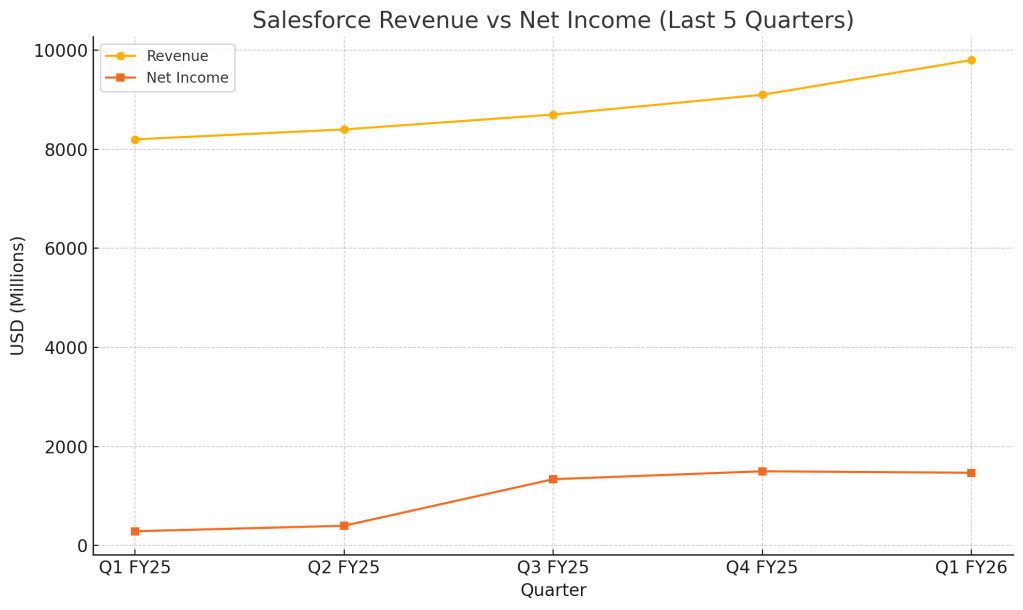
Line chart showing Salesforce’s revenue and net income over the last five quarters, with revenue rising steadily from Q1 FY25 to Q1 FY26 and net income spiking in Q3 FY25 and Q4 FY25.

Salesforce reported Q1 FY26 revenue of $9.8 billion, reflecting 8% growth year-over-year. The company continues to demonstrate financial discipline, posting a 32.3% non-GAAP operating margin and generating $6.3 billion in free cash flow — a key metric that reinforces the strength of its subscription-based business model.

However, the earnings story wasn’t just about operational metrics. Management spent considerable time during the call highlighting Salesforce’s evolving identity as an AI-first enterprise software provider. The AI and Data Cloud segment reached a milestone of over $1 billion in annualized recurring revenue, up 120% from the prior year. Additionally, Agentforce — the company’s AI-powered sales assistant platform — closed over 8,000 deals, with 50% of them already monetized.

Despite these advancements, investor enthusiasm appeared tempered. Salesforce also unveiled its intention to acquire Informatica in a transaction valued at over $8 billion. While the strategic rationale centered on data integration and platform expansion, some investors viewed it as a sign that organic AI monetization remains in its early innings.


📌 Key Highlights

(📌 Visual Placeholder: Q1 FY26 Metrics Snapshot)

  • Revenue: $9.8B (+8% YoY)
  • Subscription & Support Revenue: $9.3B (+8% YoY)
  • Non-GAAP Operating Margin: 32.3%
  • Free Cash Flow: $6.3B (+4% YoY)
  • AI & Data Cloud ARR: $1B+ (+120% YoY)
  • Agentforce Deals: 8,000+ closed, 50% paid
  • Shareholder Return: $3.1B (including $2.7B in buybacks)
  • FY26 Guidance: Revenue raised to $41–41.3B, EPS to $11.27–11.33

🧠 SWOT Analysis – Is Salesforce Building Sustainable AI Moats?

(📊 Visual Placeholder: Horizontal Bar Chart – SWOT Price Impact Ranges)
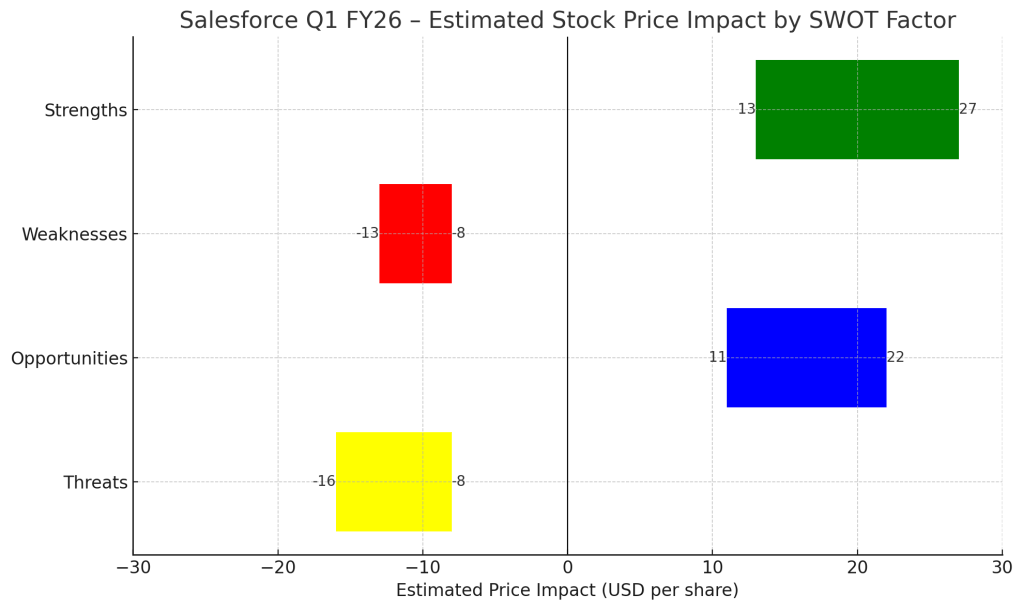
Horizontal bar chart showing Salesforce’s estimated stock price impact by SWOT factor for Q1 FY26 with x-axis from –30 to 30. Categories include Threats (–16 to –8), Opportunities (+11 to +22), Weaknesses (–13 to –8), and Strengths (+13 to +27).

To evaluate Salesforce’s trajectory, we use a SWOT framework — layering qualitative insight with quantitative impact ranges to assess where the stock could go next.

✅ Strengths

Salesforce’s high-margin business continues to generate substantial cash, supporting both R&D and shareholder returns. With a 32.3% non-GAAP operating margin and $6.3B in quarterly free cash flow, the company remains financially resilient. Meanwhile, the $1B+ in AI annual recurring revenue — up 120% year-over-year — signals that the firm’s early bets on generative AI are beginning to materialize.

Estimated Price Impact: +5% to +10% ($13–27)

⚠️ Weaknesses

At 8% year-over-year growth, revenue is expanding — but not at a pace that excites growth-focused investors. Combined with an $8B acquisition of Informatica, some view the quarter as a reminder that Salesforce still leans heavily on M&A for platform expansion. This can dilute long-term returns if integration is poorly executed or if synergy realization takes longer than anticipated.

Estimated Price Impact: –3% to –5% ($8–13)

🌱 Opportunities

The most obvious upside lies in the scaling of Agentforce and global AI deployment. Management noted that over 8,000 Agentforce deals were signed, with paid conversion already at 50%. On top of that, international expansion — particularly in Japan, the UK, and Canada — could provide incremental growth via cross-product bundling and new verticals.

Estimated Price Impact: +4% to +8% ($11–22)

🧨 Threats

Salesforce is not immune to macroeconomic uncertainty. Should enterprise IT budgets tighten further, even AI-led offerings could face delayed adoption. Add to that the integration risk tied to Informatica, and the bear case begins to take shape. Investors have seen how difficult it can be to maintain focus and cost discipline amid large-scale acquisitions.

Estimated Price Impact: –3% to –6% ($8–16)


📋 SWOT Summary Table

SWOT summary table showing Salesforce’s Q1 FY26 strengths, weaknesses, opportunities, and threats with estimated stock price impacts. Strengths include strong cash flow and $1B+ AI ARR (+$13 to +$27); weaknesses include slower revenue growth and M&A reliance (–$8 to –$13); opportunities like Agentforce expansion and international AI rollout (+$11 to +$22); and threats such as macro uncertainty and acquisition risk (–$8 to –$16).

📐 Valuation Scenarios – Realistic Upside, But No Easy Wins

Bar chart showing Salesforce Q1 FY26 valuation scenarios: Bear Case at $260, Base Case at $290, Bull Case at $320, and Current Price at $266.92. A blue dotted line represents the fair value estimate at $293.

🟢 Bull Case – Target: $320 (Probability: 30%)

A best-case scenario assumes Salesforce executes flawlessly: Agentforce expands rapidly, international AI rollouts outperform, and Informatica is integrated smoothly. In this case, margin expansion and top-line acceleration could support a price of $320.

⚫ Base Case – Target: $290 (Probability: 50%)

In a more measured scenario, AI and cloud revenue continue to build gradually while macro headwinds and integration friction create a modest drag. Here, the valuation rests on steady execution — not breakout success.

🔴 Bear Case – Target: $260 (Probability: 20%)

The bear case includes a slower-than-expected AI ramp, growing customer budget constraints, and post-acquisition inefficiencies. Margins may hold, but revenue growth could fall short.

Weighted Fair Value:

(0.3 × $320) + (0.5 × $290) + (0.2 × $260) = $293


🔍 Peer Comparison – Where Salesforce Stands in the AI-Enterprise Cloud Race

Table comparing Salesforce, Microsoft, and ServiceNow across key enterprise AI metrics: AI ARR growth, free cash flow margins, AI integration strategies, transparency in disclosures, and M&A approach. Salesforce shows 120% AI ARR growth with high cash flow and aggressive acquisitions, Microsoft focuses on embedded AI with less disclosure, while ServiceNow emphasizes workflow-native AI with selective partnerships.

While Salesforce has made impressive strides in monetizing AI, investors are right to compare its positioning against other enterprise software giants. Let’s take a closer look at how Salesforce stacks up against Microsoft and ServiceNow — two of the most visible players in enterprise AI and workflow automation.

  • Microsoft (MSFT) remains the dominant force in cloud infrastructure and productivity software, with its AI integration deeply embedded in products like Office 365, Azure OpenAI, and Dynamics. Although Microsoft has been less transparent about standalone AI ARR, its cross-product integration strategy has kept it at the forefront of enterprise adoption. Its advantage lies in seamless native integration — rather than monetizing AI as a separate revenue line, it’s baking it into everything.
  • ServiceNow (NOW), on the other hand, is pursuing a focused strategy in workflow automation with GenAI capabilities tied to task orchestration, IT operations, and HR service delivery. While it doesn’t disclose AI revenue explicitly, estimates suggest significant uptake across modules, especially post its strategic partnerships with NVIDIA and Microsoft. Its modular SaaS structure allows for more agile, vertical-specific AI adoption.
  • Salesforce (CRM) is unique in that it publicly discloses AI ARR, which recently crossed the $1B threshold (up 120% YoY). This offers greater transparency — a potential edge with analysts and investors — but also sets higher expectations. Salesforce’s AI strategy is tied closely to its Data Cloud and the Agentforce platform, but the question remains whether it can scale these innovations organically or will rely on acquisitions like Informatica to accelerate adoption.

Overall, Salesforce appears to be ahead in AI monetization transparency, but trails in seamlessness of integration (vs. Microsoft) and vertical execution (vs. ServiceNow). The coming quarters will be critical in demonstrating that these early AI wins are scalable — not just showcase projects.


🧭 Verdict – AI Execution Will Make or Break This Re-Rating

At ~$267, Salesforce is trading about 9% below its probability-weighted fair value of $293. That’s not a deep discount — but for investors willing to wait on Agentforce and international AI scaling, it may represent a reasonable opportunity.

Still, this is not a momentum trade. Salesforce must show it can deliver consistent AI-driven revenue growth without leaning too heavily on M&A to do it.


📩 Call to Action

Follow @SWOTstock and subscribe to get clear, no-spin earnings breakdowns.


⚠️ Disclaimer

This article is based solely on Salesforce’s official Q1 FY26 earnings report and management’s public comments. It is not investment advice.


Leave a comment


NVIDIA Q1 FY2026: AI Revenue Soars, but China Risk Lingers

NVIDIA’s Q1 FY2026 earnings show record AI revenue and rising risks from China export bans. See full breakdown, SWOT, and valuation scenarios.

TL;DR Summary

NVIDIA (NASDAQ: NVDA) delivered record-breaking Q1 revenue powered by AI infrastructure demand, but a $4.5B China-related inventory charge exposed its vulnerability to export regulations. Strong outlook continues, but geopolitical risks cap near-term upside.

Quarter Recap

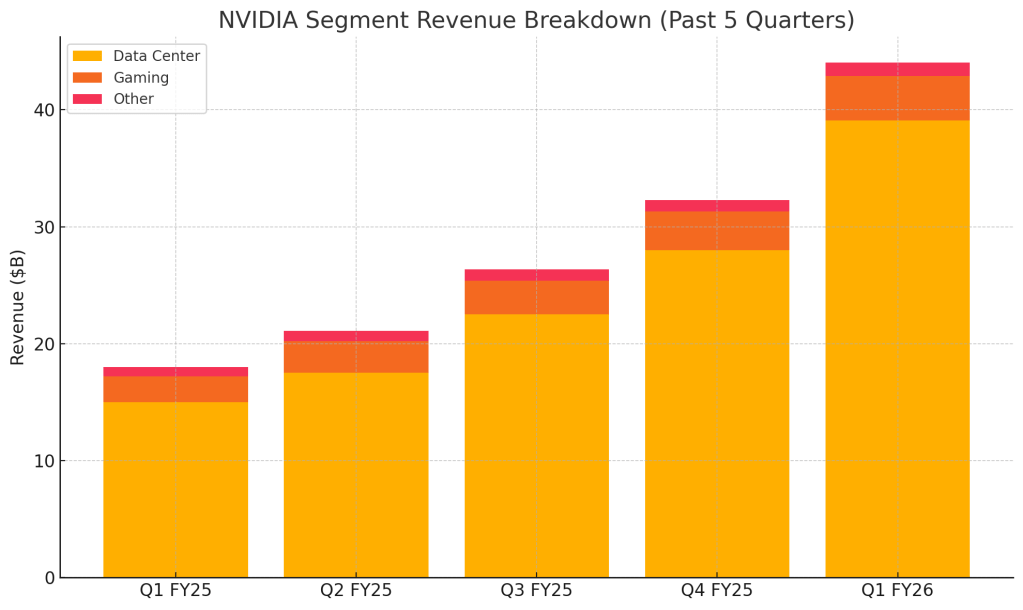
NVIDIA reported a stellar Q1 FY2026 with $44.06 billion in revenue, up 69% year-over-year, driven primarily by its Data Center segment which surged to $39.1 billion. The company’s full-stack AI platform, from Blackwell GPUs to CUDA software, continues to lead the industry.

However, a $4.5 billion inventory charge—triggered by U.S. export restrictions on H20 chips to China—cut into GAAP gross margin, bringing it down to 61.0%. Without this one-off, margins would have reached 71.3%.

CEO Jensen Huang maintained a confident tone, citing global momentum for AI compute and strong enterprise demand. Q2 guidance sits at $45 billion in revenue, despite an expected $8 billion China shortfall.

Line chart showing NVIDIA's revenue and net income growth from Q1 FY25 to Q1 FY26, highlighting consistent financial expansion.

What Changed Since Last Quarter

  • Revenue jumped 18% from Q4 FY2025’s $37.98B
  • China export losses increased and led to a $4.5B inventory charge
  • Blackwell ramp-up continued, now complemented by global AI partnerships
  • Margins would have improved sequentially if not for the export charge

Key Highlights

  • Revenue: $44.06B (+69% YoY, +18% QoQ)
  • Data Center Revenue: $39.1B (+73% YoY)
  • Gaming Revenue: $3.8B (+42% YoY)
  • Gross Margin (ex. H20 charge): 71.3%
  • Inventory Charge: $4.5B related to H20 China restrictions
  • Q2 Outlook: $45B revenue, ~$8B loss from China bans

Segment Revenue Breakdown

NVIDIA’s Q1 FY2026 results show that its Data Center business has become the overwhelming growth engine, with Gaming rebounding and smaller segments contributing steadily.

Stacked bar chart showing NVIDIA’s segment revenues, highlighting growth in Data Center and Gaming over 5 quarters.

SWOT Analysis with Price Impact

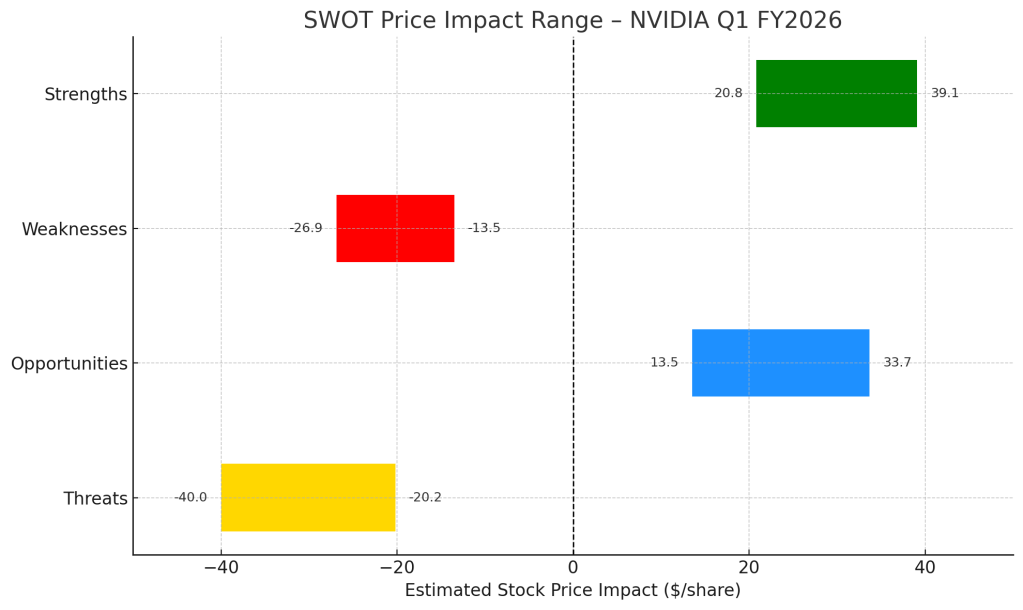
Horizontal bar chart showing estimated stock price impact for each SWOT factor, ranging from –$40 to +$40 per share.

Strengths

NVIDIA’s dominance in AI infrastructure remains unchallenged. Its platform—from Blackwell chips to CUDA and software libraries—continues to see record enterprise demand.
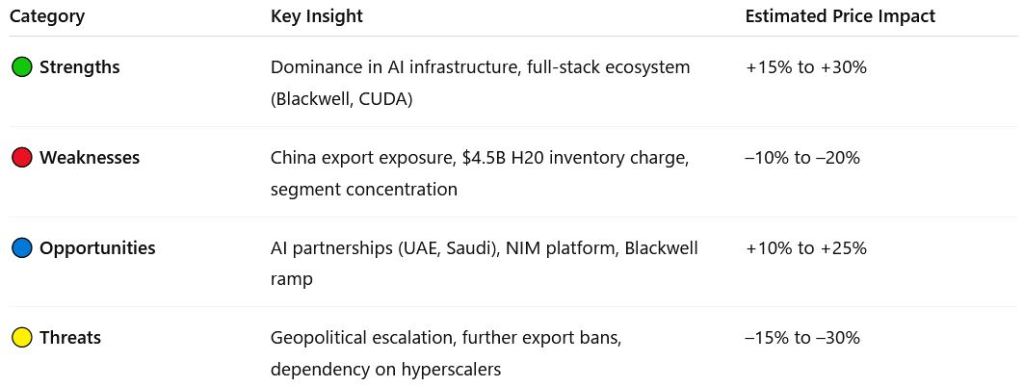
Price Impact: +15% to +30%

Weakness

The $4.5B write-down tied to H20 inventory for China highlights dependency on export-sensitive products.
Price Impact: –10% to –20%

Opportunities

New AI alliances with Saudi Arabia, UAE, and Taiwan, along with platform expansion via NIM (Inference Microservices), open large future markets.
Price Impact: +10% to +25%

Threats

China restrictions are set to cost $8B in Q2 revenue. Further geopolitical escalation may erode future sales or strain global operations.
Price Impact: –15% to –30%

SWOT Summary

Table summarizing NVIDIA’s Q1 FY2026 SWOT analysis with strengths in AI leadership, weaknesses in China exposure, opportunities in global AI expansion, and threats from geopolitical risks, each with estimated stock price impacts.

What’s NVIDIA Worth After Q1 FY2026?

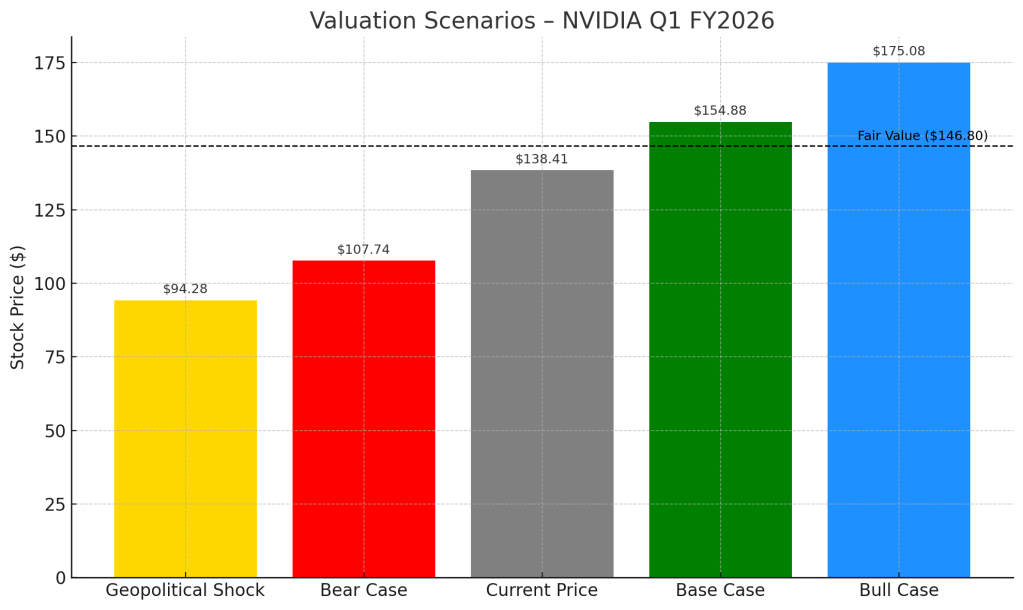
To value NVIDIA after its blockbuster Q1 FY2026 earnings, we consider three realistic scenarios for its forward earnings power—each reflecting a different blend of AI infrastructure growth, export risks, and margin execution.

Bar chart showing valuation scenarios from worst case ($94.28) to bull case ($175.08) with fair value line at $146.80.

Bull Case – $412.50/share (25% probability)

In the most optimistic scenario, NVIDIA ramps Blackwell faster than expected and U.S. export restrictions ease, allowing China sales to partially recover. Enterprise demand for generative AI compute remains red-hot globally, lifting both volumes and pricing. If earnings rise to $7.50 per share and the market awards a 55x multiple (consistent with high-growth AI comps), the stock could reach $412.50. While aggressive, this case reflects NVIDIA’s AI platform expanding into global infrastructure—and we assign it a 25% probability.

Base Case – $307.20/share (60% probability)

The base case assumes NVIDIA continues executing well, with growth sustained in the U.S., Middle East, and Asia-Pacific (excluding China). Blackwell adoption progresses on schedule, but China restrictions persist. Margins remain strong, but headline volatility lingers. We estimate forward EPS at $6.40 and apply a P/E of 48x—slightly below peak valuation—yielding a $307.20 price target. This scenario reflects the most likely outcome given current guidance and market conditions.

Bear Case – $200.00/share (15% probability)

In a downside case, AI capex moderates, China-related risks escalate, and competitors gain share in inference or custom silicon. NVIDIA faces pricing pressure or slower enterprise uptake. If forward EPS falls to $5.00 and valuation compresses to 40x, the stock could be re-rated to $200. While less likely in the near term, we assign this outcome a 15% probability due to macro and geopolitical uncertainties.

Valuation Scenarios Summary

Table comparing NVIDIA’s bull, base, and bear case stock valuations for Q1 FY2026, including EPS estimates, P/E multiples, target prices, and probabilities.

Fair Value Estimate: $308.95

Weighted across all three outcomes, our fair value estimate for NVIDIA is $308.95 per share—more than double its current price of ~$133.59 (as of June 2025). That implies significant long-term upside, especially if export risks stabilize and Blackwell adoption broadens globally.


(0.25 × $412.50) + (0.60 × $307.20) + (0.15 × $200.00) = $308.95


What to Watch Next Quarter

  • Ramp-up of Blackwell shipments outside China
  • Progress on AI factory partnerships in UAE and Saudi Arabia
  • Margin recovery trends
  • Policy developments in U.S.-China tech export restrictions

Verdict

NVIDIA remains the cornerstone of AI infrastructure. Q1 FY2026 reaffirms its growth engine, but investors should watch for regulatory headwinds. For growth stock investors, it’s a strong hold and a potential buy on dips.


Call to Action

📬 Like this kind of breakdown?
Subscribe to SWOTstock for clear, official-report-based earnings breakdown.


Disclaimer

This article is based entirely on NVIDIA’s Q1 FY2026 financial report, earnings call transcript, and management statements. It does not constitute investment advice.


Leave a comment


Why Goldman Is Backing Baidu: AI Cloud Momentum Meets Policy Tailwinds

Baidu is experiencing substantial growth in its AI cloud services, with a 42% increase despite a 6% decline in advertising revenue, leading to decreased earnings. Goldman Sachs maintains a Buy rating, citing strategic investments. However, risks include U.S. chip restrictions and regulatory changes. Baidu’s valuation suggests potential upside if AI monetization improves.

TL;DR: Baidu’s AI Cloud Is Booming, But Ad Weakness Lingers

Goldman Sachs reaffirmed its Buy rating on Baidu despite trimming its price target. Beneath the drag of declining ad revenue lies a fast-growing AI cloud engine and deep integration into China’s AI strategy. In Q1 2025, Baidu’s cloud grew over 40%, outpacing peers like Alibaba and Tencent. While earnings dipped, strategic investments in ERNIE AI and Apollo Go are gaining traction. At ~$84, Baidu trades at a 20–25% discount to its estimated fair value.

Clean infographic summarizing Baidu’s Q1 2025: +42% AI Cloud growth, –6% ad revenue decline, investments in Ernie AI and Apollo Go, and a 20–25% valuation discount, with no footer text.

Quick Risk Snapshot

Top 3 Risks at a Glance

  • Export Controls: U.S. chip curbs may limit Baidu’s model training capabilities
  • Regulatory Crackdown: Surprise data or AI rules in China could cut valuations overnight
  • Monetization Gap: ERNIE is technically impressive—but where’s the revenue?

Q1 2025 Recap: AI is Surging, but Ads Still Weigh on Profitability

Baidu delivered a mixed but forward-looking quarter. Revenue rose 3% YoY to ¥32.45 billion, beating expectations, driven by a 42% jump in AI Cloud services. However, its core advertising revenue declined 6%, pulling EPS down by 7%.

Management emphasized that Baidu is no longer just an ad business. CFO Junjie He called AI Cloud a “structural growth engine,” with new pricing strategies designed to build market share quickly.

Why it matters: This quarter signals that Baidu is chasing scale and infrastructure leadership—not just short-term margins.

Bar chart comparing Baidu’s Q1 2025 segment revenue: AI Cloud at ¥9.4B and Ad Revenue at ¥16.0B, highlighting the company’s growing cloud business versus its declining ad segment.

Key Highlights

  • Revenue: ¥32.45B (+3% YoY)
  • Adjusted EPS: ¥18.54 (–7% YoY)
  • AI Cloud: ¥9.4B (+42% YoY)
  • Ad Revenue: ¥16.0B (–6%)
  • ERNIE AI: Free-tier and Turbo upgrades launched
  • Apollo Go: Overseas ops launched in UAE and Switzerland
  • Buybacks: $445M in Q1; $2.1B total
  • Ratings: Goldman, Benchmark maintain Buy
Line chart comparing Baidu’s revenue and net income over the last five quarters (Q1 2024 to Q1 2025), showing consistent revenue near ¥32–34B and rising net income peaking at ¥7.72B in Q1 2025.

SWOT Analysis: A High-Potential Pivot With Limited Room for Error

Let’s break it down using the SWOT framework—what’s working, what’s not, where upside lies, and what could derail the story.

Strengths

  • AI Cloud Outperformance: 42% growth beats Alibaba (+18%) and Tencent (+5%)—suggests Baidu’s architecture is gaining real-world adoption.
  • ERNIE Model Pipeline: Free, open-access models with advanced reasoning (X1) and multimodal capability (4.5) aim to build developer lock-in.
  • Backed by Big Names: Goldman and Benchmark keeping Buy ratings provides institutional cover.

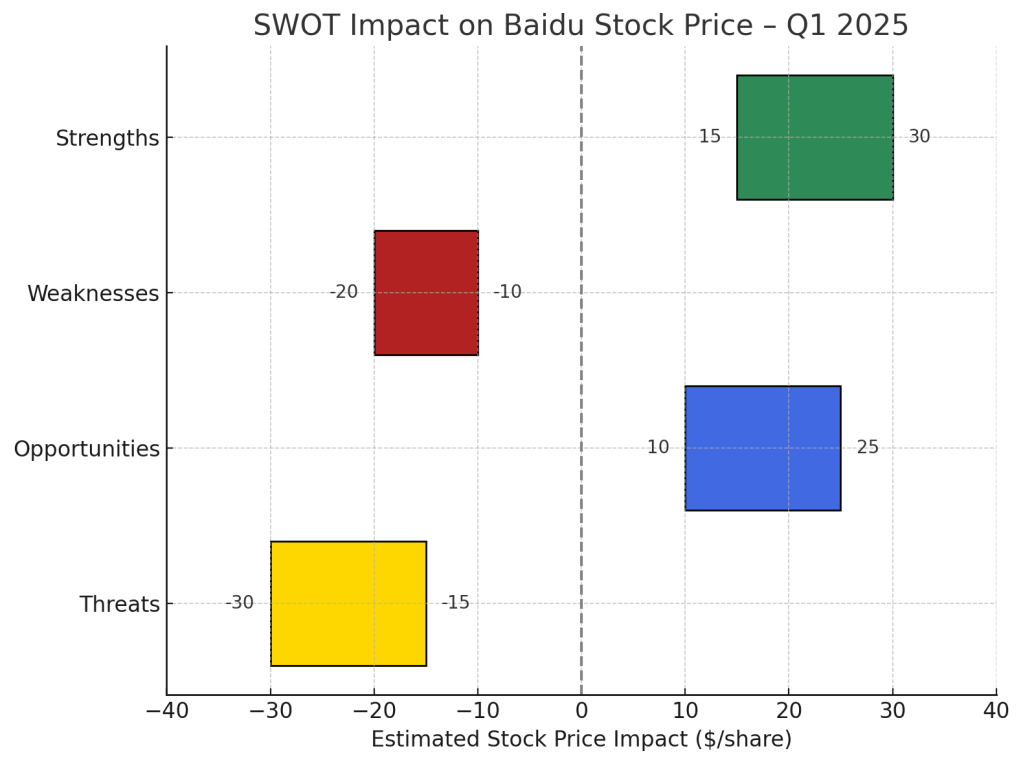
+ Price Impact: +$15 to +30

Weaknesses

  • Ad Revenue Shrinkage: 6% drop in core advertising weakens cash flow reliability.
  • Earnings Pressure: Margin compression from free tools, price cuts, and rising AI compute costs.
  • Transparency: Baidu’s upbeat tone feels disconnected from profitability trends—investors may question reporting quality.

– Price Impact: –$10 to –20

Opportunities

  • China AI Policy Tailwinds: Backed by a ¥60B national AI fund, Baidu is well-positioned as a state-aligned infrastructure play.
  • Apollo Go Global: Early mover in robotaxis beyond China borders—may attract sovereign or enterprise partnerships.
  • AI Monetization Path: If Baidu can convert ERNIE from R&D to revenue via enterprise tools or cloud inference APIs, re-rating likely.

+ Price Impact: +$10 to +25

Threats

  • Tech Export Curbs: U.S. chip bans on Nvidia/AMD AI hardware limit model training capacity.
  • Rising Domestic Competition: Alibaba’s Tongyi Qianwen and Tencent’s Hunyuan are growing fast with commercial APIs.
  • Delisting/Regulatory Risk: ADR structure, CCP data controls, or surprise regulation could drastically change valuation environment.
  • Currency Volatility: RMB depreciation adds an FX layer to Baidu’s dollar-denominated shares.

– Price Impact: –$15 to –30

Factor Range Impact Notes
Strengths +15 to +30 Cloud & ERNIE momentum
Weaknesses –10 to –20 Ad reliance, earnings fade
Opportunities +10 to +25 Policy & mobility tailwinds
Threats –15 to –30 Geopolitical and regulatory

Implied Range: $69 – $114 vs current price ~$84

Horizontal SWOT chart showing Baidu’s Q1 2025 stock price impact estimates, with fixed x-axis from –40 to +40: Threats (–30 to –15), Opportunities (+10 to +25), Weaknesses (–20 to –10), Strengths (+15 to +30), and a vertical dashed baseline at $0.

Valuation Scenarios: How It Could Play Out

Valuation = EPS forward ​× P/E

Base Case – 7.00 × 15 = $105

Cloud keeps scaling, ads stabilize
Probability: 60%

Bull Case – 7.75 × 18 = $140

Enterprise AI lands, Apollo Go JV, margin gains
Probability: 25%

Bear Case – 5.00 × 15 = $75

AI stalls, chip blocks hit hard, new China policy drop
Probability: 15%

Weighted Average Estimate: $106.25 → +26% upside

(105×0.6)+(140×0.25)+(75×0.15)=106.25

Chart comparing Baidu’s Q1 2025 valuation scenarios: Bear Case ($75), Base Case ($105), Bull Case ($140), alongside current price ($84) and a dotted fair value line at $106.25.

Verdict: Cautiously Optimistic, AI-Led Rerating Is Possible

Baidu’s execution is improving, even as its earnings lag. AI Cloud is clearly working. ERNIE shows potential. Apollo Go is going international. Still, transparency, monetization, and policy remain wildcards.

If you believe China is serious about tech independence, Baidu is its AI bet. The risk/reward is no longer binary—but still asymmetric.

Our Take: Slightly undervalued. Buy/accumulate with a long-term AI view.


What Would Change Our View?

Upside Triggers

  • AI monetization evidence (cloud APIs, enterprise adoption)
  • Positive shift in U.S.-China chip policy
  • Robotaxi revenue in H2

Downside Red Flags

  • Surprise AI regulation in China
  • Margin compression without revenue pickup
  • Negative audit news or delisting pressure

Call to Action

Want more AI-powered investment breakdowns—without the hype? Follow @SWOTstock and get the next big move before the headlines hit.


Disclaimer

This post is based solely on Baidu’s official financial report, earnings call, and verified analyst commentary. It is not investment advice. Please do your own research.


Leave a comment