Why Oracle Soared While Adobe Slipped: What Diverging Stock Reactions Reveal About Investor Confidence in AI

Oracle and Adobe both beat earnings expectations, but their stocks moved in opposite directions. Discover why Oracle soared while Adobe slipped—and what it reveals about investor confidence in AI execution vs. hype.

Two enterprise tech giants—Oracle and Adobe—both reported strong quarterly results this past week. Each beat Wall Street expectations and highlighted their advancements in artificial intelligence. But the stock market reaction couldn’t have been more different:

  • Oracle stock surged +13%
  • Adobe stock declined –7%

At SWOTstock, we examined the earnings reports, management commentary, and investor sentiment. What we found illustrates a growing gap in how the market values AI strategy: it’s not about who talks the loudest—it’s about who delivers results.

Visual comparison chart of Oracle and Adobe's Q2 FY2025 earnings and AI strategies. The chart contrasts both companies across key metrics: revenue growth (+11% each), AI strategy (Oracle monetizing, Adobe uncertain), cloud momentum (Oracle’s OCI +52%), revenue visibility ($138B RPO for Oracle), and stock reaction (+13% vs. –7%). Highlights Oracle's strong execution versus Adobe’s investor skepticism.

Oracle: AI Execution Drives Confidence and Capital

Oracle’s Q4 FY2025 earnings confirmed the company’s transformation from legacy enterprise vendor to cloud-first AI infrastructure provider. Revenue climbed 11% YoY, while Oracle Cloud Infrastructure (OCI) accelerated an impressive 52%.

What truly stood out was Oracle’s $138 billion in remaining performance obligations (RPO), offering investors forward-looking visibility. With high-profile partnerships (NVIDIA, Cohere) and GenAI workloads already in production, Oracle isn’t pitching an AI future—it’s reporting on AI present.

SWOTstock Takeaway
Oracle’s strength lies in its ability to turn AI demand into revenue now—not years from now.

Key Strengths:

  • Cloud Infrastructure (OCI) grew +52% YoY
  • AI partnerships with NVIDIA and Cohere are already monetizing
  • $138B RPO provides long-term visibility and stability

Risks to Watch:

  • Continued competition from AWS, Microsoft, and Google
  • Legacy on-premise business still weighs on blended growth
Oracle SWOT analysis chart with four quadrants:

    Strengths: Strong OCI momentum, deep enterprise relationships

    Weaknesses: Slow AI service adoption, legacy business drag

    Opportunities: Expanding AI workload footprint, growing infrastructure demand

    Threats: Cloud competition from hyperscalers, changing enterprise IT spending trends

Adobe: Solid Results, But Investors Want AI ROI

Adobe’s Q2 FY2025 results were strong on the surface: 11% revenue growth, earnings beat, and raised guidance. Yet investors responded with skepticism, sending the stock down 7%.

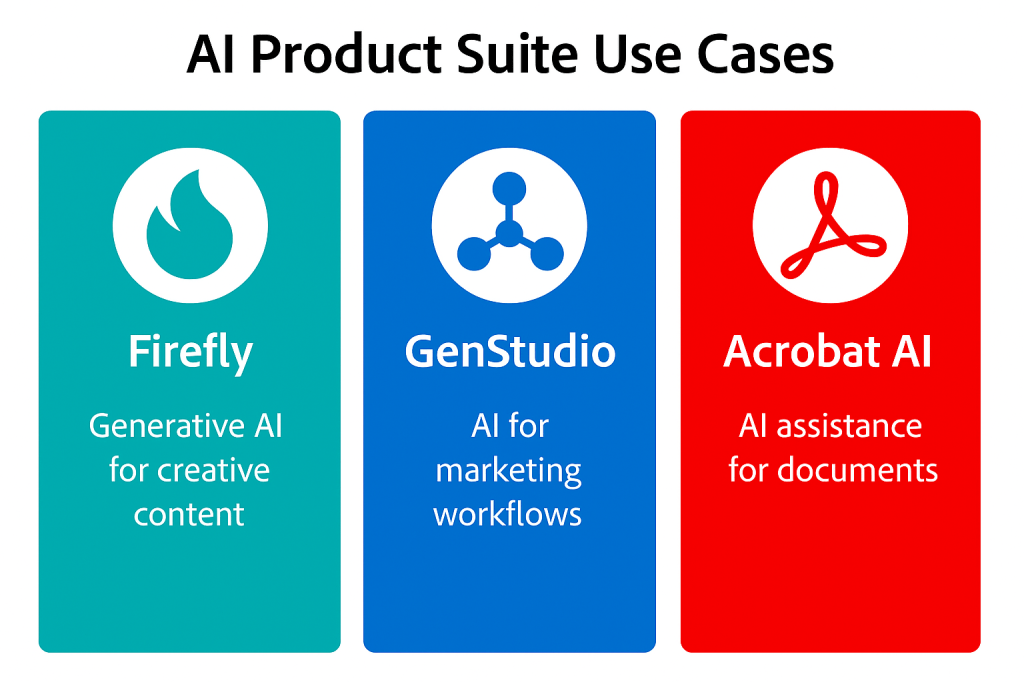
The issue? Despite promoting new AI tools like Firefly, GenStudio, and Acrobat AI, Adobe has yet to show how these innovations will contribute meaningful revenue in the short term. Investor patience is wearing thin.

Meanwhile, competition is heating up. Canva is gaining ground in design, while OpenAI and Google are introducing productivity tools that threaten Adobe’s document business. In this environment, a premium pricing model without clear AI-driven ARR growth becomes difficult to defend.

SWOTstock Takeaway
Adobe’s innovation story is still credible, but without visible monetization, the stock is vulnerable.

Key Strengths:

  • Industry-leading suite across Creative, Document, and Experience Cloud
  • Rapid rollout of AI-powered features

Risks to Watch:

  • No clear monetization path from AI features
  • Growing threats from Canva, OpenAI, and Google
  • Pressure on margins and customer retention
SWOT analysis chart of Adobe featuring the company logo at the center. The four quadrants highlight:

    Strengths: Leading creative software suite, growing AI capabilities

    Weaknesses: High valuation concerns, reliance on Creative Cloud

    Opportunities: Expansion into diverse AI applications, enterprise software potential

    Threats: Economic uncertainty, increasing competition in creative software market

Why the Divergence?

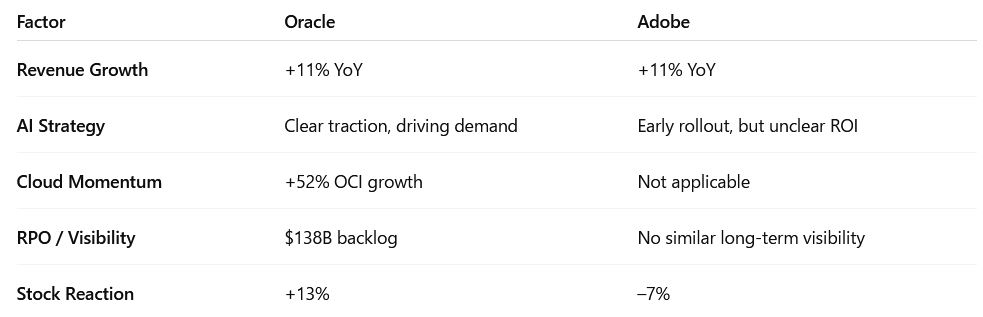
Despite similar top-line growth, the market saw Oracle and Adobe very differently:

Table comparing Oracle and Adobe’s Q2 FY2025 earnings and market reactions. Oracle delivered +11% revenue growth, +52% OCI growth, and a $138B RPO backlog, leading to a +13% stock surge. Adobe also posted +11% revenue growth but lacked visible AI monetization and competitive defense, resulting in a –7% stock drop.

Oracle showed the market what execution looks like. Adobe reminded investors that potential alone is no longer enough.


What to Watch in the Next 6–12 Months

🔮 Oracle Outlook:
Expect continued strength if cloud growth persists and GenAI partnerships scale. RPO offers downside protection in case of macro softness.

⚠️ Adobe Outlook:
Needs to prove that AI tools are driving ARR and enterprise wins. Without that, competitive pressures may accelerate valuation compression.


Final Thoughts: AI Is Entering the Show-Me Phase

This earnings season proves that we’re past the AI hype cycle. The market is now demanding proof—measurable, monetizable traction.

At SWOTstock, we’ll keep tracking this shift as it plays out in earnings calls, product roadmaps, and valuation resets.

👉 Follow us for AI-enhanced stock insights built for growth-minded and DIY value investors.


⚠️ Disclaimer

This analysis is based on publicly available company financials, earnings call commentary, and official press releases as of June 2025. It is intended for informational purposes only and does not constitute investment advice. Always perform your own due diligence.


Leave a comment


🧠 Adobe Q2 FY2025: AI Gains Momentum, But Wall Street Lags Behind

Adobe reported strong Q2 FY2025 results with $5.87 billion in revenue and raised its full-year guidance, driven by accelerating AI adoption. Despite this, the stock fell slightly, possibly due to unmet investor expectations for detailed AI revenue. Analysts see potential upside, making it an attractive long-term investment opportunity.

🚨 TL;DR — The Market Isn’t Rewarding This Beat (Yet)

Adobe (NASDAQ: ADBE) delivered double-digit growth, accelerating AI adoption, and raised full-year guidance. Yet the market response was muted. With fundamentals clearly improving and AI monetization tracking ahead of schedule, this gap presents an opportunity for long-term investors.


📆 A Strong Quarter Powered by AI and Recurring Revenue

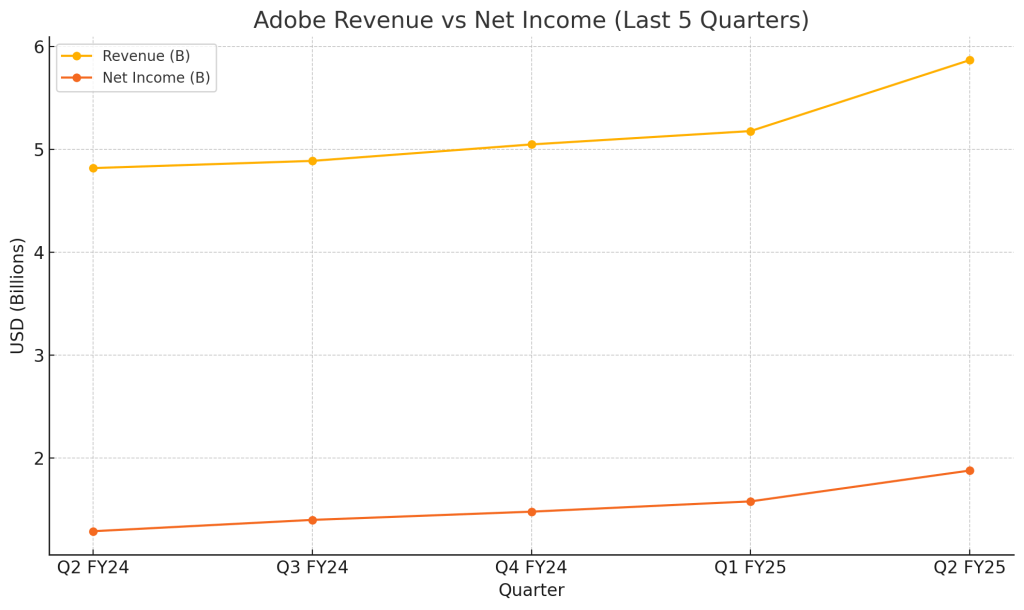
Adobe posted another record quarter with $5.87 billion in revenue (up 11% YoY) and $5.06 in non-GAAP EPS (up 13%). Management raised full-year revenue and EPS guidance, reflecting confidence in the AI product suite and its impact on customer value.

Line chart showing Adobe’s revenue and net income trends over the past five quarters, highlighting Q2 FY2025 record performance.

✨ Q2 FY2025 Highlights at a Glance

  • Revenue: $5.87B (+11% YoY)
  • Non-GAAP EPS: $5.06 (+13%)
  • Operating Income: $2.67B (non-GAAP)
  • Digital Media ARR: $18.09B (+12.1%)
  • Business Pros & Consumers: $1.6B revenue (+15%)
  • MAUs: 700M+ across Acrobat & Express (+25%)
  • AI monetization on track to surpass $250M ARR
  • Operating Cash Flow: $2.19B
  • Shares Repurchased: 8.6M
  • FY2025 Guidance Raised: Revenue to $23.5–23.6B; EPS to $20.50–$20.70

🚀 What’s Driving Growth: Firefly, Acrobat AI, GenStudio

CEO Shantanu Narayen confirmed that Firefly, Acrobat AI Assistant, and GenStudio are central to Adobe’s AI push. Adoption of these tools is growing across both creative pros and new user groups, such as business professionals and educators. While Adobe doesn’t break out revenue by product, they reiterated that AI-driven ARR is already contributing “billions” and tracking ahead of plan.


📉 Why the Stock Fell Despite the Beat

Adobe’s stock dipped around 1% in after-hours trading — a familiar pattern for growth names with high expectations. Although Adobe raised guidance and showed real AI traction, investors may have been hoping for more granular AI revenue breakdowns or a clearer timeline for when this monetization becomes a larger part of total ARR.

Additionally, macro uncertainty and the strong YTD performance likely triggered some profit-taking. But CFO Dan Durn also noted that demand rebounded in Q2, a sign that macro pressures may be easing.


🧩 SWOT Analysis: What’s Driving the Price Range?

Adobe’s own financial data and management commentary give us a clear view of its strengths and risks. Among the positives: accelerating AI monetization, strong margins, a growing base of non-creative users, and consistent free cash flow. These fundamentals could justify a price range of $455 to $475 — representing 10–15% upside.

On the flip side, investors may be disappointed by the lack of specific AI revenue detail. Combined with cautious buyback disclosures, these introduce a near-term downside risk of 3–5%. Macroeconomic pressure or poor execution on AI could also push the stock toward the $385–$390 level.

Horizontal bar chart visualizing Adobe’s SWOT analysis with estimated stock price impact ranges for Strengths, Weaknesses, Opportunities, and Threats.

📊 SWOT Summary Table

Table summarizing Adobe’s Q2 FY2025 SWOT analysis with estimated stock price impact ranges for strengths, weaknesses, opportunities, and threats.

🔮 What’s Adobe Worth? Valuing the Stock Based on Official Guidance

Using Adobe’s internal EPS guidance and valuation history, we mapped out three scenarios:

  • Bull Case: AI monetization exceeds expectations and Adobe reclaims a premium P/E multiple (30×).
    → $20.70 EPS × 30 = $621
  • Base Case: Adobe delivers its guidance and trades at 24×, slightly below its historical average.
    → $20.60 × 24 = $494
  • Bear Case: AI monetization stalls and valuation contracts to 19×.
    → $20.50 × 19 = $389
Bar chart comparing Adobe’s bear, base, and bull case valuation targets with a dashed line indicating the current share price and a dotted line for fair value.

Weighting these scenarios (20% bull, 60% base, 20% bear), our fair value estimate is $498.40 — roughly 20% above the current price of $413.


🏁 Our Take: Mispricing Creates Opportunity

Adobe’s raised guidance, strong recurring revenue growth, and accelerating AI adoption all point to a business gaining momentum. Even more compelling: our fair value estimate of $498 closely mirrors the average analyst target of ~$497, reinforcing the case for upside.

Management noted that demand improved sequentially in Q2, a sign that macro headwinds may be easing. While competition in generative AI is heating up across creative tools, Adobe is positioning itself well by embedding AI across its full product suite.

For long-term investors with a focus on high-quality, cash-generative, AI-leveraged software businesses, the post-earnings dip appears to be a gift.


💬 Like This Analysis? Get More on SWOTstock

At SWOTstock, we distill earnings calls, official filings, and executive strategy into investor-ready breakdowns — backed by data and free from noise. Please subscribe to stay on top.


⚠️ Disclaimer

This post is based entirely on Adobe’s official financial statements and earnings call from Q2 FY2025. It is not financial advice.


Leave a comment


Snowflake Q1 FY2026: AI Promise Gains Ground, But Can the Stock Justify Its Premium?

Snowflake Q1 FY2026 earnings recap: 26% product revenue growth, expanding AI platform with Cortex, and a strategic pivot toward enterprise AI workloads. Explore SWOT analysis, valuation scenarios, and investor insights.

TL;DR – AI Momentum Is Building, But Valuation Is a Hurdle

Snowflake (NYSE: SNOW) delivered another solid quarter, with strong growth in product revenue and promising early traction in AI-native services like Cortex. While the company continues to execute on its transition from data warehouse to AI platform, GAAP profitability remains elusive. The stock is trading above $200, which reflects confidence in long-term AI monetization—but may leave little room for near-term execution missteps.


Quarter Recap – Solid Fundamentals, Strong Vision, and Rising Expectations

Snowflake entered fiscal 2026 with impressive momentum. Product revenue grew 26% year-over-year to $996.8 million, supported by rising demand from enterprise clients and sustained usage from technology-forward organizations. Total remaining performance obligations (RPO) reached $6.7 billion, a 34% increase, signaling deep customer commitment over the coming quarters.

Yet what made this quarter stand out wasn’t just the numbers—it was the strategic tone. CEO Sridhar Ramaswamy framed the company’s evolution clearly: Snowflake is aiming to become the infrastructure backbone of enterprise AI. The recent launch of Cortex allows users to run LLMs and vector search on their own data, within Snowflake’s platform. This integration is expected to expand use cases and deepen wallet share with customers.

CFO Mike Scarpelli acknowledged that macro pressures still influence some customer segments, but also noted increasing contributions from AI-native businesses. These companies are growing their consumption faster and could become a larger revenue driver over time.

In short, this was a quarter where the fundamentals held steady—but the vision pushed forward even more aggressively.


Key Highlights

Line chart showing Snowflake’s quarterly revenue and net income trends from Q1 FY25 to Q1 FY26, highlighting growth and ongoing GAAP losses.
  • Product Revenue: $996.8M (+26% YoY)
  • Total Revenue: $1.04B
  • RPO: $6.7B (+34% YoY)
  • Net Revenue Retention: 124%
  • Customers with >$1M TTM Product Revenue: 606 (up from 485 YoY)
  • Non-GAAP Operating Margin: 9%
  • GAAP Operating Loss: $447M
  • Stock Buybacks: $491M for 3.2M shares
  • Cash & Equivalents: $4.9B

What’s Working, What’s Risky – A Closer Look Through SWOT

Snowflake is a stock that forces investors to weigh long-term platform optionality against short-term valuation concerns. Here’s a structured breakdown of what’s unfolding beneath the headline figures.

Horizontal bar chart showing estimated stock price impact of Snowflake’s strengths, weaknesses, opportunities, and threats.

Strengths

Snowflake’s product revenue growth remains strong, and its customer expansion—especially among those spending over $1 million annually—is accelerating. Net revenue retention of 124% underscores the stickiness and expanding utility of its platform. This kind of enterprise engagement doesn’t happen by accident; it’s driven by real product need and trust.

Stock price impact estimate: +$15–20 if this strength remains consistent and margin discipline improves.

Weaknesses

Despite strong topline growth, Snowflake still posted a $447 million GAAP operating loss. Stock-based compensation remains a drag on profitability. And while buybacks support the stock, they also reduce cash flexibility if market conditions tighten.

Stock price impact: –$5–10 as margins and profitability concerns limit upward re-rating in the near term.

Opportunities

The company is betting big on AI. Cortex could become a high-margin differentiator if widely adopted. Snowflake also benefits from developer ecosystem momentum and the expanding Data Marketplace. If it becomes the default AI+data platform for enterprises, the upside could be meaningful.

Stock price upside estimate: +$25–40 if Cortex monetization scales successfully over the next 12–18 months.

Threats

Competition in this space is no joke. AWS, Google Cloud, and Databricks are all investing heavily in adjacent technologies. Additionally, Snowflake’s premium valuation leaves little room for error—any slowdown in growth or delay in AI execution could lead to multiple compression.

Risk-adjusted downside: –$20–30 if growth cools or AI monetization underwhelms.

"Table summarizing Snowflake’s Q1 FY2026 SWOT analysis with estimated stock price impacts. Strengths include strong revenue growth and customer expansion (+15 to +20). Weaknesses highlight GAAP losses and dilution risk (–5 to –10). Opportunities like AI platform Cortex and Data Marketplace offer potential upside (+25 to +40), while competitive and execution risks are flagged as threats (–20 to –30)."

Valuation Scenarios – What’s Priced In, and What’s Not

With Snowflake closing at $203.18 post-earnings, investors are clearly pricing in confidence in long-term platform growth. But how realistic is that pricing under different conditions?

Bar chart comparing Snowflake’s bear, base, and bull valuation scenarios with a black bar for current stock price and a dotted line for estimated fair value.

Base Case

  • Summary: Continued 25%+ product revenue growth, stable margin trajectory, Cortex adoption builds gradually
  • Estimated Fair Value: $150
  • Probability: 60%

Bull Case

  • Summary: Accelerated AI adoption, operating leverage unlocks quickly, free cash flow turns sustainably positive
  • Valuation: $240
  • Probability: 25%

Bear Case

  • Summary: Macro slowdown, AI workloads fail to monetize, continued margin drag
  • Valuation: $110
  • Probability: 15%

Weighted Average Fair Value

(150×0.6)+(240×0.25)+(110×0.15) = $157.50

At $203, the stock is pricing in the bull case—or close to it.


Verdict – Hold for Believers, Wait for Better Entry for Everyone Else

Snowflake is undeniably a category-defining company. Its platform moat is real, and its long-term relevance in enterprise AI looks promising. But the valuation today assumes a lot—particularly that Cortex and related AI monetization will ramp fast and wide.

If you’re already long and believe in the vision, it’s a Hold. If you’re looking to initiate a position, it may be wiser to wait for a pullback or more concrete signs of AI revenue contribution.


Want More Candid, Analyst-Style Stock Breakdowns?

Subscribe to our newsletter and follow us for deeper, data-driven takes on the biggest names in tech and AI. No hype, no noise—just strategy and substance.


Disclaimer

This article is based solely on Snowflake’s official Q1 FY2026 earnings report and call transcript. It is not financial advice. Always do your own due diligence before investing.


Leave a comment