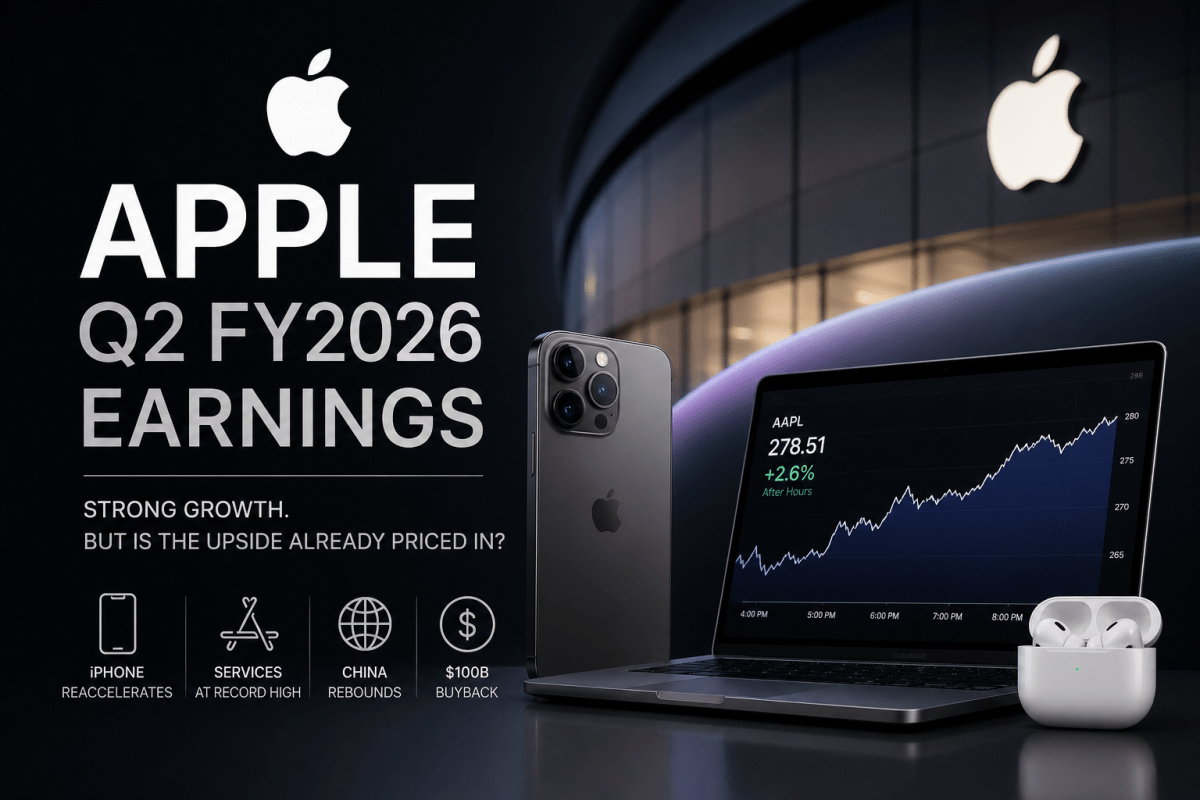
Alphabet Q1 2026 Earnings: AI Winner or Overpriced Giant?

Alphabet’s Q1 2026 results show strong revenue growth, driven by a 63% increase in Google Cloud and resilient Search performance. Despite a nearly 7% stock jump, underlying concerns about high valuation based on non-operating gains remain. The company is transitioning into a capital-intensive AI phase, stressing the importance of execution.

TL;DR Summary

Alphabet (GOOGL:NASDAQ) just delivered a breakout quarter — but the stock may have moved even faster than the fundamentals. Revenue surged, Cloud profits inflected, and AI is clearly driving engagement. The market responded with a nearly 7% jump, signaling growing confidence that Alphabet can win in the AI era.

However, once you strip out non-operating gains and normalize earnings, the valuation tells a more cautious story. At current levels, investors are paying for a future where AI monetization and Cloud profitability scale flawlessly — a future that is not fully proven yet.


Quarter Recap

Alphabet Inc. reported a strong Q1 2026, showing that its core business remains resilient even as the industry shifts toward AI. Revenue grew 22% year-over-year to $109.9 billion, while operating income climbed to $39.7 billion, expanding margins to over 36%.

The standout performance came from Google Cloud, which grew 63% and delivered a sharp increase in operating profit. Meanwhile, Search — the company’s core engine — continued to grow at a high-teens rate, contradicting fears that AI would immediately disrupt its dominance.

Management emphasized that AI is already increasing user engagement across products, with query volumes reaching all-time highs. At the same time, capital expenditures surged, reflecting the massive infrastructure buildout required to support AI at scale.


Key Highlights

  • Revenue: $109.9B (+22% YoY)
  • Operating income: $39.7B (+~30% YoY)
  • Operating margin: ~36%
  • Diluted EPS: $5.11 (~$2.35 from non-operating gains)
  • Google Cloud revenue: $20.0B (+63% YoY)
  • Google Cloud operating income: $6.6B (tripled YoY)
  • Capex (property & equipment): ~$35.7B

SWOT Analysis

Alphabet’s latest results mark a turning point. The company is no longer defending its position in AI — it is actively shaping the landscape. The key question now is not whether Alphabet can compete, but whether it can convert its scale advantage into sustainable profits.

Strengths

  • Cloud profit inflection (+10% to +18%)
    Google Cloud is now a real earnings contributor. This transition from growth to profitability could justify a structural re-rating of the business.
  • Search resilience in the AI era (+8% to +14%)
    Continued strong growth and rising engagement suggest that AI is enhancing, not replacing, Search — a major shift in narrative.
  • Unmatched AI distribution scale (+6% to +10%)
    Alphabet can deploy AI across billions of users through Search, YouTube, and Android, creating a monetization advantage that smaller AI players lack.

Weaknesses

  • Extreme capital intensity (-6% to -10%)
    AI infrastructure requires massive ongoing investment, which may pressure free cash flow and delay margin expansion.
  • High reliance on advertising (-4% to -7%)
    Despite diversification, the majority of revenue still comes from ads, exposing Alphabet to economic cycles.
  • Earnings quality distortion (-3% to -5%)
    A significant portion of EPS came from non-operating gains, which may not be repeatable.

Opportunities

  • AI-driven monetization expansion (+10% to +18%)
    If AI increases the value of each search interaction, Alphabet could unlock a higher revenue per user.
  • Cloud as a second profit engine (+8% to +15%)
    Continued growth and margin expansion in Cloud could materially change Alphabet’s earnings mix.
  • Enterprise AI ecosystem growth (+5% to +9%)
    Integration across Cloud, Workspace, and Gemini creates a powerful enterprise platform.

Threats

  • Sustained high AI cost structure (-8% to -14%)
    If inference and infrastructure costs remain elevated, profitability could be constrained.
  • Shift toward AI-native interfaces (-6% to -12%)
    Changes in user behavior away from traditional search could weaken Alphabet’s core moat over time.
  • Regulatory pressure (-4% to -8%)
    Ongoing antitrust scrutiny could impact distribution and growth.

Valuation Scenarios

Alphabet is now being priced as both a mature cash generator and a high-growth AI platform. The valuation depends heavily on whether AI investments translate into durable earnings growth.

Bear Case — $300–320

  • AI costs outpace monetization
  • Search growth slows
  • Earnings normalize without non-operating gains

→ Multiple compresses, leading to downside of 15–20%


Base Case — $360–390

  • Search remains stable
  • Cloud continues scaling profitably
  • AI monetization gradually offsets costs

→ Current valuation holds, with limited upside


Bull Case — $420–460

  • AI significantly increases monetization per query
  • Cloud becomes a major profit driver
  • Operating leverage improves despite high capex

→ Multiple expands, driving 15–25% upside


Probability-weighted fair value

  • Bear (20%): $310
  • Base (50%): $375
  • Bull (30%): $440

👉 Estimated fair value: ~$377


Verdict

Alphabet has clearly proven that it can compete — and even lead — in the AI era. The latest earnings remove a major overhang around Search disruption and validate the long-term potential of Google Cloud.

However, the stock’s sharp post-earnings move suggests that much of this optimism is already priced in. When adjusting for non-operating gains and considering the heavy capital requirements of AI, the current valuation leaves limited margin for error.

This is no longer a “buy at any price” growth story. It is a high-quality business transitioning into a capital-intensive phase, where execution matters more than ever.


Call to Action

If you want more AI-driven earnings breakdowns like this — focused on what actually moves stock prices — follow SWOTstock and stay ahead of the market narrative.


Disclaimer

This analysis is for informational purposes only and does not constitute financial advice. Always conduct your own research and consult with a qualified financial advisor before making investment decisions.

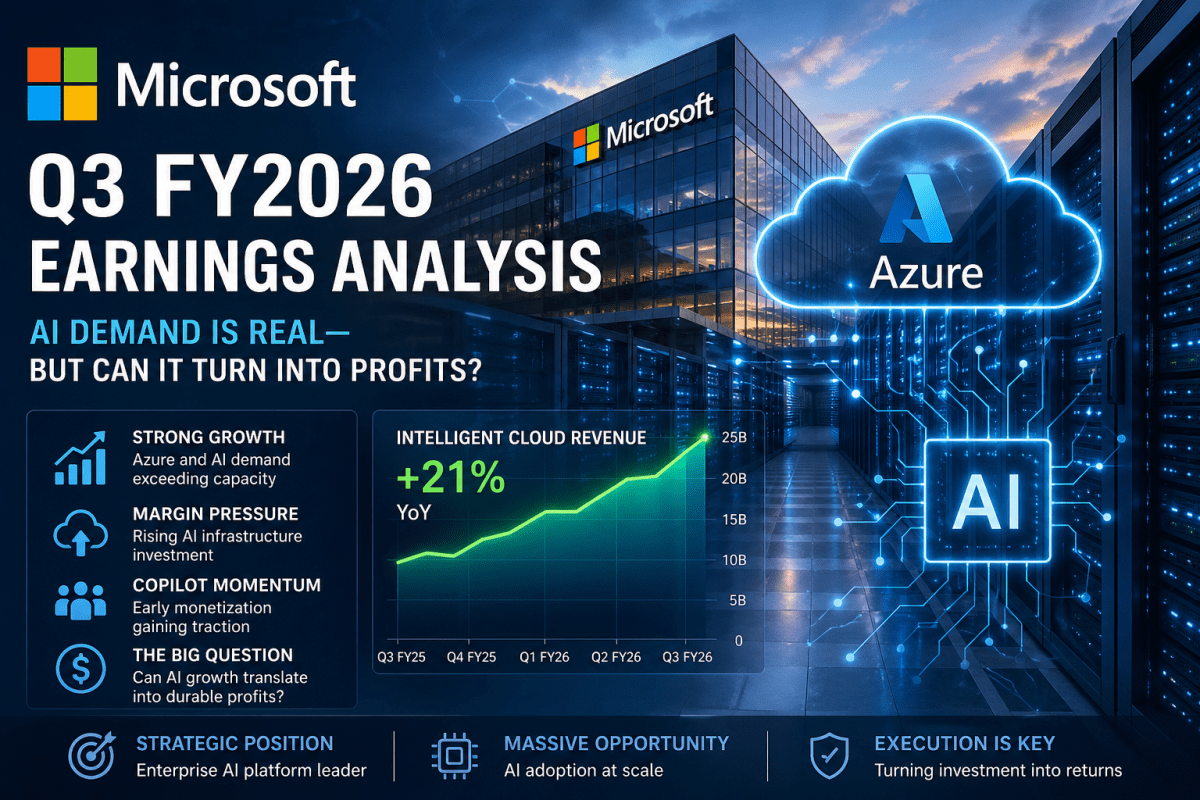
Microsoft Q3 FY2026 Earnings: AI Demand Is Real—But Can It Turn Into Profits?

Microsoft reported strong Q3 FY2026 results, primarily driven by AI and Azure demand. While investors are focused on AI’s profitability, the business faces rising costs due to infrastructure investments. The stock, priced around $425, reflects growth confidence but highlights uncertainty on margins, making future success dependent on effective execution and monetization strategies.

TL;DR Summary

Microsoft (MSFT:NASDAQ) delivered another strong quarter, driven by Azure and AI demand. The key signal—AI demand exceeding capacity—confirms real enterprise adoption.

But the story is shifting. Investors are no longer asking “Is AI real?” but rather “How profitable is AI?”

At ~$425, the stock reflects confidence in growth, but not full certainty on margins. That leaves Microsoft in a high-quality, fairly valued zone—with upside tied to execution, not hype.


Quarter Recap

Microsoft’s Q3 FY2026 results reinforce a consistent pattern: strong growth driven by cloud and AI, paired with rising investment intensity.

Revenue growth remained robust, supported by Azure and AI services. Management highlighted that demand for AI continues to outstrip available capacity, signaling strong forward visibility. This is one of the clearest indicators that AI is not theoretical—it is already being deployed at scale.

However, the cost side of the equation is becoming more visible. Continued investment in AI infrastructure—data centers, GPUs, and networking—has started to weigh on margins. This is not a sign of weakness, but it introduces a timing gap between investment and return.

The business mix continues to shift toward Intelligent Cloud and AI-driven services, while legacy segments remain stable but secondary.


Key Highlights

Microsoft’s performance this quarter can be summarized in one sentence:
AI demand is accelerating faster than the infrastructure supporting it.

Azure remains the core growth engine, increasingly tied to AI workloads. At the same time, early monetization signals from Copilot suggest Microsoft is successfully embedding AI into enterprise workflows.

Yet the trade-off is clear. Growth is strong—but it is capital-intensive.


Market Reaction

The market response was measured rather than dramatic. After-hours trading showed a slight gain of about +0.34%, bringing the stock to around $425.89.

This tells us something important.

Investors are not reacting to short-term margin pressure. Instead, they are focusing on long-term positioning. The slight positive move suggests confidence that AI investments will eventually translate into meaningful returns.

In other words, the market is currently willing to tolerate lower margins in exchange for future growth.


SWOT Analysis (with Price Impact Ranges)

Microsoft’s investment case now hinges on one central question:
Can AI demand be converted into durable, high-margin revenue?

Strengths

Microsoft’s strongest advantage is its position as the default enterprise AI platform. With Azure, Copilot, and deep integration into enterprise workflows, it has a clear monetization pathway that competitors struggle to replicate.

Estimated Impact: +8% to +12%


Weaknesses

The main constraint is capital intensity. AI requires sustained investment in infrastructure, creating near-term pressure on margins and delaying free cash flow realization.

Estimated Impact: -4% to -6%


Opportunities

The upside lies in scaling monetization. If AI usage translates into recurring, high-margin services—especially through Copilot and Azure—Microsoft could see both revenue acceleration and multiple expansion.

Estimated Impact: +6% to +10%


Threats

The biggest risk is economic efficiency. If AI remains expensive to operate or fails to deliver clear ROI for customers, growth could continue without corresponding profitability gains.

Estimated Impact: -5% to -8%

CategoryDriverPrice Impact
StrengthsAI demand + platform dominance+8% to +12%
WeaknessesCapex + margin pressure-4% to -6%
OpportunitiesAI monetization scaling+6% to +10%
ThreatsAI economics + ROI uncertainty-5% to -8%

Valuation Scenarios

Microsoft’s valuation now depends less on growth and more on how efficiently that growth converts into profit.

Base Case — Gradual Monetization

AI adoption continues steadily, with margins recovering over time.

Price Range: $430 – $470


Bull Case — Strong Monetization

AI becomes deeply embedded in enterprise workflows, driving high-margin recurring revenue.

Price Range: $500 – $560


Bear Case — Growth Without Leverage

AI demand remains strong, but profitability lags due to sustained high costs.

Price Range: $340 – $380


Probability-Weighted Fair Value

Estimated fair value: ~$456


Verdict

Microsoft remains one of the strongest structural winners in AI. Its platform positioning, enterprise distribution, and early monetization signals are all real advantages.

However, at current levels, the stock already reflects much of that optimism.

The investment case is no longer about whether Microsoft will grow—it is about whether it can convert that growth into efficient, high-margin returns.

At ~$425, the stock sits in a balanced zone:

Strong business, but limited margin of safety.


Call to Action

If you’re tracking AI leaders, Microsoft should remain on your core watchlist.

The key signals to monitor next:

  • Copilot adoption and pricing power
  • Azure AI workload monetization
  • Margin trajectory as AI scales

Follow SWOTstock for grounded, investor-focused analysis based on official company disclosures—not headlines.


Disclaimer

This content is for informational purposes only and does not constitute investment advice. Always conduct your own research before making investment decisions.

NVIDIA Q4 FY2026 Earnings: AI Dominance Intact — Is the Stock Still Underpricing the Cycle?

TL;DR Summary

NVIDIA (NVDA:NASDAQ) delivered another explosive quarter, with Q4 revenue up 73% year-over-year and Data Center revenue surging 75%. Gross margins remain near 75%, and management guided to $78B in next-quarter revenue — even excluding China data center compute revenue.

The AI infrastructure cycle is clearly not over.

Based on official financials and management guidance, fair value lands around $240–$250, versus the current price near $150. For growth investors, the debate is no longer whether NVIDIA is dominant — it’s whether the AI cycle can extend long enough to justify sustained premium valuation.


Quarter Recap

NVIDIA reported Q4 FY2026 revenue of $68.1B, up 73% year-over-year and 20% sequentially. The real engine remains Data Center, which generated $62.3B, growing 75% YoY.

Gross margins held near 75%, confirming that pricing power remains intact despite scale. Full-year FY2026 revenue reached $215.9B, up 65% from the prior year.

Management guided Q1 FY2027 revenue to $78B ±2%, notably excluding China data center compute revenue. That implies the core AI demand machine remains strong even under export constraints.


Key Highlights

• Data Center revenue continues to scale at hyperscale velocity

• Blackwell ramp is underway, supporting next-gen demand

• Gross margin durability near 75% signals structural advantage

• China revenue excluded from guidance, reducing forward visibility but also lowering expectation risk

• $41.1B returned to shareholders in FY2026 through buybacks and dividends


SWOT Analysis

NVIDIA is no longer being valued as a chipmaker. It is being valued as the foundational AI infrastructure layer. The sustainability of that thesis depends on ecosystem dominance, demand durability, and competitive containment.

Strengths

• AI infrastructure leadership with 75% YoY Data Center growth

Estimated price impact: +10% to +18%

• CUDA + NVLink ecosystem lock-in creating high switching costs

Estimated price impact: +8% to +15%

• Sustained gross margin near 75% demonstrating pricing power

Estimated price impact: +5% to +10%

• Visible product roadmap (Blackwell, Rubin) reducing cycle uncertainty

Estimated price impact: +6% to +12%


Weaknesses

• Heavy revenue concentration in Data Center

Estimated price impact: -8% to -15%

• Premium valuation near ~45x earnings requires near-flawless execution

Estimated price impact: -10% to -20%


Opportunities

• Inference demand expansion beyond training workloads

Estimated price impact: +10% to +20%

• Sovereign AI and enterprise adoption wave

Estimated price impact: +8% to +15%

• Software monetization and services layer expansion

Estimated price impact: +5% to +12%


Threats

• China export restrictions tightening further

Estimated price impact: -8% to -18%

• Hyperscaler custom silicon (ASICs) long-term margin risk

Estimated price impact: -10% to -20%

• AI capex digestion cycle if hyperscalers pause

Estimated price impact: -15% to -30%

NVIDIA Q4 FY2026 SWOT price impact range chart showing Strengths (+5% to +18%), Weaknesses (-20% to -8%), Opportunities (+5% to +20%), and Threats (-30% to -8%) with a zero reference line.
NVIDIA Q4 FY2026 SWOT price impact analysis. Strengths and Opportunities suggest upside potential of up to +20%, while Weaknesses and Threats indicate downside risk reaching -30%, highlighting both AI leadership momentum and valuation sensitivity.

Valuation Scenarios

Bear Case — AI Growth Moderates

Assumptions:

• EPS slows to ~$6.00

• Multiple compresses to ~30x

Target price: $170–$180

Probability: 25%


Base Case — Strong but Moderating Growth

Assumptions:

• EPS ~$6.50

• Multiple stabilizes ~40x

Target price: $240–$260

Probability: 50%


Bull Case — AI Cycle Extends Multi-Year

Assumptions:

• EPS ~$7.00+

• Multiple holds 45–50x

Target price: $300–$320

Probability: 25%


Probability-Weighted Fair Value

Weighted fair value: ~$246

Fair value range based strictly on official financials:

$240–$250

NVIDIA Q4 FY2026 valuation scenarios chart showing Bear case $170–$180 (25%), Base case $240–$260 (50%), and Bull case $300–$320 (25%) with a probability-weighted fair value of $246.
NVIDIA Q4 FY2026 valuation scenarios. The Base case ($240–$260) carries the highest probability at 50%, while the Bull case extends toward $320 if the AI cycle persists. The probability-weighted fair value stands near $246, with a $240–$250 range based strictly on official financials.

Verdict

For Type 1 growth investors, NVIDIA remains the clearest AI infrastructure winner. The numbers show no structural slowdown yet. Gross margins remain elite. Guidance implies continued scale.

The real risk is not weak demand — it’s cycle compression. If AI capex pauses, the stock will re-rate quickly. But as long as hyperscaler demand persists, NVIDIA remains structurally advantaged.

This is no longer an early-stage AI bet. It is an AI cycle duration bet.


Call to Action

If you follow AI infrastructure leaders, subscribe to SWOTstock for structured earnings breakdowns, price-impact SWOT analysis, and scenario-based valuation models built for growth investors.


Disclaimer

This analysis is for informational purposes only and does not constitute investment advice. Always conduct your own due diligence and consult a licensed financial advisor before making investment decisions.