Goldman Sachs Q4 2025: Earnings Power Is Back — Valuation Now Demands Durability

Goldman Sachs reported a strong Q4 2025, highlighting a recovery in capital markets with net revenues of $13.45 billion and net income of approximately $4.6 billion. The stock is now valued on sustained earnings strength, with future returns dependent on the durability of this recovery. Key opportunities and threats are outlined in a SWOT analysis.

TL;DR

Goldman Sachs (GS:NYSE) delivered a strong Q4 2025, confirming that capital markets activity has meaningfully recovered and earnings power has re-emerged. At today’s price, GS is no longer a balance-sheet or re-rating story. The stock is valued on sustained earnings strength, with future returns increasingly dependent on how durable this recovery proves to be through the next cycle.


Quarter Recap

Goldman Sachs closed out 2025 with a solid fourth quarter, reflecting improved client engagement across Investment Banking and Global Markets. Revenues rebounded, profitability strengthened, and returns moved back into the mid-teens. Management commentary pointed to healthier capital markets conditions and disciplined capital deployment, reinforcing the sense that GS has exited its post-cycle trough.


Key Highlights

  • Q4 net revenues: $13.45bn, driven by stronger Investment Banking and Markets activity
  • Net income: ~$4.6bn
  • EPS: $14.01, up meaningfully year over year
  • Annualized ROE: ~16%, back above through-cycle targets
  • Book value per share: $357.60
  • Quarterly dividend increased to: $4.50, signaling confidence in earnings durability

SWOT Analysis

At current valuation levels, Goldman Sachs is being priced primarily on normalized earnings power, not balance-sheet metrics. The SWOT below reflects that shift.

Strengths

Goldman’s core franchise is reasserting itself as capital markets normalize, with operating leverage returning across its most profitable businesses.

  • Investment Banking and trading rebound driving earnings momentum (+6% to +10%)
  • Mid-teens ROE supports a premium earnings multiple (+4% to +7%)

Weaknesses

Despite improvement, earnings remain inherently cyclical and sensitive to market conditions.

  • Revenue volatility tied to deal flow and trading activity (-6% to -10%)
  • Asset & Wealth Management margins remain below peak potential (-3% to -5%)

Opportunities

If capital markets recovery proves durable, earnings power could exceed current expectations.

  • Sustained M&A and issuance activity into 2026 (+8% to +14%)
  • Continued dividend growth and buybacks supporting total returns (+3% to +6%)

Threats

At current valuation levels, downside risk increases if the cycle turns earlier than expected.

  • Macro or market shock reducing client activity (-12% to -20%)
  • Regulatory or capital rule changes constraining ROE and payout capacity (-4% to -7%)
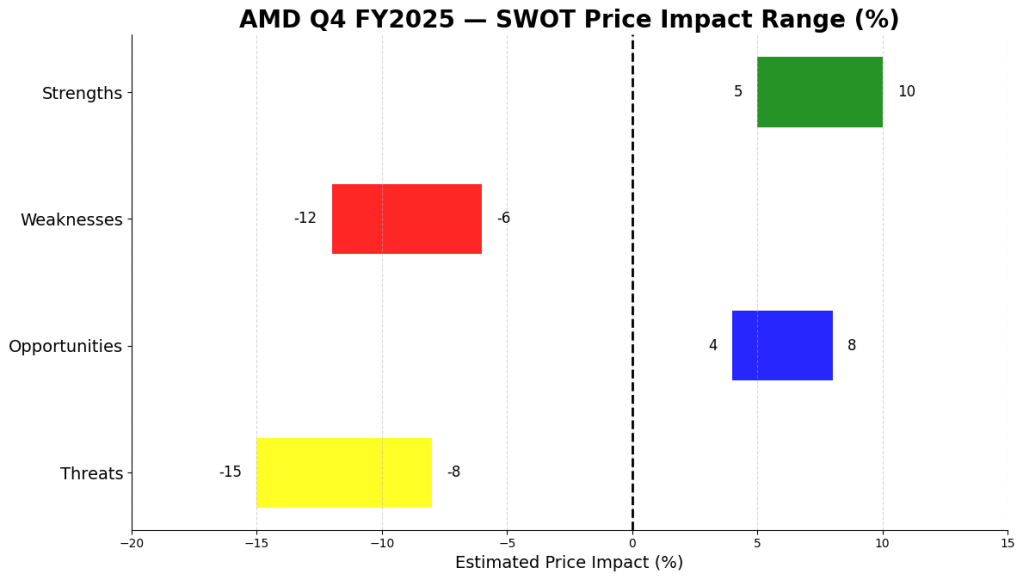
SWOT price impact range chart for Goldman Sachs Q4 2025, showing estimated percentage impact of strengths, weaknesses, opportunities, and threats on the share price.
SWOT price impact ranges highlight that Goldman Sachs’ upside is driven by capital markets recovery and earnings leverage, while downside risk remains tied to cycle sensitivity and macro conditions.

Valuation Scenarios

With GS trading far above book value, valuation should be framed around normalized earnings, not balance-sheet multiples.

Bear Case (~$675)

This scenario assumes the current capital markets rebound fades as macro conditions tighten.

  • Normalized EPS declines toward ~$45
  • Investment Banking and trading activity cool meaningfully
  • Operating leverage works in reverse, pressuring margins
  • Valuation compresses to ~15× earnings, typical of late-cycle conditions

Base Case (~$935)

The base case assumes capital markets stabilize at healthier, mid-cycle levels.

  • Normalized EPS of ~$52, broadly in line with FY 2025 earnings power
  • Deal activity and trading remain solid but not overheated
  • The stock trades at ~18× earnings, reflecting franchise strength with cyclical risk

Bull Case (~$1,160)

The bull case assumes a sustained and broad-based capital markets recovery.

  • Normalized EPS rises toward ~$58
  • Strong M&A, IPO, and trading activity drive operating leverage
  • Valuation expands to ~20× earnings on improved earnings visibility

Probability-Weighted View

  • Bear: 25%
  • Base: 50%
  • Bull: 25%

Probability-weighted fair value: ~$950

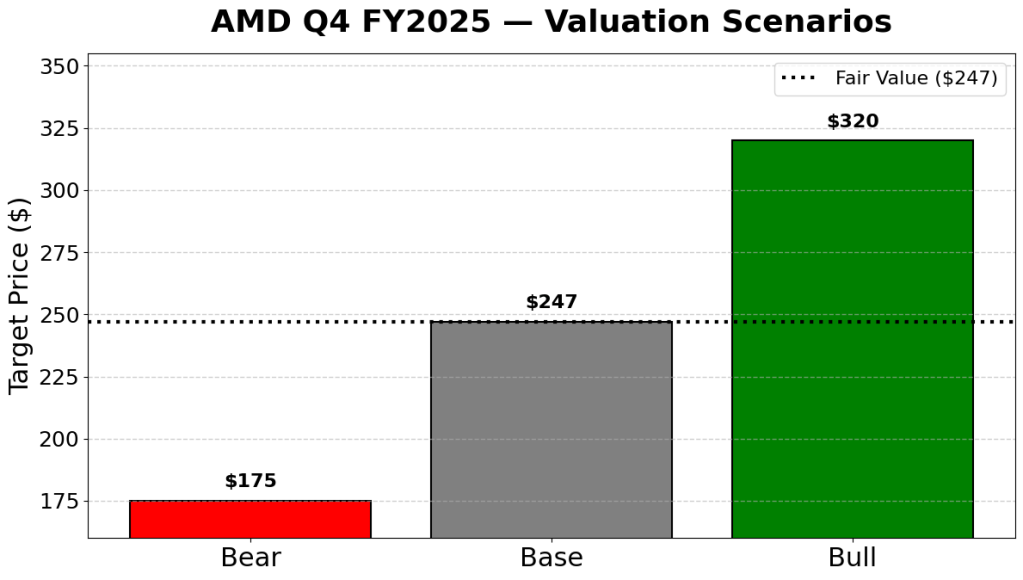
Valuation scenarios bar chart for Goldman Sachs Q4 2025 showing bear, base, and bull target prices with a dotted fair value line.
Valuation scenarios show Goldman Sachs trading near base-case assumptions, with upside tied to sustained earnings power and downside risk if capital markets momentum fades.

Verdict

Goldman Sachs has transitioned from a recovery story to an earnings-power story. At current levels, the stock appears fairly valued on normalized earnings, with upside now dependent on sustaining capital markets momentum rather than further multiple expansion. GS remains a high-quality franchise, but future returns will increasingly reflect execution and cycle durability.


Call to Action

If you’re tracking U.S. banks and capital markets exposure, follow SWOTstock for earnings-driven analysis that focuses on valuation realism — not headline noise.


Disclaimer

This content is for informational purposes only and does not constitute investment advice. Investors should conduct their own research.


Wells Fargo Q4 2025 Earnings — Capital Returns Doing the Work, Not Growth

Wells Fargo’s Q4 2025 results indicate a shift from turnaround efforts to stable, capital-driven profitability, with earnings exceeding expectations. However, concerns over declining net interest income suggest limited growth potential. Capital returns remain strong, but macro conditions will dictate future valuation. The stock is currently a hold for cautious investors.

TL;DR Summary

Wells Fargo’s (WFC:NYSE) Q4 2025 results confirmed that the bank has largely exited its turnaround phase and entered a period of normalized, capital-driven value creation. Earnings exceeded expectations, profitability targets were raised, and shareholder returns accelerated meaningfully. However, softer net interest income guidance underscored that earnings growth will remain constrained by the rate environment. At around the high-$80s per share, the stock appears fairly valued with modest upside, driven primarily by buybacks rather than revenue momentum. Wells Fargo is no longer repairing — but it is also not re-rating aggressively yet.


Quarter Recap

Wells Fargo reported Q4 2025 earnings that reinforced the durability of its earnings base while clarifying the limits of near-term growth. Results benefited from continued cost discipline and strong capital deployment, allowing the bank to deliver an earnings beat despite a more challenging net interest income backdrop.

Management used the quarter to recalibrate investor expectations. While acknowledging ongoing pressure on net interest income, leadership emphasized that Wells Fargo has now achieved sufficient operational and regulatory stability to focus on normalized profitability and shareholder returns. The quarter marked a shift away from remediation narratives toward disciplined capital allocation, even as the pace of earnings expansion remains tied to macro conditions.


Key Highlights

  • Management raised its medium-term ROTCE target to 17–18%, signaling confidence in sustainable profitability
  • FY2025 capital returns of approximately $23B, including ~$18B in share buybacks
  • Net interest income declined, with forward guidance indicating continued pressure into 2026
  • Credit performance remained stable, with no material deterioration in asset quality
  • Capital ratios stayed comfortably above regulatory requirements, preserving flexibility

SWOT Analysis

Wells Fargo’s Q4 results reinforce a clear conclusion: the investment case is no longer about fixing the franchise, but about how much value can be created through capital returns in a constrained growth environment.

Strengths

Wells Fargo’s improving profitability profile and aggressive capital return program now anchor the equity story. The decision to raise the ROTCE target reflects confidence that the bank’s earnings power is structurally higher than in prior cycles. Large-scale buybacks at or near intrinsic value materially enhance per-share value and provide downside support even in a slow-growth scenario. Balance-sheet strength and disciplined risk management further reinforce earnings durability.

Estimated price impact: +8% to +12%


Weaknesses

Net interest income remains under pressure as asset yields reset faster than deposit costs can adjust, limiting operating leverage. While cost controls have improved, revenue growth remains heavily rate-dependent, constraining near-term upside. The reliance on capital returns rather than organic growth also caps the stock’s re-rating potential in the absence of a more favorable rate backdrop.

Estimated price impact: −6% to −10%


Opportunities

Sustained execution toward the newly raised ROTCE target could gradually improve investor confidence and support modest multiple expansion. Continued buybacks represent a powerful compounding mechanism, particularly if shares remain priced near intrinsic value. Incremental recovery in fee-based businesses, including wealth and card services, offers optional upside not fully reflected in current expectations.

Estimated price impact: +7% to +12%


Threats

The primary risks remain macro-driven. Faster-than-expected rate cuts would extend net interest income pressure, delaying earnings normalization. A material economic slowdown could push credit costs higher, overwhelming incremental efficiency gains. Regulatory intervention also remains a structural risk, even if less acute than in prior years.

Estimated price impact: −7% to −14%

Capital returns and profitability targets drive upside, while net interest income pressure and macro risks cap near-term re-rating.

Valuation Scenarios

Wells Fargo is best valued using a normalized profitability and capital-return framework, rather than quarter-to-quarter earnings volatility. The scenarios below illustrate how different macro and execution paths could shape valuation outcomes.

Bear Scenario

This scenario assumes prolonged net interest income pressure combined with rising credit costs, limiting earnings growth and keeping valuation anchored near historical lows.

  • Assumptions: Continued NII decline into 2026; higher credit costs; slower buyback pace
  • Implied value: ~$70–75

Base Scenario

This reflects the current market consensus: net interest income stabilizes, credit remains well-behaved, and capital returns continue at scale.

  • Assumptions: Mid-to-high-teens ROTCE; stable credit; sustained buybacks
  • Implied value: ~$88–95

Bull Scenario

This scenario assumes a more supportive rate environment, fee income recovery, and faster progress toward profitability targets, enabling modest multiple expansion.

  • Assumptions: NII stabilization; strong capital returns; gradual re-rating
  • Implied value: ~$105–110

Probability-Weighted Fair Value

Across scenarios, Wells Fargo’s fair value clusters around:

~$90–95 per share

Valuation scenarios bar chart for Wells Fargo Q4 2025 showing three price targets: Bear case around $73, Base case around $92, and Bull case around $108, with a dotted horizontal line indicating a fair value near $92.
Base-case valuation centers on normalized earnings and sustained capital returns, while upside depends on fee recovery and rate stabilization rather than near-term growth acceleration.

Verdict

Wells Fargo has decisively moved beyond its remediation phase, but it has not yet entered a clear growth-driven re-rating regime. Q4 confirmed improved earnings quality, strong capital returns, and rising profitability targets, yet the stock remains constrained by net interest income headwinds and macro uncertainty.

At current levels, Wells Fargo is best viewed as a hold or incremental accumulate for DIY value investors. The return profile is attractive, but it is driven by capital discipline and patience, not acceleration. The upside case exists — but it will take time.


Call to Action

If you own Wells Fargo, the key question is no longer whether the bank is fixed — that question has largely been answered. The real issue is whether capital returns and normalized profitability can compound value while investors wait for the rate cycle to turn. For valuation-aware investors building durable portfolios, Wells Fargo remains relevant — but not urgent.


Disclaimer

This analysis is for informational purposes only and does not constitute investment advice. Always conduct your own research and consider your financial situation before making investment decisions.


Bank of America Q4 2025 Earnings — Waiting for the Rate Cycle, Not the Franchise

Bank of America reported strong Q4 results, with earnings and revenue exceeding expectations despite pressures on net interest income. The bank’s capital ratios remain healthy, and credit costs are controlled. However, future performance hinges on interest rate normalization and capital return timing. Current stock valuation suggests a hold or accumulate strategy for investors.

TL;DR Summary

Bank of America (BAC: NYSE) delivered a solid Q4, reinforcing the durability of its core franchise even as net interest income continued to soften. Earnings exceeded expectations, credit remained well-behaved, and capital levels stayed comfortably above regulatory requirements. At around $53 per share, the stock appears fairly valued to modestly undervalued, but the upside case remains dependent on rate normalization and capital return timing, not quarterly momentum. BAC is no longer under stress — but it is still in a waiting phase.


Quarter Recap

Bank of America reported Q4 2025 results that confirmed earnings resilience amid an unfavorable interest-rate backdrop. Revenue and EPS came in ahead of expectations, supported by strong trading performance and diversified fee income, which partially offset continued pressure on net interest income.

While credit costs remained within management’s guidance, the quarter also made clear that NII has not yet bottomed, delaying the point at which operating leverage can meaningfully re-emerge. Management reiterated confidence in the underlying strength of the U.S. consumer and emphasized balance-sheet flexibility, while acknowledging that the pace and shape of rate cuts will be the dominant driver of earnings normalization into 2026.


Key Highlights

  • Revenue of approximately $28.4B and EPS of $0.98 exceeded consensus expectations
  • Net interest income continued to decline, with no clear trough yet visible
  • Trading and markets revenues provided meaningful offset to rate-driven pressure
  • Credit costs remained controlled and within guided ranges
  • Capital ratios stayed comfortably above regulatory minimums, preserving long-term buyback optionality

SWOT Analysis

Bank of America’s Q4 results reinforce a familiar conclusion: this is a high-quality, systemically important bank whose valuation is now driven less by execution risk and more by macro timing and capital deployment.

Strengths

Bank of America’s scale, deposit franchise, and balance-sheet strength continue to provide earnings durability across cycles. Despite ongoing NII pressure, the bank generated mid-teens returns on tangible equity, underscoring the resilience of its core business. Diversified revenue streams — particularly in markets and fee-based businesses — further reduce earnings volatility and reinforce franchise quality.

Estimated price impact: +$5 to +$8

Weaknesses

Net interest income remains under pressure as asset yields reset faster than deposit costs can adjust. In addition, the bank’s structurally high cost base limits operating leverage in a slow-growth environment, delaying the inflection point investors are waiting for.

Estimated price impact: −$4 to −$7

Opportunities

A gradual rate normalization cycle would allow NII to stabilize and support a re-rating toward historical mid-cycle valuation multiples. In parallel, the eventual re-acceleration of share buybacks could materially enhance EPS growth even in a modest revenue environment, providing a powerful lever for shareholder value creation.

Estimated price impact: +$6 to +$10

Threats

The primary downside risk remains macro-driven. Faster-than-expected rate cuts would extend margin pressure, while any material deterioration in consumer or commercial credit would quickly overwhelm incremental operating improvements. Regulatory intervention also remains a persistent, though less immediate, structural risk.

Estimated price impact: −$6 to −$12

Horizontal SWOT price-impact chart for Bank of America Q4 2025 showing estimated percentage ranges: strengths and opportunities on the positive side, weaknesses and threats on the negative side, with a dashed zero reference line.
Bank of America Q4 2025 — Estimated SWOT price-impact ranges based on earnings results and macro assumptions. Early-stage view, not a final valuation

Valuation Scenarios

Bank of America should be valued using a normalized return-on-tangible-equity framework, rather than quarter-to-quarter earnings volatility. The scenarios below reflect how changes in rates, credit, and capital returns would shape valuation outcomes.

Bear Scenario

This scenario assumes prolonged NII pressure combined with rising credit costs, forcing valuation toward the lower end of historical P/TBV ranges.

  • Assumptions: NII continues to decline into 2026; credit losses rise above guidance; buybacks remain constrained
  • Implied value: ~$40–43

Base Scenario

This reflects the current market view: NII bottoms over the next several quarters, credit normalizes, and modest capital returns resume.

  • Assumptions: Mid-teens ROTCE; stable credit; gradual buyback recovery
  • Implied value: ~$55–60

Bull Scenario

This scenario assumes a supportive rate environment, stable credit, and an accelerated buyback cycle that lifts EPS growth.

  • Assumptions: NII stabilization; strong capital return; valuation re-rates toward mid-cycle multiples
  • Implied value: ~$65–70

Probability-Weighted Fair Value

Taking these scenarios together, Bank of America’s fair value clusters around:

~$57–60 per share

Valuation scenarios bar chart for Bank of America Q4 2025 showing bear, base, and bull target prices, with a dotted horizontal line indicating the probability-weighted fair value estimate.
Bank of America Q4 2025 — Bear, base, and bull valuation scenarios with probability-weighted fair value based on normalized earnings and capital return assumptions

Verdict

Bank of America has moved decisively out of the “stress discount” phase, but it has not yet entered a clear re-rating regime. Q4 confirmed franchise strength and earnings durability, yet the stock remains anchored by uncertainty around rates and the timing of capital return acceleration.

At current levels, BAC is best viewed as a hold or accumulate-on-weakness position for DIY value investors. The upside case exists, but it is macro-dependent, not execution-driven. Patience — rather than optimism — remains the dominant investment requirement.


Call to Action

If you own Bank of America, the key question is no longer balance-sheet safety — that has been reaffirmed. The real question is whether the rate cycle will cooperate in unlocking earnings normalization and capital returns. For investors building resilient, valuation-aware portfolios, BAC remains a credible component — but not yet a high-conviction opportunity.


Disclaimer

This analysis is for informational purposes only and does not constitute investment advice. Always conduct your own research and consider your financial situation before making investment decisions.