Bank of America Q2 2025: Earnings Beat, Dividend Growth Ahead, and a Fair Value Play for Income Investors

TL;DR

Bank of America posted Q2 2025 EPS of $0.89, topping expectations, driven by record net interest income and robust trading revenue. Management reaffirmed NII guidance toward $15.5–$15.7 billion and announced an 8% dividend hike (raising forward yield to ~3.2%). While credit risks in commercial real estate and macro uncertainties persist, BAC remains fairly valued near $48, making it a steady, income‑oriented choice for DIY value investors.


Quarter Recap

In Q2 2025, Bank of America reported revenue of $26.6 billion (+4% YoY) with net interest income (NII) reaching $14.8 billion — a record high. Net income rose to $7.1 billion (EPS $0.89), beating estimates by 3 cents.

Management highlighted:

  • Efficiency progress: Non‑interest expenses dropped ~$600 million QoQ, with a target to reach ~60% efficiency ratio.
  • Deposit strength: 8th straight quarter of deposit growth, with average checking balances rising from $6K to $9.2K YoY.
  • Credit costs: Provisions increased to ~$1.6 billion, mainly from office‑related CRE loans.
  • Trading resilience: Markets revenue rose ~15% YoY, with management expecting a 13‑quarter growth streak to continue.
  • Shareholder returns: $7.3 billion in Q2 (dividends + buybacks) and an 8% dividend increase announced for Q3.

Key Highlights

  • EPS: $0.89 (+7% YoY), beat by 3 cents
  • Revenue: $26.6 billion (+4% YoY)
  • Net Interest Income: $14.8 billion (record)
  • Efficiency: Expenses down $600 million QoQ; targeting ~60% ratio
  • Dividend: 8% hike brings forward yield to ~3.2%
  • Asset quality: Net charge‑offs of $1.5 billion; provisions up to $1.6 billion
  • Deposits: 8th consecutive quarter of growth
Line chart showing Bank of America revenue and net income over the past five quarters, highlighting Q2 2025 growth in both metrics.

SWOT Analysis

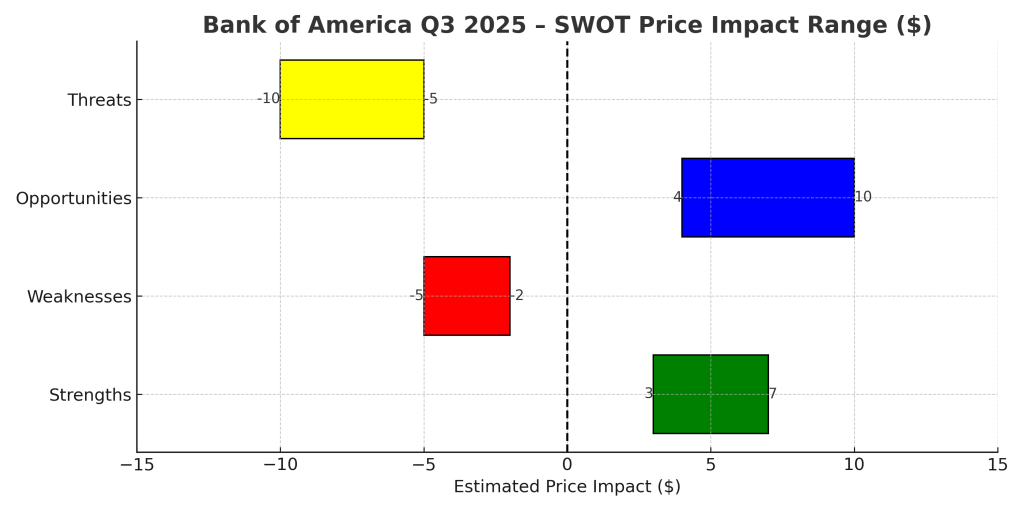
  • Strengths (+$2 – 4 impact):
    Record NII, diversified revenue streams, improving efficiency, and a dividend hike reflecting capital confidence.
  • Weaknesses (−$1 – 2 impact):
    Slower revenue growth than peers, elevated CRE‑related losses, and a still‑high expense base.
  • Opportunities (+$1.5 – 3 impact):
    AI & digital investments, sustained deposit momentum, expanding trading revenue, and higher dividend yield enhancing total return.
  • Threats (−$2 – 3.5 impact):
    Tariff‑driven macro risks, potential Fed rate cuts compressing NII, and rising credit costs in commercial real estate.

Net price impact: ≈ +$1.0–1.5/share vs. pre‑earnings levels, supporting the current range.


SWOT Summary Table

Bank of America Q2 2025 SWOT price impact analysis table showing strengths, weaknesses, opportunities, and threats with estimated stock price impacts.
Bar chart showing Bank of America Q2 2025 SWOT price impact ranges: strengths (+2 to +4), weaknesses (−1 to −2), opportunities (+1.5 to +3), and threats (−2 to −3.5), with X-axis starting at −5.

Valuation Scenarios

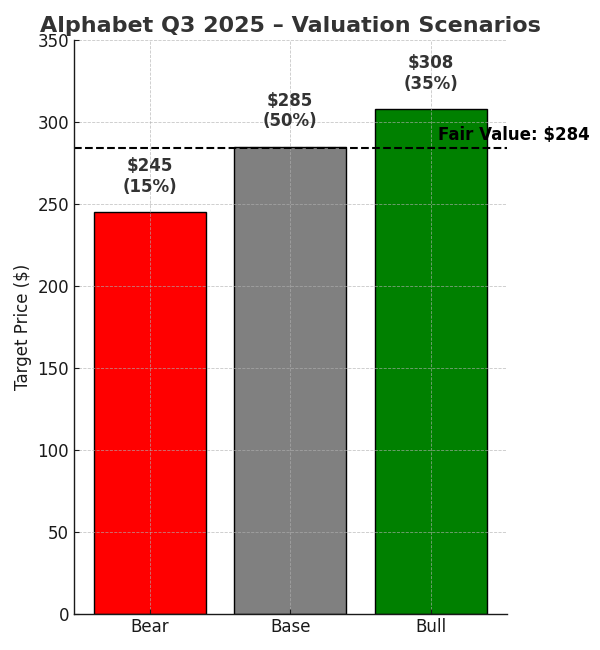
To frame a realistic outlook for Bank of America’s stock, we modeled three scenarios based on management’s guidance, Q2 results, and macro risks. The Base Case assumes steady EPS growth, stable net interest income, and controlled expenses, keeping the stock near its current range. The Bull Case reflects a scenario where trading revenue momentum accelerates, the efficiency ratio improves faster toward the 60% target, and net interest income benefits from a slower‑than‑expected pace of Fed rate cuts. Conversely, the Bear Case factors in higher commercial real estate charge‑offs and a compressed margin environment from rapid rate cuts. These scenarios give a clear range of plausible outcomes for value investors, balancing potential upside with key risks.

Bank of America Q2 2025 valuation scenarios table showing bull case at $52, base case at $48, and bear case at $42 with probability-weighted fair value of $48.

Probability‑Weighted Fair Value:(0.5 × 48) + (0.3 × 52) + (0.2 × 42) ≈ $48

Bar chart showing Bank of America Q2 2025 valuation scenarios: Bear case at $42, Base case at $48, and Bull case at $52, with a dotted line for the $48 fair value.

Dividend Growth Snapshot

Bank of America’s 8% dividend hike for Q3 2025 raises the quarterly payout from $0.24 to $0.26 per share, pushing the forward yield to roughly 3.2% at current prices. This increase continues the bank’s consistent multi‑year trend of dividend growth, reflecting management’s confidence in earnings stability and capital strength. Combined with $7.3 billion in share buybacks during Q2, this makes BAC a compelling choice for income‑focused investors who prioritize reliable cash returns and long‑term capital appreciation.

  • Q2 dividend: $0.24/share → Q3: $0.26/share
  • 8% increase = forward yield of ~3.2% at $48/share

Peer Comparison

When compared to its large‑cap U.S. banking peers, Bank of America sits in the middle of the pack. At a price‑to‑book ratio of ~1.3× and forward P/E around 13×, it trades cheaper than JPMorgan (P/B ~1.6×, P/E ~12×) but at a premium to Citigroup (P/B ~0.8×, P/E ~9×). Dividend yield at ~3.2% (post‑hike) makes BAC more attractive than JPMorgan (~2.8%) but still below Citi’s ~4%. This positioning reflects its balanced profile: steadier than Citi, but with less growth momentum than JPMorgan — a mix that appeals to value‑oriented investors seeking income without extreme risk exposure.

Peer comparison table for Bank of America Q2 2025 versus JPMorgan and Citigroup, showing price-to-book, price-to-earnings, and dividend yield metrics.

Verdict

At ≈$48/share, BAC trades close to our fair value estimate. For DIY value investors, it offers steady dividendsaggressive buybacks, and a resilient balance sheet. While upside is modest without macro support, the dividend hikeand sustained trading & deposit growth make it a hold‑to‑accumulate for long‑term portfolios.


Call to Action

Do you hold Bank of America or other bank stocks? Comment below — is BAC your top pick for steady income, or do you prefer peers like Citi or JPMorgan?


Disclaimer

This analysis is for informational purposes only and based solely on Bank of America’s official Q2 2025 financial report and earnings call. It does not constitute financial advice. Please consult a licensed advisor before making investment decisions.

SAP Q2 2025 Earnings: Cloud Momentum, AI Push — Is This Pullback a Buy?

SAP’s Q2 2025 earnings delivered 24% cloud growth, margin expansion, and a strong AI roadmap, yet shares dipped 6%. Is this a buying opportunity for growth investors?

TL;DR

SAP’s Q2 2025 delivered 24% YoY cloud growth83% free cash flow surge, and margin expansion, yet the stock dropped ~6%. For growth‑minded investors, this may be an opportunity to accumulate, as SAP pushes deeper into AI‑driven enterprise solutions and China expansion, though macro and FX risks remain.


Quarter Recap: Why This Matters to Growth Investors

SAP posted Q2 revenues of €9.43B, driven by cloud revenue of €5.13B (+24% YoY) and a backlog increase of 22%Operating margin rose to 27.2% (+1.8pp), while free cash flow surged 83% to €2.36B.

So why did shares drop ~6%? The market zeroed in on slowing backlog growthmacroeconomic uncertainty, and FX drag, which overshadowed the otherwise strong report.

Why you should care: SAP’s fundamentals still point to a cloud‑first, AI‑powered transformation with improving profitability — a combination attractive for growth investors with a mid‑term horizon.


Key Highlights

  • Cloud revenue: €5.13B (+24% YoY)
  • Total backlog: +22% YoY
  • Operating margin27.2% (+1.8pp YoY)
  • Free cash flow€2.36B (+83% YoY)
  • Share buyback: Up to €5B, supporting EPS
Line chart showing SAP’s revenue and net income over the past five quarters, highlighting steady growth through Q2 2025.

AI: More Than a Buzzword — What SAP Is Building

SAP is embedding generative AI into its Business AI platform, integrating tools across ERP, procurement, and HR. It’s also expanding AI‑as‑a‑service offerings, giving customers access to pre‑built, domain‑specific AI models.

CEO Christian Klein emphasized that AI is “not just an add‑on but core to SAP’s next‑generation enterprise software.” This positions SAP to capture higher‑margin, stickier revenue as clients adopt AI‑enhanced workflows.


Peer Comparison: How Does SAP Stack Up?

Bar chart comparing SAP, Oracle, and Microsoft in Q2 2025 for cloud growth percentage, operating margin percentage, and P/E ratio.
  • SAP: Cloud +24%, margin 27.2%, P/E ~24x
  • Oracle: Cloud +20%, margin ~41%, P/E ~30x
  • Microsoft (Intelligent Cloud): +21%, margin ~42%, P/E ~35x

SAP trades at a relative discount while maintaining competitive growth — a point for long‑term investors to watch.


SWOT Analysis: Price Impact on the Table

SAP’s Q2 shows resilience in cloudgrowing AI initiatives, and geographic diversification, offset by backlog sensitivity and macro risk.

Horizontal bar chart showing SAP Q2 2025 SWOT price impact: strengths and opportunities with positive effects, weaknesses and threats with negative effects.
SWOT analysis table for SAP Q2 2025 showing strengths, weaknesses, opportunities, and threats with estimated price impact ranges.

Valuation Scenarios: Where Could the Stock Go?

Bar chart showing SAP Q2 2025 valuation scenarios: Bear case €165, Base case €200, Bull case €230, Current Price €185, with a dotted line marking the fair value at €199.
Valuation scenarios table for SAP Q2 2025 showing bull, base, and bear cases with assumptions, target prices, and probabilities.

Probability‑Weighted Fair Value:
(0.50 × 200) + (0.25 × 230) + (0.25 × 165) = €198.75 (~€199).


Verdict: An Attractive Mid‑Term Entry for Growth Investors

SAP is cheaper than its peers, with comparable growth and a clear AI‑driven roadmap. The post‑earnings dip brings it within our fair value range (€195–205), offering a tactical entry for investors who believe in its AI and China growth story.


Call to Action: Should You Buy?

Before adding SAP, ask yourself:

  • Do you believe AI integration will drive higher‑margin growth?
  • Are you comfortable with China exposure amid global trade uncertainty?
  • Does SAP’s valuation vs. Oracle/Microsoft justify a position in your portfolio?

Join the conversation: What’s your take on SAP’s AI pivot? Share your thoughts in the comments and explore more at SWOTstock.com.


Disclaimer

This article is for informational purposes only and does not constitute investment advice. All analysis is based solely on SAP’s official Q2 2025 financial statements, earnings call transcript, and management commentary.


Leave a comment


Coca‑Cola Q2 2025: A Sweet Beat, but Is the Fizz Fading?

Coca-Cola Q2 2025 earnings: EPS beat, raised guidance, and margin gains offset North American volume declines. See SWOT analysis, valuation scenarios, and peer comparison for DIY value investors.

TL;DR — Quick Take

Coca‑Cola (KO) delivered an EPS beat and raised its full‑year revenue guidance, demonstrating its pricing power and operational discipline. However, flat global volumes, persistent FX headwinds, and consumer price sensitivitytempered enthusiasm. At $69.66, KO trades slightly below our fair value of $70.40, making it a Hold for dividend‑focused value investors, with opportunities to accumulate on dips.


Quarter Recap — What Happened?

Coca‑Cola reported Q2 2025 revenue of $12.52 billion, up 2% year‑over‑year, driven by 8% organic revenue growthoffsetting a 1% decline in global unit case volumes.

Adjusted EPS came in at $0.84, beating consensus of $0.81. Operating margins expanded by 80 bps to 31.8%, reflecting strong pricing execution and productivity gains.

Management raised full‑year guidance, now expecting 8–9% organic revenue growth (previously 7–8%) and reaffirmed its outlook for comparable currency‑neutral EPS growth of ~8%.

Emerging markets like India, Brazil, and Mexico posted double‑digit growth, which partially offset North America’s 2% volume declineFX headwinds shaved 5% off reported revenue, underscoring currency exposure risks.

CEO James Quincey: “We continue to execute with clear intent in every market, leveraging our global system’s strengths while navigating challenges. Our updated guidance reflects our confidence in delivering for the full year.”


Regional Breakdown — Where Growth Is Coming From

  • Latin America: Price/mix +15%, volumes flat — strong revenue resilience despite economic volatility.
  • EMEA: Volumes +3%, price/mix +6% — sparkling flavors and affordable pack innovations drove performance.
  • Asia‑Pacific: Price/mix +10%, volumes –3% — India and Southeast Asia offset softer China demand.
  • North America: Volumes –2%, price/mix +5% — consumer trade‑downs evident, especially in standard sparkling.

Key Highlights

  • EPS Beat: $0.84 vs $0.81 expected
  • Organic Revenue Growth: +8% YoY
  • Global Volume: –1% (NA volumes –2%)
  • Operating Margin: 31.8% (+80 bps)
  • Guidance Raised: FY25 organic growth now 8–9%
  • Emerging Markets: Double‑digit growth in India, Brazil, Mexico
  • Zero Sugar Segment: Volumes up 14% — strong consumer traction
Line chart showing Coca-Cola revenue and net income for the past five quarters through Q2 2025

SWOT Analysis — What It Means for KO’s Price

Coca‑Cola’s Q2 2025 results highlight a business that continues to rely on pricing power and emerging market growthto offset volume weakness and FX pressures. The company’s innovation pipeline (like Zero Sugar and cane‑sugar Coke) and margin discipline strengthen its investment case, but softness in North America volumes and persistent macro risks keep a lid on upside potential. For value investors, these dynamics reinforce Coca‑Cola’s role as a steady defensive holding with modest growth prospects rather than a high‑beta growth story.

SWOT price impact analysis for Coca-Cola Q2 2025 showing estimated stock price effects of strengths, weaknesses, opportunities, and threats
Horizontal bar chart showing Coca-Cola Q2 2025 estimated stock price impacts of strengths, weaknesses, opportunities, and threats with values in dollars

Valuation Scenarios — What’s Coca‑Cola Worth?

To assess Coca‑Cola’s fair value, we modeled bull, base, and bear price targets based on management’s guidance, market conditions, and our SWOT insights. The bull case reflects a scenario where volumes recover and FX stabilizes, while the bear case accounts for prolonged volume declines and heightened macro risks. Our probability‑weighted outcome produces a fair value of $70.40, suggesting that KO is fairly valued with limited near‑term upside, though its dividend yield provides a strong floor for total returns.

Valuation scenarios for Coca-Cola Q2 2025 showing bull, base, and bear case stock price targets with probabilities and fair value estimate
Vertical bar chart showing Coca-Cola Q2 2025 valuation scenarios with bull, base, bear, and current price compared to fair value line

Fair Value Calculation:

(0.25×74)+(0.60×70)+(0.15×66)=70.40(0.25×74)+(0.60×70)+(0.15×66)=70.40

→ Fair Value: $70.40


Cash Flow & Dividend Health

Coca‑Cola generated $11.7 B in operating cash flow and $3.9 B in non‑GAAP free cash flow (excluding one‑time items) in the first half of the year. With $2.2 B in capital expenditures, the company comfortably covers its dividend.

Dividend context:

  • Current dividend yield: ~3%
  • 3‑year dividend CAGR: ~4.5%
  • 5‑year dividend CAGR: ~4.1%

Takeaway: KO remains a reliable dividend compounder for income‑focused portfolios.


Peer Snapshot — How KO Stacks Up

Compared to PepsiCo (PEP):

  • KO trades at a slightly lower forward P/E (~21x vs PEP’s ~22x).
  • KO has higher operating margins but slower topline growth (PEP’s snacks business offers more volume resilience).
  • Dividend yields are comparable (~3%).

Bottom line: KO offers superior margin efficiency but less diversification than PEP.

Bar charts comparing Coca-Cola and PepsiCo on forward P/E ratio, operating margin, and dividend yield for Q2 2025

Verdict — Hold for Dividend Stability

Coca‑Cola continues to execute on pricing and cost discipline while driving innovation in health‑focused categories. However, FX pressures and North American volume softness cap short‑term upside.

For value investors, KO remains a defensive anchor with a reliable dividend. At $69.66, it’s fairly valued near our $70.40 fair priceHold, with opportunities to accumulate on dips below $68 for long‑term dividend compounding.


Call to Action

Do you see Coca‑Cola as a steady dividend compounder or a slow‑growth beverage giant?
Join the discussion below and subscribe to SWOTstock for more value‑driven earnings breakdowns.


Disclaimer

This analysis is for informational purposes only and based solely on Coca‑Cola’s official Q2 2025 financial report and earnings call. It is not financial advice. Always perform your own due diligence or consult a financial advisor before investing.


Leave a comment