💼 JPMorgan Q3 2025 Earnings — The Fortress Bank Tightens Its Grip on Stability

JPMorgan Chase’s Q3 2025 results showcase strong performance with EPS of $5.07 and a net income of $13.7 billion. Investment banking surged 25%, and AI efficiencies are enhancing operations. The stock, currently at $308, appears undervalued with a fair value of $328, making it a solid choice for long-term investors.

TL;DR Summary

JPMorgan Chase (JPM:NYSE) once again proved why it’s considered Wall Street’s fortress.
Third-quarter earnings beat expectations, investment banking is rebounding, and AI-driven efficiency is quietly reshaping operations.
At around $308 per share, the stock looks slightly undervalued with a fair value near $328 — steady upside for long-term value investors.


Quarter Recap

On October 14, 2025, JPMorgan reported EPS $5.07 on $46.4 billion in revenue, up about 9 percent year over year.
Net income reached $13.7 billion, with ROTCE 24 percent and ROE 20 percent, both exceptional for a global bank.
The company raised its full-year net interest income guidance to roughly $93 billion (excluding Markets), signaling confidence in margin stability.

CEO Jamie Dimon described the U.S. economy as “resilient but still pressured,” while emphasizing that AI adoption is already driving measurable productivity gains across fraud detection, operations, and client service.


Key Highlights

  • Investment banking surged 25 percent year over year, led by stronger M&A and equity underwriting.
  • Net interest income continued to climb, supported by robust consumer deposits.
  • Wealth and asset management hit record levels: $4.7 trillion AUM with $80 billion in net inflows.
  • Capital strength: CET1 ratio rose to 14.3 percent; management plans ≈ $30 billion in dividends and buybacks.
  • Credit quality: Card loss rates normalized to ~2.6 percent — still well below pre-pandemic levels.

Market response was positive: the stock climbed roughly 3 percent to $310 following the release, as investors rewarded its steady execution.


SWOT Analysis (12-Month Price-Impact View)

Strengths (+ $15 to + $25)

  • Industry-leading ROE (20 %) and ROTCE (24 %) sustain premium valuation.
  • Fortress capital position (CET1 14.3 %) supports $30 B capital return program.
  • AI and automation enhance efficiency and risk controls.
  • Diversified revenue mix limits cyclicality across business lines.

Weaknesses (– $10 to – $18)

  • Deposit costs rising faster than loan yields — NII growth plateau ahead.
  • Consumer credit losses slowly normalizing.
  • Technology and compliance investments pressure short-term margins.

Opportunities (+ $8 to + $20)

  • Revival in deal-making and capital markets fees.
  • Continued wealth inflows boost recurring revenues.
  • Efficiency gains from AI could add ~3 % EPS growth through 2026.

Threats (– $12 to – $20)

  • Potential U.S. slowdown reducing loan demand.
  • Basel III Endgame rules may tighten capital buffers.
  • Global market volatility could curb trading income.
A bar graph illustrating the SWOT analysis for JPMorgan Chase's Q3 2025 price impact range, featuring four colored bars representing strengths, weaknesses, opportunities, and threats, with corresponding estimated price impact values.
SWOT analysis of JPMorgan’s price impact range for Q3 2025, highlighting strengths, weaknesses, opportunities, and threats.

Valuation Scenarios

  • Bull (+ 20 %) → $370
    • Net interest income stays high, AI efficiency adds ~3 % to EPS, and P/B expands to 1.9×.
  • Base (+ 5 %) → $325
    • Stable credit costs and moderate growth support 1.7× P/B multiple.
  • Bear (– 10 %) → $277
    • Economic soft landing turns shaky; credit loss > 3 %, multiple compresses to 1.5×.

Probability-weighted fair value: ≈ $328 per share, implying a 6–7 % upside from the current $308.
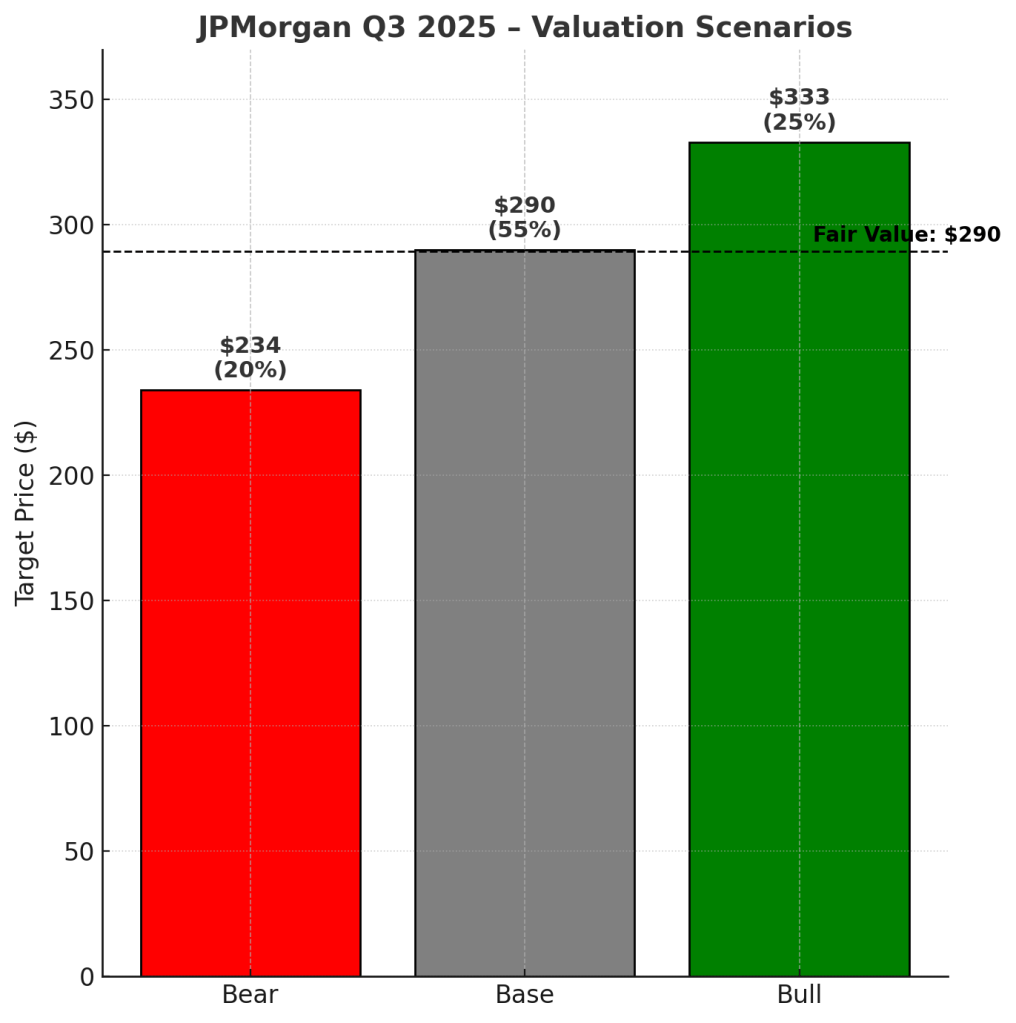
Bar chart illustrating valuation scenarios for JPMorgan in Q3 2025, with target prices for Bear ($234), Base ($290), and Bull ($333), highlighting the fair value at $290.
JPMorgan Q3 2025 Valuation Scenarios: Bear, Base, and Bull target prices with fair value highlighted.

Fair Price Assessment

The valuation rests on JPMorgan’s own fundamentals — not sentiment.
At 24 percent ROTCE and 1.7× book value, shares reflect fortress-level returns with room for modest re-rating.
AI efficiency and buybacks should sustain mid-single-digit EPS growth, keeping the fair price range between $315 and $340.


Verdict

JPMorgan is the definition of a fortress value stock — disciplined, diversified, and resilient.
It won’t outpace Silicon Valley, but its consistency and capital strength make it a cornerstone holding for long-term DIY value investors.
If you’re seeking steady dividends and defensive growth in an uncertain rate environment, this remains one of the best-managed banks in the world.


Call to Action

Track how AI efficiency unfolds across JPMorgan’s business lines in the coming quarters.
If those gains compound like its interest income, the “fortress bank” might quietly build its next growth engine.


Disclaimer

This analysis is for informational purposes only and is based solely on JPMorgan Chase’s official Q3 2025 financial report and earnings call transcript.
It does not constitute investment advice or a recommendation to buy or sell securities.


ASML’s Q3 Performance: Steady Growth Amid Challenges

ASML posted a solid Q3 with €7.5 billion in sales and €2.1 billion in net income, leading to a positive stock reaction. Despite a projected decline in Chinese demand for 2026, management remains optimistic, maintaining a fair valuation of approximately $1,190 per share, indicating significant growth potential driven by AI advancements.

🔎 TL;DR Summary

ASML (AMSL:NASDAQ) just delivered another steady quarter: €7.5 billion in sales, €2.1 billion net income, and margins holding above 51 %. The stock reacted positively in pre-market, climbing ~3 %, as investors looked beyond a cautious China outlook to renewed confidence in ASML’s long-term AI-driven roadmap. Our fair-value model points to ~ $1,190 per share, ≈ 25 % upside.


🧭 Quarter Recap

Management called Q3 “in line with guidance.” Bookings hit €5.4 billion, supported by continued momentum in EUV and early shipments of High-NA EUV systems. The company also highlighted its new AI partnership with Mistral AI, aiming to embed machine-learning control into yield and productivity.

The only dark cloud: ASML expects a “significant decline in China demand in 2026.” Still, management does not foresee overall sales falling below 2025 levels — a sign of resilience amid geopolitical shifts.


💡 Key Highlights

  • Net sales: €7.52 billion | Gross margin: 51.6 %
  • Net income: €2.13 billion | EPS: €5.49
  • Bookings: €5.4 billion | Service revenue: €1.96 billion
  • Guidance: Q4 sales €9.2 – €9.8 billion | Full-year +15 % growth

🧩 SWOT Analysis (Q3 2025)

Strengths (+8 to +12 %) Technological monopoly in EUV and upcoming High-NA tools sustain >50 % gross margin and high visibility.

Weaknesses (−4 to −7 %) Cap-ex cycles and €1.2 billion quarterly R&D keep cash flows volatile.

Opportunities (+10 to +18 %) AI lithography, Mistral AI integration, and High-NA adoption expand ASML’s total addressable market through 2028.

Threats (−8 to −12 %) China sales normalization and export controls could trim €1.5 – 2 billion from 2026 revenue.

Net SWOT bias: +5 % to +9 % upside.

A graph illustrating the SWOT analysis of ASML for Q3 2025, showing estimated price impact ranges for strengths, weaknesses, opportunities, and threats in percentage.
SWOT analysis chart highlighting ASML’s strengths, weaknesses, opportunities, and threats for Q3 2025.

📊 Valuation Scenarios

• Bull Case: ASML’s High-NA EUV rollout and AI-driven lithography adoption accelerate revenue growth above 20 % annually through 2027. → Estimated EPS 2026: €27 | P/E 45× | Fair Value ≈ $1,310 (+44 %).

• Base Case: Steady 15 % growth and margin stability around 52 %. → Estimated EPS 2026: €25 | P/E 40× | Fair Value ≈ $1,080 (+14 %).

• Bear Case: China demand softens (-15 % revenue in 2026) and margins slip to 49 %. → Estimated EPS 2026: €22 | P/E 35× | Fair Value ≈ $830 (-13 %).

🎯 Weighted Fair Value:$1,190 per share (+25 % upside)


Bar chart depicting ASML's valuation scenarios for Q3 2025, with 'Bear' case at $830, 'Base' case at $1080, and 'Bull' case at $1310, along with a dashed line indicating the fair value at $1099.
ASML Q3 2025 Valuation Scenarios: Target prices under Bear, Base, and Bull cases.

🧠 Verdict

ASML remains the “picks-and-shovels” play for the AI era. Even as near-term demand wobbles, its EUV and High-NA roadmap locks in a multi-year growth path few companies can match. For tech-savvy growth investors, the setup still favours accumulation on dips.


💬 Investor Takeaway

Market reaction shows confidence in ASML’s long-term story: from chipmaker orders to AI co-design tools, it continues to define the semiconductor future. Short-term noise aside, the firm’s monopoly position and AI-linked flywheel justify a premium valuation — and our $1,190 fair price reflects that potential.


Disclaimer: This post is for informational purposes only and not financial advice. Please do your own research before investing.

Berkshire Hathaway Q2 2025: Fortress Balance Sheet, Capital Inaction, and the Buffett‑to‑Abel Transition

Berkshire Hathaway’s Q2 2025 results show a cautious approach, with operating earnings of $11.16B down 4% YoY and a significant net income drop of 59% due to a Kraft Heinz writedown. Despite strong cash reserves of $344B, no buybacks occurred, raising investor concerns over capital deployment ahead of Buffett’s leadership transition to Greg Abel.

📌 TL;DR Summary:

Berkshire Hathaway reported Q2 2025 operating earnings of $11.16 B (–4% YoY) and a $3.8 B writedown on Kraft Heinz, dragging net income down 59%. Cash remains enormous at $344 B, but no buybacks were executed, leaving investors questioning capital deployment. Book value per share grew 6% YoY, but the stock trades near 1.45× book — above Buffett’s historical repurchase thresholds. For value investors, Berkshire remains a fortress‑like hold, but not an obvious bargain as the leadership transition to Greg Abel approaches.


🧾 Quarter Recap:

Berkshire Hathaway’s Q2 2025 earnings reflect disciplined caution with limited offensive moves.

  • Operating earnings: $11.16 B (–4% YoY).
  • Net income: $12.37 B (–59% YoY) due to a $3.8 B Kraft Heinz impairment.
  • Cash: $344 B, slightly down from Q1 but still near record highs.
  • Book value per share~$262, up 6% YoY and ~1% sequentially.
  • No share repurchases, for the second consecutive quarter.
  • Equity activity: Net seller of ~$3 B in stock.
  • Buffett’s discipline holds: As he wrote in the 2023 letter, “We only repurchase shares when we believe they are selling at a meaningful discount to intrinsic value.”

In Q1, we observed:

“Berkshire is signaling caution, not conviction — sitting on cash, avoiding buybacks, and waiting for real value to emerge.”

Q2 results confirm this stance — cash is stockpiled, but deployment remains elusive.


📌 Key Highlights:

  • BNSF Railway: Operating profit up ~19% to $1.47 B on freight volume growth.
  • Geico: Underwriting profit ~$1.8 B, with ~16.5% margin.
  • Insurance (reinsurance & P/C): Underwriting income declined 12%, with P&C reinsurance premiums down ~10%. Float rose to ~$174 B.
  • Consumer goods: Revenue fell ~5%, impacted by tariffs and slowing demand for brands like Fruit of the Loom.
  • FX losses: ~$877 M, pressuring underwriting results.
Line chart showing Berkshire Hathaway’s revenue and net income over the last five quarters: revenue remains relatively stable between $92B and $97B, while net income declines from about $30B in Q2 2024 to $12.37B in Q2 2025.

📈 Book Value & Valuation Context:

  • Book value per share: ~$262, up 6% YoY.
  • Price-to-book: ~1.45×, slightly below the 10‑year average of 1.5×.
  • Historical buyback threshold: Buffett previously authorized buybacks when shares traded under 1.2× book. At current levels (~1.45×), Berkshire remains above that range, which explains the lack of repurchases.

Value investor insight: Berkshire’s market price suggests it’s fully valued by Buffett’s own conservative yardstick.


🧠 SWOT Analysis with Price Impact Estimates:

Strengths (+$15 – $25/share)

  • Fortress balance sheet: $344 B in cash and $174 B in insurance float.
  • Operational resilience: BNSF and Geico continue to deliver.
  • Diversified revenue streams: Core industrials and energy shield against sector shocks.

Weaknesses (–$10 – $20/share)

  • Kraft Heinz writedown exposes underperforming legacy investments.
  • No share buybacks, signaling management sees limited margin of safety at current levels.
  • Underwriting softness and FX headwinds pressure insurance results.

Opportunities (+$10 – $20/share)

  • Capital deployment: $344 B cash can be deployed for opportunistic M&A or buybacks if valuations fall.
  • Rail consolidation: BNSF may benefit from strategic M&A moves in the sector.
  • Insurance cycle hardening: Potential for improved pricing in future quarters.

Threats (–$10 – $15/share)

  • Leadership transition: Buffett‑to‑Abel handoff raises uncertainty about future capital allocation.
  • Macro risks: Tariffs and FX volatility weigh on consumer and manufacturing units.
  • Equity portfolio volatility: GAAP fair‑value swings distort net income.

📊 SWOT Summary Table

SWOT summary table for Berkshire Hathaway Q2 2025 showing strengths, weaknesses, opportunities, and threats with estimated price impacts
Horizontal bar chart showing Berkshire Hathaway Q2 2025 SWOT price impact: Threats at approximately –12.5, Opportunities at +15, Weaknesses at –15, and Strengths at +20, with a vertical dashed line at zero.

💸 Valuation Scenarios:

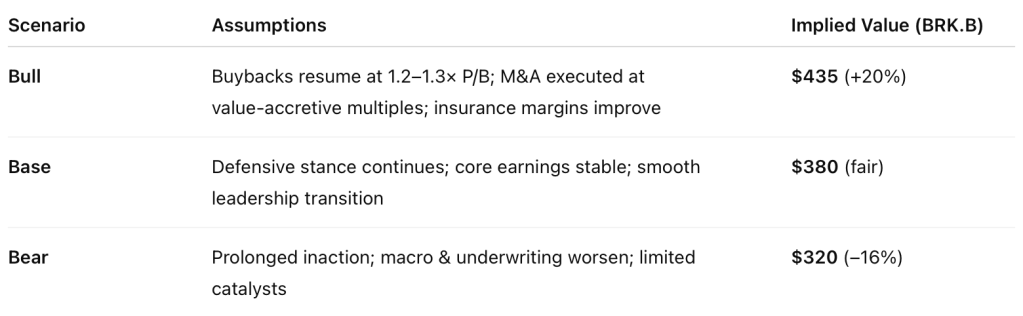
We apply sum‑of‑parts (subsidiary cash flows + equity portfolio) and P/B benchmarking:

Valuation scenarios table for Berkshire Hathaway Q2 2025 showing bull, base, and bear cases with assumptions and implied BRK.B share prices

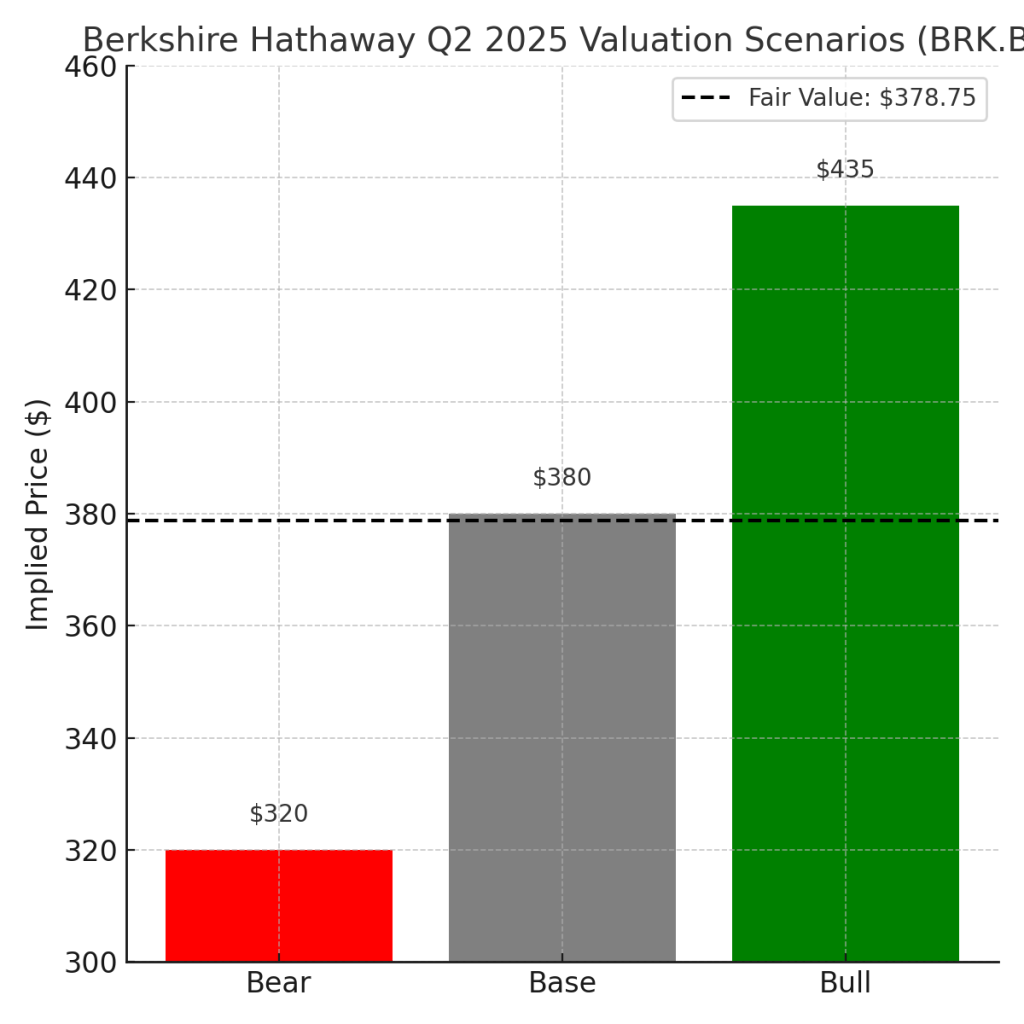
Probability‑Weighted Fair Value = (0.25 × 435) + (0.5 × 380) + (0.25 × 320) = $378.75/share.

Vertical bar chart showing Berkshire Hathaway Q2 2025 valuation scenarios: Bear case at $320, Base case at $380, and Bull case at $435, with a horizontal dashed line indicating the probability-weighted fair value of approximately $378.75.

📊 Peer Comparison Insight:


Berkshire Hathaway’s P/B ratio of 1.45 positions it above Markel (1.2) but far below the S&P 500 average of 4.2, reinforcing its standing as a value‑oriented conglomerate rather than a growth‑priced index constituent. Its ROE of 10% trails the S&P 500’s 14%, reflecting Berkshire’s conservative leverage and capital deployment posture, yet it still outpaces Markel’s 8%. The YTD return of 4% lags the S&P 500’s 6%, highlighting market skepticism about near‑term catalysts amid Buffett’s upcoming transition and limited capital actions. For DIY value investors, this underscores Berkshire’s role as a steady compounding hold rather than a momentum‑driven outperformer.

Horizontal bar chart comparing Berkshire Hathaway, Markel, and the S&P 500 in Q2 2025: Berkshire shows a P/B ratio of 1.45, ROE of 10%, and YTD return of 4%; Markel shows a P/B ratio of 1.2, ROE of 8%, and YTD return of 6%; S&P 500 shows a P/B ratio of 4.2, ROE of 14%, and YTD return of 6%.

🔑 Catalysts for Re‑rating and Market Reaction

Berkshire’s stock continues to trade like the fortress it is — steady but unspectacular — with a year‑to‑date gain of about 4%, trailing the S&P 500’s roughly 6% advance. The muted market response to Q2 earnings suggests that investors see the quarter as “business as usual”: strong balance sheet, reliable operating results, but little in the way of near‑term excitement. For the stock to re‑rate higher, investors are watching for clearer capital deployment signals — whether that’s buybacks at higher price‑to‑book levels, opportunistic large‑scale acquisitions, or a more aggressive investment approach under Greg Abel’s leadership once the Buffett transition is complete. A significant market downturn, which would give Berkshire the chance to deploy its $344 B cash pile into undervalued opportunities, also remains a potential catalyst for a re‑rating. Until then, the shares are likely to trade within a range that reflects their defensive compounding profile rather than breakout growth.


🧠 Verdict:

For value investors, Berkshire remains a defensive cornerstone: diversified, cash‑rich, and well‑positioned for opportunistic moves. But at ~1.45× book, shares are not trading at a margin of safety by Buffett’s standards. Until buybacks resume, M&A materializes, or valuations reset lower, this is a hold for long‑term compounding — not a bargain entry point.


📣 Call to Action:

Stay ahead of Berkshire’s next moves — from buybacks to the post‑Buffett era.
Subscribe to SWOTstock for deep‑dive analyses that cut through the headlines.


⚠️ Disclaimer:

This analysis is based solely on Berkshire Hathaway’s Q2 2025 public filings (Form 10‑Q, earnings release). It does not constitute financial advice. Perform your own due diligence or consult a licensed advisor before making investment decisions.


Leave a comment