SAP Q1 2026 Earnings: From Cloud Transition to Cash Flow Compounder?

SAP reported strong Q1 2026 results, showcasing accelerated cloud ERP growth, a significant backlog increase, and improved profitability. Although investors reacted positively, full-year guidance remains unchanged, raising concerns about future growth sustainability. As SAP transitions to a recognized compounder, investors must evaluate if its current premium valuation is warranted.

TL;DR

SAP (SAP:NYSE) delivered a strong Q1 2026 with accelerating cloud ERP growth, rising backlog visibility, and expanding margins. The stock’s ~+6% post-earnings reaction signals that investors are regaining confidence in SAP as a durable, high-quality enterprise software compounder.

However, the key debate has shifted: this is no longer about turnaround — it’s about whether SAP deserves a premium valuation.


Quarter Recap

SAP’s Q1 results confirmed that its multi-year cloud transition is not only intact but strengthening. Cloud backlog rose to €21.9B, growing 25% in constant currency, while cloud ERP suite revenue accelerated to 30% growth.

At the same time, profitability improved meaningfully, with operating profit rising 24% in constant currency. This combination — growth plus margin expansion — is exactly what long-term investors look for in a maturing software platform.

Yet, SAP did not raise full-year guidance. That detail matters more than it looks.


Key Highlights

SAP’s quarter can be summarized as follows:

  • Strong cloud backlog growth reinforcing revenue visibility
  • Continued dominance in cloud ERP, the company’s core moat
  • Clear operating leverage and margin expansion
  • Ongoing decline in legacy license and services revenue
  • Stable (not upgraded) FY2026 guidance

This creates a tension between strong execution today and uncertainty about the growth trajectory ahead.


SWOT Analysis (with Price Impact)

SAP’s current positioning reflects a transition into a quality compounder, but not without risks.

Strengths

SAP’s backlog growth provides strong forward visibility, reducing downside risk and supporting valuation stability. At the same time, its cloud ERP suite continues to expand rapidly, reinforcing its dominance in mission-critical enterprise systems. Combined with rising operating leverage, SAP is increasingly viewed as a cash flow engine rather than just a cloud transition story.

Weaknesses

The decline in legacy license and services revenue continues to weigh on overall growth perception. More importantly, the decision to maintain — rather than raise — full-year guidance introduces uncertainty about how sustainable the current growth momentum really is.

Opportunities

SAP is uniquely positioned to embed AI into existing ERP workflows, which could unlock incremental monetization. In parallel, continued margin expansion could justify a re-rating toward premium software multiples.

Threats

Growth normalization remains the biggest risk. SAP itself signaled that Q1 benefited from timing effects, with slower growth expected in Q2. In addition, macro and geopolitical assumptions embedded in guidance introduce external uncertainty uncommon for software firms.

CategoryDriverPrice Impact
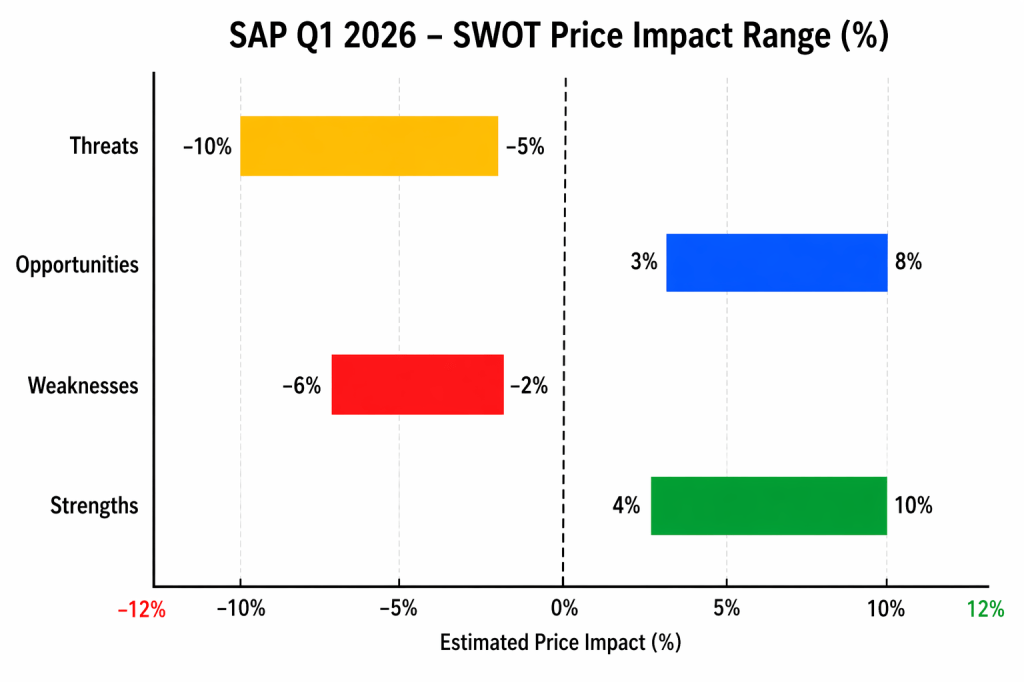
StrengthBacklog visibility+6% to +10%
StrengthCloud ERP dominance+5% to +9%
StrengthMargin expansion+4% to +8%
WeaknessLegacy decline-3% to -6%
WeaknessNo guidance raise-2% to -5%
OpportunityAI monetization+3% to +8%
OpportunityMultiple expansion+4% to +7%
ThreatGrowth normalization-5% to -10%
ThreatMacro/geopolitical risk-3% to -7%
SAP Q1 2026 SWOT price impact range chart showing upside from backlog and ERP growth versus downside from normalization risks
SAP’s valuation is driven by strong ERP and backlog momentum, with downside risks centered on growth normalization

Valuation Scenarios (EUR & USD)

The ADR closing price after earnings released was ~USD175, up more than 7%

  • FX assumption: €1 ≈ $1.08

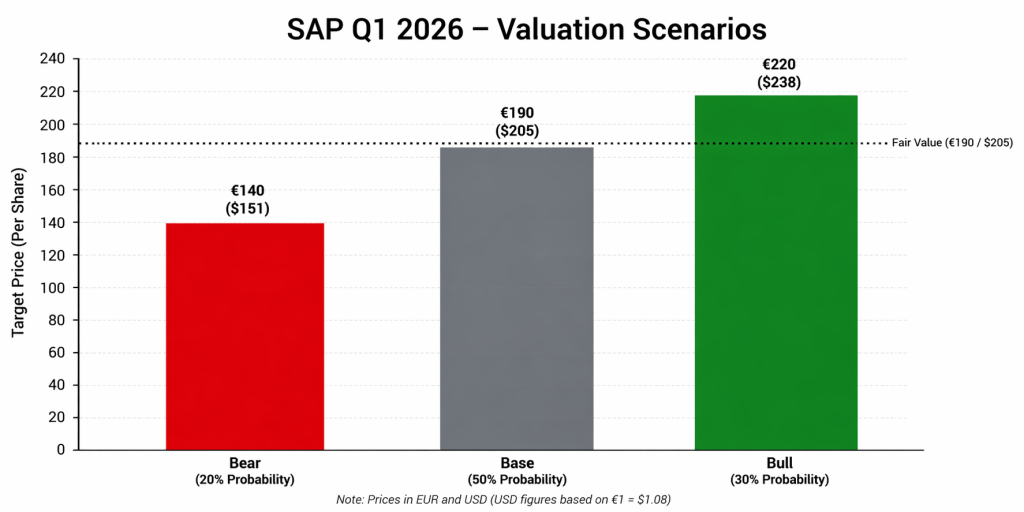
Bull Case (30% probability)

SAP successfully transitions into a premium compounder with sustained ERP growth and continued margin expansion.

  • EUR: €210 – €230
  • USD: $227 – $248

Base Case (50% probability)

Growth moderates but remains durable. SAP trades as a high-quality but mature enterprise software leader.

  • EUR: €184 – €196
  • USD: $199 – $212

Bear Case (20% probability)

Growth slows faster than expected, and Q1 proves to be a peak quarter.

  • EUR: €130 – €150
  • USD: $140 – $162

Probability-Weighted Outcome

  • Expected fair value range:
    → €187 – €193
    → $202 – $208

This implies moderate upside from current levels, but not a deep margin of safety.

SAP Q1 2026 valuation scenarios chart showing bear, base, and bull case price targets in euros and US dollars with probability weighting and fair value reference
SAP’s valuation suggests moderate upside under the base case, with potential re-rating if margin expansion continues, while downside risk remains if growth normalizes faster than expected

Verdict

SAP is no longer a turnaround story. It is evolving into a high-quality enterprise compounder with strong cash flow characteristics.

But that evolution comes with a new challenge:

The market is already starting to price it that way.

For investors, the opportunity is not in identifying whether SAP is improving — that is now clear. The real question is whether the current valuation fully reflects that improvement.


Call to Action

If you are a long-term investor, SAP remains a strong candidate for a core portfolio holding, especially if you believe in the durability of enterprise ERP systems.

However, this is no longer a stock to chase aggressively. Entry discipline matters more than ever.


Disclaimer

This analysis is for informational purposes only and does not constitute financial advice. Always conduct your own research and consider your risk tolerance before making investment decisions.

Accenture Q2 FY2026 Earnings: Strong AI Demand, But Still Waiting for Growth Acceleration

Accenture reported solid Q2 FY2026 results with record bookings of $22.1 billion and raised its revenue growth guidance to 4–7%. However, revenue growth remains mid-single digits, and GAAP margins compressed. The stock price is near its fair value, with future performance dependent on executing AI strategies rather than just demand narratives.

TL;DR Summary

Accenture (ACN:NYSE) delivered a solid quarter with record bookings and raised guidance, confirming strong enterprise AI demand. However, revenue growth remains in the mid-single digits, and margin pressure suggests AI investments are still in the build phase. The stock is trading close to its probability-weighted fair value, meaning future upside depends on execution—not narrative.


Quarter Recap

Accenture reported Q2 FY2026 results that reflect strong execution but measured growth. Revenue reached $18.0 billion, growing 7% in U.S. dollars and 4% in local currency. Adjusted EPS came in at $3.59, up 10% year over year, while GAAP EPS declined 4%.

The most notable metric was bookings, which hit a record $22.1 billion for a second quarter, indicating strong forward demand. The company also raised its full-year revenue growth guidance to 4–7%, reinforcing confidence in its pipeline.

However, margin trends were mixed. Adjusted operating margin improved slightly, but GAAP margins declined, reflecting continued investment in AI capabilities.


Key Highlights

  • Revenue: $18.0B (+7% USD, +4% local currency)
  • Adjusted EPS: $3.59 (+10% YoY)
  • GAAP EPS: $3.19 (-4% YoY)
  • Record bookings: $22.1B
  • Raised FY2026 revenue growth guidance: 4–7%
  • Free cash flow: $2.68B
  • Share repurchases: $1.7B

SWOT Analysis

Accenture’s results reinforce its position as a high-quality execution platform for enterprise transformation and AI adoption. The company is seeing strong demand and improving visibility, but the market is still waiting for clear evidence that this demand can translate into sustained revenue acceleration and margin expansion.


Strengths

  • Record bookings ($22.1B) → strong forward revenue visibilityEstimated impact: +6% to +10%
  • Raised FY2026 guidance (4–7%) → improving confidenceEstimated impact: +4% to +7%
  • Balanced model (Consulting + Managed Services)Estimated impact: +3% to +6%
  • Positioned as enterprise AI orchestrator across ecosystemsEstimated impact: +5% to +12% (long-term)

Weaknesses

  • Revenue growth still mid-single digit (4% local currency)Estimated impact: -5% to -10%
  • GAAP margin compression (-70bps)Estimated impact: -3% to -6%
  • GAAP EPS decline (-4% YoY)Estimated impact: -3% to -5%

Opportunities

  • AI bookings converting into revenue accelerationEstimated impact: +10% to +20%
  • Early-stage enterprise AI adoption cycleEstimated impact: +8% to +15%
  • Large deal momentum (41 clients >$100M bookings)Estimated impact: +5% to +10%

Threats

  • AI commoditization (clients internalizing capabilities)Estimated impact: -8% to -15%
  • Hyperscalers capturing more value chainEstimated impact: -5% to -12%
  • Macro-driven IT spending volatilityEstimated impact: -6% to -10%
Horizontal SWOT chart showing Accenture Q2 FY2026 estimated stock price impact ranges, with strengths and opportunities in positive territory and weaknesses and threats in negative ranges on a -20% to +20% scale.
SWOT price impact ranges for Accenture’s Q2 FY2026 earnings, highlighting the balance between strong AI-driven demand and ongoing growth and margin constraints.

Valuation Scenarios

Accenture is currently being valued as a stable, high-quality operator with AI exposure, but not yet as a high-growth AI beneficiary. The key variable remains whether strong bookings can translate into sustained revenue acceleration.


Bear Case — $170 to $180

If revenue growth remains around 4–5% and AI demand takes longer to convert into revenue, while margins remain under pressure, the stock could see multiple compression toward traditional consulting peers.


Base Case — $195 to $210

If Accenture delivers within its updated 4–7% growth guidance and AI contributes incrementally without significantly accelerating growth, the stock is likely to remain around current levels with modest upside.


Bull Case — $230 to $260

If AI bookings translate into revenue acceleration above 8–10% and margins expand through operating leverage, Accenture could be re-rated as a leading AI execution platform.


Probability-weighted fair value

Based on the scenario analysis:

  • Bear case (25%): ~$175
  • Base case (50%): ~$202
  • Bull case (25%): ~$245

👉 Estimated fair value: ~$206

At a current price of around $203, Accenture is trading very close to its probability-weighted fair value, suggesting that the market is already pricing in its current level of execution.

Bar chart showing Accenture Q2 FY2026 valuation scenarios with bear case at $175, base case at $202, and bull case at $245, including a dashed fair value line at approximately $206.
Accenture Q2 FY2026 valuation scenarios showing bear, base, and bull price targets, with a probability-weighted fair value of approximately $206 based on execution and AI growth assumptions.

Verdict

Accenture continues to execute well, supported by strong demand and improving guidance. However, the market is still waiting for clear evidence that AI demand can drive sustained revenue acceleration.

At current levels, the stock appears fairly valued. This shifts the investment case from valuation-driven upside to execution-driven upside.

For now, Accenture remains a “show-me” story—a high-quality compounder with AI optionality, but not yet a full AI re-rating.


Call to Action

If you want more breakdowns like this—focused on how earnings translate into real price impact—follow SWOTstock for SWOT analysis on major companies.


Disclaimer

This analysis is for informational purposes only and does not constitute financial advice. Always conduct your own research before making investment decisions.


Netflix Q3 2025 — “AI Meets Ad Money: A Plot Twist in the Streaming Story”

Netflix’s Q3 2025 earnings showed record revenue of $9.62 billion and operating income of $2.27 billion, although a $619 million tax hit in Brazil lowered EPS to $4.25. Management affirmed strong fundamentals, with significant ad-tier growth expected. The company is evolving towards a profit-focused model amid expansion and AI enhancements.

TL;DR Summary

Netflix’s (NASDAQ: NFLX) Q3 2025 results delivered record revenue of $9.62 billion (+12.6 % YoY) and operating income of $2.27 billion (+18 %), but a $619 million tax expense in Brazil clipped EPS to $4.25, below expectations.
Despite a 6 % after-hours drop, management reaffirmed margin and cash-flow guidance, and the ad-tier business is scaling faster than expected. The fundamentals remain strong — the market reaction was all sentiment.


Quarter Recap

  • Revenue: $9.62 B (+12.6 % YoY)
  • Operating Margin: 23.6 % (up 1.1 pts)
  • Net Income: $1.94 B (+15 %)
  • EPS: $4.25 (+14 %)
  • Free Cash Flow: $1.7 B (slightly lower on $18 B content spend)
  • Paid Memberships: 282 M (+9 %)
  • Ad-tier Share: ≈ 16 % of new sign-ups (vs 9 % in Q2)
  • Regional Growth: APAC +22 %, LATAM +18 %, EMEA +10 %, UCAN +8 %

Key Highlights and Management Comments

Greg Peters (Co-CEO):

“Our ad-supported plan is scaling faster than expected. We’re now live in 15 markets, and we expect this to be a multi-billion-dollar business by 2026.”

Spencer Neumann (CFO):

“We’re on track for roughly $7 billion in free cash flow this year, even after increasing content investment to $18 billion.”

Ted Sarandos (Co-CEO):

“AI is improving localization, dubbing, and recommendations — helping creators reach global audiences, not replacing them.”


SWOT Analysis

Before breaking down Netflix’s quarter into strengths, weaknesses, opportunities, and threats, it’s useful to step back and look at what really moved the numbers this time. Q3 2025 wasn’t a story about subscriber growth or content costs alone — it was about a business transitioning into a more diversified, margin-focused platform. The sudden tax hit added noise, but underneath, Netflix is shaping a clearer long-term trajectory.
The SWOT framework highlights how each of these forces may translate into real price impact for investors.

Strengths

  • Ad-tier scaling ahead of plan (+8 – 12 %)
  • Operating margin expanding (+4 – 6 %)
  • Solid subscriber growth (+3 – 5 %)

Weaknesses

  • Heavy content spend pressures FCF (–3 – 5 %)
  • UCAN saturation limits pricing (–2 – 3 %)

Opportunities

  • Global ad expansion (15 markets, 16 % of sign-ups) (+10 – 15 %)
  • AI-powered localization & discovery (+4 – 6 %)
  • Gaming and live content diversification (+2 – 3 %)

Threats

  • Brazil tax dispute (–6 – 8 %)
  • Streaming competition (–4 – 6 %)
  • FX headwinds in LATAM (–2 – 3 %)

Net Impact: ≈ +1.5 – 2 % upside vs current price.


SWOT Price Impact Chart for Netflix Q3 2025 showing estimated price impact ranges for each SWOT factor.


Valuation Scenarios (Q4 2025 – Mid 2026 Horizon)

With the SWOT picture in place, the next step is understanding how these drivers translate into valuation. Netflix is no longer purely a high-growth streaming play; it’s a hybrid model balancing global expansion, ad monetization, and AI-driven efficiency. Each scenario—bull, base, and bear—reflects a different path the company could take depending on execution, competitive pressure, and regulatory risks.
The following valuation scenarios show how those paths map to price targets and a probability-weighted fair value.

Bull Case (35 %)

  • Ad-tier accelerates; margin 25 % +; EPS >$6 → Target $1,450 (+17 %)

Base Case (45 %)

  • Stable 7 % subscriber growth; margin 24 % → Target $1,250 (+1 %)

Bear Case (20 %)

  • Tax drag repeats; churn rises; cost inflation → Target $1,000 (–19 %)

Fair Value: Weighted Average ≈ $1,270
Current Price: ≈ $1,240 → +2.4 % Upside

Valuation scenarios chart for Netflix Q3 2025 showing three vertical bars: Bear case ($1,000 at 20%, red), Base case ($1,250 at 45%, gray), and Bull case ($1,450 at 35%, green). A dashed horizontal line marks the fair value at $1,270, following the same format as the Palo Alto Networks valuation chart.

Valuation Scenarios Chart for Netflix Q3 2025 displaying Bear, Base, and Bull targets with a fair-value line at $1,270.


Verdict

Netflix is shifting from a subscriber-growth story to a profit-platform narrative.
The 6 % post-earnings drop looks more like a valuation reset than a fundamental issue.
If the Brazil tax charge proves one-off, Q3 2025 may mark the start of a more sustainable, AI-enhanced growth chapter.

Short-term: Hold / Accumulate on weakness
Medium-term: Attractive for growth investors eyeing AI and ad-tier upside


Call to Action

👉 Follow SWOTstock for AI-driven SWOT analyses of top global companies.
📈 Stay ahead of the market with data-driven insights simplified for retail investors.


Disclaimer

This analysis is based solely on Netflix’s official Q3 2025 financial statements and earnings call materials. It is for educational and informational purposes only and does not constitute investment advice.