Snowflake Q1 FY2026: AI Promise Gains Ground, But Can the Stock Justify Its Premium?

Snowflake Q1 FY2026 earnings recap: 26% product revenue growth, expanding AI platform with Cortex, and a strategic pivot toward enterprise AI workloads. Explore SWOT analysis, valuation scenarios, and investor insights.

TL;DR – AI Momentum Is Building, But Valuation Is a Hurdle

Snowflake (NYSE: SNOW) delivered another solid quarter, with strong growth in product revenue and promising early traction in AI-native services like Cortex. While the company continues to execute on its transition from data warehouse to AI platform, GAAP profitability remains elusive. The stock is trading above $200, which reflects confidence in long-term AI monetization—but may leave little room for near-term execution missteps.


Quarter Recap – Solid Fundamentals, Strong Vision, and Rising Expectations

Snowflake entered fiscal 2026 with impressive momentum. Product revenue grew 26% year-over-year to $996.8 million, supported by rising demand from enterprise clients and sustained usage from technology-forward organizations. Total remaining performance obligations (RPO) reached $6.7 billion, a 34% increase, signaling deep customer commitment over the coming quarters.

Yet what made this quarter stand out wasn’t just the numbers—it was the strategic tone. CEO Sridhar Ramaswamy framed the company’s evolution clearly: Snowflake is aiming to become the infrastructure backbone of enterprise AI. The recent launch of Cortex allows users to run LLMs and vector search on their own data, within Snowflake’s platform. This integration is expected to expand use cases and deepen wallet share with customers.

CFO Mike Scarpelli acknowledged that macro pressures still influence some customer segments, but also noted increasing contributions from AI-native businesses. These companies are growing their consumption faster and could become a larger revenue driver over time.

In short, this was a quarter where the fundamentals held steady—but the vision pushed forward even more aggressively.


Key Highlights

Line chart showing Snowflake’s quarterly revenue and net income trends from Q1 FY25 to Q1 FY26, highlighting growth and ongoing GAAP losses.
  • Product Revenue: $996.8M (+26% YoY)
  • Total Revenue: $1.04B
  • RPO: $6.7B (+34% YoY)
  • Net Revenue Retention: 124%
  • Customers with >$1M TTM Product Revenue: 606 (up from 485 YoY)
  • Non-GAAP Operating Margin: 9%
  • GAAP Operating Loss: $447M
  • Stock Buybacks: $491M for 3.2M shares
  • Cash & Equivalents: $4.9B

What’s Working, What’s Risky – A Closer Look Through SWOT

Snowflake is a stock that forces investors to weigh long-term platform optionality against short-term valuation concerns. Here’s a structured breakdown of what’s unfolding beneath the headline figures.

Horizontal bar chart showing estimated stock price impact of Snowflake’s strengths, weaknesses, opportunities, and threats.

Strengths

Snowflake’s product revenue growth remains strong, and its customer expansion—especially among those spending over $1 million annually—is accelerating. Net revenue retention of 124% underscores the stickiness and expanding utility of its platform. This kind of enterprise engagement doesn’t happen by accident; it’s driven by real product need and trust.

Stock price impact estimate: +$15–20 if this strength remains consistent and margin discipline improves.

Weaknesses

Despite strong topline growth, Snowflake still posted a $447 million GAAP operating loss. Stock-based compensation remains a drag on profitability. And while buybacks support the stock, they also reduce cash flexibility if market conditions tighten.

Stock price impact: –$5–10 as margins and profitability concerns limit upward re-rating in the near term.

Opportunities

The company is betting big on AI. Cortex could become a high-margin differentiator if widely adopted. Snowflake also benefits from developer ecosystem momentum and the expanding Data Marketplace. If it becomes the default AI+data platform for enterprises, the upside could be meaningful.

Stock price upside estimate: +$25–40 if Cortex monetization scales successfully over the next 12–18 months.

Threats

Competition in this space is no joke. AWS, Google Cloud, and Databricks are all investing heavily in adjacent technologies. Additionally, Snowflake’s premium valuation leaves little room for error—any slowdown in growth or delay in AI execution could lead to multiple compression.

Risk-adjusted downside: –$20–30 if growth cools or AI monetization underwhelms.

"Table summarizing Snowflake’s Q1 FY2026 SWOT analysis with estimated stock price impacts. Strengths include strong revenue growth and customer expansion (+15 to +20). Weaknesses highlight GAAP losses and dilution risk (–5 to –10). Opportunities like AI platform Cortex and Data Marketplace offer potential upside (+25 to +40), while competitive and execution risks are flagged as threats (–20 to –30)."

Valuation Scenarios – What’s Priced In, and What’s Not

With Snowflake closing at $203.18 post-earnings, investors are clearly pricing in confidence in long-term platform growth. But how realistic is that pricing under different conditions?

Bar chart comparing Snowflake’s bear, base, and bull valuation scenarios with a black bar for current stock price and a dotted line for estimated fair value.

Base Case

  • Summary: Continued 25%+ product revenue growth, stable margin trajectory, Cortex adoption builds gradually
  • Estimated Fair Value: $150
  • Probability: 60%

Bull Case

  • Summary: Accelerated AI adoption, operating leverage unlocks quickly, free cash flow turns sustainably positive
  • Valuation: $240
  • Probability: 25%

Bear Case

  • Summary: Macro slowdown, AI workloads fail to monetize, continued margin drag
  • Valuation: $110
  • Probability: 15%

Weighted Average Fair Value

(150×0.6)+(240×0.25)+(110×0.15) = $157.50

At $203, the stock is pricing in the bull case—or close to it.


Verdict – Hold for Believers, Wait for Better Entry for Everyone Else

Snowflake is undeniably a category-defining company. Its platform moat is real, and its long-term relevance in enterprise AI looks promising. But the valuation today assumes a lot—particularly that Cortex and related AI monetization will ramp fast and wide.

If you’re already long and believe in the vision, it’s a Hold. If you’re looking to initiate a position, it may be wiser to wait for a pullback or more concrete signs of AI revenue contribution.


Want More Candid, Analyst-Style Stock Breakdowns?

Subscribe to our newsletter and follow us for deeper, data-driven takes on the biggest names in tech and AI. No hype, no noise—just strategy and substance.


Disclaimer

This article is based solely on Snowflake’s official Q1 FY2026 earnings report and call transcript. It is not financial advice. Always do your own due diligence before investing.

Leave a comment


Salesforce Q1 FY26: AI Signals Are Strong, But The Market Demands More Than Hype

Salesforce Q1 FY26 earnings: strong cash flow, $1B+ AI revenue, and raised guidance—but the stock dipped. Discover our in-depth SWOT analysis, valuation scenarios, and why long-term tech investors may see upside.

🚀 TL;DR – Earnings Solid, Outlook Raised, But Street Unconvinced

Salesforce (NYSE: CRM) delivered on many fronts in Q1 FY26: strong free cash flow, a raised full-year outlook, and impressive AI momentum with over $1B in annualized AI revenue. Yet the market reaction was subdued. Shares slipped ~3% post-earnings as investors weighed modest growth against growing acquisition dependency. For long-term investors focused on enterprise AI, the current pullback may offer an attractive re-entry point — but execution risk remains high.


📊 Quarter Recap – Cash-Rich, AI-Forward, But Investors Ask: What’s Next?

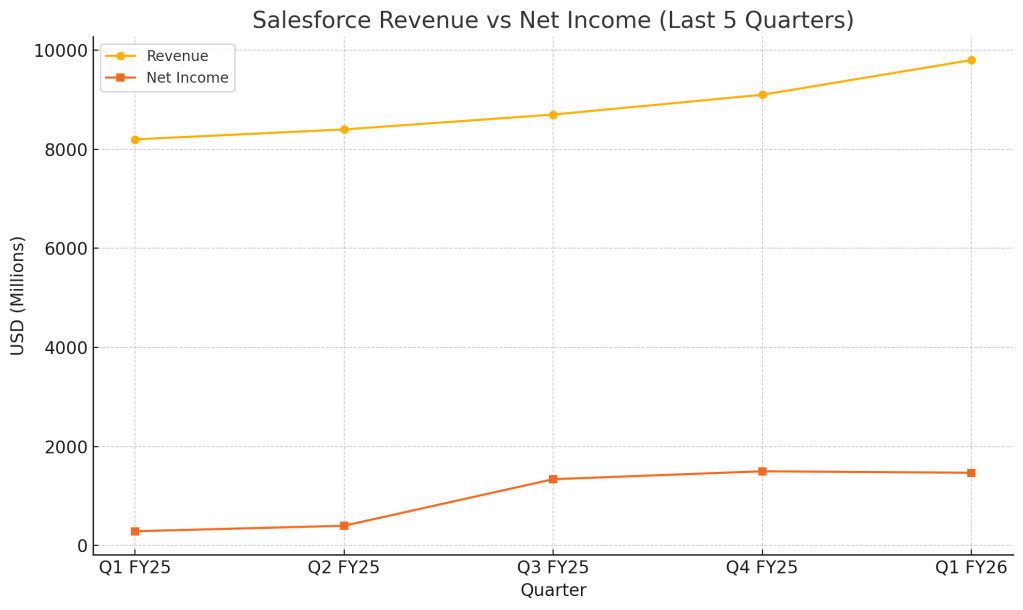
Line chart showing Salesforce’s revenue and net income over the last five quarters, with revenue rising steadily from Q1 FY25 to Q1 FY26 and net income spiking in Q3 FY25 and Q4 FY25.

Salesforce reported Q1 FY26 revenue of $9.8 billion, reflecting 8% growth year-over-year. The company continues to demonstrate financial discipline, posting a 32.3% non-GAAP operating margin and generating $6.3 billion in free cash flow — a key metric that reinforces the strength of its subscription-based business model.

However, the earnings story wasn’t just about operational metrics. Management spent considerable time during the call highlighting Salesforce’s evolving identity as an AI-first enterprise software provider. The AI and Data Cloud segment reached a milestone of over $1 billion in annualized recurring revenue, up 120% from the prior year. Additionally, Agentforce — the company’s AI-powered sales assistant platform — closed over 8,000 deals, with 50% of them already monetized.

Despite these advancements, investor enthusiasm appeared tempered. Salesforce also unveiled its intention to acquire Informatica in a transaction valued at over $8 billion. While the strategic rationale centered on data integration and platform expansion, some investors viewed it as a sign that organic AI monetization remains in its early innings.


📌 Key Highlights

(📌 Visual Placeholder: Q1 FY26 Metrics Snapshot)

  • Revenue: $9.8B (+8% YoY)
  • Subscription & Support Revenue: $9.3B (+8% YoY)
  • Non-GAAP Operating Margin: 32.3%
  • Free Cash Flow: $6.3B (+4% YoY)
  • AI & Data Cloud ARR: $1B+ (+120% YoY)
  • Agentforce Deals: 8,000+ closed, 50% paid
  • Shareholder Return: $3.1B (including $2.7B in buybacks)
  • FY26 Guidance: Revenue raised to $41–41.3B, EPS to $11.27–11.33

🧠 SWOT Analysis – Is Salesforce Building Sustainable AI Moats?

(📊 Visual Placeholder: Horizontal Bar Chart – SWOT Price Impact Ranges)

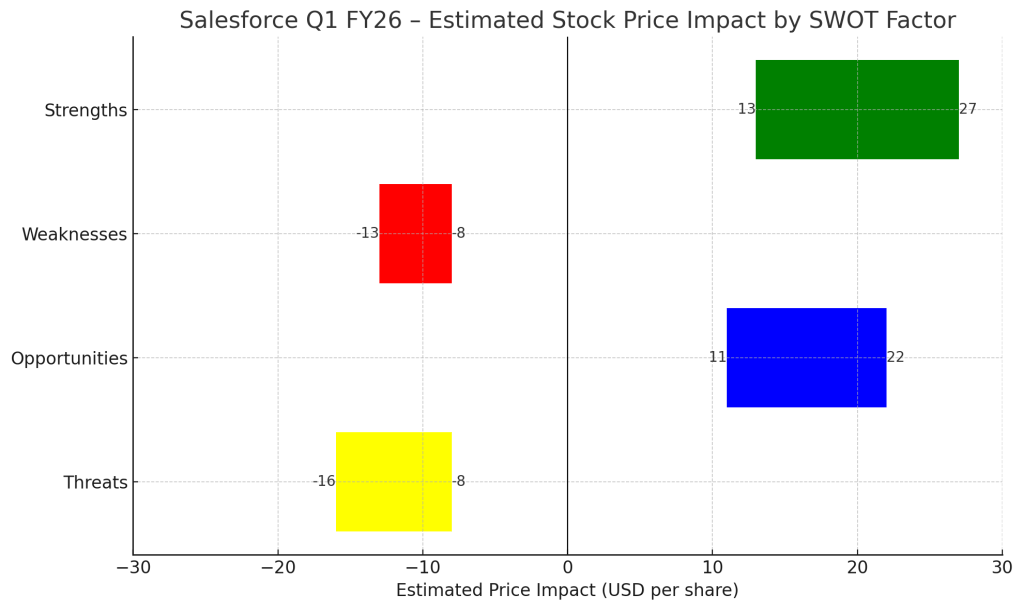
Horizontal bar chart showing Salesforce’s estimated stock price impact by SWOT factor for Q1 FY26 with x-axis from –30 to 30. Categories include Threats (–16 to –8), Opportunities (+11 to +22), Weaknesses (–13 to –8), and Strengths (+13 to +27).

To evaluate Salesforce’s trajectory, we use a SWOT framework — layering qualitative insight with quantitative impact ranges to assess where the stock could go next.

✅ Strengths

Salesforce’s high-margin business continues to generate substantial cash, supporting both R&D and shareholder returns. With a 32.3% non-GAAP operating margin and $6.3B in quarterly free cash flow, the company remains financially resilient. Meanwhile, the $1B+ in AI annual recurring revenue — up 120% year-over-year — signals that the firm’s early bets on generative AI are beginning to materialize.

Estimated Price Impact: +5% to +10% ($13–27)

⚠️ Weaknesses

At 8% year-over-year growth, revenue is expanding — but not at a pace that excites growth-focused investors. Combined with an $8B acquisition of Informatica, some view the quarter as a reminder that Salesforce still leans heavily on M&A for platform expansion. This can dilute long-term returns if integration is poorly executed or if synergy realization takes longer than anticipated.

Estimated Price Impact: –3% to –5% ($8–13)

🌱 Opportunities

The most obvious upside lies in the scaling of Agentforce and global AI deployment. Management noted that over 8,000 Agentforce deals were signed, with paid conversion already at 50%. On top of that, international expansion — particularly in Japan, the UK, and Canada — could provide incremental growth via cross-product bundling and new verticals.

Estimated Price Impact: +4% to +8% ($11–22)

🧨 Threats

Salesforce is not immune to macroeconomic uncertainty. Should enterprise IT budgets tighten further, even AI-led offerings could face delayed adoption. Add to that the integration risk tied to Informatica, and the bear case begins to take shape. Investors have seen how difficult it can be to maintain focus and cost discipline amid large-scale acquisitions.

Estimated Price Impact: –3% to –6% ($8–16)


📋 SWOT Summary Table

SWOT summary table showing Salesforce’s Q1 FY26 strengths, weaknesses, opportunities, and threats with estimated stock price impacts. Strengths include strong cash flow and $1B+ AI ARR (+$13 to +$27); weaknesses include slower revenue growth and M&A reliance (–$8 to –$13); opportunities like Agentforce expansion and international AI rollout (+$11 to +$22); and threats such as macro uncertainty and acquisition risk (–$8 to –$16).

📐 Valuation Scenarios – Realistic Upside, But No Easy Wins

Bar chart showing Salesforce Q1 FY26 valuation scenarios: Bear Case at $260, Base Case at $290, Bull Case at $320, and Current Price at $266.92. A blue dotted line represents the fair value estimate at $293.

🟢 Bull Case – Target: $320 (Probability: 30%)

A best-case scenario assumes Salesforce executes flawlessly: Agentforce expands rapidly, international AI rollouts outperform, and Informatica is integrated smoothly. In this case, margin expansion and top-line acceleration could support a price of $320.

⚫ Base Case – Target: $290 (Probability: 50%)

In a more measured scenario, AI and cloud revenue continue to build gradually while macro headwinds and integration friction create a modest drag. Here, the valuation rests on steady execution — not breakout success.

🔴 Bear Case – Target: $260 (Probability: 20%)

The bear case includes a slower-than-expected AI ramp, growing customer budget constraints, and post-acquisition inefficiencies. Margins may hold, but revenue growth could fall short.

Weighted Fair Value:

(0.3 × $320) + (0.5 × $290) + (0.2 × $260) = $293


🔍 Peer Comparison – Where Salesforce Stands in the AI-Enterprise Cloud Race

Table comparing Salesforce, Microsoft, and ServiceNow across key enterprise AI metrics: AI ARR growth, free cash flow margins, AI integration strategies, transparency in disclosures, and M&A approach. Salesforce shows 120% AI ARR growth with high cash flow and aggressive acquisitions, Microsoft focuses on embedded AI with less disclosure, while ServiceNow emphasizes workflow-native AI with selective partnerships.

While Salesforce has made impressive strides in monetizing AI, investors are right to compare its positioning against other enterprise software giants. Let’s take a closer look at how Salesforce stacks up against Microsoft and ServiceNow — two of the most visible players in enterprise AI and workflow automation.

  • Microsoft (MSFT) remains the dominant force in cloud infrastructure and productivity software, with its AI integration deeply embedded in products like Office 365, Azure OpenAI, and Dynamics. Although Microsoft has been less transparent about standalone AI ARR, its cross-product integration strategy has kept it at the forefront of enterprise adoption. Its advantage lies in seamless native integration — rather than monetizing AI as a separate revenue line, it’s baking it into everything.
  • ServiceNow (NOW), on the other hand, is pursuing a focused strategy in workflow automation with GenAI capabilities tied to task orchestration, IT operations, and HR service delivery. While it doesn’t disclose AI revenue explicitly, estimates suggest significant uptake across modules, especially post its strategic partnerships with NVIDIA and Microsoft. Its modular SaaS structure allows for more agile, vertical-specific AI adoption.
  • Salesforce (CRM) is unique in that it publicly discloses AI ARR, which recently crossed the $1B threshold (up 120% YoY). This offers greater transparency — a potential edge with analysts and investors — but also sets higher expectations. Salesforce’s AI strategy is tied closely to its Data Cloud and the Agentforce platform, but the question remains whether it can scale these innovations organically or will rely on acquisitions like Informatica to accelerate adoption.

Overall, Salesforce appears to be ahead in AI monetization transparency, but trails in seamlessness of integration (vs. Microsoft) and vertical execution (vs. ServiceNow). The coming quarters will be critical in demonstrating that these early AI wins are scalable — not just showcase projects.


🧭 Verdict – AI Execution Will Make or Break This Re-Rating

At ~$267, Salesforce is trading about 9% below its probability-weighted fair value of $293. That’s not a deep discount — but for investors willing to wait on Agentforce and international AI scaling, it may represent a reasonable opportunity.

Still, this is not a momentum trade. Salesforce must show it can deliver consistent AI-driven revenue growth without leaning too heavily on M&A to do it.


📩 Call to Action

Follow @SWOTstock and subscribe to get clear, no-spin earnings breakdowns.


⚠️ Disclaimer

This article is based solely on Salesforce’s official Q1 FY26 earnings report and management’s public comments. It is not investment advice.


Leave a comment


Walmart Q1 2025: E-Commerce Turns a Profit—But Is That Enough for the Stock to Break Out?

Walmart reported strong Q1 FY2026 results, with sales rising to $165.61 billion and e-commerce profitability achieved globally. Despite these positives, stock prices remained flat due to inflation, pricing pressures, and a lack of EPS guidance. While Walmart presents growth opportunities, macroeconomic risks traditionally temper investor enthusiasm.

Quick Take: Steady Growth, But Macro Risks Keep a Lid on the Rally

Walmart (NYSE: WMT) delivered a strong Q1 with rising sales, expanding operating income, and—most importantly—e-commerce profitability. Yet the stock barely moved. Why? Inflation, pricing pressure, and the decision to withhold EPS guidance signal near-term caution. For long-term, low-risk growth seekers, Walmart still looks like a solid bet, but now’s the time to watch execution closely.


Quarter Recap: A Landmark Quarter, But Tariff Warnings Weigh Heavily

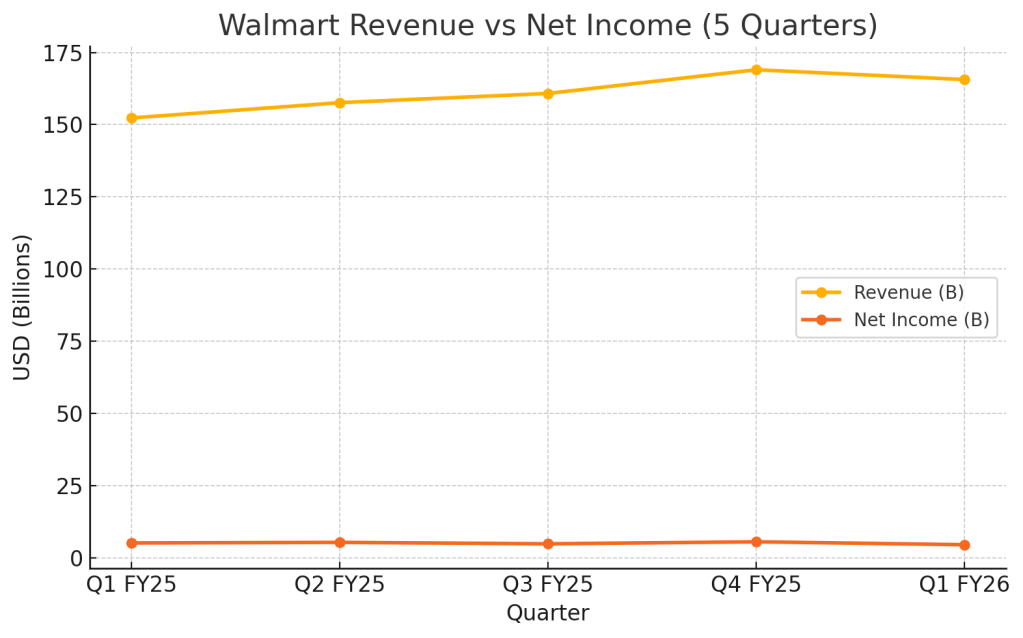
Walmart’s Q1 FY2026 (calendar Q1 2025) showed revenue of $165.61 billion (+2.5% YoY), with operating income up 4.3%. U.S. comparable sales rose 4.5%, driven by strong performance in food and pharmacy. A standout highlight: e-commerce operations became profitable globally—a signal that Walmart’s long-term tech investments are beginning to pay off.

Despite this, the stock dipped –0.5% during regular trading and was down 4% at open, after an initial premarket rise. The reason? CEO Doug McMillon acknowledged that Walmart would raise prices in response to persistent tariffs. And critically, the company withheld EPS guidance, citing economic uncertainty.

Why this quarter matters: Walmart just hit a key profitability milestone in digital—but cost pressures and visibility concerns are limiting investor enthusiasm.


Walmart Q1 2025 – Key Financial Highlights

  • Revenue: $165.61B (+2.5% YoY)
  • Net Income: $4.49B (down from $5.10B YoY)
  • EPS: $0.61 (beat by $0.03)
  • U.S. Comp Sales: +4.5%
  • Global E-commerce Sales: +22% YoY
  • E-commerce Profitability: First time achieved globally
  • Operating Income: +4.3%
  • FY Guidance: Reaffirmed 3–4% sales growth; EPS guidance withheld
Line chart showing Walmart's revenue and net income trend over five quarters, highlighting solid sales with recent profit compression.

Walmart vs. Amazon vs. Target: Who’s Winning the Retail Transformation?

MetricWalmartAmazonTarget
E-commerce ProfitabilityAchieved (Q1 2025)Long-establishedStill lagging
In-store Sales Growth+4.5% U.S. compsMinimal (no store footprint)Flat to slightly negative
Ad Revenue MonetizationExpanding (Walmart Connect)Robust (Amazon Ads)Early stage
Inventory StrategyAI + automation scalingLogistics leaderStruggling with excess
Guidance ToneCautious, no EPS givenConfidentDefensive, cost-cutting

Takeaway: Walmart is the only large-format retailer with profitable e-commerce and store traffic momentum. It lags Amazon in tech monetization but is clearly outpacing Target in operational agility.


SWOT Breakdown: Walmart’s Digital Wins Meet Margin Headwinds

Let’s break it down using a simple SWOT framework—what’s going well, what’s not, where the upside lies, and what risks could derail the story.

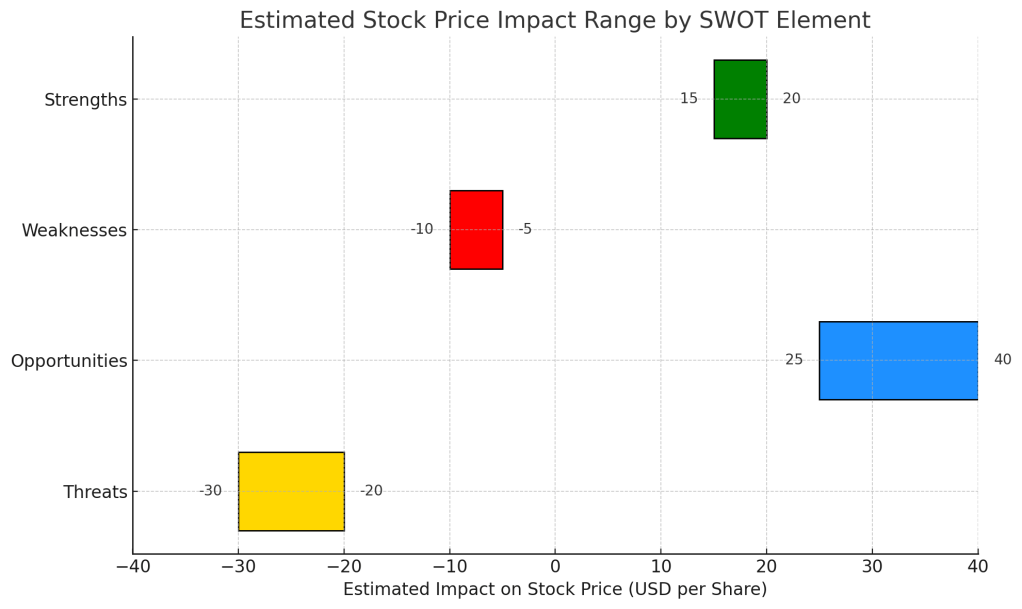
Strengths

Walmart is scaling e-commerce profitably while growing in-store comps. Fulfillment efficiency and automation are boosting operating income.

Stock Price Impact Estimate:
Could support a +$3 to +$5 upside if this continues.

Weaknesses

Margins remain pressured. Net income declined, and the decision not to issue EPS guidance raises questions about confidence in short-term forecasting.

Stock Price Impact Estimate:
Could cap the stock by –$1 to –$3 per share.

Opportunities

Automation, Walmart+, advertising, and health services offer high-margin growth channels. AI integration in logistics and demand planning could unlock additional EPS upside.

Stock Price Impact Estimate:
If scaled well, could add +$4 to +$6 to valuation.

Threats

Tariffs, inflation, and pricing action could impact demand—especially in general merchandise. Management’s caution suggests macro risk isn’t fully priced in.

Stock Price Impact Estimate:
Worst-case downside of –$4 to –$6.

Horizontal bar chart estimating stock price impact ranges for Walmart’s Q1 2025 SWOT elements: strengths, weaknesses, opportunities, and threats.

SWOT Table Summary

CategoryKey TakeawaysEst. Stock Impact
StrengthsSolid comp growth, e-commerce profitability+$3 to +$5
WeaknessesMargin pressure, EPS visibility unclear–$1 to –$3
OpportunitiesMonetization of tech, AI, memberships, ad platform+$4 to +$6
ThreatsTariffs, inflation, pricing backlash–$4 to –$6
Four-quadrant SWOT chart summarizing Walmart’s Q1 2025 strengths, weaknesses, opportunities, and threats with the Walmart logo in the center.

Valuation Scenarios: How Walmart Stock Could Play Out from Here

Let’s revisit Walmart’s valuation in light of its solid operational execution, profitability in e-commerce, and the macro risks it faces. With the current stock price at $96.35, here’s how the stock could move in three realistic scenarios.


Base Case (Most Likely – 50%)

  • Summary: Walmart maintains low-single-digit revenue growth, keeps e-commerce profitable, and stabilizes margins with the help of automation and better inventory management. However, wage inflation and tariffs continue to pressure near-term earnings. EPS growth remains modest, and valuation multiples stay flat.
  • Fair Value Estimate: $100
  • Probability: 50%

Bull Case (Optimistic – 30%)

  • Summary: Walmart’s automation and AI-driven efficiencies begin to show stronger results, driving margin expansion. Advertising and subscription revenue accelerate, and general merchandise demand rebounds despite pricing headwinds. The company regains multiple expansion as investors price in stronger long-term profitability.
  • Fair Value Estimate: $110
  • Probability: 30%

Bear Case (Downside – 20%)

  • Summary: Consumer demand weakens as inflation and tariff-related pricing continue to rise. Walmart is forced to absorb more costs to maintain competitiveness, leading to margin compression. EPS flattens or declines. Valuation contracts slightly due to uncertainty around macro execution.
  • Fair Value Estimate: $85
  • Probability: 20%
Bar chart showing Walmart's valuation scenarios—bear, base, and bull—based on Q1 2025 performance and forward outlook.

Weighted Average Fair Value Calculation

(64×0.5)+(72×0.3)+(52×0.2)=$64.00


Valuation Verdict

With the current price at $96.35 (as of May 15, 2025), Walmart appears slightly undervalued based on its fundamental performance and risk-balanced outlook. For long-term, growth-conscious investors seeking resilience and scalable upside, Walmart may offer a reasonable entry point—especially if the company can maintain its digital momentum while defending margins.


Call to Action

Want focused stock breakdowns like this for every major earnings report?
Subscribe now for no-jargon, data-backed posts you can trust.


Disclaimer

This analysis is based solely on Walmart’s official Q1 FY2026 financial report and earnings call transcript. It is not investment advice. Please do your own research before investing.


Leave a comment