TL;DR Summary
ServiceNow (NOW:NYSE) delivered a stronger-than-expected second quarter, supported by 21.5% constant-currency cRPO growth, accelerating large transactions and AI annual contract value exceeding $1 billion. The report materially weakened the most bearish argument that artificial intelligence is already eroding ServiceNow’s competitive position.
The results were not unambiguously bullish, however. Acquisitions contributed meaningfully to reported growth, part of the revenue outperformance came from business moving forward from Q3, and AI infrastructure costs pressured gross-margin guidance.
Using dilution-adjusted owner earnings and three valuation scenarios, SWOTstock estimates ServiceNow’s probability-weighted fair value at approximately $113 per share. Against the pre-earnings closing price of $95.46, the shares appeared moderately undervalued—but without a large margin of safety.
Quarter Recap
ServiceNow reported Q2 2026 subscription revenue of $3.877 billion, increasing 24.5% as reported and 23% in constant currency. Total revenue reached $3.987 billion, representing 24% reported growth and 22.5% constant-currency growth.
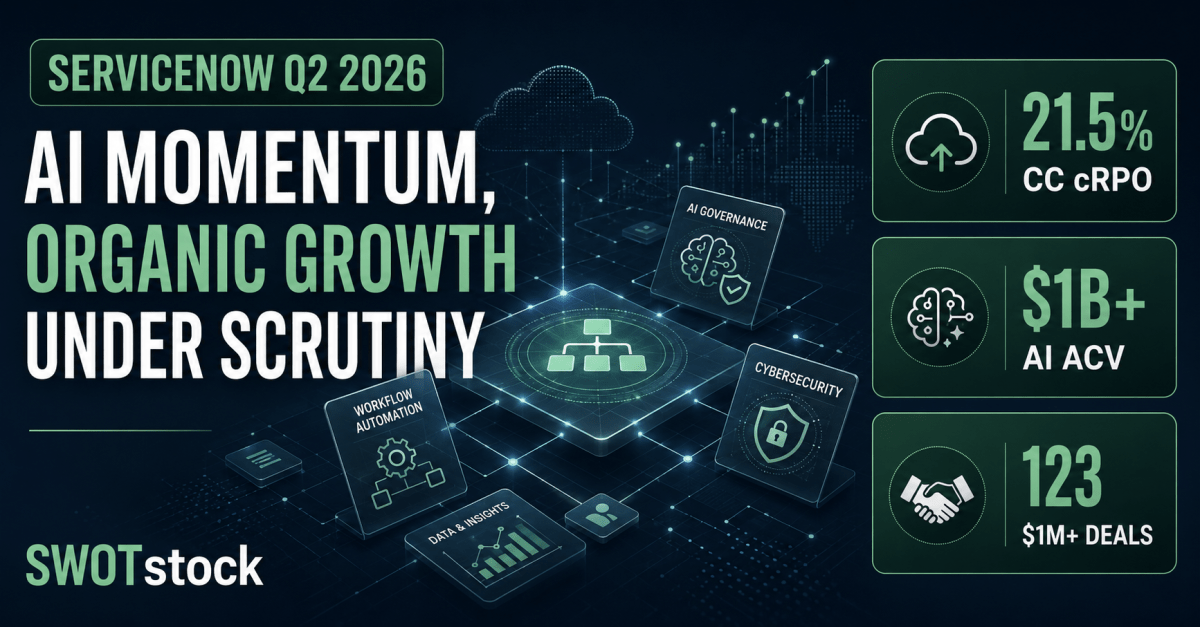
The more important forward-looking indicator was current remaining performance obligations, or cRPO. ServiceNow ended the quarter with $13.20 billion of cRPO, up 21% as reported and 21.5% in constant currency. This exceeded management’s previous 19.5% constant-currency guidance by approximately 200 basis points.
Approximately 125 basis points of Q2 cRPO growth came from Armis. Subtracting that disclosed contribution produces an estimated ex-Armis growth rate of approximately 20.25%. This is not a complete organic-growth calculation because ServiceNow did not separately disclose the contribution from every acquisition, but it suggests that the underlying platform remained healthy during the quarter.
ServiceNow also reported $29 billion of total remaining performance obligations, up 22% in constant currency, while its subscription renewal rate remained 98%.
Key Highlights
The quarter provided stronger commercial evidence than a simple revenue beat. Large contracts increased, AI adoption became more measurable and operating profitability exceeded guidance.
- ServiceNow completed 123 transactions above $1 million in net-new annual contract value, nearly 40% more than last year.
- The company ended the quarter with 658 customers generating more than $5 million in ACV, approximately 23% more than a year earlier.
- ServiceNow AI crossed $1 billion in ACV and remained on track to exceed $1.5 billion by the end of 2026.
- Management reported that million-dollar AI transactions approximately tripled, while customers operating agentic AI in production increased ninefold over nine months.
- Approximately 50% of net-new business is now generated through non-seat-based models, helping reduce ServiceNow’s dependence on the number of human software users.
- Non-GAAP operating margin reached 29.5%, 300 basis points above guidance.
- ServiceNow maintained its full-year non-GAAP operating-margin target of 31.5% and free-cash-flow margin target of 35%.
There were also important qualifications.
- Management said approximately half the Q2 revenue outperformance came from strong federal demand that moved some on-premise subscription revenue from Q3 into Q2.
- Full-year subscription-revenue guidance was increased only modestly to $15.760–$15.780 billion.
- Subscription gross-margin guidance was reduced from 81.5% to 81%, reflecting greater hyperscaler usage and accelerating AI consumption.
- Q3 cRPO guidance is 20% in constant currency, including approximately 150 basis points from Armis. The estimated Q3 growth rate excluding Armis is therefore closer to 18.5%.
The quarter was fundamentally bullish, but it did not prove that ServiceNow’s organic growth is reaccelerating beyond 20%.
SWOT Analysis
The following price-impact ranges estimate how individual developments could affect ServiceNow’s shares over approximately 12–18 months. They are scenario sensitivities and should not be added together mechanically.
Strengths
ServiceNow’s core strengths remain its high customer retention, deeply embedded workflows and ability to expand relationships across multiple enterprise functions.
- Strong contracted demand: potential price impact of +8% to +15%. Constant-currency cRPO growth reached 21.5%, while the estimated result excluding Armis remained approximately 20.25%.
- Large-deal momentum: potential price impact of +5% to +10%. Transactions exceeding $1 million in net-new ACV increased nearly 40%, supporting the quality of the cRPO result.
- Measurable AI monetization: potential price impact of +8% to +18%. AI ACV exceeded $1 billion, large AI transactions increased and more customers moved agentic applications into production.
- Durable customer relationships: potential price impact of +5% to +10%. The 98% renewal rate indicates that customers are not broadly replacing ServiceNow with standalone AI platforms.
- Strong operating leverage: potential price impact of +5% to +12%. The operating-margin beat and maintained full-year FCF-margin target demonstrate continued financial discipline.
Weaknesses
ServiceNow’s weaknesses center on the quality of reported growth, the difference between GAAP and non-GAAP profitability, and the economic cost of employee compensation.
- Acquisition-supported growth: potential price impact of −8% to −15%. Estimated Q3 cRPO growth falls from 20% to approximately 18.5% after removing the disclosed Armis contribution.
- Limited guidance increase: potential price impact of −4% to −8%. The small full-year revenue increase suggests management is not extrapolating the entire Q2 outperformance.
- Gross-margin pressure: potential price impact of −5% to −10%. AI adoption is increasing hyperscaler and consumption expenses before the full revenue benefit is visible.
- High stock-based compensation: potential price impact of −10% to −18%. Q2 SBC reached $655 million, while management expects it to represent approximately 15% of full-year revenue.
- Low GAAP operating margin: potential price impact of −5% to −12%. ServiceNow’s 4% GAAP operating margin was substantially below its 29.5% non-GAAP result.
Opportunities
ServiceNow’s principal opportunity is to become the governance and execution layer through which enterprises operate AI agents across different models, applications and infrastructure providers.
- AI ACV exceeding $1.5 billion: potential price impact of +10% to +20%. Achieving this target would strengthen the case that AI is becoming a durable incremental revenue stream.
- AI reaching 30% of total ACV by 2030: potential price impact of +20% to +35%. This would transform ServiceNow’s positioning from an incumbent adding AI features into a major enterprise AI platform.
- Security expansion: potential price impact of +10% to +20%. The combination of AI Control Tower, Armis and Veza could establish a differentiated security, identity and connected-asset platform.
- Non-seat-based monetization: potential price impact of +8% to +15%. Usage- and outcome-based revenue could offset slower growth in human software seats.
- CRM and employee-workflow expansion: potential price impact of +8% to +18%. ServiceNow can increase its share of customer spending by expanding beyond its established IT workflow position.
Threats
The largest long-term threat is not necessarily immediate replacement by an AI model. It is the possibility that AI reduces human software usage while increasing ServiceNow’s delivery costs faster than new AI products generate revenue.
- AI-driven seat compression: potential price impact of −20% to −35%. Fewer human users could weaken traditional subscription revenue before alternative pricing models become sufficiently large.
- Organic growth falling below 15%: potential price impact of −20% to −30%. The current valuation still requires sustained double-digit owner-earnings growth.
- Acquisition-integration problems: potential price impact of −15% to −25%. ServiceNow spent approximately $8.8 billion on acquisitions during the first half, increasing goodwill, acquired intangibles and debt.
- AI costs rising faster than monetization: potential price impact of −10% to −20%. Continued gross-margin pressure would reduce the value of otherwise impressive AI ACV growth.
- Growth-stock multiple compression: potential price impact of −15% to −25%. ServiceNow remains sensitive to discount rates and changes in investor appetite for enterprise software.
Valuation Scenarios
The valuation begins with ServiceNow’s official full-year guidance. Subscription revenue is expected to reach approximately $15.77 billion at the midpoint, while total revenue should be approximately $16.2 billion after including professional services.
A 35% non-GAAP FCF margin implies approximately $5.7 billion of reported free cash flow. However, stock-based compensation remains a genuine economic cost. Deducting estimated SBC produces normalized owner earnings of approximately $3.2–$3.3 billion, or around $3.10–$3.20 per diluted share.
Bear Scenario — $60
The bear scenario assumes that acquisition-adjusted growth moves toward the low teens, AI monetization does not fully offset seat pressure and ServiceNow receives a lower valuation multiple.
- Starting owner earnings: approximately $3.0 billion
- First five years’ growth: 10%
- Following five years’ growth: 5%
- Discount rate: 10%
- Terminal growth: 3%
- Probability: 20%
- Estimated value: $60 per share
This represents approximately 37% downside from the $95.46 reference price.
Base Scenario — $105
The base scenario assumes that ServiceNow sustains mid-teens owner-earnings growth, AI becomes incrementally profitable and the company successfully integrates its acquisitions.
- Starting owner earnings: approximately $3.25 billion
- First five years’ growth: 15%
- Following five years’ growth: 8%
- Discount rate: 9%
- Terminal growth: 3%
- Probability: 50%
- Estimated value: $105 per share
This represents approximately 10% upside from the reference price.
Bull Scenario — $163
The bull scenario assumes that ServiceNow sustains growth close to 20%, successfully monetizes AI at attractive margins and establishes its platform as the governance and action layer for enterprise AI.
- Starting owner earnings: approximately $3.5 billion
- First five years’ growth: 18%
- Following five years’ growth: 10%
- Discount rate: 8.5%
- Terminal growth: 3.5%
- Probability: 30%
- Estimated value: $163 per share
This represents approximately 71% upside from the reference price.
Applying the assigned probabilities produces a probability-weighted fair value of approximately $113 per share.
Verdict
ServiceNow’s Q2 report materially improved the investment thesis. Contracted growth remained strong, large transactions accelerated and AI adoption produced measurable ACV rather than only product announcements or pilot activity.
The evidence also challenges the strongest version of the enterprise-software pessimism. Customers are not broadly leaving ServiceNow, the renewal rate remains high, and AI appears to be generating additional products and use cases. The company’s movement toward non-seat-based pricing also gives it a potential mechanism to monetize work performed by AI agents.
Nevertheless, the report did not remove every concern. Acquisitions contributed meaningfully to growth, underlying Q3 cRPO may remain in the high teens, AI is pressuring gross margin and SBC continues to absorb a significant portion of the economic value generated by the business.
At $95.46, ServiceNow appeared moderately undervalued, with approximately 18% potential appreciation to the $113 probability-weighted fair value. The corresponding margin of safety was approximately 16%.
That is sufficient to make the stock more interesting, but it is not yet a clear fat pitch. A price near $90 would offer approximately a 20% margin of safety, while a price around $79 would provide approximately 30%.
The appropriate conclusion is therefore:
ServiceNow remains a high-quality growth company whose Q2 results weakened the AI-disruption thesis. The valuation has become reasonable, but the stock still requires successful AI monetization and acquisition integration to generate substantial long-term upside.
Call to Action
Do you believe ServiceNow’s $1 billion of AI ACV proves that established enterprise-software platforms can benefit from AI, or does acquisition-supported growth still make the underlying picture too difficult to judge?
Share your view in the comments, and follow SWOTstock for independent, evidence-based earnings analysis.
Disclaimer
This article is for informational and educational purposes only and does not constitute investment advice, a recommendation or an offer to buy or sell securities. The valuation scenarios and estimated price impacts reflect judgment based on ServiceNow’s publicly available company materials and may not occur. Investors should conduct their own research and consider their financial circumstances, investment objectives and risk tolerance before making investment decisions.