ASML Q4 2025: Record AI Orders, But Is the Stock Pricing Perfection?

ASML recorded €13.2B in new bookings in Q4 2025, driven by AI semiconductor demand, pushing its backlog to nearly €39B. However, the stock trades above calculated fair value, emphasizing reliance on High-NA EUV adoption and sustained AI capital expenditure. Valuation risks and geopolitical threats could impact future returns.

TL;DR Summary

ASML just reported record bookings driven by AI-related semiconductor demand, reinforcing its role as the critical infrastructure supplier to advanced chip manufacturing. However, the stock is already trading well above our calculated fair value, meaning future returns now depend on High-NA EUV adoption and sustained AI capex growth exceeding already-lofty expectations.


Quarter Recap

ASML delivered a strong Q4 2025 report, with revenue reaching €9.7B and gross margins holding above 52%, a rare level of profitability for capital equipment companies. The headline number was bookings: €13.2B in new orders, more than doubling expectations and pushing backlog to nearly €39B. Management guided 2026 revenue to €34–39B, signaling continued demand from AI-driven chip investments.

This quarter confirmed that ASML is no longer a purely cyclical semiconductor equipment supplier; it is increasingly viewed as a structural AI infrastructure enabler.


Key Highlights

• Record quarterly bookings driven by EUV demand

• Strong margin stability above 50%

• Backlog provides multi-quarter revenue visibility

• 2026 guidance above prior expectations

• Services and installed base growing as recurring revenue stream


SWOT Analysis

ASML sits at the center of the AI semiconductor supply chain. The business shows structural strengths, but valuation risk is becoming more relevant as expectations rise.

Strengths

• EUV monopoly with pricing power → +8% to +15% price impact

• Record bookings visibility → +6% to +10%

• High gross margins (~52%) → +4% to +7%

• Large backlog reducing cyclical risk → +5% to +9%

Weakness

• Heavy reliance on few mega customers → –5% to –9%

• Long lead times cause revenue timing swings → –3% to –6%

• Elevated valuation multiples → –6% to –12%

Opportunities

• High-NA EUV adoption cycle → +10% to +18%

• AI data center chip demand → +7% to +14%

• Services growth from installed base → +4% to +8%

Threats

• China export restrictions → –7% to –13%

• Semiconductor capex downturn risk → –8% to –15%

• Geopolitical supply chain risks → –4% to –8%
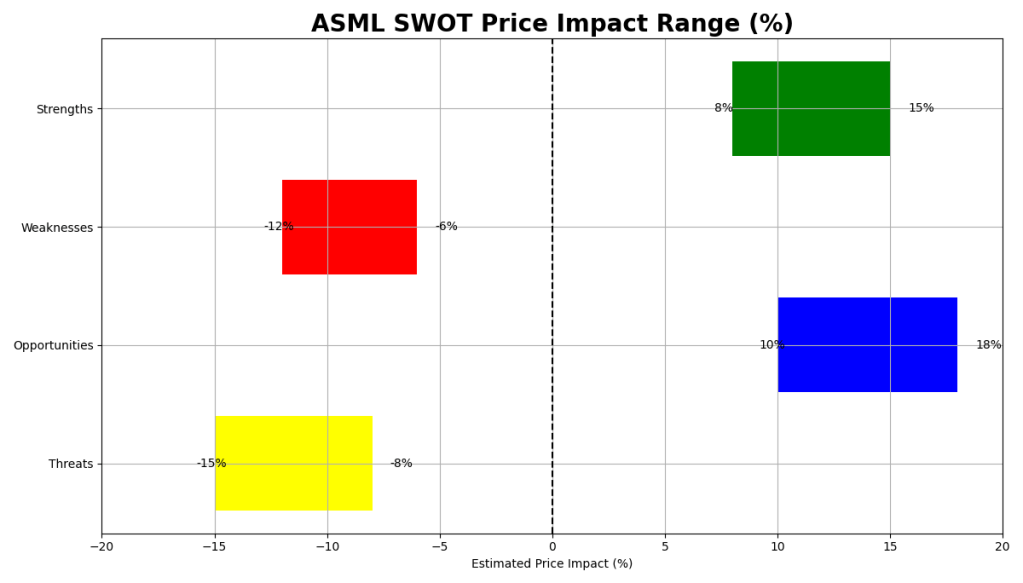
ASML SWOT price impact chart showing strengths (+8% to +15%), opportunities (+10% to +18%), weaknesses (–12% to –6%), and threats (–15% to –8%) with a zero baseline, illustrating potential valuation drivers and risks after the latest earnings.
ASML SWOT price impact ranges: Structural strengths from EUV monopoly and AI demand provide upside potential, while valuation risk, customer concentration, and export restrictions represent key downside factors.

Valuation Scenarios

ASML’s valuation reflects its position as a toll collector on advanced chip manufacturing rather than a traditional cyclical equipment maker.

Bear Case

AI spending slows, High-NA adoption delayed, and multiples compress.

→ –20% to –30% downside

Base Case

Steady AI demand, gradual High-NA ramp, stable margins.

→ +10% to +18% upside

Bull Case

Accelerated AI infrastructure buildout and faster High-NA adoption.

→ +30% to +45% upside

Probability-weighted expected return: ~+10–12%
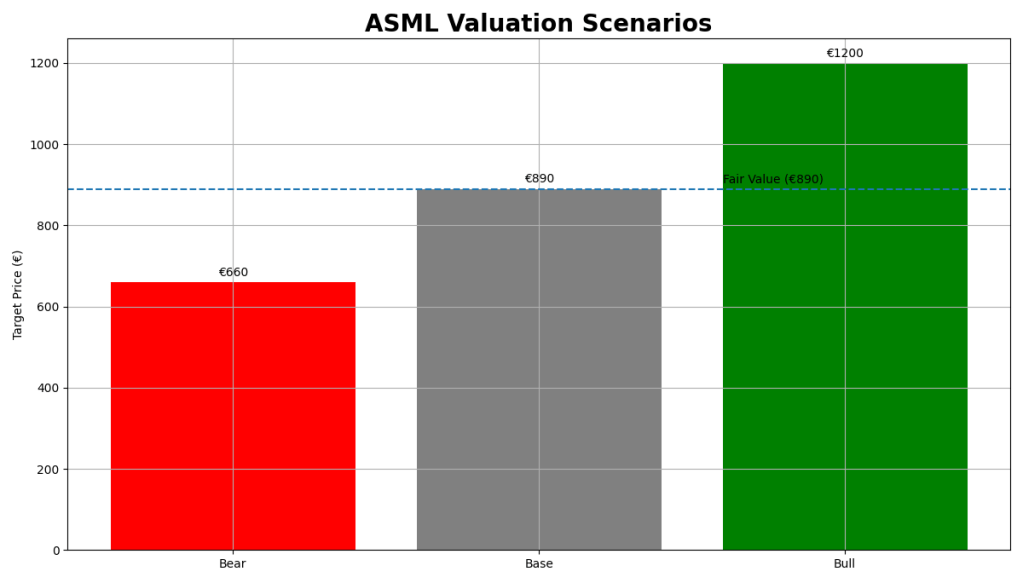
ASML valuation scenarios chart showing Bear case at €660, Base case fair value at €890, and Bull case at €1200, with a dashed fair value line illustrating potential upside and downside based on AI demand and semiconductor cycle assumptions.
ASML valuation scenarios: The base case fair value centers around €890, with downside risk if AI spending slows and upside potential if High-NA EUV adoption and global AI infrastructure investment accelerate.

Verdict

ASML remains one of the most strategic companies in the global technology supply chain. However, with shares trading well above our fair value estimate of €880–900 (≈ $1,040–1,065), the stock appears priced for a strong AI expansion scenario. Investors are now paying for execution perfection.


Call to Action

Follow SWOTstock for structured, fundamentals-driven breakdowns that cut through earnings hype and focus on valuation, risk, and long-term positioning.


Disclaimer

This analysis is for informational purposes only and does not constitute investment advice. Investors should conduct their own research and consider risk tolerance before making investment decisions.

Morgan Stanley Q4 2025 Earnings: Investment Banking Is Back, but Is the Stock Fully Priced?

Morgan Stanley’s Q4 2025 earnings surpassed expectations, driven by investment banking recovery and stable wealth management. The firm achieved record profits, with an estimated fair value of $180 per share, indicating limited upside post-rally. Despite strengths in diversified revenue, the stock appears fairly valued against market risks and economic conditions.

TL;DR Summary

  • Morgan Stanley (MS:NYSE) delivered a strong Q4 2025, driven by a sharp rebound in investment banking and steady wealth management growth.
  • Full-year profitability and returns remain well above cost of capital, reinforcing MS as a high-quality franchise.
  • However, after a post-earnings rally, the stock looks close to fair value rather than clearly cheap.
  • Fair value estimate: around $180 per share, implying limited upside at current levels unless the deal cycle stays strong.

Quarter Recap

Morgan Stanley reported Q4 2025 results that clearly exceeded market expectations. Net revenues rose meaningfully year-over-year, with earnings boosted by a recovery in advisory and underwriting activity. Wealth Management continued to provide a stable backbone, while Institutional Securities re-accelerated as capital markets activity improved into year-end.

The earnings release confirmed that FY2025 was a record year for the firm in terms of revenues and earnings, validating the long-term strategy of building a more balanced, fee-driven business alongside cyclical market activities.


Key Highlights

  • Q4 net revenues: $17.9B, up solidly year-over-year
  • Q4 EPS: $2.68
  • FY2025 EPS: $10.21 (record)
  • ROTCE: ~22%, firmly above historical averages
  • CET1 capital ratio: ~15%, supporting dividends and buybacks
  • Wealth Management revenues: $8.4B in Q4, reflecting durable fee income
  • Investment Banking revenues: sharply higher year-over-year, signaling a deal-cycle rebound

SWOT Analysis

Morgan Stanley’s Q4 results highlight the strength of its integrated model: a resilient wealth management base combined with cyclical upside from investment banking. The following SWOT translates these drivers into estimated valuation impacts.

Strengths

  • High-quality earnings power and profitability driven by diversified businesses and ~22% ROTCE. (Estimated impact: +6% to +12%)
  • Wealth Management scale and stickiness, with large fee-based assets providing earnings stability. (+5% to +10%)
  • Clear rebound in investment banking, supporting upside to normalized earnings. (+4% to +9%)
  • Strong capital position (CET1 ~15%), enabling consistent capital returns. (+2% to +5%)

Weakness

  • Earnings remain market-sensitive, particularly in trading and underwriting. (−2% to −6%)
  • Rising technology and execution costs, which could pressure margins if they become structural. (−2% to −5%)
  • Isolated credit noise, including CRE-related charge-offs, reminds investors of tail risks. (−1% to −3%)

Opportunities

  • Sustained deal-cycle recovery could keep Institutional Securities returns elevated. (+4% to +10%)
  • Further shift toward fee-based wealth revenues enhances durability and valuation quality. (+3% to +8%)
  • Operating leverage, as incremental revenues flow through at higher margins. (+2% to +6%)

Threats

  • A reversal in capital markets sentiment could quickly compress revenues and multiples. (−6% to −15%)
  • Regulatory or capital rule changes that reduce returns on equity. (−3% to −8%)
  • Cost inflation becoming structural, limiting valuation re-rating. (−2% to −7%)
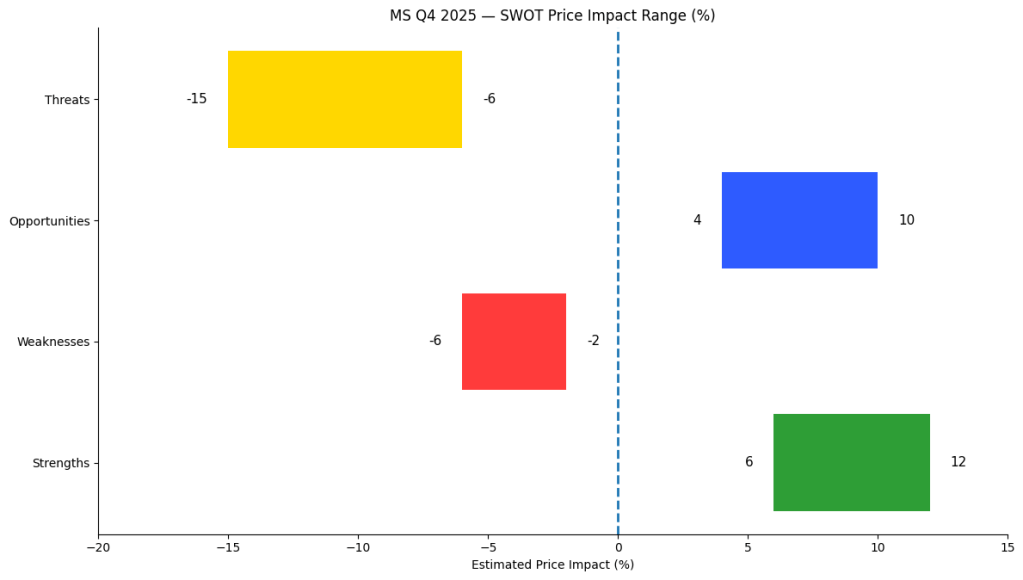
SWOT price impact chart for Morgan Stanley Q4 2025, illustrating strengths, weaknesses, opportunities, and threats with estimated share price impact ranges from −20% to +15%.
Morgan Stanley Q4 2025 SWOT analysis showing estimated price impact ranges. Strengths and opportunities reflect investment banking recovery and wealth management durability, while weaknesses and threats capture market cyclicality and downside risks.

Valuation Scenarios

For Morgan Stanley, valuation is best anchored on tangible book value and returns on equity. With tangible book value per share around $50, different P/TBV multiples reflect how much premium the market assigns to a ~20%+ ROTCE franchise.

Bear case (~$160)

  • Deal activity cools and market conditions soften.
  • Valuation compresses toward a more conservative quality-bank multiple.

Base case (~$180)

  • Wealth Management remains stable and investment banking normalizes.
  • MS sustains premium returns without further multiple expansion.

Bull case (~$200)

  • Deal momentum persists and the integrated-firm narrative strengthens.
    • Market assigns a top-tier multiple to durable earnings power.

Probability-weighted fair value: ~$180 per share.

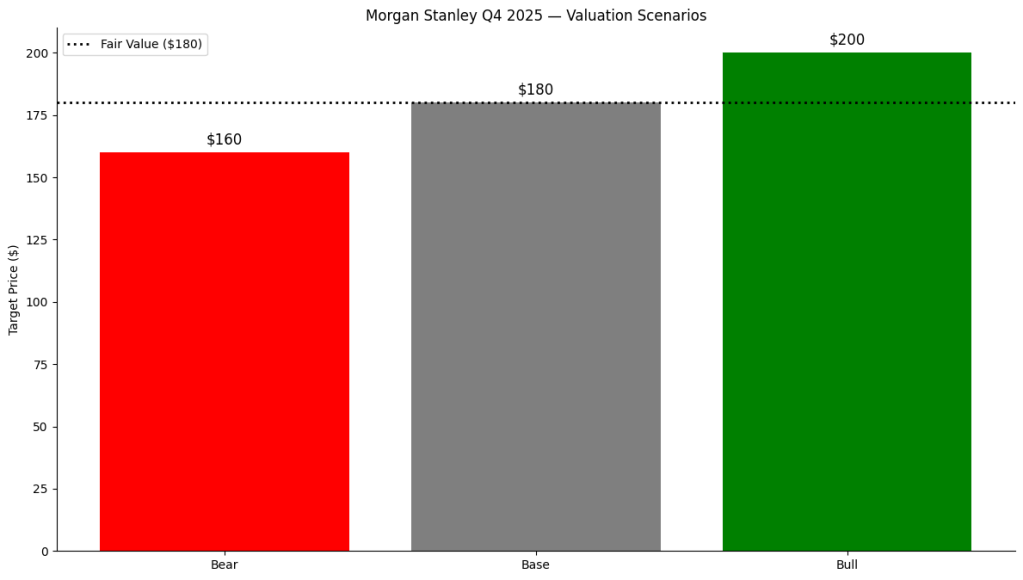
Valuation scenarios chart for Morgan Stanley Q4 2025 with three bars showing bear case at $160, base case at $180, and bull case at $200, alongside a dotted fair value line at $180.
Morgan Stanley Q4 2025 valuation scenarios showing bear, base, and bull price targets. The probability-weighted fair value centers around $180 per share, highlighting limited upside after the post-earnings rally.

Verdict

Morgan Stanley remains a best-in-class financial franchise, and Q4 2025 confirms that its diversified model works when markets recover. However, after the post-earnings rally, the stock appears fairly valued rather than obviously undervalued.

For long-term, value-oriented investors:

  • Above ~$190: upside looks limited unless the deal cycle stays unusually strong.
  • Around ~$180: valuation is reasonable for a high-quality compounder.
  • Below ~$165: the stock would begin to offer a more compelling margin of safety.

Call to Action

If you found this breakdown useful, follow SWOTstock for clear, fundamentals-driven earnings analysis that cuts through the noise and focuses on valuation, risk, and long-term returns.


Disclaimer

This article is for informational purposes only and does not constitute investment advice. All analysis is based on publicly available company disclosures. Investors should conduct their own research or consult a financial professional before making investment decisions.


Goldman Sachs Q4 2025: Earnings Power Is Back — Valuation Now Demands Durability

Goldman Sachs reported a strong Q4 2025, highlighting a recovery in capital markets with net revenues of $13.45 billion and net income of approximately $4.6 billion. The stock is now valued on sustained earnings strength, with future returns dependent on the durability of this recovery. Key opportunities and threats are outlined in a SWOT analysis.

TL;DR

Goldman Sachs (GS:NYSE) delivered a strong Q4 2025, confirming that capital markets activity has meaningfully recovered and earnings power has re-emerged. At today’s price, GS is no longer a balance-sheet or re-rating story. The stock is valued on sustained earnings strength, with future returns increasingly dependent on how durable this recovery proves to be through the next cycle.


Quarter Recap

Goldman Sachs closed out 2025 with a solid fourth quarter, reflecting improved client engagement across Investment Banking and Global Markets. Revenues rebounded, profitability strengthened, and returns moved back into the mid-teens. Management commentary pointed to healthier capital markets conditions and disciplined capital deployment, reinforcing the sense that GS has exited its post-cycle trough.


Key Highlights

  • Q4 net revenues: $13.45bn, driven by stronger Investment Banking and Markets activity
  • Net income: ~$4.6bn
  • EPS: $14.01, up meaningfully year over year
  • Annualized ROE: ~16%, back above through-cycle targets
  • Book value per share: $357.60
  • Quarterly dividend increased to: $4.50, signaling confidence in earnings durability

SWOT Analysis

At current valuation levels, Goldman Sachs is being priced primarily on normalized earnings power, not balance-sheet metrics. The SWOT below reflects that shift.

Strengths

Goldman’s core franchise is reasserting itself as capital markets normalize, with operating leverage returning across its most profitable businesses.

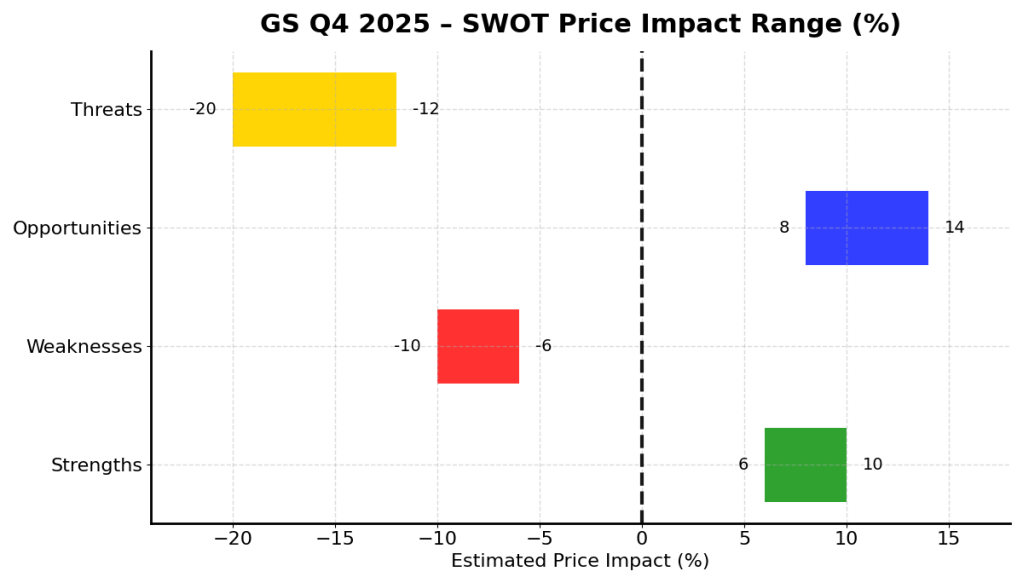
  • Investment Banking and trading rebound driving earnings momentum (+6% to +10%)
  • Mid-teens ROE supports a premium earnings multiple (+4% to +7%)

Weaknesses

Despite improvement, earnings remain inherently cyclical and sensitive to market conditions.

  • Revenue volatility tied to deal flow and trading activity (-6% to -10%)
  • Asset & Wealth Management margins remain below peak potential (-3% to -5%)

Opportunities

If capital markets recovery proves durable, earnings power could exceed current expectations.

  • Sustained M&A and issuance activity into 2026 (+8% to +14%)
  • Continued dividend growth and buybacks supporting total returns (+3% to +6%)

Threats

At current valuation levels, downside risk increases if the cycle turns earlier than expected.

  • Macro or market shock reducing client activity (-12% to -20%)
  • Regulatory or capital rule changes constraining ROE and payout capacity (-4% to -7%)
SWOT price impact range chart for Goldman Sachs Q4 2025, showing estimated percentage impact of strengths, weaknesses, opportunities, and threats on the share price.
SWOT price impact ranges highlight that Goldman Sachs’ upside is driven by capital markets recovery and earnings leverage, while downside risk remains tied to cycle sensitivity and macro conditions.

Valuation Scenarios

With GS trading far above book value, valuation should be framed around normalized earnings, not balance-sheet multiples.

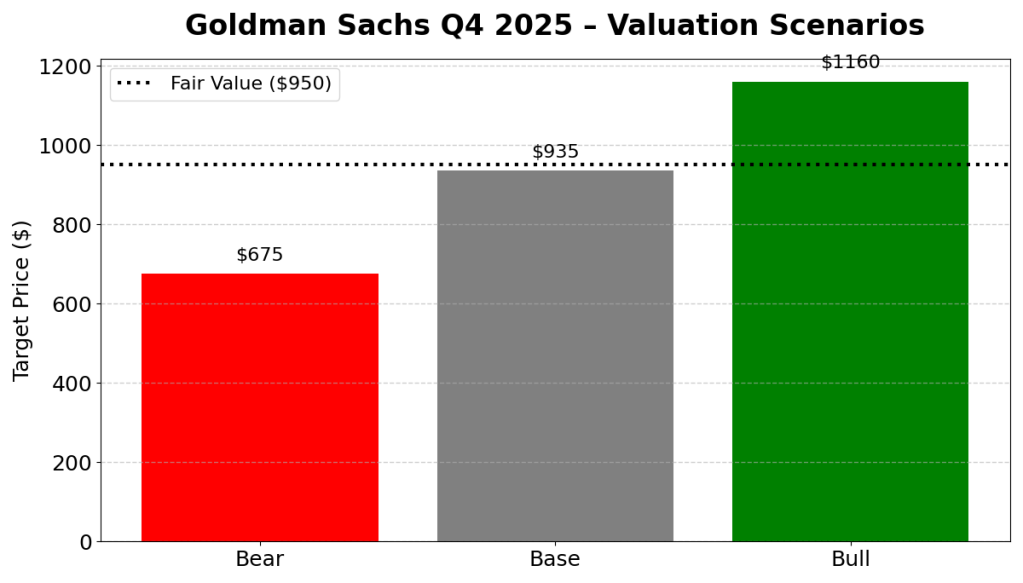
Bear Case (~$675)

This scenario assumes the current capital markets rebound fades as macro conditions tighten.

  • Normalized EPS declines toward ~$45
  • Investment Banking and trading activity cool meaningfully
  • Operating leverage works in reverse, pressuring margins
  • Valuation compresses to ~15× earnings, typical of late-cycle conditions

Base Case (~$935)

The base case assumes capital markets stabilize at healthier, mid-cycle levels.

  • Normalized EPS of ~$52, broadly in line with FY 2025 earnings power
  • Deal activity and trading remain solid but not overheated
  • The stock trades at ~18× earnings, reflecting franchise strength with cyclical risk

Bull Case (~$1,160)

The bull case assumes a sustained and broad-based capital markets recovery.

  • Normalized EPS rises toward ~$58
  • Strong M&A, IPO, and trading activity drive operating leverage
  • Valuation expands to ~20× earnings on improved earnings visibility

Probability-Weighted View

  • Bear: 25%
  • Base: 50%
  • Bull: 25%

Probability-weighted fair value: ~$950

Valuation scenarios bar chart for Goldman Sachs Q4 2025 showing bear, base, and bull target prices with a dotted fair value line.
Valuation scenarios show Goldman Sachs trading near base-case assumptions, with upside tied to sustained earnings power and downside risk if capital markets momentum fades.

Verdict

Goldman Sachs has transitioned from a recovery story to an earnings-power story. At current levels, the stock appears fairly valued on normalized earnings, with upside now dependent on sustaining capital markets momentum rather than further multiple expansion. GS remains a high-quality franchise, but future returns will increasingly reflect execution and cycle durability.


Call to Action

If you’re tracking U.S. banks and capital markets exposure, follow SWOTstock for earnings-driven analysis that focuses on valuation realism — not headline noise.


Disclaimer

This content is for informational purposes only and does not constitute investment advice. Investors should conduct their own research.