
Oracle Q1 FY2027: 121% OCI Growth Is Real — Now Oracle Must Prove the Returns

Oracle’s Q1 FY2027 results indicate a significant transition toward becoming an AI hyperscale infrastructure company, with OCI revenue surging 121% and total cloud revenue increasing by 62%. Despite impressive growth, risks related to returns on invested capital remain as the company shifts from high-margin software to capital-intensive infrastructure.

TL;DR

Oracle’s Q1 FY2027 results increasingly confirm that it is transforming from a database and enterprise software company into an AI hyperscale infrastructure company anchored by its existing database and applications franchise.

The good: OCI revenue surged 121% to $7.4 billion, total cloud revenue grew 62%, and RPO reached $664 billion. AI demand continues to exceed available supply. Importantly, customer prepayments and customer-provided infrastructure are helping finance parts of Oracle’s enormous buildout, reducing the capital risk suggested by headline capex.

The concern: Oracle is exchanging some of the attractive economics of an asset-light software business for a much more capital-intensive infrastructure model. Customer funding reduces financing risk, but it doesn’t answer the bigger question: What margins and returns on invested capital will Oracle ultimately earn from this infrastructure?

Our revised SWOT: Strengths +18% to +28%, Weaknesses -10% to -18%, Opportunities +20% to +35%, and Threats -22% to -35%.

Our valuation: Using management’s FY2027 non-GAAP EPS guidance of $8.10, we estimate Bear/Base/Bull values of $121.50 / $162 / $202.50. With probabilities of 20%/50%/30%, our probability-weighted fair value is approximately $166 per share.

Bottom line: Oracle has increasingly proven the AI demand, and customer-funded infrastructure reduces the financing concern. What Oracle hasn’t yet proven is whether becoming an AI hyperscaler will generate returns comparable to the highly attractive software economics investors historically associated with Oracle.


Oracle’s Q1 FY2027 results make one thing increasingly difficult to dispute:

Oracle is becoming a genuine AI hyperscale infrastructure company.

Oracle Cloud Infrastructure (OCI) revenue surged 121% year over year to $7.4 billion. Total cloud revenue reached $11.6 billion, up 62%, while Remaining Performance Obligations (RPO) climbed to $664 billion.

Oracle also booked more than $30 billion of additional AI cloud contracts during the quarter. Demand for AI training and inference continues to grow faster than available supply.

The company has delivered more than 300,000 GPUs since the end of Q4 and added approximately 850MW of data-center capacity during Q1.

The argument that Oracle’s cloud growth was merely the result of a small starting base or temporary overflow demand from other hyperscalers is becoming much harder to sustain.

But the investment question has changed.

A year ago, investors needed to determine whether Oracle could become a serious AI infrastructure provider.

Q1 provides increasingly convincing evidence that it can.

The more important question now is:

Can Oracle turn this enormous AI infrastructure business into attractive long-term returns for shareholders?

That distinction is critical because Oracle is transforming from a predominantly high-margin database and enterprise software company into something much more capital intensive.

Yet Q1 also revealed an important counterargument to the capital-risk thesis: Oracle’s customers are increasingly helping finance the infrastructure required to serve them.

That makes the Oracle story considerably more interesting.

Oracle Q1 FY2027: The Numbers That Matter

Oracle reported Q1 revenue of $19.3 billion, up 30% year over year.

Cloud revenue increased 62% to $11.6 billion.

Within cloud, however, Oracle is becoming a two-speed company.

OCI/IaaS revenue increased:

121% to $7.4 billion

Cloud Applications/SaaS increased:

10% to $4.2 billion

Meanwhile, software revenue declined 3% to approximately $5.5 billion.

Operating performance remained strong.

GAAP operating income increased 57% to approximately $6.7 billion, while non-GAAP operating income increased 31% to approximately $8.2 billion.

Non-GAAP EPS increased 30% to $1.92.

The most striking number, however, may be Oracle’s backlog.

RPO reached $664 billion, increasing by $209 billion year over year and another $26 billion since Q4.

Oracle also booked more than $30 billion of additional AI cloud contracts during Q1.

The company’s center of gravity is clearly shifting.

Oracle is no longer primarily a database and enterprise applications company that happens to operate a cloud infrastructure business.

It is increasingly becoming an AI hyperscale infrastructure company anchored by its database and enterprise applications franchise.

Oracle Is Becoming an AI Hyperscaler

Last year, there was a reasonable bearish explanation for Oracle’s rapid OCI growth.

AWS, Microsoft Azure and Google Cloud were struggling to satisfy extraordinary AI infrastructure demand. Oracle started from a much smaller infrastructure base.

Perhaps OCI was simply benefiting from capacity shortages elsewhere.

That hypothesis has weakened considerably.

OCI growth has accelerated from 55% in Q1 FY2026 to 121% in Q1 FY2027.

Oracle says demand for AI training and inference continues to grow faster than supply.

And Oracle isn’t merely signing contracts.

It is physically scaling the infrastructure necessary to deliver them.

Since Q4, Oracle has delivered more than 300,000 GPUs—nearly three times the capacity delivered during Q4 FY2026—and added approximately 850MW of data-center capacity during Q1.

This doesn’t mean Oracle will overtake AWS, Azure or Google Cloud.

It doesn’t need to.

If Oracle establishes itself as a durable fourth hyperscale infrastructure provider, the addressable opportunity could still be enormous.

Oracle’s Database and ERP Business May Be Its Biggest AI Advantage

Oracle’s transformation shouldn’t be interpreted as simply abandoning database and ERP software for infrastructure.

A more interesting strategy may be emerging:

Enterprise applications → proprietary enterprise data → AI models and agents → OCI infrastructure

Oracle already sits on one of the most valuable assets in enterprise computing: enormous quantities of mission-critical corporate data.

Its database and applications customers use Oracle systems for financial transactions, supply chains, human resources, customer information and other core business processes.

Oracle’s new AI Data Platform is intended to automatically create enterprise ontologies, allowing AI systems to understand relationships within customers’ private data and automate business processes.

This potentially connects several businesses that investors traditionally evaluated separately.

Oracle Database provides the data layer.

Fusion and NetSuite provide applications and workflows.

Oracle AI provides intelligence and agents.

OCI provides the computing infrastructure.

If Oracle can integrate these successfully, its traditional software installed base becomes a powerful distribution channel for OCI.

That would make Oracle considerably more difficult to compare with a generic GPU-hosting provider.

The $28.5 Billion Capex Number Doesn’t Tell the Whole Story

This is where the Q1 investment thesis becomes more nuanced.

Oracle generated approximately $23 billion of operating cash flow, up 184%.

Yet free cash flow remained approximately negative $5 billion because Oracle is investing extraordinary amounts of money into infrastructure.

That implies roughly $28.5 billion of gross capital expenditures during Q1.

At first glance, this appears alarming.

Oracle also completed a $20 billion common-stock ATM issuance during Q1 as part of its capital-investment program.

Looking only at those numbers could produce a straightforward conclusion:

Oracle is turning itself into a hyperscaler and putting enormous strain on its balance sheet to finance the transformation.

But that conclusion is incomplete.

A meaningful portion of Oracle’s infrastructure expansion is increasingly supported by customer prepayments, customer-provided hardware and other contractual structures.

Management has specifically explained that many of the large AI contracts added to RPO don’t require Oracle to fund the entire infrastructure requirement itself.

This changes the risk considerably.

There is a major economic difference between:

Oracle builds $20 billion of speculative AI capacity and hopes customers arrive

and:

Customers commit to long-term contracts, provide capital or hardware, and Oracle builds capacity against those commitments.

The infrastructure remains extremely capital intensive.

But Oracle’s financing burden may be substantially lower than the headline gross capex number implies.

Customer Prepayments Are More Than Financing

There is another implication.

Customer prepayments aren’t merely a financing mechanism.

They also provide additional evidence about the quality of AI demand.

Signing a long-term contract indicates customer interest.

Committing substantial capital toward the infrastructure necessary to fulfill that contract represents a considerably stronger commitment.

This strengthens the interpretation of Oracle’s enormous $664 billion RPO.

Oracle isn’t simply building infrastructure in anticipation of future AI demand.

Increasingly, it is building capacity against contracted demand.

That reduces one of the most important risks in our previous Oracle thesis.

Demand risk is falling.

Financing risk is also falling.

But another risk remains.

Financing Risk and Economic-Return Risk Are Not the Same Thing

This distinction may now be the most important part of the Oracle investment thesis.

Customer prepayments help answer:

Who pays to build the infrastructure?

They don’t necessarily answer:

What return will Oracle earn from operating it?

Oracle could successfully build enormous amounts of capacity, fulfill its $664 billion backlog and generate spectacular revenue growth.

But if AI compute becomes increasingly commoditized, infrastructure pricing falls or customers gain greater bargaining power, Oracle could still earn lower returns on its invested capital than investors expect.

This matters because the business Oracle is transforming from had unusually attractive economics.

Database software and support can produce substantial recurring cash flow with relatively modest incremental capital requirements.

Hyperscale infrastructure requires data centers, GPUs, networking equipment, power, cooling and continuous hardware replacement.

Oracle could therefore become a much larger and faster-growing company while simultaneously becoming a business with structurally lower returns on capital.

That is now the central investment risk.

Oracle SWOT Analysis After Q1 FY2027

Strengths: Estimated +18% to +28% Price Impact

Oracle has substantially strengthened its position as a credible AI infrastructure provider.

OCI revenue increased 121%, cloud revenue increased 62%, and RPO reached $664 billion.

Demand continues to exceed supply.

Customer prepayments and customer-provided infrastructure also strengthen Oracle’s ability to scale without financing every dollar of infrastructure itself.

Meanwhile, Oracle’s database and enterprise applications franchise provides a potential competitive advantage unavailable to pure infrastructure providers.

If Oracle successfully connects enterprise data, AI agents and OCI infrastructure, it could create considerable customer stickiness.

Weaknesses: Estimated -10% to -18% Price Impact

Oracle is still moving from relatively asset-light software economics toward much more capital-intensive infrastructure economics.

Q1 gross capex was approximately $28.5 billion, while free cash flow remained negative despite record operating cash flow.

Cloud Applications grew only 10%, while software revenue declined 3%.

The weakness, however, is less severe than the headline capex figure initially suggests.

Customer prepayments and other funding structures mean Oracle isn’t necessarily financing the entire AI buildout itself.

The weakness is therefore better characterized as:

Extreme gross capital intensity, partially mitigated by customer-funded infrastructure structures.

Opportunities: Estimated +20% to +35% Price Impact

Oracle’s opportunity has expanded substantially.

OCI growth accelerated rather than slowed.

Oracle could establish itself as a durable fourth hyperscale AI infrastructure provider without needing to displace AWS, Azure or Google Cloud.

More importantly, Oracle could combine infrastructure with its existing database and applications ecosystem.

If enterprise AI increasingly requires access to proprietary corporate data, Oracle’s enormous installed base could become a significant competitive advantage.

The AI Data Platform potentially strengthens this opportunity by connecting enterprise data, ontologies, AI agents and OCI compute.

Threats: Estimated -22% to -35% Price Impact

The biggest threat is increasingly return on invested capital rather than demand or financing.

AI compute could become commoditized.

Infrastructure prices could decline.

Customers could gain bargaining power.

Competition from AWS, Azure, Google Cloud and other infrastructure providers could pressure margins.

Oracle could therefore successfully fulfill enormous AI contracts while still producing lower economic returns than its historical software business.

There is also increasing concentration risk whenever very large infrastructure contracts represent significant portions of future revenue.

The $664 billion RPO is enormously valuable only if Oracle converts that backlog into profitable revenue at attractive returns on capital.

Oracle Valuation: Bull, Base and Bear Scenarios

Oracle expects FY2027 revenue of at least $90 billion and non-GAAP EPS of approximately $8.10.

Because current free cash flow is heavily distorted by the infrastructure construction cycle, FY2027 EPS provides a more useful near-term valuation anchor.

Bear Case — $121.50

Oracle’s AI demand remains strong, but infrastructure economics ultimately disappoint.

Applying 15x FY2027 EPS:

$8.10 × 15 = $121.50

Probability: 20%

Base Case — $162

Oracle converts its AI backlog successfully and establishes OCI as a durable hyperscale infrastructure platform, but capital intensity limits the valuation multiple.

Applying 20x FY2027 EPS:

$8.10 × 20 = $162

Probability: 50%

Bull Case — $202.50

Oracle demonstrates that hyperscale growth can coexist with attractive returns, while its database and applications ecosystem differentiates OCI from commodity compute.

Applying 25x FY2027 EPS:

$8.10 × 25 = $202.50

Probability: 30%

Revised Oracle Fair Value: Approximately $166

Probability weighting produces:

Bear: $121.50 × 20% = $24.30
Base: $162 × 50% = $81.00
Bull: $202.50 × 30% = $60.75

Probability-weighted fair value: approximately $166 per share.

The increase from our previous $162 estimate isn’t driven by higher OCI growth.

It reflects our revised assessment that customer-funded infrastructure reduces Oracle’s financing risk.

What Growth Investors Should Watch Next

Going forward, investors should focus less on whether Oracle can generate AI demand—it clearly can—and more on whether it can convert that demand into attractive economics.

The critical indicators are OCI growth, RPO conversion, free cash flow recovery and ultimately return on invested capital.

OCI growth tells us whether Oracle is delivering the infrastructure.

RPO tells us whether future demand remains strong.

Free cash flow tells us when today’s investment begins producing cash.

But ROIC ultimately tells us whether Oracle’s transformation is actually creating shareholder value.

Investment Takeaway

Oracle’s Q1 FY2027 results materially strengthen the AI investment thesis.

OCI growing 121%, RPO reaching $664 billion, demand exceeding supply and customers increasingly helping finance infrastructure make Oracle look increasingly like a genuine AI hyperscaler rather than a secondary beneficiary of temporary capacity shortages.

That changes the risk profile.

Demand risk has fallen.

Financing risk has fallen.

But economic-return risk remains.

Our probability-weighted fair value is approximately $166 per share.

Oracle has increasingly proven that it can become an AI hyperscaler.

Now it has to prove that becoming one is as attractive for shareholders as it is impressive for revenue growth.

Disclaimer

This article is for informational and educational purposes only and does not constitute investment advice, financial advice or a recommendation to buy or sell any security.

Valuation scenarios and estimated price impacts are analytical estimates based on assumptions and are inherently uncertain. Investors should conduct their own research and consider their objectives, financial circumstances and risk tolerance before making investment decisions.
NVIDIA Q2 FY2027 Earnings: AI Demand Accelerates, but NVIDIA Is Taking on More of the Risk

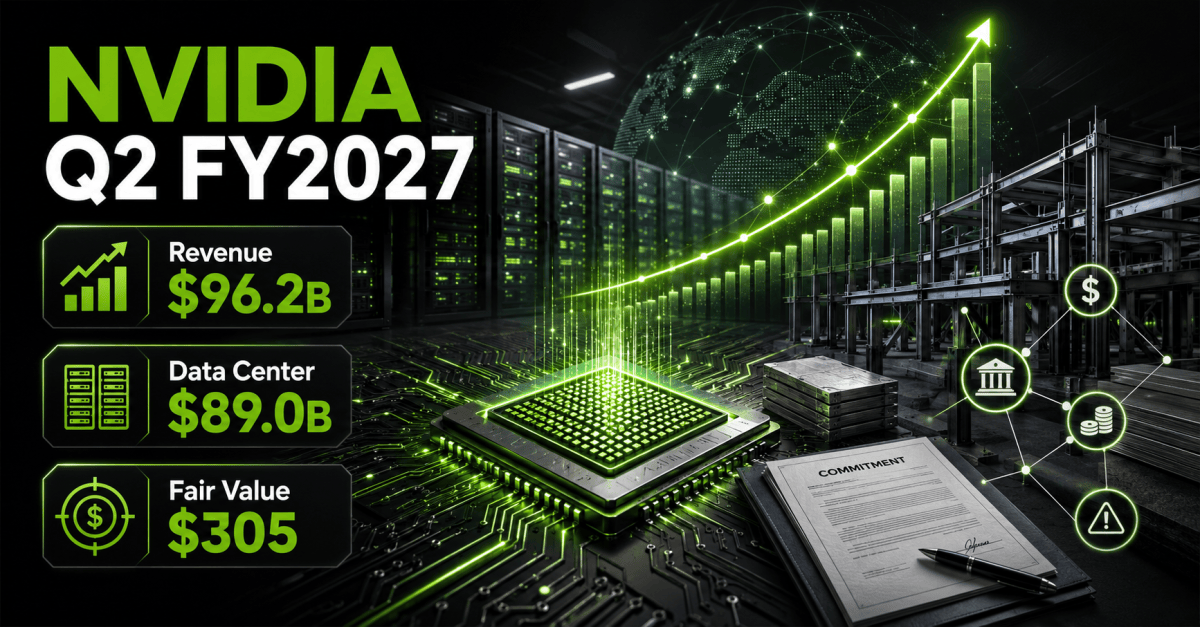
NVIDIA reported a record quarterly revenue of $96.2 billion, driven by a significant increase in Data Center sales, which reached $89 billion. Despite strong growth and positive market response, increased commitments for supply and infrastructure raise risks. Analysts estimate a fair value of around $305 per share, making it an attractive investment option but with caution advised due to potential economic pressures on customer spending.

TL;DR Summary

NVIDIA (NVDA:NASDAQ) delivered another exceptional quarter. Revenue more than doubled to $96.2 billion, Data Center revenue reached $89.0 billion, and non-GAAP earnings per share increased 120% to $2.22.

Management’s Q3 revenue guidance of $108 billion indicates that demand continues to accelerate even without any assumed China Data Center compute revenue. The strongest signal was not just hyperscaler spending: revenue from AI clouds, industrial companies and enterprise customers grew 25% sequentially and 138% year over year.

The market initially responded enthusiastically. NVIDIA rose 8.7% in the first trading session after earnings, before giving back part of the gain the following day. At the August 28 closing price of $217.55, the shares remained 3.8% above their pre-earnings level.

However, the quarter also revealed a significant evolution in NVIDIA’s risk profile. Supply and capacity commitments jumped from $119 billion to $279 billion. Accounts-receivable days increased from 45 to 60, and NVIDIA is committing capital, cloud capacity and potentially substantial financial guarantees to support the wider AI infrastructure ecosystem.

Our central fair-value estimate is approximately $305 per share, with a reasonable range of $270 to $330. At $217.55, the stock offers attractive upside for a tech-savvy growth investor—but the investment case increasingly depends on whether NVIDIA’s customers can generate enough AI revenue to sustain their infrastructure spending.

Quarter Recap

NVIDIA reported fiscal second-quarter results on August 26, 2026, covering the period ended July 26.

Revenue reached a record $96.2 billion, increasing 18% from the previous quarter and 106% from a year earlier. The company’s growth was once again driven by demand for accelerated computing and AI infrastructure.

GAAP gross margin was 75%, broadly unchanged sequentially and 260 basis points higher than a year earlier. The margin improvement was driven by a more favorable Blackwell Ultra product mix.

GAAP operating income reached $63.7 billion, up 124% year over year, while non-GAAP operating income increased at the same rate to approximately $64.0 billion.

GAAP diluted earnings per share were $2.46, compared with $1.08 a year earlier. Non-GAAP EPS increased 120% to $2.22.

The distinction between GAAP and non-GAAP earnings is important in this quarter. GAAP net income included approximately $7.8 billion of gains from equity securities. Those gains should not be treated as recurring operating earnings, making non-GAAP EPS the more suitable foundation for valuation.

Key Highlights

Data Center revenue more than doubled

Data Center revenue reached $89.0 billion, increasing 18% sequentially and 117% year over year. It now accounts for approximately 92.5% of NVIDIA’s total revenue.

Blackwell Ultra was the primary growth driver. Management said Blackwell represented the vast majority of revenue, while the next-generation Vera Rubin platform had already entered production.

The scale of NVIDIA’s Data Center business is extraordinary. It generated almost twice as much quarterly revenue as the entire company did one year earlier.

AI demand is broadening beyond hyperscalers

Hyperscale revenue reached $48.7 billion, up 13% sequentially and 102% year over year.

More importantly, AI Clouds, Industrial and Enterprise revenue reached $40.3 billion. This category increased 25% sequentially and 138% year over year.

That diversification matters. One of the main concerns surrounding NVIDIA has been that its growth depends on a small number of technology companies continually increasing their capital expenditure. The latest results suggest that demand is spreading to AI-native companies, sovereign customers and traditional enterprises.

This does not eliminate hyperscaler concentration, but it makes the growth thesis broader than it was several quarters ago.

Operating leverage remained exceptional

GAAP operating expenses increased 55% year over year, largely because of higher computing-infrastructure and compensation costs.

That is a substantial increase in absolute terms, but it was far below the 106% growth in revenue. As a result, GAAP operating margin expanded from 60.8% to 66.2%.

NVIDIA is simultaneously funding new processors, networking products, software and AI models while still allowing revenue growth to translate into higher operating profitability.

Q3 guidance points to continued acceleration

Management expects Q3 revenue of approximately $108 billion, plus or minus 2%.

At the midpoint, this represents sequential growth of approximately 12.2%. The guidance assumes no Data Center compute revenue from China, meaning that the next quarter does not require a recovery in that market.

Management expects GAAP and non-GAAP gross margins of approximately 74%, down from 75% in Q2. The decline is manageable, particularly during the transition to increasingly complex rack-scale infrastructure, but future margin direction deserves close attention.

Vera Rubin has entered production

The Vera Rubin platform is ramping into production, with racks running at partners including Microsoft Azure, Google Cloud, Oracle Cloud Infrastructure, CoreWeave and Nebius.

This reduces the risk of a material product-cycle pause between Blackwell and Rubin.

NVIDIA’s annual product cadence is also becoming an important competitive advantage. Customers are not simply buying more accelerators; they are moving through recurring generations of processors, networking and integrated systems.

The principal risk is execution. These rack-scale systems require advanced packaging, memory, networking, cooling and power infrastructure. Supply constraints or integration problems anywhere in the system could affect deployment schedules.

The AI buildout is consuming more of NVIDIA’s balance sheet

The most consequential disclosure was the expansion of NVIDIA’s future commitments.

Supply and capacity commitments increased from $119 billion in the previous quarter to $279 billion, primarily because NVIDIA is securing memory and other components required to meet anticipated demand.

Total disclosed future commitments reached approximately $366 billion, including:

  • Supply and manufacturing capacity.
  • Cloud-service agreements.
  • Data-center leases.
  • Equity investments.
  • Capital expenditures.

NVIDIA also disclosed $36 billion of AI-cloud agreements under which it may purchase capacity not sold to third-party customers.

Separately, its maximum gross guarantee exposure included $3.5 billion related to certain AI-cloud partners and as much as $105 billion connected to a phased data-center development intended for OpenAI.

These maximum figures are not current losses or immediate liabilities. Many obligations are conditional, phased and spread over several years. Nevertheless, they represent a material change in NVIDIA’s role.

NVIDIA is no longer only supplying the AI infrastructure industry. It is helping secure components, cloud capacity, financing and physical data-center development for that industry.

Cash conversion weakened during the quarter

Operating cash flow was $24.1 billion, up from $15.4 billion a year earlier but down sharply from $50.3 billion in Q1.

Some of the sequential decline reflected cash-tax payments and working-capital requirements. However, accounts receivable increased to $63.1 billion, while days sales outstanding rose from 45 to 60.

NVIDIA attributed the increase to extended payment terms under large, multi-quarter agreements with investment-grade customers.

Inventory also rose from $25.8 billion to $31.6 billion as NVIDIA prepared for Rubin production.

Neither development proves that demand is weakening. Both are consistent with a company preparing for rapid expansion. But they show that more cash is becoming tied up in inventory and customer financing.

SWOT Analysis

NVIDIA’s operating performance strengthened the growth thesis, but the quarter also widened the range of potential outcomes. The estimated price impacts below are sensitivity ranges rather than additive forecasts.

Strengths

  • Exceptional revenue momentum: estimated price impact of +12% to +25%. Revenue increased 106% year over year, while Q3 guidance implies another 12% sequential increase.
  • Dominant AI infrastructure platform: +10% to +20%. NVIDIA combines processors, networking, systems and software, making its competitive advantage broader than raw accelerator performance.
  • Broadening demand: +8% to +18%. AI Clouds, Industrial and Enterprise revenue grew 138% year over year, indicating that adoption is expanding beyond the largest hyperscalers.
  • Strong operating leverage: +8% to +15%. Revenue grew almost twice as quickly as operating expenses, lifting GAAP operating margin to 66.2%.
  • Sustained pricing power: +7% to +15%. NVIDIA maintained a 75% gross margin while scaling complex Blackwell Ultra infrastructure.
  • Rubin product transition: +8% to +18%. Early production reduces product-cycle risk and creates another reason for customers to expand and upgrade their infrastructure.
  • Strong liquidity: +3% to +8%. NVIDIA held $56.6 billion in cash, cash equivalents and marketable debt securities, in addition to $42.8 billion of marketable equity securities.

Weaknesses

  • Dependence on Data Center spending: estimated price impact of −12% to −25%. Approximately 92.5% of revenue now comes from Data Center, leaving NVIDIA exposed to any AI capital-spending slowdown.
  • Customer concentration: −8% to −18%. One direct customer represented 16% of Q2 revenue, while three customers each represented at least 13% of first-half revenue.
  • Longer customer payment terms: −5% to −12%. Days sales outstanding increased from 45 to 60 as NVIDIA extended terms on large customer agreements.
  • Weaker cash conversion: −5% to −12%. Quarterly operating cash flow was considerably below reported net income because of taxes and working-capital investment.
  • Investment gains inflated GAAP earnings: −3% to −8%. Approximately $7.8 billion of Q2 GAAP earnings came from gains on equity securities.
  • Increasing inventory exposure: −4% to −10%. Inventory rose to $31.6 billion ahead of Rubin, increasing the potential cost of forecasting or execution errors.

Opportunities

  • Global AI infrastructure expansion: estimated price impact of +15% to +35%. Multiple frontier laboratories, AI clouds, enterprises and sovereign customers are expanding capacity simultaneously.
  • Inference and agentic AI demand: +10% to +25%. Reasoning models and AI agents could generate substantially more inference workloads than conventional chat applications.
  • Recurring product upgrades: +10% to +22%. The transition from Blackwell to Rubin can make AI infrastructure an ongoing replacement and expansion market.
  • Enterprise and sovereign adoption: +8% to +20%. Growth outside hyperscalers could make NVIDIA’s revenue base more diversified and durable.
  • Networking and software monetization: +6% to +15%. NVIDIA can capture a larger share of AI-factory spending by selling integrated systems rather than individual chips.
  • Potential China recovery: +3% to +10%. Any legally permitted return to the Chinese Data Center market would be incremental because management’s Q3 guidance assumes no China compute revenue.
  • Infrastructure partnerships: +5% to +18%. Financing and capacity arrangements could remove obstacles preventing customers from deploying more NVIDIA systems.

Threats

  • Unproven customer economics: estimated price impact of −20% to −40%. If AI applications cannot generate sufficient revenue or cost savings, customers may eventually reduce infrastructure spending.
  • Commitments and guarantees: −15% to −35%. NVIDIA is accepting more supply, counterparty and infrastructure risk to support the expansion of its ecosystem.
  • Circular-demand concerns: −10% to −25%. Investors may assign a lower valuation if more sales depend on NVIDIA investing in customers, committing to their capacity or extending payment terms.
  • Margin normalization: −8% to −18%. Higher memory costs, system complexity, tariffs and competition could reduce NVIDIA’s unusually high gross margin.
  • Custom accelerators and competing platforms: −12% to −30%. Hyperscalers are developing internal chips, while other semiconductor companies are expanding their accelerator offerings.
  • Export restrictions: −6% to −15%. China currently contributes little to Data Center revenue, but continued restrictions remove a large potential market and encourage competing local ecosystems.
  • Supply-chain execution: −8% to −20%. NVIDIA depends on advanced packaging, memory, networking, cooling and external manufacturing partners.
  • Valuation sensitivity: −10% to −25%. At a market capitalization above $5 trillion, even strong operating results may not prevent a decline if interest rates rise or the market assigns a lower earnings multiple.

Valuation Scenarios

The valuation uses estimated FY2028 earnings, giving NVIDIA approximately 12–18 months to execute beyond the reported quarter.

The analysis begins with estimated FY2027 normalized EPS of approximately $9.10 to $9.20. It excludes unrealized investment gains and uses management’s Q3 revenue, margin, expense and tax guidance.

Bear case: $159

The bear case assumes that the AI infrastructure cycle slows sharply after the current order backlog is fulfilled.

  • FY2028 revenue reaches approximately $425 billion.
  • Revenue growth slows to approximately 5%.
  • Non-GAAP net margin falls to 45%.
  • EPS is approximately $7.94.
  • The market applies a 20-times earnings multiple.
  • Estimated value is approximately $159 per share.
  • Downside from $217.55 is approximately 27%.
  • Assigned probability is 25%.

This scenario does not require NVIDIA to lose its technological leadership. It assumes that customers moderate spending, margins normalize and investors apply a lower multiple because of NVIDIA’s growing commitments and financing exposure.

Base case: $313

The base case assumes that AI demand remains strong but normalizes from its present triple-digit growth rate.

  • FY2028 revenue reaches approximately $527 billion.
  • Revenue grows approximately 30%.
  • Non-GAAP net margin is approximately 51%.
  • EPS is approximately $11.19.
  • The market applies a 28-times earnings multiple.
  • Estimated value is approximately $313 per share.
  • Upside from $217.55 is approximately 44%.
  • Assigned probability is 55%.

This scenario assumes a successful Rubin ramp, continued enterprise and AI-cloud adoption, modest margin normalization and no material losses from NVIDIA’s commitments or guarantees.

Bull case: $469

The bull case assumes that inference, AI agents, sovereign AI and physical AI create another major acceleration in demand.

  • FY2028 revenue reaches approximately $608 billion.
  • Revenue grows approximately 50%.
  • Non-GAAP net margin remains around 54%.
  • EPS reaches approximately $13.78.
  • The market applies a 34-times earnings multiple.
  • Estimated value is approximately $469 per share.
  • Upside from $217.55 is approximately 116%.
  • Assigned probability is 20%.

This outcome requires NVIDIA to maintain platform leadership while its customer-support arrangements successfully accelerate genuine third-party demand.

Probability-weighted value

Weighting the three scenarios produces an estimated value of approximately $306 per share.

To avoid false precision, our final central fair-value estimate is $305, with a reasonable range of $270 to $330.

At $217.55:

  • The shares trade approximately 29% below the $305 central estimate.
  • Appreciation to fair value would be approximately 40%.
  • The shares trade approximately 19% below the conservative $270 fair-value boundary.
  • Appreciation to $270 would be approximately 24%.

Verdict

NVIDIA’s Q2 FY2027 results provided strong evidence that the AI infrastructure cycle remains intact.

Revenue more than doubled. Data Center demand accelerated. Growth broadened beyond hyperscalers. Blackwell Ultra supported a 75% gross margin, and Rubin entered production without an evident pause in customer demand.

At $217.55, investors do not need NVIDIA to maintain triple-digit growth indefinitely to justify a higher valuation. Our central case assumes approximately 30% FY2028 revenue growth and produces a fair value close to $305.

That makes the risk-reward attractive for a tech growth investor.

However, the quarter also marked a turning point. NVIDIA is increasingly using its balance sheet, supplier commitments, investments, cloud-capacity agreements, extended payment terms and guarantees to support the AI infrastructure ecosystem.

The critical investment question is therefore changing.

It is no longer simply:

Will customers continue buying NVIDIA systems?

The more important question is:

Can those customers generate enough economic value from AI to finance the systems without progressively greater support from NVIDIA?

If the answer is yes, NVIDIA may still be in the early stages of a much larger infrastructure cycle. If the answer is no, the company’s expanded commitments could magnify the eventual slowdown.

Our conclusion is that NVIDIA remains an attractive growth investment near $217.55, but it should not be treated as low risk merely because it trades below estimated fair value. The operating moat is exceptional; the ecosystem’s financial durability is still being tested.

Call to Action

Would you buy NVIDIA at approximately $218, or do its growing infrastructure commitments and customer-financing exposure make you demand a larger margin of safety?

Follow SWOTstock for earnings analysis that separates operating performance, market expectations and valuation risk.

Disclaimer

This article is for informational and educational purposes only and does not constitute investment advice, financial advice or a recommendation to buy or sell any security.

Valuation estimates depend on assumptions about revenue growth, profitability, share count and valuation multiples. Actual results may differ materially. Investors should conduct their own research and consider their objectives, financial circumstances and risk tolerance before making an investment decision.

Official sources include NVIDIA’s Q2 FY2027 earnings release, CFO commentary, Form 10-Q and official earnings webcast.


AMD Q2 2026 Earnings: Record Growth, but Is the AI Success Already Priced In?

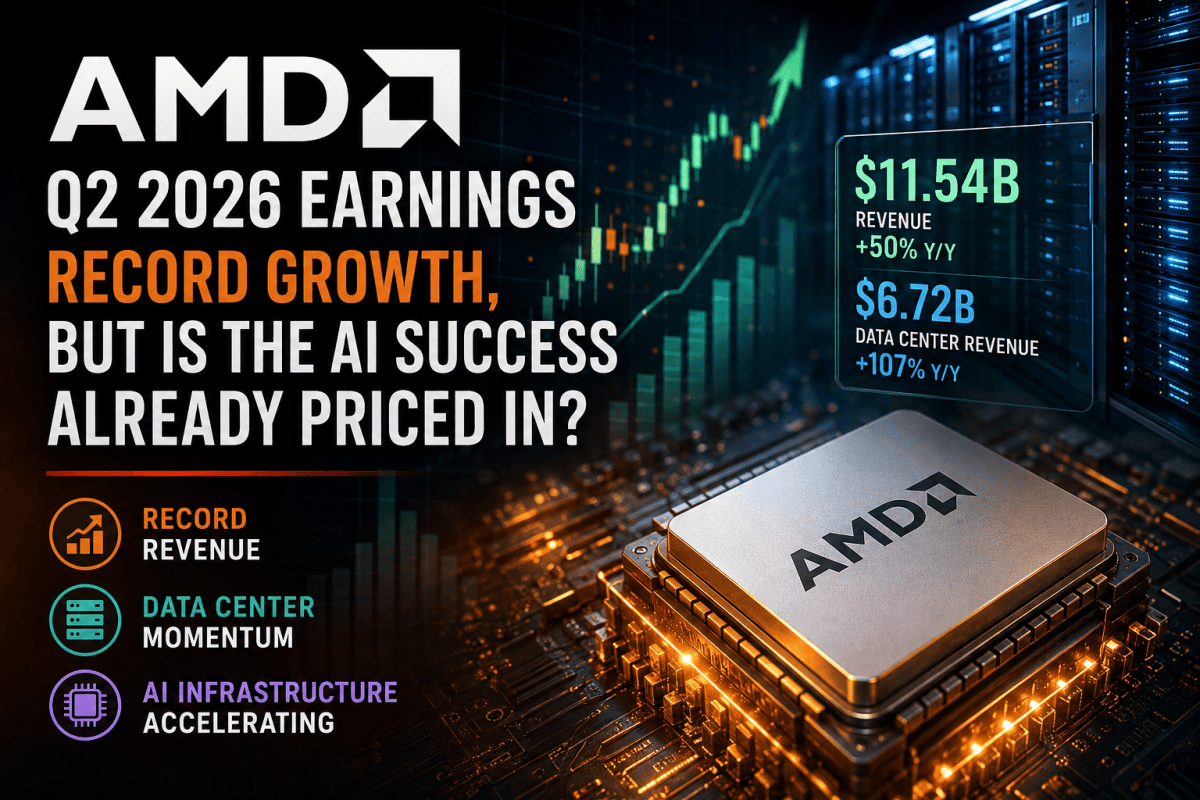
AMD achieved a record quarter with a 50% revenue increase to $11.5 billion, driven by a doubling of Data Center revenue to $6.7 billion. Despite strong operational growth and a positive outlook for Q3, shares fell post-report amid investor concerns over high expectations. Valuation risks loom as confidence in future AI success is needed.

TL;DR Summary

AMD (AMD:NASDAQ) delivered another record quarter, with revenue rising 50% year over year to $11.5 billion and Data Center revenue more than doubling to $6.7 billion. The company also guided for approximately $13.0 billion of revenue in Q3, suggesting that its AI accelerator and EPYC server momentum is continuing rather than peaking.

The earnings report strengthens the case that AMD is becoming a meaningful second platform in AI computing. Data Center now represents approximately 58% of total revenue, operating leverage is emerging, and management expects further acceleration in the second half of 2026.

However, AMD entered the report with extremely high expectations. The shares closed at $518.58 before the results, following a 7% gain during the session, and then fell sharply in after-hours and premarket trading. The market appears to have wanted faster margin expansion and more immediate evidence that AMD can convert its AI partnerships into NVIDIA-like economics.

Our probability-weighted fair value is approximately $400 per share, with a reasonable valuation range of $350 to $450.

At prices around $470 to $520:

  • AMD’s business momentum is strong.
  • Its long-term AI opportunity is substantial.
  • Its valuation risk remains high.
  • There is currently little or no margin of safety.
  • Further upside increasingly depends on the bull case becoming reality.

The earnings report made AMD’s business more convincing. It did not make the stock inexpensive.

Quarter Recap

AMD reported fiscal Q2 2026 revenue of $11.54 billion, up 50% year over year and 13% sequentially.

The company reported:

  • GAAP gross margin of 54%
  • GAAP operating income of $1.99 billion
  • GAAP operating margin of 17%
  • GAAP net income of $2.30 billion
  • GAAP diluted EPS of $1.38
  • Non-GAAP gross margin of 56%
  • Non-GAAP operating income of $3.09 billion
  • Non-GAAP operating margin of 27%
  • Non-GAAP diluted EPS of $1.66

AMD’s results demonstrate that its growth is no longer based solely on expectations surrounding future AI products. Data Center is already the company’s largest segment and is generating substantial operating profit.

The year-over-year comparison nevertheless requires some caution. Q2 2025 included an approximately $800 million inventory and related charge associated with U.S. export restrictions on MI308 products. The absence of that charge magnified the improvement in operating income and EPS.

Even after adjusting for this comparison effect, the sequential numbers remain strong. Revenue increased approximately 13% from Q1, and management is guiding for another approximately 13% sequential increase in Q3.

For Q3 2026, AMD expects:

  • Revenue of approximately $13.0 billion, plus or minus $300 million
  • Year-over-year revenue growth of approximately 41% at the midpoint
  • Sequential revenue growth of approximately 13%
  • Non-GAAP gross margin of approximately 56%

The guidance indicates continued expansion, although the unchanged gross-margin outlook is one reason investors may have found the report less transformative than expected.

Key Highlights

Data Center becomes the centre of the AMD investment thesis

Data Center revenue reached $6.72 billion, representing approximately 58% of total company revenue.

Revenue increased 107% year over year, supported by demand for EPYC server processors and Instinct MI350-series accelerators. Segment operating income reached approximately $2.1 billion, compared with a loss in the prior-year period.

This is the most important change in AMD’s financial profile. The company is no longer primarily a PC and gaming semiconductor business with an emerging AI opportunity. It is increasingly a Data Center company with additional Client, Gaming and Embedded operations.

Continued sequential growth supports the AI thesis

AMD’s approximately 13% sequential revenue growth in Q2 and another approximately 13% increase implied by Q3 guidance suggest that demand is continuing to expand.

Management expects Data Center sales to accelerate during the second half of 2026, supported by:

  • Continued EPYC adoption
  • Scaling Instinct deployments
  • The beginning of the Helios rack-scale platform ramp
  • New and expanding customer relationships
  • Growing demand for AI inference and general-purpose computing

AMD’s official materials also highlight its broader strategy of combining CPUs, GPUs and adaptive computing through an open ecosystem.

Operating leverage is beginning to appear

AMD’s non-GAAP operating margin reached 27%, while operating expenses declined as a percentage of revenue.

This indicates that revenue is currently growing faster than the underlying expense base. If this continues, earnings could grow materially faster than sales.

That operating leverage is essential to the valuation. Rapid revenue growth alone cannot support the current market capitalisation unless AMD also converts more of each incremental revenue dollar into operating profit and free cash flow.

Cash generation improved significantly

For the first half of 2026, AMD generated approximately $5.3 billion of operating cash flow from continuing operations.

After approximately $1.2 billion of property and equipment purchases, simplified first-half free cash flow was approximately $4.1 billion.

AMD also ended the quarter with approximately $13.1 billion of cash, cash equivalents and short-term investments.

The stronger cash position gives the company flexibility to support product development, secure supply, expand its platform capabilities and pursue strategic investments.

Client growth was strong, but pricing was mixed

Client revenue reached approximately $3.1 billion, up 23% year over year.

Processor unit shipments increased 34%, but average selling prices declined 6% because of a less favourable product mix.

This suggests that AMD gained volume, although the quality of the growth was not as strong as the headline revenue increase alone might imply.

Gaming remains the weakest segment

Gaming revenue fell 31% year over year to approximately $779 million, primarily because of lower semi-custom revenue.

Higher Radeon GPU sales provided some support, but Gaming remains a drag on consolidated growth.

Its declining relative importance limits the damage to the overall investment thesis, but the weakness reduces the diversification benefits of AMD’s portfolio.

SWOT Analysis

AMD’s Q2 results strengthen the operational case, but the share price already reflects significant expectations surrounding AI accelerators, rack-scale systems and future market-share gains. The following impact ranges estimate how each factor could affect AMD’s fair value. They should not be added mechanically because several factors overlap.

Strengths

  • Data Center has reached critical scale: estimated fair-value impact of +20% to +35%Data Center now represents most of AMD’s revenue and is generating substantial segment profit. This provides concrete financial evidence that AMD is participating meaningfully in the AI and server-computing expansion.
  • Strong sequential growth and management visibility: +12% to +22%Q2 revenue increased approximately 13% sequentially, while Q3 guidance implies another increase of roughly the same magnitude. This reduces the risk that Q2 was an isolated demand spike.
  • Multiple Data Center growth engines: +10% to +20%AMD is not dependent solely on AI accelerators. EPYC server CPUs remain an important source of revenue growth and customer adoption.
  • Emerging operating leverage: +10% to +20%Revenue is growing faster than operating expenses. Continued leverage could raise AMD’s sustainable earnings power considerably.
  • Broad and open computing ecosystem: +5% to +15%AMD can offer CPUs, GPUs, adaptive computing and rack-scale solutions. Its open-ecosystem positioning may appeal to customers seeking alternatives and less dependence on one proprietary platform.

Weaknesses

  • The valuation assumes substantial future success: −25% to −45%At the pre-earnings price, AMD was valued as though a significant portion of its future AI growth and market-share gains were already assured.
  • Gross-margin expansion remains limited: −10% to −20%Q3 non-GAAP gross-margin guidance remained at approximately 56%. Investors expecting rapidly improving AI economics received little evidence of near-term margin acceleration.
  • Large gap between GAAP and adjusted earnings: −6% to −12%Stock-based compensation, intangible-asset amortisation and acquisition-related items create a meaningful difference between GAAP and non-GAAP profitability.
  • Gaming remains in contraction: −3% to −8%Lower semi-custom demand continues to weigh on the segment.
  • Client growth was partially volume-led: −3% to −7%Lower average selling prices indicate that Client growth was not accompanied by equivalent pricing or mix improvement.

Opportunities

  • Instinct becomes the established second AI accelerator platform: +30% to +60%AMD does not need to overtake NVIDIA to generate significant shareholder value. Establishing a durable position as the clear second supplier could support substantially higher revenue and earnings.
  • Helios expands AMD into rack-scale systems: +15% to +30%A successful Helios ramp could increase the value of each deployment and allow AMD to compete with a more complete infrastructure solution.
  • EPYC continues gaining server adoption: +10% to +20%Continued CPU gains would provide a more durable and diversified Data Center earnings stream.
  • Software improvements lower adoption barriers: +10% to +25%Better ROCm usability, framework support and migration tools could make AMD hardware accessible to more customers and developers.
  • AI demand broadens beyond hyperscalers: +8% to +20%Sovereign AI, enterprises, research organisations and specialised cloud providers could expand AMD’s addressable market.

Threats

  • NVIDIA’s ecosystem advantage remains durable: −25% to −45%Competitive hardware alone may not be sufficient if customers remain tied to NVIDIA’s software, developer tools and infrastructure ecosystem.
  • AI infrastructure spending enters a digestion period: −25% to −50%AMD’s growth is increasingly exposed to continued capital spending by hyperscalers and major AI developers.
  • MI400 or Helios execution problems: −15% to −30%Product delays, software shortcomings, inadequate supply or weak deployment performance could cost AMD an important product cycle.
  • Export controls and China uncertainty: −5% to −15%Regulatory restrictions can reduce AMD’s addressable market and create inventory, tariff and licensing risks.
  • Supply commitments exceed actual demand: −8% to −20%AMD must secure significant capacity to support growth. Those commitments could become burdensome if demand or customer deployments are delayed.

Valuation Scenarios

AMD does not provide sufficiently detailed long-term guidance to calculate intrinsic value directly. The scenarios below therefore begin with the company’s Q2 financials and Q3 guidance, then apply SWOTstock assumptions for sustainable revenue, margins and valuation multiples.

These are not AMD management forecasts.

Bear Scenario — $210 per share

The bear case does not assume business failure. It assumes that AMD continues growing but captures less AI-platform value than the current share price expects.

Assumptions:

  • Sustainable annual revenue of approximately $55 billion
  • Sustainable net margin of approximately 18%
  • Net income of approximately $9.9 billion
  • Diluted share count of approximately 1.63 billion
  • Earnings per share of approximately $6.07
  • Valuation multiple of 35 times earnings

Calculation:

  • $55 billion revenue multiplied by an 18% net margin produces approximately $9.9 billion of net income.
  • $9.9 billion divided by 1.63 billion shares produces approximately $6.07 of EPS.
  • $6.07 multiplied by 35 produces approximately $212 per share.

Rounded bear-case value: $210

This outcome could result from:

  • Slower AI spending growth
  • Limited gross-margin expansion
  • Gradual Helios adoption
  • Continued NVIDIA ecosystem dominance
  • AMD remaining a secondary supplier without capturing platform-level economics
  • Valuation compression as revenue growth normalises

Base Scenario — $385 per share

The base case assumes substantial operational success, but not NVIDIA-like economics.

Assumptions:

  • Sustainable annual revenue of approximately $65 billion
  • Sustainable net margin of approximately 23%
  • Net income of approximately $14.95 billion
  • Diluted share count of approximately 1.63 billion
  • Earnings per share of approximately $9.17
  • Valuation multiple of 42 times earnings

Calculation:

  • $65 billion multiplied by a 23% net margin produces approximately $14.95 billion of net income.
  • $14.95 billion divided by 1.63 billion shares produces approximately $9.17 of EPS.
  • $9.17 multiplied by 42 produces approximately $385 per share.

Base-case value: $385

This outcome assumes:

  • Data Center remains AMD’s primary growth engine
  • Instinct becomes a credible second accelerator platform
  • EPYC continues gaining adoption
  • Helios ramps without major delays
  • Operating margins improve gradually
  • AMD retains a premium growth valuation

Bull Scenario — $620 per share

The bull case assumes AMD captures a meaningful share of the expanding AI-compute market and converts that scale into materially higher profitability.

Assumptions:

  • Sustainable annual revenue of approximately $75 billion
  • Sustainable net margin of approximately 27%
  • Net income of approximately $20.25 billion
  • Diluted share count of approximately 1.63 billion
  • Earnings per share of approximately $12.42
  • Valuation multiple of 50 times earnings

Calculation:

  • $75 billion multiplied by a 27% net margin produces approximately $20.25 billion of net income.
  • $20.25 billion divided by 1.63 billion shares produces approximately $12.42 of EPS.
  • $12.42 multiplied by 50 produces approximately $621 per share.

Rounded bull-case value: $620

This outcome requires:

  • Broad Instinct and Helios adoption
  • Significant hyperscaler deployments
  • Major improvements in software usability
  • Continued EPYC growth
  • Meaningful gross- and operating-margin expansion
  • Investor confidence that AMD can retain a durable share of AI-platform economics

Probability-Weighted Fair Value

We assign:

  • Bear case: 25% probability
  • Base case: 50% probability
  • Bull case: 25% probability

Calculation:

  • $210 multiplied by 25% equals $52.50.
  • $385 multiplied by 50% equals $192.50.
  • $620 multiplied by 25% equals $155.00.

The combined probability-weighted value is approximately:

$400 per share

Because AMD’s outcome is highly sensitive to competitive execution and future AI infrastructure spending, a reasonable fair-value range is $350 to $450.

Verdict

AMD delivered an objectively strong quarter.

Data Center revenue more than doubled, the segment became the majority of company revenue, operating leverage improved and Q3 guidance indicated continued sequential expansion.

The results strengthen several important conclusions:

  • AMD is becoming a meaningful participant in AI infrastructure.
  • Its opportunity extends beyond AI accelerators to EPYC processors and rack-scale systems.
  • The company has started converting AI expectations into reported revenue and profit.
  • Its financial momentum is no longer merely theoretical.

The market’s negative initial reaction does not mean that the quarter was poor.

AMD closed at $518.58 before the report after rising 7% during the session, then fell approximately 9% in premarket trading. The decline appears to reflect the difference between strong results and the extraordinary level of success already incorporated into the share price.

Investors appear to have wanted:

  • Faster near-term AI revenue acceleration
  • Expanding gross margins
  • Stronger evidence of immediate Helios contribution
  • More proof that AMD is narrowing NVIDIA’s ecosystem advantage
  • A larger upward revision to future earnings expectations

At approximately $400, AMD would be priced closer to a reasonable base case.

At approximately $350 or below, a modest margin of safety begins to appear, assuming the Data Center thesis remains intact.

At prices above $500, investors are paying in advance for a significant portion of the bull case.

Our assessment is therefore:

  • Business momentum: Strong
  • Long-term AI opportunity: Substantial
  • Competitive risk: High
  • Execution risk: High
  • Valuation risk above $500: High
  • Probability-weighted fair value: Approximately $400
  • Reasonable fair-value range: $350 to $450
  • Margin of safety near the post-earnings price: Low

AMD may eventually grow into or exceed its current valuation. But at the present price, the investment requires confidence that AMD will become much more than a rapidly growing alternative supplier.

It must become a durable, highly profitable second AI-compute platform.

Call to Action

Would you buy AMD after the post-earnings decline, or does the current valuation still assume too much future AI success?

Follow SWOTstock for independent earnings analysis based primarily on company-reported financials, management commentary and scenario-based valuation.

Disclaimer

This article is for informational and educational purposes only and does not constitute financial, investment, tax or legal advice.

The valuation scenarios and fair-value estimates are based on assumptions and independent interpretation of publicly available company information. They are not company guidance and should not be treated as precise predictions of future share prices.

Stock prices can fluctuate significantly, and investors may lose some or all of their invested capital. Always conduct your own research and consider your financial situation, objectives and risk tolerance before making an investment decision.