Accenture and the Edge-AI Race: Can It Really Move the Needle?

The article discusses the rising importance of edge AI in enterprise technology, emphasizing its role in reducing latency, enhancing privacy, and optimizing costs. Accenture is positioned well to capitalize on this trend due to its strategic acquisitions and industry relationships. Potential valuation growth is estimated at around $378 per share by 2030, contingent on successful execution.

If you follow enterprise tech, you’ve probably noticed that “edge AI” has shifted from buzzword to board-level priority. Companies want AI that runs close to where data is created—on phones, sensors, cameras, factory lines, cars—so decisions happen in milliseconds, data stays private, and costs don’t balloon in the cloud. This article looks at where Accenture sits in that shift, how crowded the field has become, and what all of this could mean for the stock. I’ll keep the tone conversational and minimize bullet points, while still laying out a clear, investor-minded view with a fair-value estimate at the end.


Edge AI, briefly—why it matters now

Edge AI means running models locally on devices rather than shipping everything to cloud data centers. The benefits are straightforward: lower latency, better privacy, less bandwidth, and the ability to operate even when connectivity is spotty. Think of a security camera that flags anomalies on-device, a factory sensor that predicts failures in real time, or a car that fuses vision and language models to assist the driver without calling home.

Generative AI gets more headlines, but edge AI sits where operational value is created—on the shop floor, in vehicles, at retail, inside hospitals. The two are connected: many enterprises will pair cloud-scale GenAI with compact models running at the edge. Any services firm that can bridge that gap has a shot at premium work.


How Accenture has built its edge-AI muscle

Over the last couple of years Accenture has been stitching together a mix of consulting depth and hands-on engineering. It acquired silicon design firms (Excelmax and Cientra), invested in a model-compression startup (CLIKA), and trained a very large portion of its workforce in AI practices. That combination lets the company talk strategy with the C-suite, design and test solutions with embedded systems teams, and then scale deployments across dozens of plants or thousands of devices. Few consultancies can credibly do all three.

Just as important, Accenture already sits inside the industries where edge AI is landing first: manufacturing, automotive, telecom, healthcare, energy. Those client relationships, plus a broad partner web with chipmakers and cloud providers, position the company to win repeat work as pilots graduate to rollouts.


The competitive reality

This is not an empty field. On the platform and hardware side, NVIDIA, Qualcomm, Intel, Apple and others drive silicon and software stacks; hyperscalers offer toolchains that extend to the edge; consulting rivals like IBM and Capgemini bring strong engineering pedigrees; Deloitte and McKinsey remain influential with boards and regulators. In a crowded landscape, Accenture’s edge is less about owning a platform and more about orchestrating outcomes—choosing the right models and hardware, compressing them to fit, integrating with legacy systems, and running change management at enterprise scale.


SWOT analysis with price impacts

Accenture’s strengths in edge AI are unusually tangible for a services firm. The chip-design acquisitions and the investment in model optimization give it a way to reduce the “last mile” friction that often kills edge projects: getting models small, fast, and reliable on constrained devices. Coupled with its global delivery network, that capability can add real growth optionality. In valuation terms, I see those strengths supporting roughly +5% to +8% upside versus a no-edge-AI baseline, because investors tend to pay up for firms that can both advise and execute.

Weaknesses are more prosaic but matter. Accenture does not sell chips or devices, so it relies on partners for the building blocks. And because the company is already very large, even successful edge programs may represent a modest slice of overall revenue for a while. Those factors can dampen the multiple and shave –2% to –4% from what otherwise looks like an AI-premium narrative.

Opportunities are where things get interesting. Edge AI spending is compounding as factories modernize, cars become rolling computers, and hospitals instrument workflows. Accenture can bundle cloud GenAI and on-device intelligence into “reinvention” programs that attack cost, speed, and safety at once. If execution matches the pipeline, that story can support another +7% to +12% of valuation tailwind as investors price in higher growth durability.

Threats are real and mostly competitive. If hardware vendors and hyperscalers push turnkey offerings faster than expected, services can look more like commodity integration. If clients deploy more slowly, or if ROI takes longer to prove in regulated industries, momentum can stall. Put a –3% to –6% drag on valuation for those risks and you have a balanced, but still favorable, tilt.

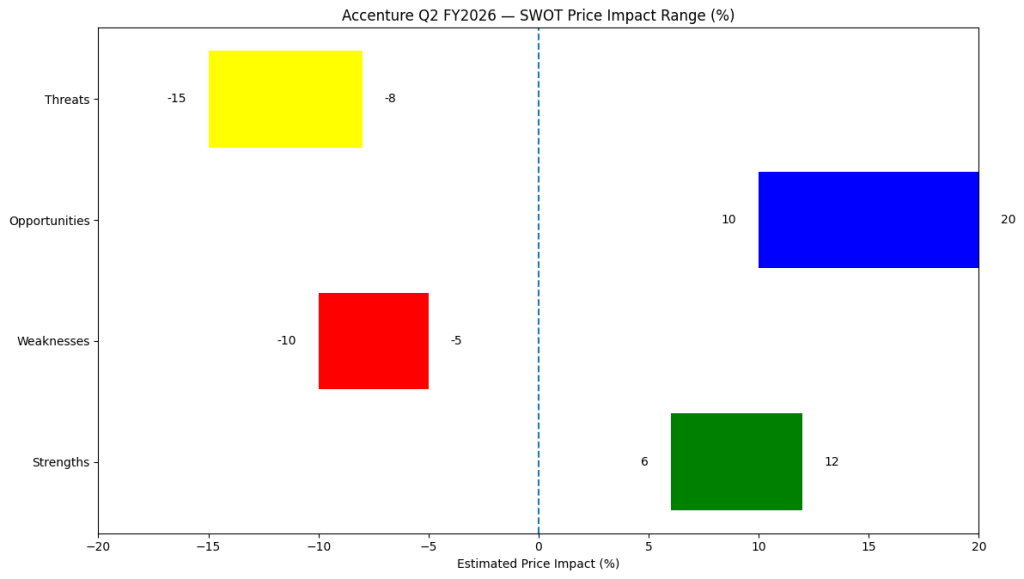
SWOT chart showing Accenture’s edge AI price impact ranges: strengths (+5 to +8), weaknesses (–2 to –4), opportunities (+7 to +12), and threats (–3 to –6).

Scenarios and fair value (illustrative)

Because Accenture doesn’t break out “edge AI revenue” as a line item, we model the impact at the level investors actually trade on: earnings power and the multiple the market is willing to pay. To keep this grounded, I anchor on reasonable ranges for EPS growth and P/E by 2030, then weigh the outcomes.

Bull case (40% probability). Edge programs scale alongside cloud GenAI work. AI-related revenue becomes a visible growth wedge, margins hold, and investors reward execution. If EPS reaches about $16 by 2030 and the market assigns a 28× multiple, you get an implied price near $448.

Base case (45%). Edge AI contributes meaningfully but remains under 10% of total revenue. Growth is steady, not explosive. With EPS around $14 and a 25× multiple, the implied price is about $350.

Bear case (15%). Adoption is slower, work skews toward integration, and the multiple compresses. With EPS near $12.5and a 22× multiple, the stock sketches to roughly $275.

Weighting those three paths yields a probability-weighted fair value of ~$378. It is not a moonshot number; it reflects confidence that Accenture will keep winning complex, multi-year AI programs where edge and cloud meet, without assuming platform-owner economics.

(Note: current share price fluctuates; the scenario math is illustrative rather than price-tick precise.)

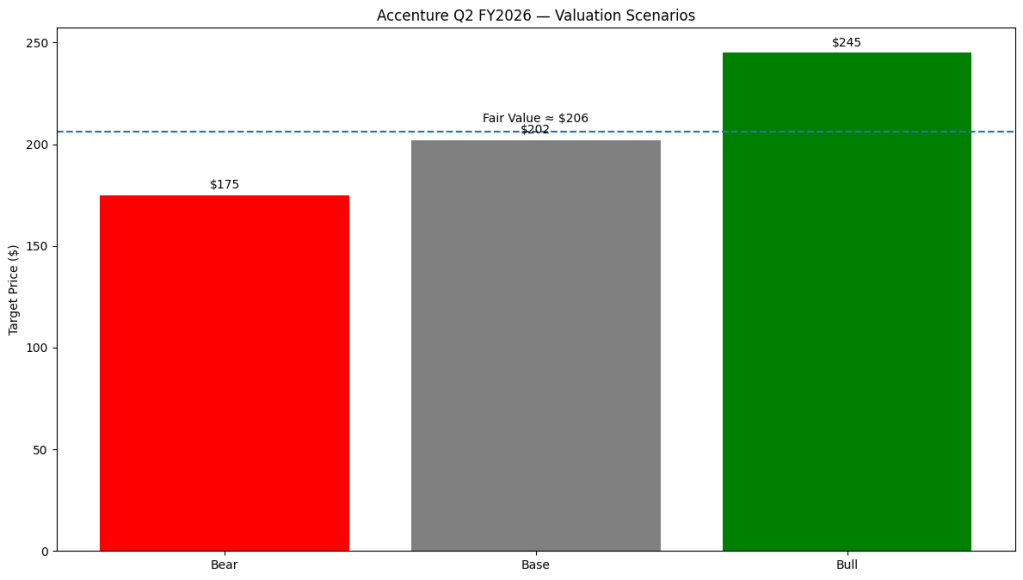
Valuation scenarios for Accenture’s edge AI adoption: bull case target $448 (40% probability), base case $350 (45%), bear case $275 (15%), with fair value estimate around $378.

What could change this view

Two things would push the needle higher. First, proof that model-compression and embedded engineering are shortening time-to-value on real deployments—think a global auto program or a multi-country factory network moving from pilot to standard with measurable savings. Second, clearer disclosure connecting AI bookings to revenue and margin expansion, so investors can track conversion rather than treating it as a narrative line.

On the downside, watch for customers delaying capital plans, hyperscalers tightening their grip on the edge toolchain, or a visible shift in project mix from “design and build” to lower-margin staff augmentation.


Bottom line

Edge AI isn’t a side show; it’s the place where AI meets the physical world. Accenture’s blend of consulting reach, embedded engineering from its acquisitions, and model-optimization capability puts it in a strong position to lead enterprise edge deployments. The field is busy and the company is already large, so don’t expect edge AI alone to redefine the business overnight. But as part of a broader AI reinvention engine, it can support healthier growth and a sturdier multiple. On the numbers above, that argues for a fair value around $378, with the bias skewed to the upside if execution stays crisp.


Disclosure & methodology: This article synthesizes public information on Accenture’s recent acquisitions and AI investments, industry reports on edge-AI adoption, and a scenario framework based on plausible EPS and P/E ranges through 2030. Accenture does not separately disclose edge-AI revenue, so assumptions are required; figures are illustrative, not precise forecasts. This is for education and discussion only and is not investment advice.

🧠 Oracle Q4 FY2025: Cloud Growth Surges, But Is the AI Premium Fully Priced In?

Oracle’s Q4 FY2025 earnings revealed explosive cloud growth and bold AI infrastructure plans. Our analysis breaks down the market reaction, SWOT insights, and valuation scenarios for tech-savvy investors. Is $190 justified — or overextended?

💡 TL;DR – Oracle’s AI Engine is Revving, But Is the Price Already Peaked?

Oracle (NYSE: ORCL) delivered a blockbuster Q4 with cloud revenue up 27% and Infrastructure-as-a-Service (OCI) growing 52%. Management forecasts even stronger acceleration in FY2026 — with 70%+ OCI growth and a $25 billion capex plan focused on GenAI. Investors loved it, bidding up the stock nearly 8% after hours. But with Oracle now trading around $190, the key question is whether the AI-fueled upside is already fully priced in.


📅 Oracle’s Cloud Pivot Is Real — and It’s Speeding Up

Oracle’s fiscal Q4 FY2025 results (for the quarter ending May 31) showcased a company in transition — and perhaps finally hitting escape velocity from its legacy roots. Total revenue rose 11% YoY to $15.9 billion, fueled by explosive growth in cloud services. Cloud now accounts for over 42% of Oracle’s total revenue base, with the Infrastructure business leading the charge.

Cloud Infrastructure (OCI) revenue surged 52% year-over-year to $3.0 billion. While that slightly missed some analyst whisper numbers, it still handily beat consensus and helped the company deliver a non-GAAP EPS of $1.70. More importantly, management struck an unusually aggressive tone for FY2026, projecting OCI growth of over 70% and overall cloud growth north of 40%.

Investors immediately rewarded the shift in tone — and trajectory. Oracle shares surged from $176.50 to nearly $190 in after-hours trading, reflecting a vote of confidence in the company’s AI roadmap.


🌟 Key Highlights from the Call

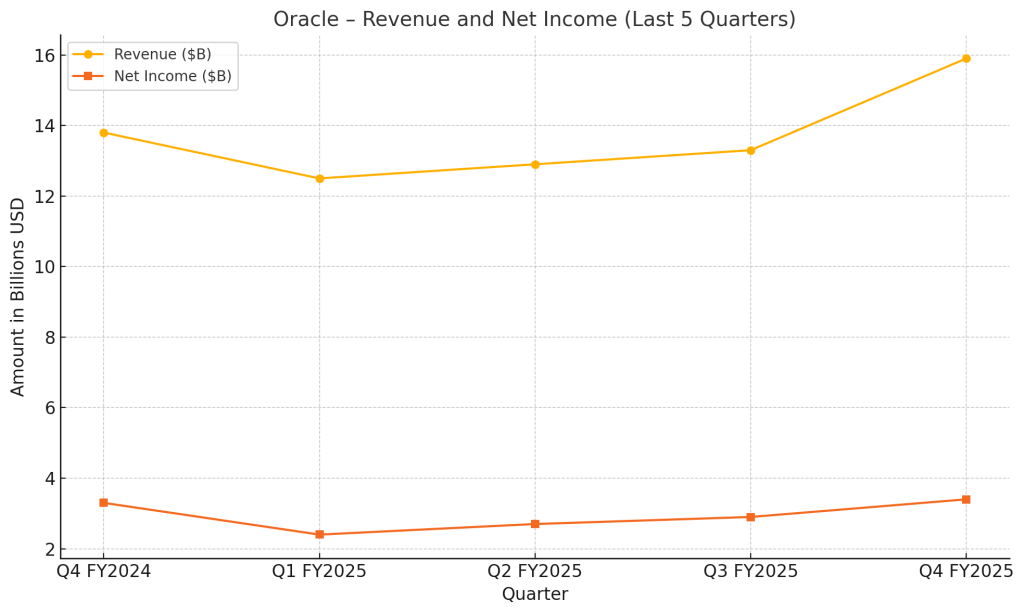
Line chart showing Oracle's revenue and net income over the past five quarters, highlighting a strong Q4 FY2025 performance with revenue reaching $15.9B and net income at $3.4B.
  • Cloud Infrastructure (OCI) revenue grew 52%, and management expects >70% in FY2026.
  • Multicloud partnerships (AWS, Azure, Google) driving 115% YoY database growth.
  • AI infrastructure: NVIDIA GPU clusters fully sold out; Oracle now trains large LLMs.
  • Operating cash flow for the year was $20.8B (+12% YoY).
  • Legacy business drag continues, with hardware down 6% and license support up just 3%.

🔍 What Oracle’s Execs Just Told Us (and Why It Matters)

CEO Safra Catz called FY2025 a “very good year,” but made clear the company sees FY2026 as an inflection point. That’s not just talk — Oracle is backing its vision with capital, planning to invest $25 billion into AI-focused infrastructure, including NVIDIA GPU clusters and new datacenters.

Larry Ellison emphasized that Oracle now trains large-scale language models on OCI superclusters and highlighted that OCI’s AI capacity is already fully sold out. He also touted 115% year-over-year growth in multi-cloud database revenue from hyperscaler partners like Microsoft, Google, and AWS. That stat alone turns heads — and signals that Oracle is more than just a slow-moving enterprise giant.

At the same time, Oracle’s legacy businesses continue to lag. Hardware revenue was down 6%, and traditional license support only grew 3%. But it’s clear where the company’s energy — and investor attention — is going.


🧠 Oracle’s AI Trajectory: What Could Go Right (or Very Wrong)

Bar chart showing Oracle’s SWOT analysis for Q4 FY2025 with estimated share price impact ranges: Strengths (+15 to +30) in green, Weaknesses (–10 to –5) in red, Opportunities (+10 to +25) in blue, and Threats (–20 to –10) in yellow, labeled at both ends of each bar.

✅ Strengths (+15 to +30 USD/share)

Oracle’s biggest asset right now is momentum. The company isn’t just talking about AI infrastructure — it’s actively deploying it. With OCI consumption revenue up 62% and GPU demand outpacing supply, the company’s pivot into AI cloud infrastructure is both real and scalable. If Oracle delivers on its >70% growth target, investors could reward it with a premium multiple, adding as much as $30/share in upside.

❌ Weaknesses (–5 to –10 USD/share)

Still, legacy Oracle hasn’t disappeared. Low-growth segments like license support and hardware continue to weigh on consolidated performance. Margins remain under pressure, and part of the recent EPS growth came from share buybacks and tax adjustments, not pure operating leverage.

🌱 Opportunities (+10 to +25 USD/share)

Oracle’s MultiCloud strategy — deploying services across AWS, Azure, and Google Cloud — is opening new frontiers. Government workloads, healthcare, and sovereign cloud deployments are becoming high-growth areas. This isn’t just a defensive move; it’s Oracle expanding its addressable market at precisely the right time.

⚠️ Threats (–10 to –20 USD/share)

Of course, scaling infrastructure this aggressively brings risk. The company is committing $25 billion in capex, and any delay in deployment, cost overruns, or demand shortfall could damage margins. On top of that, the competitive threat from hyperscalers like AWS and Microsoft remains fierce.


📊 SWOT Summary Table

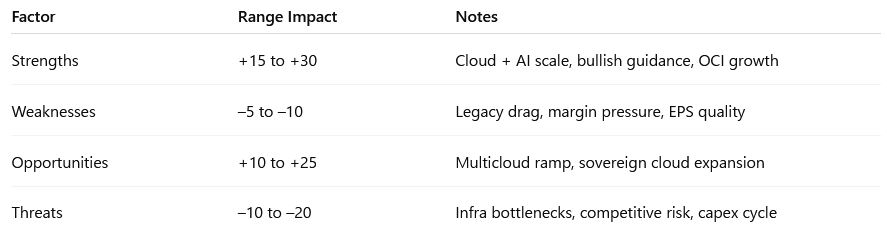
Table summarizing Oracle’s Q4 FY2025 SWOT analysis with estimated share price impacts: Strengths (+15 to +30 USD) driven by cloud and AI growth; Weaknesses (–5 to –10 USD) from legacy drag and margin pressure; Opportunities (+10 to +25 USD) from multicloud and sovereign cloud expansion; Threats (–10 to –20 USD) from execution risks and competition.

💰 Oracle’s Future by the Numbers — How Far Can It Run?

To evaluate Oracle’s investment case, we modeled three potential futures based entirely on official guidance and internal execution assumptions.

Bar chart showing Oracle’s Q4 FY2025 valuation scenarios: Bear Case at $160 (red), Base Case at $185 (gray), Bull Case at $210 (green), and Current Price at $190 (black), with a dotted blue line indicating the fair value of $187.50.

Bull Case – $210 (25%)

In the bull case, Oracle delivers on everything. GPU constraints ease, datacenters ramp up smoothly, and OCI’s explosive growth becomes the new norm. FY2026 EPS could reach $8.40, and if the market assigns a 25x multiple, we get a $210/share valuation. That would reflect Oracle’s full transformation into an enterprise AI infrastructure leader. We assign a 25% probability to this outcome.

Base Case – $185 (60%)

The base case, our most likely scenario (60%), assumes that execution remains strong, but not flawless. Some datacenter bottlenecks persist, but cloud revenues grow consistently. EPS lands around $7.40, which supports a $185/share valuation under a stable 25x multiple. This scenario reflects healthy, disciplined growth and is likely already reflected in current investor expectations.

Bear Case – $160 (15%)

In the bear case, execution lags. Capex pressures margins, and OCI growth slows to below expectations. If EPS only reaches $6.40, and multiples remain steady, we get a $160/share valuation. We think the chance of this outcome is about 15%.

Taken together, these scenarios point to a weighted fair value of $187.50/share, which is just about where Oracle is trading after earning released.

🎯 Weighted Fair Value Calculation

(0.25×210)+(0.60×185)+(0.15×160)=52.5+111+24=187.5

📌 Estimated Fair Value = $187.50/share


🎯 Should You Buy Oracle Now — or Wait for the Dip?

There’s no question Oracle is no longer the conservative enterprise holdout it once was. Its Q4 results and aggressive AI roadmap show that it’s pushing hard to become a core infrastructure layer for the AI economy. If you believe in that future, it may still have room to run — but likely at a steadier pace than the post-earnings rally suggests.

With the stock already trading near our fair value estimate, we think the best move now depends on your position. If you’re a long-term holder, this quarter reinforced your thesis. But if you’re still on the sidelines, a pullback toward $175 may offer a better risk-adjusted entry.


📣 Call to Action

Looking for clear, data-driven earnings insights that cut through the noise?
🟢 Subscribe to SWOTstock for no-hype analysis that follows the money, not the buzzwords.


⚠️ Disclaimer

This article is for informational purposes only and does not constitute financial advice. All data and commentary are based solely on Oracle’s official Q4 FY2025 earnings release and management statements.


Leave a comment


Snowflake Q1 FY2026: AI Promise Gains Ground, But Can the Stock Justify Its Premium?

Snowflake Q1 FY2026 earnings recap: 26% product revenue growth, expanding AI platform with Cortex, and a strategic pivot toward enterprise AI workloads. Explore SWOT analysis, valuation scenarios, and investor insights.

TL;DR – AI Momentum Is Building, But Valuation Is a Hurdle

Snowflake (NYSE: SNOW) delivered another solid quarter, with strong growth in product revenue and promising early traction in AI-native services like Cortex. While the company continues to execute on its transition from data warehouse to AI platform, GAAP profitability remains elusive. The stock is trading above $200, which reflects confidence in long-term AI monetization—but may leave little room for near-term execution missteps.


Quarter Recap – Solid Fundamentals, Strong Vision, and Rising Expectations

Snowflake entered fiscal 2026 with impressive momentum. Product revenue grew 26% year-over-year to $996.8 million, supported by rising demand from enterprise clients and sustained usage from technology-forward organizations. Total remaining performance obligations (RPO) reached $6.7 billion, a 34% increase, signaling deep customer commitment over the coming quarters.

Yet what made this quarter stand out wasn’t just the numbers—it was the strategic tone. CEO Sridhar Ramaswamy framed the company’s evolution clearly: Snowflake is aiming to become the infrastructure backbone of enterprise AI. The recent launch of Cortex allows users to run LLMs and vector search on their own data, within Snowflake’s platform. This integration is expected to expand use cases and deepen wallet share with customers.

CFO Mike Scarpelli acknowledged that macro pressures still influence some customer segments, but also noted increasing contributions from AI-native businesses. These companies are growing their consumption faster and could become a larger revenue driver over time.

In short, this was a quarter where the fundamentals held steady—but the vision pushed forward even more aggressively.


Key Highlights

Line chart showing Snowflake’s quarterly revenue and net income trends from Q1 FY25 to Q1 FY26, highlighting growth and ongoing GAAP losses.
  • Product Revenue: $996.8M (+26% YoY)
  • Total Revenue: $1.04B
  • RPO: $6.7B (+34% YoY)
  • Net Revenue Retention: 124%
  • Customers with >$1M TTM Product Revenue: 606 (up from 485 YoY)
  • Non-GAAP Operating Margin: 9%
  • GAAP Operating Loss: $447M
  • Stock Buybacks: $491M for 3.2M shares
  • Cash & Equivalents: $4.9B

What’s Working, What’s Risky – A Closer Look Through SWOT

Snowflake is a stock that forces investors to weigh long-term platform optionality against short-term valuation concerns. Here’s a structured breakdown of what’s unfolding beneath the headline figures.

Horizontal bar chart showing estimated stock price impact of Snowflake’s strengths, weaknesses, opportunities, and threats.

Strengths

Snowflake’s product revenue growth remains strong, and its customer expansion—especially among those spending over $1 million annually—is accelerating. Net revenue retention of 124% underscores the stickiness and expanding utility of its platform. This kind of enterprise engagement doesn’t happen by accident; it’s driven by real product need and trust.

Stock price impact estimate: +$15–20 if this strength remains consistent and margin discipline improves.

Weaknesses

Despite strong topline growth, Snowflake still posted a $447 million GAAP operating loss. Stock-based compensation remains a drag on profitability. And while buybacks support the stock, they also reduce cash flexibility if market conditions tighten.

Stock price impact: –$5–10 as margins and profitability concerns limit upward re-rating in the near term.

Opportunities

The company is betting big on AI. Cortex could become a high-margin differentiator if widely adopted. Snowflake also benefits from developer ecosystem momentum and the expanding Data Marketplace. If it becomes the default AI+data platform for enterprises, the upside could be meaningful.

Stock price upside estimate: +$25–40 if Cortex monetization scales successfully over the next 12–18 months.

Threats

Competition in this space is no joke. AWS, Google Cloud, and Databricks are all investing heavily in adjacent technologies. Additionally, Snowflake’s premium valuation leaves little room for error—any slowdown in growth or delay in AI execution could lead to multiple compression.

Risk-adjusted downside: –$20–30 if growth cools or AI monetization underwhelms.

"Table summarizing Snowflake’s Q1 FY2026 SWOT analysis with estimated stock price impacts. Strengths include strong revenue growth and customer expansion (+15 to +20). Weaknesses highlight GAAP losses and dilution risk (–5 to –10). Opportunities like AI platform Cortex and Data Marketplace offer potential upside (+25 to +40), while competitive and execution risks are flagged as threats (–20 to –30)."

Valuation Scenarios – What’s Priced In, and What’s Not

With Snowflake closing at $203.18 post-earnings, investors are clearly pricing in confidence in long-term platform growth. But how realistic is that pricing under different conditions?

Bar chart comparing Snowflake’s bear, base, and bull valuation scenarios with a black bar for current stock price and a dotted line for estimated fair value.

Base Case

  • Summary: Continued 25%+ product revenue growth, stable margin trajectory, Cortex adoption builds gradually
  • Estimated Fair Value: $150
  • Probability: 60%

Bull Case

  • Summary: Accelerated AI adoption, operating leverage unlocks quickly, free cash flow turns sustainably positive
  • Valuation: $240
  • Probability: 25%

Bear Case

  • Summary: Macro slowdown, AI workloads fail to monetize, continued margin drag
  • Valuation: $110
  • Probability: 15%

Weighted Average Fair Value

(150×0.6)+(240×0.25)+(110×0.15) = $157.50

At $203, the stock is pricing in the bull case—or close to it.


Verdict – Hold for Believers, Wait for Better Entry for Everyone Else

Snowflake is undeniably a category-defining company. Its platform moat is real, and its long-term relevance in enterprise AI looks promising. But the valuation today assumes a lot—particularly that Cortex and related AI monetization will ramp fast and wide.

If you’re already long and believe in the vision, it’s a Hold. If you’re looking to initiate a position, it may be wiser to wait for a pullback or more concrete signs of AI revenue contribution.


Want More Candid, Analyst-Style Stock Breakdowns?

Subscribe to our newsletter and follow us for deeper, data-driven takes on the biggest names in tech and AI. No hype, no noise—just strategy and substance.


Disclaimer

This article is based solely on Snowflake’s official Q1 FY2026 earnings report and call transcript. It is not financial advice. Always do your own due diligence before investing.


Leave a comment