🧠 Oracle Q4 FY2025: Cloud Growth Surges, But Is the AI Premium Fully Priced In?

Oracle’s Q4 FY2025 earnings revealed explosive cloud growth and bold AI infrastructure plans. Our analysis breaks down the market reaction, SWOT insights, and valuation scenarios for tech-savvy investors. Is $190 justified — or overextended?

💡 TL;DR – Oracle’s AI Engine is Revving, But Is the Price Already Peaked?

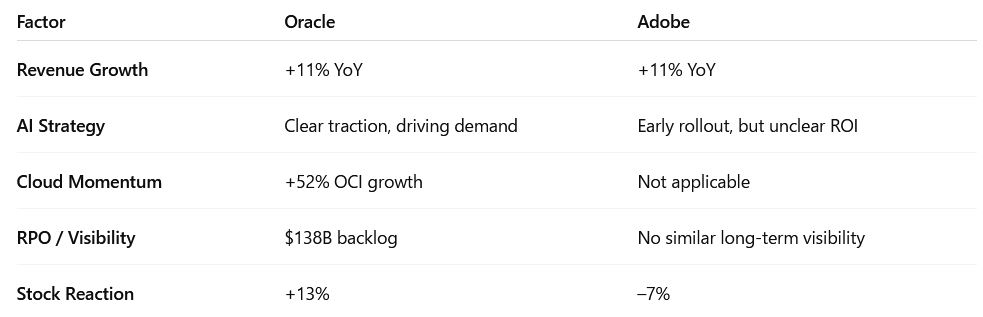
Oracle (NYSE: ORCL) delivered a blockbuster Q4 with cloud revenue up 27% and Infrastructure-as-a-Service (OCI) growing 52%. Management forecasts even stronger acceleration in FY2026 — with 70%+ OCI growth and a $25 billion capex plan focused on GenAI. Investors loved it, bidding up the stock nearly 8% after hours. But with Oracle now trading around $190, the key question is whether the AI-fueled upside is already fully priced in.


📅 Oracle’s Cloud Pivot Is Real — and It’s Speeding Up

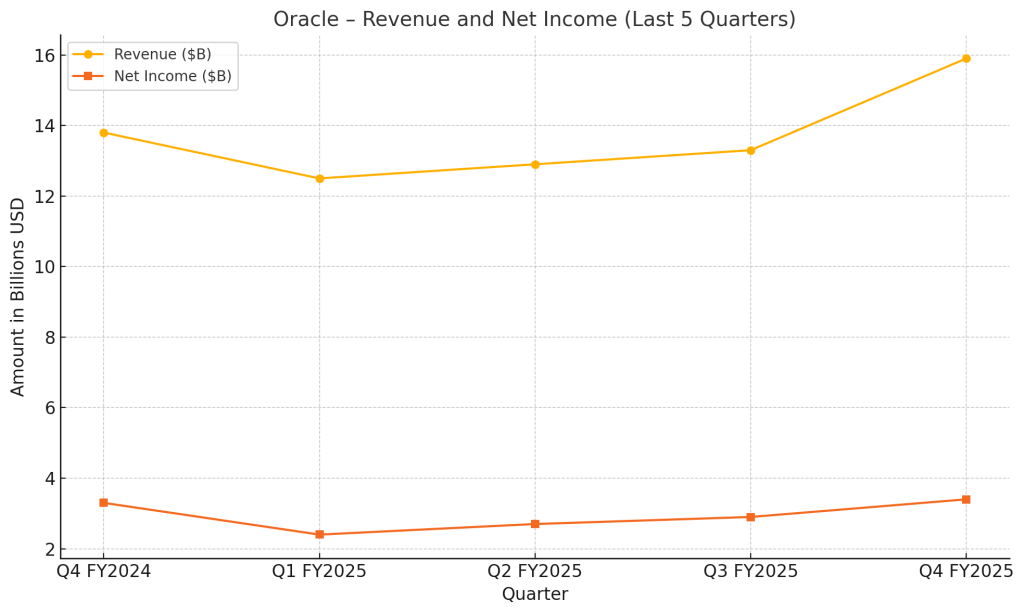
Oracle’s fiscal Q4 FY2025 results (for the quarter ending May 31) showcased a company in transition — and perhaps finally hitting escape velocity from its legacy roots. Total revenue rose 11% YoY to $15.9 billion, fueled by explosive growth in cloud services. Cloud now accounts for over 42% of Oracle’s total revenue base, with the Infrastructure business leading the charge.

Cloud Infrastructure (OCI) revenue surged 52% year-over-year to $3.0 billion. While that slightly missed some analyst whisper numbers, it still handily beat consensus and helped the company deliver a non-GAAP EPS of $1.70. More importantly, management struck an unusually aggressive tone for FY2026, projecting OCI growth of over 70% and overall cloud growth north of 40%.

Investors immediately rewarded the shift in tone — and trajectory. Oracle shares surged from $176.50 to nearly $190 in after-hours trading, reflecting a vote of confidence in the company’s AI roadmap.


🌟 Key Highlights from the Call

Line chart showing Oracle's revenue and net income over the past five quarters, highlighting a strong Q4 FY2025 performance with revenue reaching $15.9B and net income at $3.4B.
  • Cloud Infrastructure (OCI) revenue grew 52%, and management expects >70% in FY2026.
  • Multicloud partnerships (AWS, Azure, Google) driving 115% YoY database growth.
  • AI infrastructure: NVIDIA GPU clusters fully sold out; Oracle now trains large LLMs.
  • Operating cash flow for the year was $20.8B (+12% YoY).
  • Legacy business drag continues, with hardware down 6% and license support up just 3%.

🔍 What Oracle’s Execs Just Told Us (and Why It Matters)

CEO Safra Catz called FY2025 a “very good year,” but made clear the company sees FY2026 as an inflection point. That’s not just talk — Oracle is backing its vision with capital, planning to invest $25 billion into AI-focused infrastructure, including NVIDIA GPU clusters and new datacenters.

Larry Ellison emphasized that Oracle now trains large-scale language models on OCI superclusters and highlighted that OCI’s AI capacity is already fully sold out. He also touted 115% year-over-year growth in multi-cloud database revenue from hyperscaler partners like Microsoft, Google, and AWS. That stat alone turns heads — and signals that Oracle is more than just a slow-moving enterprise giant.

At the same time, Oracle’s legacy businesses continue to lag. Hardware revenue was down 6%, and traditional license support only grew 3%. But it’s clear where the company’s energy — and investor attention — is going.


🧠 Oracle’s AI Trajectory: What Could Go Right (or Very Wrong)

Bar chart showing Oracle’s SWOT analysis for Q4 FY2025 with estimated share price impact ranges: Strengths (+15 to +30) in green, Weaknesses (–10 to –5) in red, Opportunities (+10 to +25) in blue, and Threats (–20 to –10) in yellow, labeled at both ends of each bar.

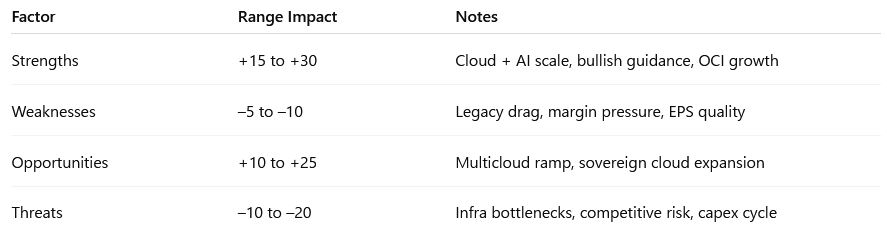
✅ Strengths (+15 to +30 USD/share)

Oracle’s biggest asset right now is momentum. The company isn’t just talking about AI infrastructure — it’s actively deploying it. With OCI consumption revenue up 62% and GPU demand outpacing supply, the company’s pivot into AI cloud infrastructure is both real and scalable. If Oracle delivers on its >70% growth target, investors could reward it with a premium multiple, adding as much as $30/share in upside.

❌ Weaknesses (–5 to –10 USD/share)

Still, legacy Oracle hasn’t disappeared. Low-growth segments like license support and hardware continue to weigh on consolidated performance. Margins remain under pressure, and part of the recent EPS growth came from share buybacks and tax adjustments, not pure operating leverage.

🌱 Opportunities (+10 to +25 USD/share)

Oracle’s MultiCloud strategy — deploying services across AWS, Azure, and Google Cloud — is opening new frontiers. Government workloads, healthcare, and sovereign cloud deployments are becoming high-growth areas. This isn’t just a defensive move; it’s Oracle expanding its addressable market at precisely the right time.

⚠️ Threats (–10 to –20 USD/share)

Of course, scaling infrastructure this aggressively brings risk. The company is committing $25 billion in capex, and any delay in deployment, cost overruns, or demand shortfall could damage margins. On top of that, the competitive threat from hyperscalers like AWS and Microsoft remains fierce.


📊 SWOT Summary Table

Table summarizing Oracle’s Q4 FY2025 SWOT analysis with estimated share price impacts: Strengths (+15 to +30 USD) driven by cloud and AI growth; Weaknesses (–5 to –10 USD) from legacy drag and margin pressure; Opportunities (+10 to +25 USD) from multicloud and sovereign cloud expansion; Threats (–10 to –20 USD) from execution risks and competition.

💰 Oracle’s Future by the Numbers — How Far Can It Run?

To evaluate Oracle’s investment case, we modeled three potential futures based entirely on official guidance and internal execution assumptions.

Bar chart showing Oracle’s Q4 FY2025 valuation scenarios: Bear Case at $160 (red), Base Case at $185 (gray), Bull Case at $210 (green), and Current Price at $190 (black), with a dotted blue line indicating the fair value of $187.50.

Bull Case – $210 (25%)

In the bull case, Oracle delivers on everything. GPU constraints ease, datacenters ramp up smoothly, and OCI’s explosive growth becomes the new norm. FY2026 EPS could reach $8.40, and if the market assigns a 25x multiple, we get a $210/share valuation. That would reflect Oracle’s full transformation into an enterprise AI infrastructure leader. We assign a 25% probability to this outcome.

Base Case – $185 (60%)

The base case, our most likely scenario (60%), assumes that execution remains strong, but not flawless. Some datacenter bottlenecks persist, but cloud revenues grow consistently. EPS lands around $7.40, which supports a $185/share valuation under a stable 25x multiple. This scenario reflects healthy, disciplined growth and is likely already reflected in current investor expectations.

Bear Case – $160 (15%)

In the bear case, execution lags. Capex pressures margins, and OCI growth slows to below expectations. If EPS only reaches $6.40, and multiples remain steady, we get a $160/share valuation. We think the chance of this outcome is about 15%.

Taken together, these scenarios point to a weighted fair value of $187.50/share, which is just about where Oracle is trading after earning released.

🎯 Weighted Fair Value Calculation

(0.25×210)+(0.60×185)+(0.15×160)=52.5+111+24=187.5

📌 Estimated Fair Value = $187.50/share


🎯 Should You Buy Oracle Now — or Wait for the Dip?

There’s no question Oracle is no longer the conservative enterprise holdout it once was. Its Q4 results and aggressive AI roadmap show that it’s pushing hard to become a core infrastructure layer for the AI economy. If you believe in that future, it may still have room to run — but likely at a steadier pace than the post-earnings rally suggests.

With the stock already trading near our fair value estimate, we think the best move now depends on your position. If you’re a long-term holder, this quarter reinforced your thesis. But if you’re still on the sidelines, a pullback toward $175 may offer a better risk-adjusted entry.


📣 Call to Action

Looking for clear, data-driven earnings insights that cut through the noise?
🟢 Subscribe to SWOTstock for no-hype analysis that follows the money, not the buzzwords.


⚠️ Disclaimer

This article is for informational purposes only and does not constitute financial advice. All data and commentary are based solely on Oracle’s official Q4 FY2025 earnings release and management statements.


Leave a comment


NVIDIA Q1 FY2026: AI Revenue Soars, but China Risk Lingers

NVIDIA’s Q1 FY2026 earnings show record AI revenue and rising risks from China export bans. See full breakdown, SWOT, and valuation scenarios.

TL;DR Summary

NVIDIA (NASDAQ: NVDA) delivered record-breaking Q1 revenue powered by AI infrastructure demand, but a $4.5B China-related inventory charge exposed its vulnerability to export regulations. Strong outlook continues, but geopolitical risks cap near-term upside.

Quarter Recap

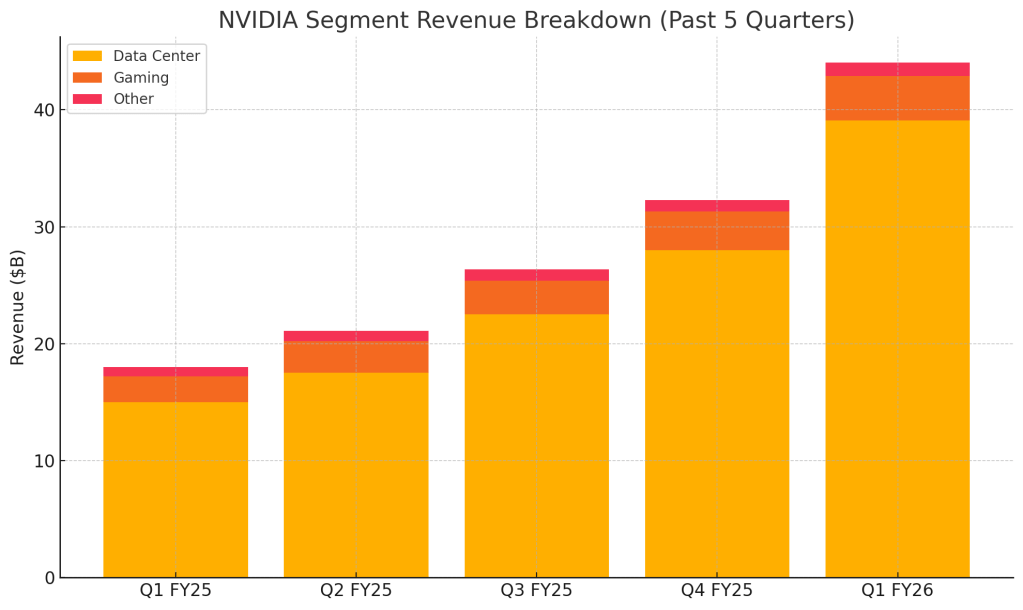
NVIDIA reported a stellar Q1 FY2026 with $44.06 billion in revenue, up 69% year-over-year, driven primarily by its Data Center segment which surged to $39.1 billion. The company’s full-stack AI platform, from Blackwell GPUs to CUDA software, continues to lead the industry.

However, a $4.5 billion inventory charge—triggered by U.S. export restrictions on H20 chips to China—cut into GAAP gross margin, bringing it down to 61.0%. Without this one-off, margins would have reached 71.3%.

CEO Jensen Huang maintained a confident tone, citing global momentum for AI compute and strong enterprise demand. Q2 guidance sits at $45 billion in revenue, despite an expected $8 billion China shortfall.

Line chart showing NVIDIA's revenue and net income growth from Q1 FY25 to Q1 FY26, highlighting consistent financial expansion.

What Changed Since Last Quarter

  • Revenue jumped 18% from Q4 FY2025’s $37.98B
  • China export losses increased and led to a $4.5B inventory charge
  • Blackwell ramp-up continued, now complemented by global AI partnerships
  • Margins would have improved sequentially if not for the export charge

Key Highlights

  • Revenue: $44.06B (+69% YoY, +18% QoQ)
  • Data Center Revenue: $39.1B (+73% YoY)
  • Gaming Revenue: $3.8B (+42% YoY)
  • Gross Margin (ex. H20 charge): 71.3%
  • Inventory Charge: $4.5B related to H20 China restrictions
  • Q2 Outlook: $45B revenue, ~$8B loss from China bans

Segment Revenue Breakdown

NVIDIA’s Q1 FY2026 results show that its Data Center business has become the overwhelming growth engine, with Gaming rebounding and smaller segments contributing steadily.

Stacked bar chart showing NVIDIA’s segment revenues, highlighting growth in Data Center and Gaming over 5 quarters.

SWOT Analysis with Price Impact

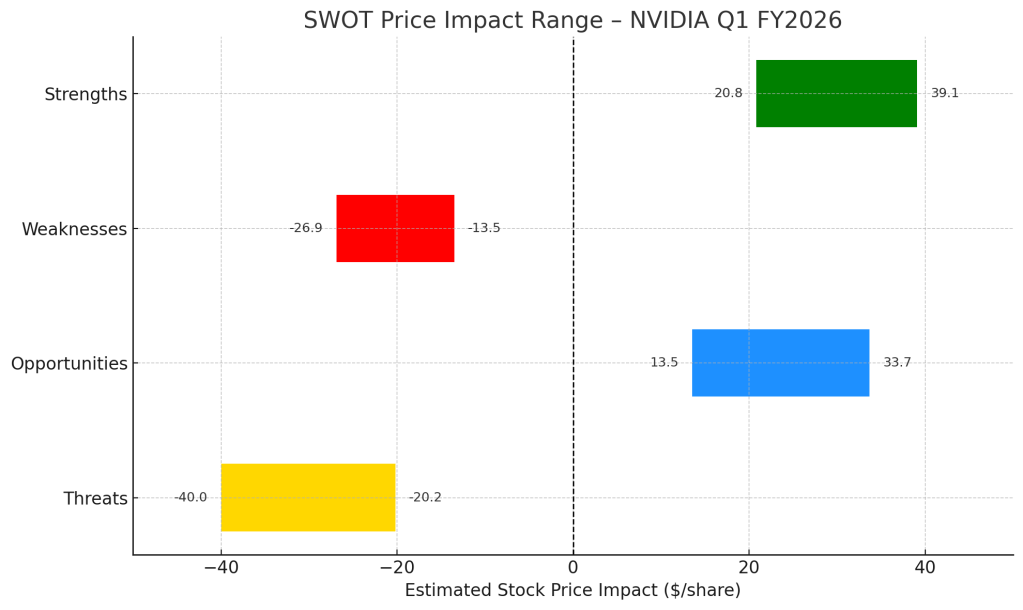
Horizontal bar chart showing estimated stock price impact for each SWOT factor, ranging from –$40 to +$40 per share.

Strengths

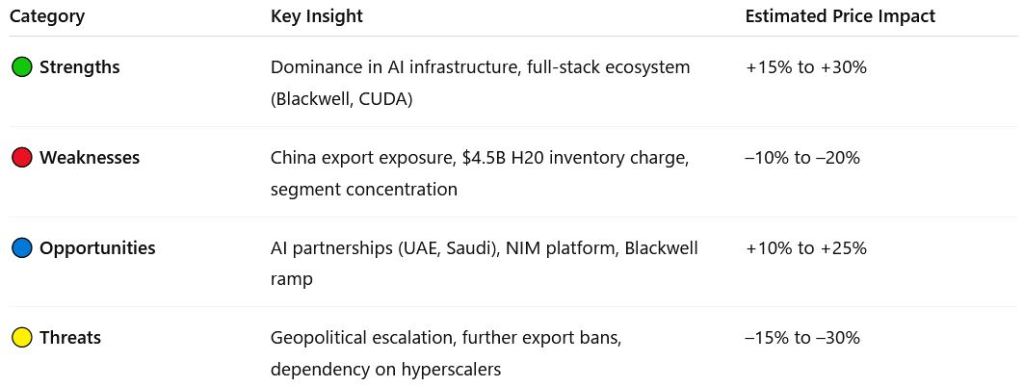
NVIDIA’s dominance in AI infrastructure remains unchallenged. Its platform—from Blackwell chips to CUDA and software libraries—continues to see record enterprise demand.
Price Impact: +15% to +30%

Weakness

The $4.5B write-down tied to H20 inventory for China highlights dependency on export-sensitive products.
Price Impact: –10% to –20%

Opportunities

New AI alliances with Saudi Arabia, UAE, and Taiwan, along with platform expansion via NIM (Inference Microservices), open large future markets.
Price Impact: +10% to +25%

Threats

China restrictions are set to cost $8B in Q2 revenue. Further geopolitical escalation may erode future sales or strain global operations.
Price Impact: –15% to –30%

SWOT Summary

Table summarizing NVIDIA’s Q1 FY2026 SWOT analysis with strengths in AI leadership, weaknesses in China exposure, opportunities in global AI expansion, and threats from geopolitical risks, each with estimated stock price impacts.

What’s NVIDIA Worth After Q1 FY2026?

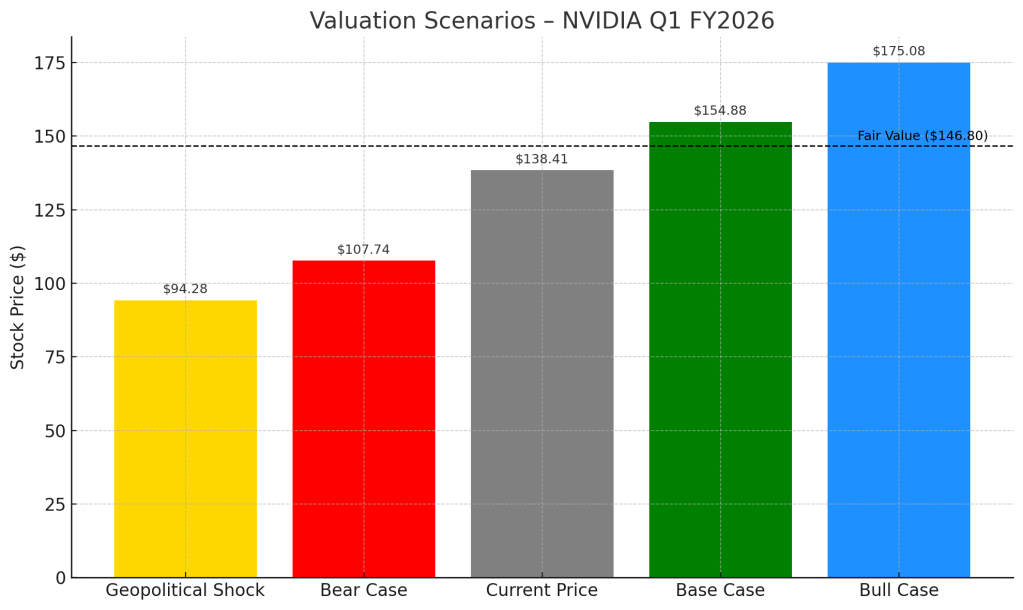
To value NVIDIA after its blockbuster Q1 FY2026 earnings, we consider three realistic scenarios for its forward earnings power—each reflecting a different blend of AI infrastructure growth, export risks, and margin execution.

Bar chart showing valuation scenarios from worst case ($94.28) to bull case ($175.08) with fair value line at $146.80.

Bull Case – $412.50/share (25% probability)

In the most optimistic scenario, NVIDIA ramps Blackwell faster than expected and U.S. export restrictions ease, allowing China sales to partially recover. Enterprise demand for generative AI compute remains red-hot globally, lifting both volumes and pricing. If earnings rise to $7.50 per share and the market awards a 55x multiple (consistent with high-growth AI comps), the stock could reach $412.50. While aggressive, this case reflects NVIDIA’s AI platform expanding into global infrastructure—and we assign it a 25% probability.

Base Case – $307.20/share (60% probability)

The base case assumes NVIDIA continues executing well, with growth sustained in the U.S., Middle East, and Asia-Pacific (excluding China). Blackwell adoption progresses on schedule, but China restrictions persist. Margins remain strong, but headline volatility lingers. We estimate forward EPS at $6.40 and apply a P/E of 48x—slightly below peak valuation—yielding a $307.20 price target. This scenario reflects the most likely outcome given current guidance and market conditions.

Bear Case – $200.00/share (15% probability)

In a downside case, AI capex moderates, China-related risks escalate, and competitors gain share in inference or custom silicon. NVIDIA faces pricing pressure or slower enterprise uptake. If forward EPS falls to $5.00 and valuation compresses to 40x, the stock could be re-rated to $200. While less likely in the near term, we assign this outcome a 15% probability due to macro and geopolitical uncertainties.

Valuation Scenarios Summary

Table comparing NVIDIA’s bull, base, and bear case stock valuations for Q1 FY2026, including EPS estimates, P/E multiples, target prices, and probabilities.

Fair Value Estimate: $308.95

Weighted across all three outcomes, our fair value estimate for NVIDIA is $308.95 per share—more than double its current price of ~$133.59 (as of June 2025). That implies significant long-term upside, especially if export risks stabilize and Blackwell adoption broadens globally.


(0.25 × $412.50) + (0.60 × $307.20) + (0.15 × $200.00) = $308.95


What to Watch Next Quarter

  • Ramp-up of Blackwell shipments outside China
  • Progress on AI factory partnerships in UAE and Saudi Arabia
  • Margin recovery trends
  • Policy developments in U.S.-China tech export restrictions

Verdict

NVIDIA remains the cornerstone of AI infrastructure. Q1 FY2026 reaffirms its growth engine, but investors should watch for regulatory headwinds. For growth stock investors, it’s a strong hold and a potential buy on dips.


Call to Action

📬 Like this kind of breakdown?
Subscribe to SWOTstock for clear, official-report-based earnings breakdown.


Disclaimer

This article is based entirely on NVIDIA’s Q1 FY2026 financial report, earnings call transcript, and management statements. It does not constitute investment advice.


Leave a comment