AI and the Social Cost of Disruption: How Big Tech’s Bold Bets Can Build a Future for Everyone

Big Tech is betting billions on AI and data centers — but will these investments drive shared growth or deepen divides? Here’s what history tells us, and what needs to change.

AI is changing everything — and faster than any technology before it.

Google, Microsoft, Amazon, and Meta are spending tens of billions on AI and data centers, betting big on a future where intelligent systems power every part of business and life. Alphabet alone has raised its 2025 CapEx guidance to $85 billion — the biggest single‑year infrastructure push in its history.

This is thrilling — but it’s also unsettling.

Because history tells us that when technology moves this fast, people and communities often get left behind.


We’ve Seen This Before

AI may feel new, but the playbook isn’t.

  • 1980s: Robots transformed auto plants. Companies promised “upskilling,” but Rust Belt towns were hollowed out.
  • 1990s: Office computers streamlined workflows. Administrative jobs shrank. New IT careers emerged — but in different cities, for different people.
  • 2000s: The internet created digital giants and e‑commerce while wiping out thousands of brick‑and‑mortar businesses.

Every time, it’s the same two‑step:

  1. Phase 1: Use new tech to cut costs and boost margins.
  2. Phase 2: Eventually reinvest the gains to create new industries and jobs — often far away from those disrupted by Phase 1.

AI’s SWOT: Where We Stand Today

Looking at this AI revolution through a SWOT lens:

Strengths:
Big Tech has the scale, cash, and vision to reimagine industries. Google is reshaping search with AI Overviews. Microsoft wants Copilot in everything. Amazon is transforming logistics and the cloud. They’re building capabilities that could change how the world works.

Opportunities:
These investments could unlock entirely new markets — AI‑driven enterprise services, personalized tools, and products we can’t yet imagine. If done right, this could spark another tech‑driven growth era, creating jobs and opportunities across the economy.

Weaknesses:
The spending is enormous — Alphabet’s CapEx jumped 70% YoY — and it’s based on a bet that demand for AI will match the scale of these build‑outs. If enterprise adoption slows or ROI disappoints, this could become overcapacity, not innovation.

Threats:
The social cost is already visible: layoffs in tech, finance, and operations. Productivity gains are flowing to shareholders and elite talent — not the communities losing jobs. Political backlash is building. Regulators are circling. And if the economy slows — tariffs, inflation, geopolitical shocks — these bold bets could quickly look like overreach.


Why This Matters Beyond Big Tech

This isn’t just a Silicon Valley story.

  • Communities are hollowing out. The jobs being cut aren’t coming back to the same towns.
  • Wealth is concentrating. AI’s early gains are flowing to the top — executives, shareholders, and highly skilled tech workers.
  • Politics are polarizing. Resentment over lost livelihoods is fueling unrest and hardening divisions worldwide.

AI isn’t the cause of these divides — but it’s accelerating them.


The Choice Ahead

Here’s the good news: this doesn’t have to end the way previous tech disruptions did.

Big Tech can choose to:

  • Reinvest productivity gains into building new industries and creating meaningful roles for displaced workers.
  • Upskill employees so they can thrive in an AI‑powered economy instead of being left behind by it.
  • Partner with communities and governments to make AI adoption a growth engine for more than just shareholders.

This isn’t about slowing innovation. It’s about making sure progress works for more than a few.


Bottom Line

AI is the boldest bet Big Tech has made in decades. It has the potential to change everything — how we work, how we live, how we create.

But if these investments remain focused only on efficiency and cost‑cutting, they won’t just disrupt industries. They’ll deepen inequality, fuel resentment, and harden the divides already pulling societies apart.

If instead they’re used to build new opportunities for more people, AI could be remembered not as a disruptor, but as the engine of a new era of shared growth.

That choice is still on the table.


What do you think? Are these bold AI investments building a better future for everyone — or just for a few?


Leave a comment


Alphabet Q2 2025 Earnings: AI Momentum vs. Rising CapEx — Is GOOGL Still a Buy?

Alphabet’s Q2 2025 earnings beat expectations with 14% revenue growth, soaring cloud margins, and AI‑driven engagement. Is GOOGL fairly valued or poised for more upside? Read our full SWOT and valuation analysis.

TL;DR

Alphabet delivered Q2 2025 revenue of $96.4B (+14% YoY) and EPS of $2.31 (+22% YoY), driven by AI‑powered engagement across Search and YouTube, and a Google Cloud margin jump to 20.7%. However, CapEx surged 70% YoY to $22.4B (guidance raised to $85B), raising near‑term cash flow concerns. Our probability‑weighted fair value: ~$195/share, suggesting GOOGL is fairly valued with modest upside.


Quarter Recap: Alphabet’s AI‑Fueled Growth

Alphabet beat expectations across the board:

  • Revenue: $96.43B (+14% YoY)
  • Net Income: $28.2B (+19% YoY)
  • EPS: $2.31 (+22% YoY)
  • Google Services: $82.5B (+12%), driven by Search & YouTube.
  • YouTube Ads: $9.8B (+13% YoY); Shorts monetization now equals in‑stream levels.
  • Google Cloud: $13.62B (+32% YoY) with 20.7% operating margin, nearly doubling YoY.
  • CapEx: $22.4B (↑70% YoY), FY25 guidance lifted to $85B for AI/cloud data centers.

CEO Sundar Pichai emphasized AI as “positively impacting every part of the business.” He highlighted that $250M+ Google Cloud deals doubled YoY, showcasing enterprise AI traction.


Key Highlights from Q2

  • AI at Scale: AI Overviews hit 2B+ monthly users; AI Mode reached 100M+ monthly users in the U.S. & India.
  • Enterprise Momentum: Cloud operating margin doubled to 20.7%, with stronger large‑scale enterprise deals.
  • Subscription Growth: Platforms & Devices up 20% YoY, enhancing recurring revenue streams.
  • Regulatory Watch: Q2 included $1.4B in legal costs; DOJ antitrust rulings could progress later this year.
  • AI Talent Retention: Pichai addressed competitive pressures, reaffirming Alphabet’s “ability to attract and retain top‑tier researchers.”
  • Search Trade‑offs: AI Overviews may reduce ad click rates in some verticals — management is testing new ad formats to offset this.
Line chart showing Alphabet’s revenue and net income for the past five quarters, highlighting strong growth with Q2 2025 revenue at $96.4 billion and net income at $28.2 billion.

SWOT Analysis (With Price Impact)

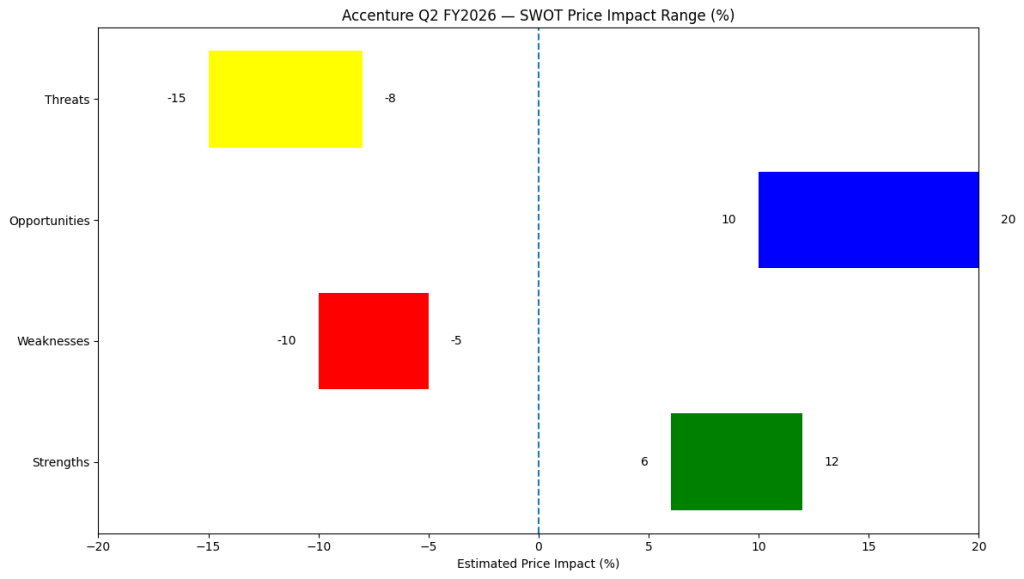
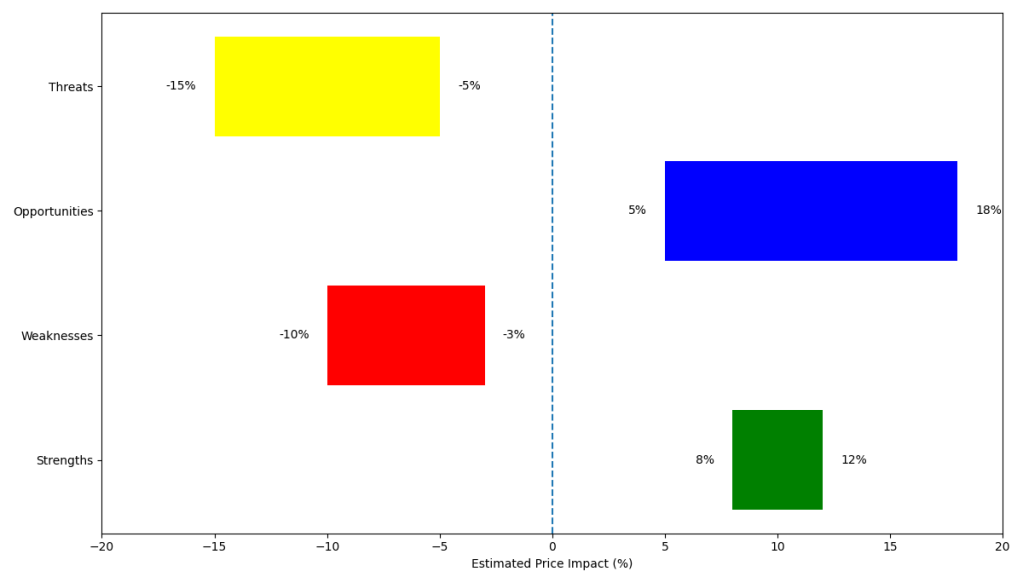
Strengths (+$8 to +$12):

  • AI products deepening Search & YouTube engagement.
  • Cloud at 20.7% margin, $50B+ annualized revenue run‑rate.
  • Strong cash position ($95B) and shareholder returns ($13.6B buybacks, $2.5B dividends).

Weaknesses (–$5 to –$8):

  • FY25 CapEx raised to $85B, weighing on free cash flow.
  • Rising TAC (traffic acquisition costs) and operating expenses.
  • Elevated legal expenses impacting profitability.

Opportunities (+$6 to +$10):

  • Enterprise adoption of Gemini AI models and Google Cloud solutions.
  • AI‑driven Search and YouTube monetization enhancements.
  • Subscription and device growth for stable recurring revenue.

Threats (–$6 to –$10):

  • DOJ antitrust remedies may reshape Search monetization.
  • Intense competition from AWS & Azure in enterprise AI.
  • Ad spend vulnerability during macroeconomic slowdowns.

SWOT Price Impact Table

SWOT analysis table for Alphabet Q2 2025 showing key drivers and estimated price impact for strengths, weaknesses, opportunities, and threats.
Horizontal bar chart showing Alphabet Q2 2025 SWOT price impact ranges: Strengths (+8 to +12) in green, Weaknesses (−8 to −5) in red, Opportunities (+6 to +10) in blue, and Threats (−10 to −6) in yellow, with a vertical zero line for reference.

Valuation Scenarios

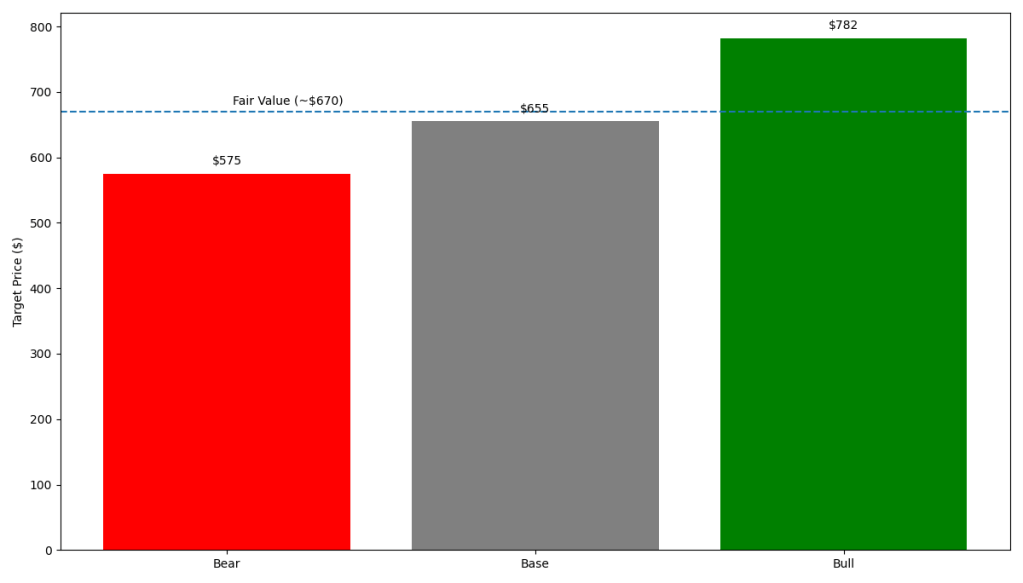
Valuation scenarios table for Alphabet Q2 2025 with target prices and probabilities

Fair Value Calculation (12‑month outlook)

From the valuation scenarios:

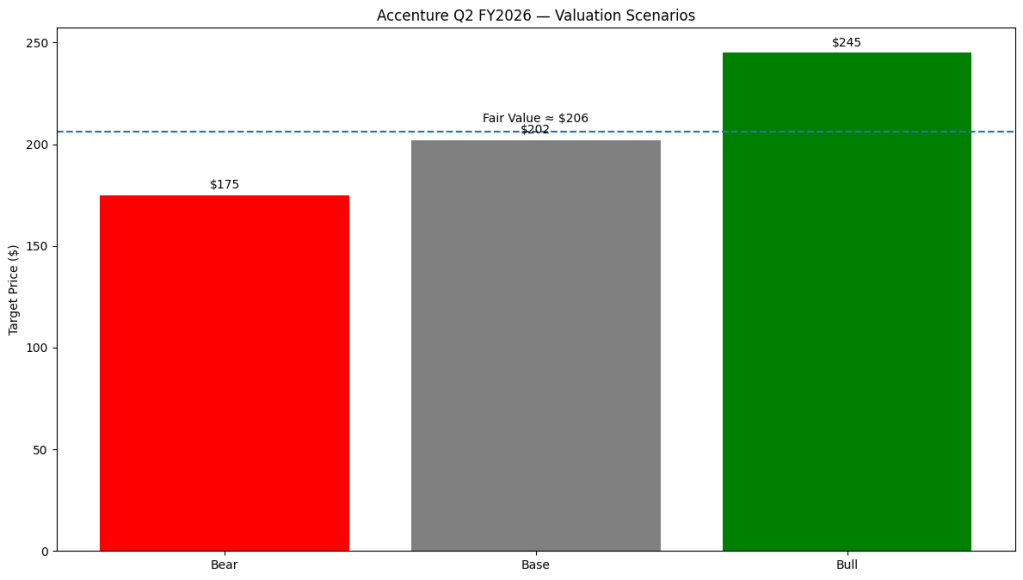
  • Bull: $225 × 30% = $67.5
  • Base: $192 × 50% = $96.0
  • Bear: $156 × 20% = $31.2

Weighted Fair Value=67.5+96.0+31.2=194.7Weighted Fair Value=67.5+96.0+31.2=194.7

Rounded: ≈ $195 per share

Vertical bar chart showing Alphabet Q2 2025 valuation scenarios: Bear case at $156 (20% probability) in red, Base case at $192 (50% probability) in gray, and Bull case at $225 (30% probability) in green, with a dotted line indicating the fair value at $195.

Verdict

At $192, Alphabet is fairly valued, offering limited short-term upside but strong long-term growth potential if AI-driven monetization plays out as management anticipates. Growth-focused investors may see this as an attractive hold for AI & cloud exposure; value-focused investors may prefer to wait for a wider margin of safety.


Call to Action

Are you positioning for Alphabet’s AI-powered future? Share your thoughts — is GOOGL a buyhold, or wait for a dip?


Disclaimer

This analysis is for informational purposes only and based solely on Alphabet’s official Q2 2025 financial report and earnings call. It does not constitute financial advice.


Leave a comment


Why Oracle Soared While Adobe Slipped: What Diverging Stock Reactions Reveal About Investor Confidence in AI

Oracle and Adobe both beat earnings expectations, but their stocks moved in opposite directions. Discover why Oracle soared while Adobe slipped—and what it reveals about investor confidence in AI execution vs. hype.

Two enterprise tech giants—Oracle and Adobe—both reported strong quarterly results this past week. Each beat Wall Street expectations and highlighted their advancements in artificial intelligence. But the stock market reaction couldn’t have been more different:

  • Oracle stock surged +13%
  • Adobe stock declined –7%

At SWOTstock, we examined the earnings reports, management commentary, and investor sentiment. What we found illustrates a growing gap in how the market values AI strategy: it’s not about who talks the loudest—it’s about who delivers results.

Visual comparison chart of Oracle and Adobe's Q2 FY2025 earnings and AI strategies. The chart contrasts both companies across key metrics: revenue growth (+11% each), AI strategy (Oracle monetizing, Adobe uncertain), cloud momentum (Oracle’s OCI +52%), revenue visibility ($138B RPO for Oracle), and stock reaction (+13% vs. –7%). Highlights Oracle's strong execution versus Adobe’s investor skepticism.

Oracle: AI Execution Drives Confidence and Capital

Oracle’s Q4 FY2025 earnings confirmed the company’s transformation from legacy enterprise vendor to cloud-first AI infrastructure provider. Revenue climbed 11% YoY, while Oracle Cloud Infrastructure (OCI) accelerated an impressive 52%.

What truly stood out was Oracle’s $138 billion in remaining performance obligations (RPO), offering investors forward-looking visibility. With high-profile partnerships (NVIDIA, Cohere) and GenAI workloads already in production, Oracle isn’t pitching an AI future—it’s reporting on AI present.

SWOTstock Takeaway
Oracle’s strength lies in its ability to turn AI demand into revenue now—not years from now.

Key Strengths:

  • Cloud Infrastructure (OCI) grew +52% YoY
  • AI partnerships with NVIDIA and Cohere are already monetizing
  • $138B RPO provides long-term visibility and stability

Risks to Watch:

  • Continued competition from AWS, Microsoft, and Google
  • Legacy on-premise business still weighs on blended growth
Oracle SWOT analysis chart with four quadrants:

    Strengths: Strong OCI momentum, deep enterprise relationships

    Weaknesses: Slow AI service adoption, legacy business drag

    Opportunities: Expanding AI workload footprint, growing infrastructure demand

    Threats: Cloud competition from hyperscalers, changing enterprise IT spending trends

Adobe: Solid Results, But Investors Want AI ROI

Adobe’s Q2 FY2025 results were strong on the surface: 11% revenue growth, earnings beat, and raised guidance. Yet investors responded with skepticism, sending the stock down 7%.

The issue? Despite promoting new AI tools like Firefly, GenStudio, and Acrobat AI, Adobe has yet to show how these innovations will contribute meaningful revenue in the short term. Investor patience is wearing thin.

Meanwhile, competition is heating up. Canva is gaining ground in design, while OpenAI and Google are introducing productivity tools that threaten Adobe’s document business. In this environment, a premium pricing model without clear AI-driven ARR growth becomes difficult to defend.

SWOTstock Takeaway
Adobe’s innovation story is still credible, but without visible monetization, the stock is vulnerable.

Key Strengths:

  • Industry-leading suite across Creative, Document, and Experience Cloud
  • Rapid rollout of AI-powered features

Risks to Watch:

  • No clear monetization path from AI features
  • Growing threats from Canva, OpenAI, and Google
  • Pressure on margins and customer retention
SWOT analysis chart of Adobe featuring the company logo at the center. The four quadrants highlight:

    Strengths: Leading creative software suite, growing AI capabilities

    Weaknesses: High valuation concerns, reliance on Creative Cloud

    Opportunities: Expansion into diverse AI applications, enterprise software potential

    Threats: Economic uncertainty, increasing competition in creative software market

Why the Divergence?

Despite similar top-line growth, the market saw Oracle and Adobe very differently:

Table comparing Oracle and Adobe’s Q2 FY2025 earnings and market reactions. Oracle delivered +11% revenue growth, +52% OCI growth, and a $138B RPO backlog, leading to a +13% stock surge. Adobe also posted +11% revenue growth but lacked visible AI monetization and competitive defense, resulting in a –7% stock drop.

Oracle showed the market what execution looks like. Adobe reminded investors that potential alone is no longer enough.


What to Watch in the Next 6–12 Months

🔮 Oracle Outlook:
Expect continued strength if cloud growth persists and GenAI partnerships scale. RPO offers downside protection in case of macro softness.

⚠️ Adobe Outlook:
Needs to prove that AI tools are driving ARR and enterprise wins. Without that, competitive pressures may accelerate valuation compression.


Final Thoughts: AI Is Entering the Show-Me Phase

This earnings season proves that we’re past the AI hype cycle. The market is now demanding proof—measurable, monetizable traction.

At SWOTstock, we’ll keep tracking this shift as it plays out in earnings calls, product roadmaps, and valuation resets.

👉 Follow us for AI-enhanced stock insights built for growth-minded and DIY value investors.


⚠️ Disclaimer

This analysis is based on publicly available company financials, earnings call commentary, and official press releases as of June 2025. It is intended for informational purposes only and does not constitute investment advice. Always perform your own due diligence.


Leave a comment