Palo Alto Networks Q1 FY2026 — “Steady Growth, Strong ARR, and a Market That Wanted More”

Palo Alto Networks reported strong FY2026 Q1 results, with a 16% revenue increase to $2.50 billion and a 29% rise in NGS ARR to $5.9

TL;DR Summary

Palo Alto Networks delivered a solid first quarter for FY2026: revenue climbed 16% to $2.50 billion, NGS ARR rose 29% to $5.9 billion, and RPO expanded 24% to $15.5 billion. Non-GAAP EPS of $0.93 beat expectations, reaffirming the company’s execution as customers expand platform adoption across Strata, Prisma, and Cortex. Yet shares traded lower after earnings as full-year guidance held steady, signaling a “good but not great” quarter for a stock priced for upside surprises. Our probability-weighted fair value comes in at $211, modestly above today’s ~$200 level.


Quarter Recap

Palo Alto Networks opened fiscal 2026 with steady momentum across its recurring revenue engines. Revenue grew 16% year-on-year to $2.50 billion, reflecting consistent demand for platformized security solutions. Next-Generation Security ARR expanded 29% to $5.9 billion, and the company’s Remaining Performance Obligation reached $15.5 billion, illustrating multi-year visibility as customers commit to broader and longer-term contracts. Non-GAAP EPS of $0.93 came in ahead of expectations, supported by robust software mix and continued traction in large deals. GAAP net income softened to $334 million due to higher operating investments and recent acquisition activity. Full-year guidance was reaffirmed at 14% revenue growth and 38–39% free cash flow margin, indicating stable execution without major revisions.


Key Highlights

  • Revenue grew 16% YoY to $2.50B
  • NGS ARR increased 29% YoY to $5.9B
  • RPO reached $15.5B, up 24% YoY
  • GAAP net income: $334M
  • Non-GAAP EPS: $0.93
  • FY2026 revenue guide: $10.50B–$10.54B (~14% YoY)
  • FY2026 non-GAAP EPS guide: $3.80–$3.90
  • FY2026 FCF margin: 38–39%
  • Strong platform adoption across Strata, Prisma, Cortex
  • Deal cycles remain healthy with large multi-module wins

SWOT Analysis

Strengths (+6% to +12%)

Palo Alto’s platform strategy continues to resonate, with customers consolidating disparate tools into unified architectures across network, cloud, and SOC operations. Robust ARR and RPO growth demonstrate durable demand and expanding wallet share. Execution remains consistent, with non-GAAP EPS beating expectations and free cash flow margins reaffirmed at attractive levels.

Weaknesses (–5% to –10%)

GAAP profitability remains pressured as the company absorbs integration costs and continues its investment cycle. The flat full-year revenue outlook reflects strong but not accelerating momentum, which limits near-term operating leverage. Competition and elevated valuation require continuous outperformance to sustain premium multiples.

Opportunities (+8% to +15%)

AI-aligned security represents a significant long-term catalyst. Enterprises are rearchitecting systems to protect AI workloads, model governance, and data pipelines — opening the door for larger platform deals. If AI-driven security cycles broaden or ARR momentum accelerates, Palo Alto could benefit from expanding deal sizes and higher-margin software adoption.

Threats (–8% to –15%)

The competitive landscape remains intense, with CrowdStrike, Zscaler, Fortinet, and hyperscalers rolling out AI-native security features. Deal timing remains sensitive to macro conditions, and any slowdown in billings or ARR conversion could weigh on sentiment. With valuation elevated, even modest disappointments can trigger multiple compression.


SWOT Table

Strengths
+6% to +12%
Execution strength, ARR growth, platform adoption

Weaknesses
–5% to –10%
GAAP margin pressure, flat guide, integration costs

Opportunities
+8% to +15%
AI-security demand, larger platform deals, multi-year contracts

Threats
–8% to –15%
Intense competition, valuation risk, deal-cycle volatility
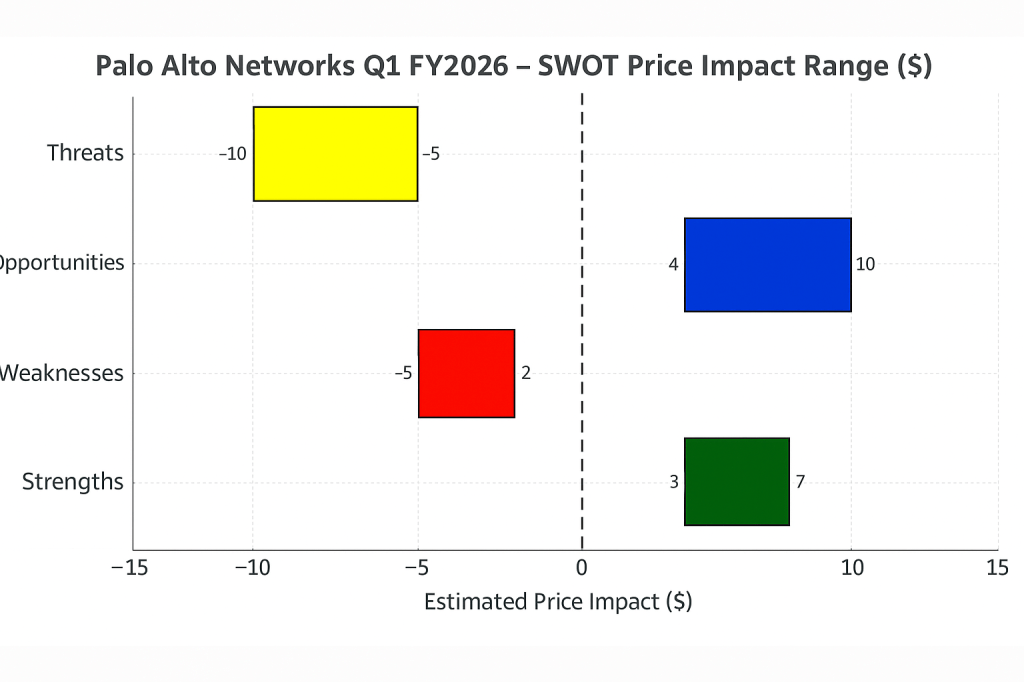
SWOT price impact chart for Palo Alto Networks Q1 FY2026 showing strengths, weaknesses, opportunities, and threats with corresponding dollar impact ranges on a horizontal bar graph.

Valuation Scenarios & Fair Value

Bull Case — $253 (35% probability)

Assumes stronger ARR expansion, AI-security deal momentum, and upside to FY26 revenue.
EPS: $3.95
Multiple: 64×
Target: $253

Base Case — $200 (50% probability)

Represents steady execution consistent with FY26 guidance.
EPS: $3.85
Multiple: 52×
Target: $200

Bear Case — $152 (15% probability)

Reflects slower deal cycles or competitive pressure leading to multiple compression.
EPS: $3.80
Multiple: 40×
Target: $152

Probability-Weighted Fair Value

0.35(253)+0.50(200)+0.15(152)=2110.35(253)+0.50(200)+0.15(152)=211

➡️ Fair Value Estimate: $211 per share

Today’s price near ~$200 suggests modest upside.
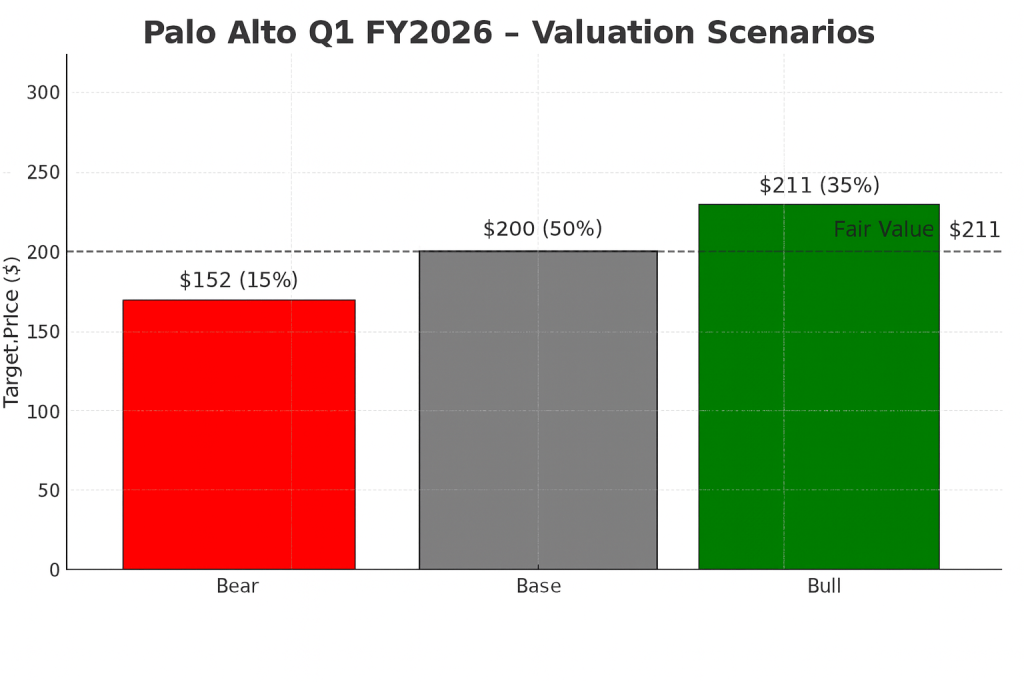
Valuation scenarios chart for Palo Alto Networks Q1 FY2026 showing bear case target of $152, base case target of $200, and bull case target of $253, with a dashed line indicating fair value at $211.”

Verdict

Palo Alto delivered a confident and well-executed quarter with strong ARR performance and healthy deal momentum. The reaffirmed full-year outlook signals stability, but the market was looking for acceleration, especially given the AI-security narrative. For long-term growth investors, the fundamentals remain compelling: resilient demand, high software mix, and strong free cash flow. With shares trading slightly below our $211 fair-value estimate, Palo Alto represents a reasonable entry point for exposure to platformized, AI-aligned cybersecurity — though upside may rely on renewed momentum in billings or a more aggressive guidance raise later in FY2026.


Call to Action

If you found this breakdown helpful, follow SWOTstock for more AI-driven fundamental analysis on today’s most important tech and cybersecurity companies. Each report is built from official filings, earnings transcripts, and a structured methodology designed for disciplined investors.


Disclaimer

This article is for informational purposes only and is not investment advice. All analysis is based exclusively on Palo Alto Networks’ official earnings report, financial disclosures, and management commentary from the latest quarter. Investors should perform their own research or consult a financial professional before making investment decisions.
Tesla Q3 2025 — When Growth Meets Gravity

Tesla’s Q3 results show record revenue of $25.2 billion and net income of $2.1 billion. While margins are recovering, they remain below 2022 levels. The fair value estimate is $227 per share, with current valuation suggesting a hold recommendation. Investors should consider a buy zone around $180-$190.

TL;DR:

Tesla reported record Q3 revenue of $25.2 B (+7.8 %) and net income of $2.1 B (+11 %), but margin recovery remains shallow.

The fair value sits near $227/share — reasonable for holders, not yet a bargain for new buyers.


📊 Quarter Recap

• Revenue $25.2 B (+7.8 %)

• Gross Profit $5.65 B (+13 %)

• Operating Income $2.17 B (+29 %)

• Free Cash Flow $1.47 B (+61 %)

• Auto Gross Margin 19.6 % (↑ 1.3 pts YoY)

Margins have stabilized after two years of price cuts — but at ~19 %, still far below the 25 % peak of 2022.

Each 1 pt margin shift ≈ $1 B impact to net income.


💬 Management Tone

“We’re entering the autonomy era — vehicle hardware is ready.” – Elon Musk

“Capex will rise into 2026 as we ramp Optimus and Dojo.” – CFO

Translation: positive cash flow continues, but the AI and robotics push keeps capex heavy. Patience required.


🧩 SWOT Summary (Price Impact Ranges)

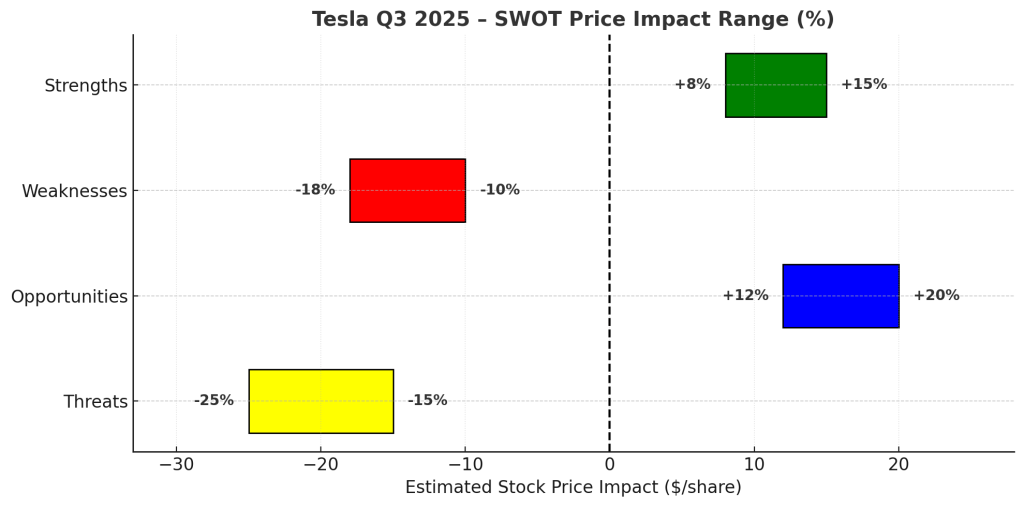
Strengths (+8 – 15 %)

– Vertically integrated EV + AI ecosystem

– $25 B net cash cushion

– Sequential margin recovery

Weaknesses (–10 – 18 %)

– Margins well below 2022 levels

– Tariff + mix pressure

– Energy unit still small

Opportunities (+12 – 20 %)

– FSD subscriptions and Dojo compute could add 1–2 pts to margin

– Energy backlog extending beyond 2026

Threats (–15 – 25 %)

– BYD and Hyundai competition

– Capex overshoot risk

– Governance noise around Musk pay

Horizontal bar chart showing Tesla’s Q3 2025 SWOT price impact ranges: Strengths (+8% to +15%, green), Weaknesses (−10% to −18%, red), Opportunities (+12% to +20%, blue), and Threats (−15% to −25%, yellow). Each range is labeled at both ends, with a dashed line at zero representing neutral stock price impact.

🎯 Valuation Scenarios

(Baseline price $235 pre-earnings)

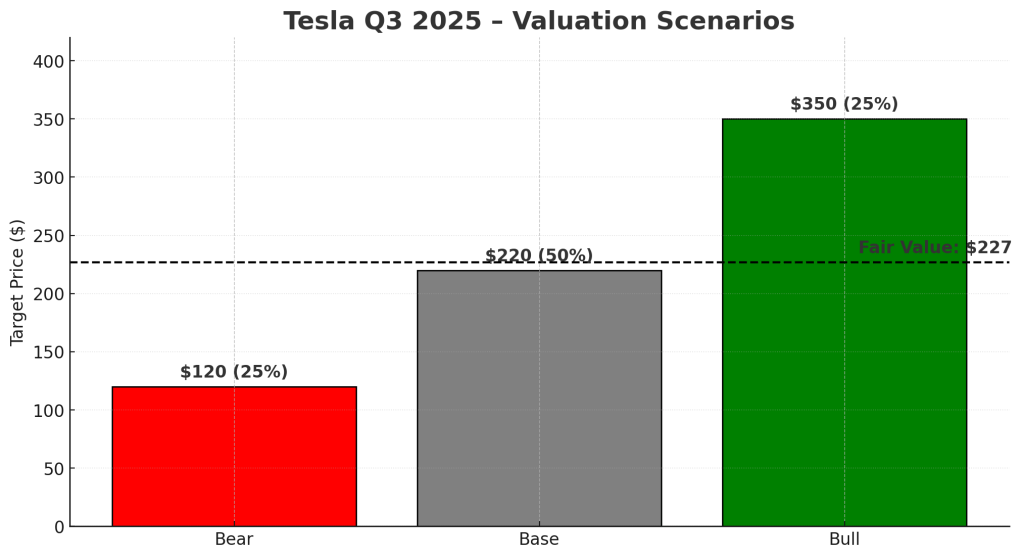
• Bull ($350) — Autonomy success & 22 % margins → 25 % probability

• Base ($220) — 19 % margins & steady FCF → 50 %

• Bear ($120) — Margin < 17 %, flat cash flow → 25 %

➡ Fair Value ≈ $227/share

Buy Zone $180–190  |  Hold $200–250  |  Trim/Avoid > $260

Bar chart showing Tesla’s Q3 2025 valuation scenarios: Bear case at $120, Base case at $220, and Bull case at $350, each labeled with its probability. A dashed horizontal line marks the fair value estimate at $227. The chart uses red, gray, and green bars against a clean financial-style layout.

🧮 Value-Investor Checklist

✅ Auto margin ≥ 19 % → base case safe

⚠️ Capex > $3 B/qtr → cash pressure

🚗 FSD revenue traction → bull trigger

📉 China ASP trend → bear signal


Verdict — HOLD (Fair Value ≈ $227)

Tesla remains a great company at a reasonable price, not a clear bargain.

Investors seeking 20 %+ margin of safety should target $180–190.

Patience beats momentum — cash and discipline will define returns.


Call to Action

📈 Subscribe to SWOTstock for AI-driven SWOT breakdowns of Tesla and other AI-era leaders — turning official filings into investor-ready insights.


Disclaimer

Based solely on Tesla Inc.’s official Q3 2025 10-Q and management remarks. Not investment advice. Do your own due diligence.


🔋 AMD Q3 2025 — AI Growth Kicks Into High Gear, but Valuation Catches Up

AMD reported record Q3 2025 earnings with a 36% revenue increase to $9.25 billion and a gross margin of 54%. Data Center sales grew 22%, while Client & Gaming surged 73%. Despite strong results, stock dipped due to export-control concerns. Q4 revenue guidance is between $9.3-$9.9 billion.

🧭 TL;DR Summary

Advanced Micro Devices (AMD:NASDAQ) posted record Q3 2025 results: revenue up 36 % y/y to $ 9.25 billion, non-GAAP EPS $ 1.20, and gross margin 54 %.
Data Center sales jumped 22 %, Client & Gaming soared 73 %, while Embedded declined 8 %.
Guidance for Q4 calls for $ 9.3 – 9.9 billion revenue—yet the stock dipped ≈ 4 % after hours as investors digested export-control headwinds and lofty expectations.


🧾 Quarter Recap

AMD’s Q3 marked a clear inflection in its AI and compute franchise.
CEO Lisa Su described the quarter as “a step-up in our growth trajectory as our rapidly scaling data-center AI business drives significant revenue and earnings growth.”
Gross margin improved two points y/y to 52 % (GAAP) and 54 % (non-GAAP), underscoring richer product mix led by EPYC CPUs and Instinct GPUs.
Operating income more than doubled to $ 1.27 billion.

Segment breakdown:

  • Data Center: $ 4.34 b (+ 22 %) — 5th Gen EPYC and Instinct MI350 ramp.
  • Client + Gaming: $ 4.05 b (+ 73 %) — Ryzen and console demand rebound.
  • Embedded: $ 0.86 b (– 8 %) — soft industrial & networking orders.

Management guided Q4 revenue $ 9.3 – 9.9 b (midpoint $ 9.6 b), excluding China-bound MI308 GPU shipments awaiting approval.


🌟 Key Highlights

  1. AI acceleration: Instinct MI350 shipments ramping, with MI308 awaiting export clearance.
  2. Margin expansion: Gross margin 54 % shows strong mix shift to high-end compute.
  3. Balanced growth: Client & Gaming offset softer Embedded demand.
  4. Cautious guidance: China restrictions = headwind, but secular AI TAM tailwinds intact.

🧩 SWOT Analysis (with Price-Impact Ranges)

Strengths (+ 7 – 15 %)
High-margin AI and server products drive sustainable earnings growth. Data Center + Client momentum supports multiple expansion.

Weaknesses (– 6 – 12 %)
Exposure to export controls and volatile PC cycle; Embedded softness limits diversification.

Opportunities (+ 10 – 22 %)
Next-gen MI350 and Zen 5 launches could unlock share gains vs NVIDIA and Intel; AI server TAM expands through 2026.

Threats (– 8 – 18 %)
Regulatory uncertainty (China exports), intense AI competition, macro slowdown risk.

AMD Q3 2025 SWOT price impact chart showing strengths, weaknesses, opportunities, and threats with colored horizontal bars from –45 to +55 dollars, indicating potential stock price impact ranges.

💸 Valuation Scenarios

  • Bull Case (35 % probability)
    • 2026 E EPS ≈ $ 6.50
    • P/E multiple ≈ 40×
    • Target Price: $ 260 – 300 (+ 20 %)
    • Thesis: Strong AI GPU and EPYC share gains, China shipments resume, margin expansion continues.
  • Base Case (50 % probability)
    • 2026 E EPS ≈ $ 5.50
    • P/E multiple ≈ 35×
    • Target Price: $ 230 – 250 (± 0 %)
    • Thesis: Balanced growth across Data Center and Client, modest Embedded recovery, stable margins.
  • Bear Case (15 % probability)
    • 2026 E EPS ≈ $ 4.50
    • P/E multiple ≈ 30×
    • Target Price: $ 180 – 200 (– 20 %)
    • Thesis: AI spending slows, export restrictions persist, competition pressures gross margin.

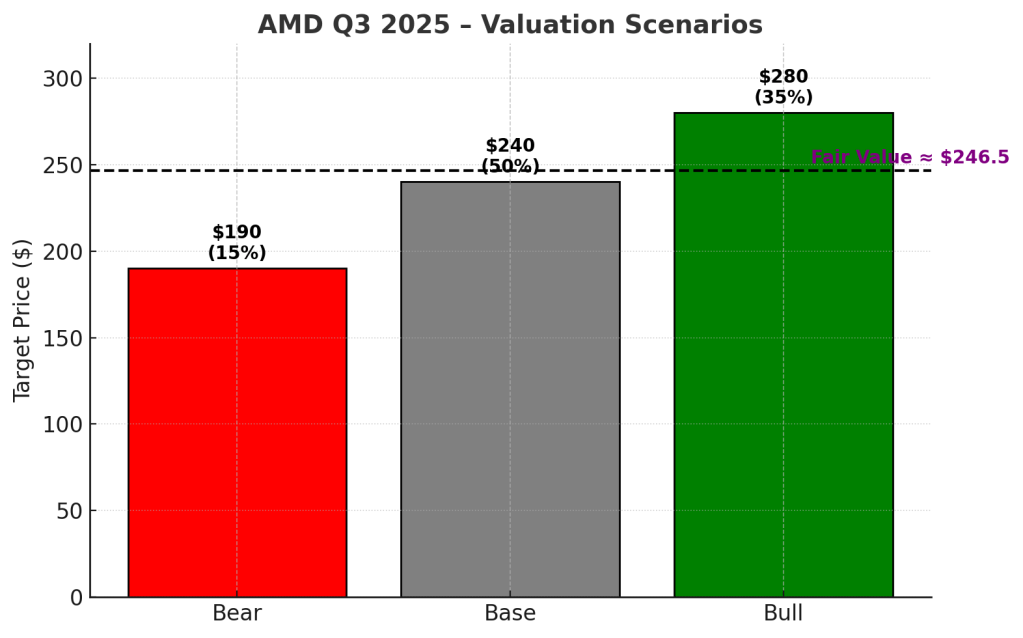
🎯 Probability-weighted fair value: $ 242 – 255 per share — roughly aligned with current post-earnings price, indicating AMD is fairly valued with moderate upside if AI acceleration outperforms.💸 Valuation Scenarios

AMD Q3 2025 valuation scenarios chart showing Bear, Base, and Bull cases with target prices of $190, $240, and $280, and a dashed line marking fair value around $246.

🧠 Verdict

AMD Q3 2025 shows AI execution is translating into profits. The stock’s valuation now reflects that success.
Short-term pullbacks from export or competitive news could offer better entries, but long-term investors still have a clear AI compounder.

Call: ⚖️ Hold / Accumulate on Weakness
Fair Value: $ 242 – 255 per share


🗣️ Call to Action

If you’re an AI-infrastructure-focused investor, keep AMD on your watchlist for pullbacks below $ 240.
The next earnings cycle will reveal whether the MI350 and Zen 5 ramps translate into market-share inflection.


⚠️ Disclaimer

This analysis is based solely on AMD’s official Q3 2025 financial report and earnings call. It is not investment advice. Please conduct your own due diligence before making investment decisions.