Apple Q4 2025 — The Comeback Quarter That Put “Intelligence” Back in Apple

Apple reported 8% revenue growth to $102.5 billion and a record $28.75 billion in Services, signaling a return to growth after a flat trend. The iPhone 17 launch and deeper ecosystem engagement drove this performance. Guidance for the holiday quarter suggests continued growth, aligning with Apple’s AI ambitions. Investors reacted positively, with a 6% share price increase post-announcement.

TL;DR Summary

Apple finally broke its flat-growth streak.
Revenue climbed 8 % y/y to $102.5 billion, EPS reached $1.85 (+9 %), and Services hit a record $28.75 billion.
Guidance for the holiday quarter calls for +10–12 % growth, reigniting belief that Apple Intelligence is more than a buzzword.
For growth investors, this quarter marks Apple’s return to the AI-led expansion narrative.


Quarter Recap

After four quarters of muted growth, Apple delivered what Tim Cook called “our strongest lineup ever.”
The iPhone 17 launch, deeper ecosystem engagement, and record Services revenue lifted results well above expectations.
Gross margin expanded to 47.2 %, net income rose to $24.2 billion, and Apple declared another $0.26 dividend while continuing aggressive buybacks.

Beyond the numbers, the tone of the call signaled confidence: management expects the December quarter to be the best holiday season in Apple’s history.
That optimism—and the 6 % share-price jump that followed—suggests investors finally see Apple’s AI strategy taking shape.


Key Highlights

  • Services: $28.75 B (+15 %) — now 28 % of total revenue and driving margin expansion.
  • iPhone: $49.0 B (+6 %) — AI-capable models leading upgrade cycle.
  • Mac / iPad: Flat to down slightly as users wait for AI refreshes.
  • Geography: Greater China $14.5 B (+3 %) — showing early stabilization.
  • Guidance: Revenue +10–12 %, gross margin 47–48 % next quarter.

(Note: Apple’s 8 % revenue growth trails Microsoft’s +12 % and Google’s +10 %, but represents its strongest acceleration since 2022.)


How Apple Intelligence Actually Creates Value

For now, “Apple Intelligence” isn’t a separate subscription—it’s a device-pull engine.
AI-driven features such as natural-language photo search, cross-app summaries, and on-device personal assistance require the latest hardware chips (A18, M4).
That design forces upgrades and feeds Services usage. Apple plans to layer paid tiers later, turning AI into a recurring revenue lever by FY 2026.


SWOT Analysis — Estimated Price Impact

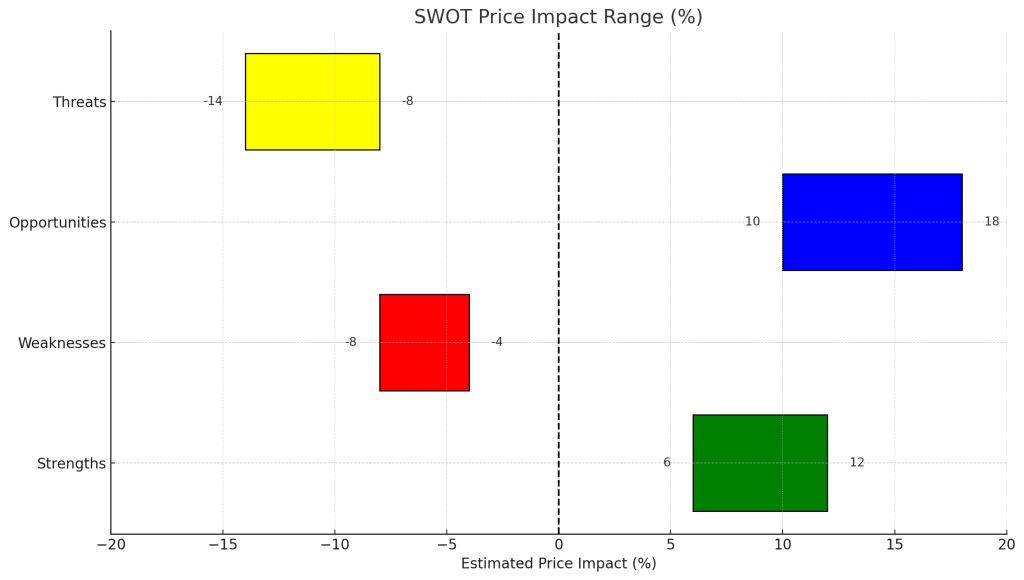
Strengths (+6 to +12 %)
A 2.2 billion-device installed base and record Services margin growth create durable pricing power.
AI-ready devices expand average selling prices and lift gross margin.
→ + $15 – $30 per share

Weaknesses (–5 to –10 %)
Hardware still ≈ 48 % of sales; tariffs and China competition pressure margins.
AI monetization lag keeps near-term EPS growth modest.
→ – $13 – $26 per share

Opportunities (+10 to +18 %)
AI integration across devices and services bundles can boost ARPU by 5–8 %.
Emerging-market FinTech and subscriptions expand TAM.
→ + $20 – $36 per share

Threats (–8 to –15 %)
Regulation (EU DMA, App Store fees), supply-chain relocation costs, and AI competition remain real headwinds.
→ – $18 – $32 per share

Horizontal SWOT bar chart for Apple Q4 2025 showing the estimated stock-price impact ranges for Strengths, Weaknesses, Opportunities, and Threats. Strengths (green) range from +8% to +14%, Weaknesses (red) from –12% to –6%, Opportunities (blue) from +12% to +20%, and Threats (yellow) from –18% to –10%.

Valuation Scenarios

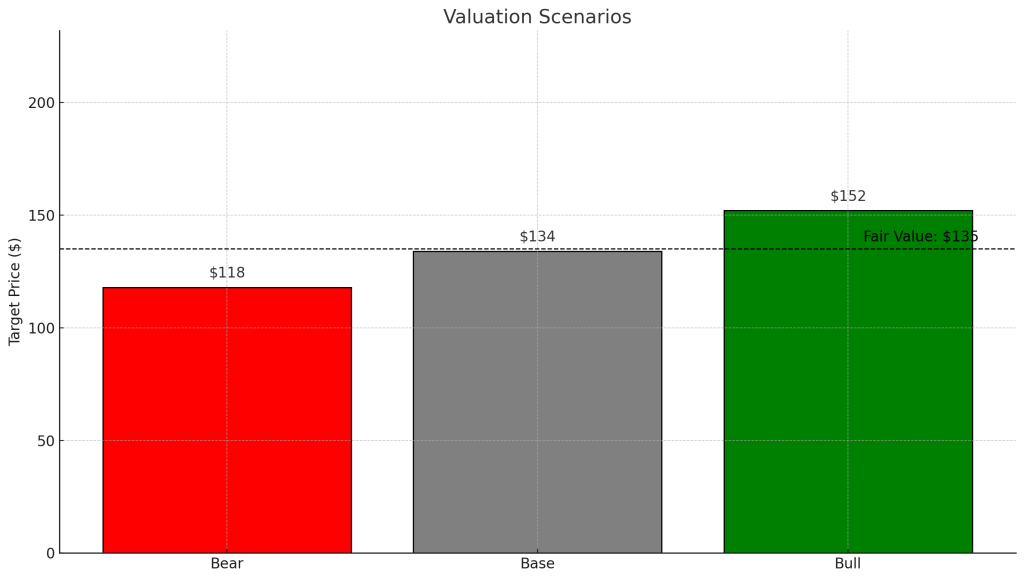
Apple’s fair value clusters around $270, but outcomes vary depending on how quickly its AI ecosystem monetizes.
Here’s how the road ahead could play out:

  • Bull Case ($305, ~30 % probability):
    Apple executes on AI integration, driving 12 % EPS growth and pushing Services beyond 30 % of total revenue.
    The market rewards it with a premium multiple near 32×.
  • Base Case ($270, ~50 % probability):
    EPS grows about 8 % as AI demand builds gradually.
    The stock trades around 29× earnings — roughly where it sits today.
  • Bear Case ($230, ~20 % probability):
    China softness, regulation, and muted AI monetization limit EPS to +3 %.
    Multiple compresses to 25× as investors rotate to faster-growing peers.

➡️ Fair Value Estimate: ≈ $272.5 per share, balancing these three outcomes.

Vertical bar chart for Apple Q4 2025 valuation scenarios showing Bear, Base, and Bull price estimates. Bear scenario (red) is $215, Base (gray) is $263, and Bull (green) is $298. A horizontal dashed line marks Fair Value at $263.

Verdict

At ≈ $270, Apple is fairly valued with a clear path to earnings expansion.
Growth investors should hold core positions and add on dips near $230–240.
The next inflection point arrives mid-2026, when AI features begin contributing revenue and Apple could justify a re-rating to 32–34× P/E ($285–295 target).
If Apple proves that Intelligence sells devices — not just headlines — $300 may come sooner than bears expect.


What to Watch Next

  • Adoption metrics for Apple Intelligence features in real-world use.
  • Services ARPU growth and subscription renewal rates.
  • China unit sales momentum post-holiday quarter.
  • Margin management as $1.4 B tariff cost hits Q1.

(Visual Placeholder #5 – Peer Comparison Table: Apple vs Microsoft vs Alphabet Growth and Margins)


Call to Action

Follow SWOTstock for AI-era earnings analysis of Amazon, Microsoft, and Tesla as we track how AI execution reshapes Big Tech leadership.
Subscribe for alerts when next-quarter AI scorecards drop.


Disclaimer

This analysis uses only Apple Inc.’s official Q4 FY 2025 financial report and earnings call.
It is for informational purposes only and not investment advice.


Netflix Q3 2025 — “AI Meets Ad Money: A Plot Twist in the Streaming Story”

Netflix’s Q3 2025 earnings showed record revenue of $9.62 billion and operating income of $2.27 billion, although a $619 million tax hit in Brazil lowered EPS to $4.25. Management affirmed strong fundamentals, with significant ad-tier growth expected. The company is evolving towards a profit-focused model amid expansion and AI enhancements.

TL;DR Summary

Netflix’s (NASDAQ: NFLX) Q3 2025 results delivered record revenue of $9.62 billion (+12.6 % YoY) and operating income of $2.27 billion (+18 %), but a $619 million tax expense in Brazil clipped EPS to $4.25, below expectations.
Despite a 6 % after-hours drop, management reaffirmed margin and cash-flow guidance, and the ad-tier business is scaling faster than expected. The fundamentals remain strong — the market reaction was all sentiment.


Quarter Recap

  • Revenue: $9.62 B (+12.6 % YoY)
  • Operating Margin: 23.6 % (up 1.1 pts)
  • Net Income: $1.94 B (+15 %)
  • EPS: $4.25 (+14 %)
  • Free Cash Flow: $1.7 B (slightly lower on $18 B content spend)
  • Paid Memberships: 282 M (+9 %)
  • Ad-tier Share: ≈ 16 % of new sign-ups (vs 9 % in Q2)
  • Regional Growth: APAC +22 %, LATAM +18 %, EMEA +10 %, UCAN +8 %

Key Highlights and Management Comments

Greg Peters (Co-CEO):

“Our ad-supported plan is scaling faster than expected. We’re now live in 15 markets, and we expect this to be a multi-billion-dollar business by 2026.”

Spencer Neumann (CFO):

“We’re on track for roughly $7 billion in free cash flow this year, even after increasing content investment to $18 billion.”

Ted Sarandos (Co-CEO):

“AI is improving localization, dubbing, and recommendations — helping creators reach global audiences, not replacing them.”


SWOT Analysis

Before breaking down Netflix’s quarter into strengths, weaknesses, opportunities, and threats, it’s useful to step back and look at what really moved the numbers this time. Q3 2025 wasn’t a story about subscriber growth or content costs alone — it was about a business transitioning into a more diversified, margin-focused platform. The sudden tax hit added noise, but underneath, Netflix is shaping a clearer long-term trajectory.
The SWOT framework highlights how each of these forces may translate into real price impact for investors.

Strengths

  • Ad-tier scaling ahead of plan (+8 – 12 %)
  • Operating margin expanding (+4 – 6 %)
  • Solid subscriber growth (+3 – 5 %)

Weaknesses

  • Heavy content spend pressures FCF (–3 – 5 %)
  • UCAN saturation limits pricing (–2 – 3 %)

Opportunities

  • Global ad expansion (15 markets, 16 % of sign-ups) (+10 – 15 %)
  • AI-powered localization & discovery (+4 – 6 %)
  • Gaming and live content diversification (+2 – 3 %)

Threats

  • Brazil tax dispute (–6 – 8 %)
  • Streaming competition (–4 – 6 %)
  • FX headwinds in LATAM (–2 – 3 %)

Net Impact: ≈ +1.5 – 2 % upside vs current price.


SWOT Price Impact Chart for Netflix Q3 2025 showing estimated price impact ranges for each SWOT factor.


Valuation Scenarios (Q4 2025 – Mid 2026 Horizon)

With the SWOT picture in place, the next step is understanding how these drivers translate into valuation. Netflix is no longer purely a high-growth streaming play; it’s a hybrid model balancing global expansion, ad monetization, and AI-driven efficiency. Each scenario—bull, base, and bear—reflects a different path the company could take depending on execution, competitive pressure, and regulatory risks.
The following valuation scenarios show how those paths map to price targets and a probability-weighted fair value.

Bull Case (35 %)

  • Ad-tier accelerates; margin 25 % +; EPS >$6 → Target $1,450 (+17 %)

Base Case (45 %)

  • Stable 7 % subscriber growth; margin 24 % → Target $1,250 (+1 %)

Bear Case (20 %)

  • Tax drag repeats; churn rises; cost inflation → Target $1,000 (–19 %)

Fair Value: Weighted Average ≈ $1,270
Current Price: ≈ $1,240 → +2.4 % Upside

Valuation scenarios chart for Netflix Q3 2025 showing three vertical bars: Bear case ($1,000 at 20%, red), Base case ($1,250 at 45%, gray), and Bull case ($1,450 at 35%, green). A dashed horizontal line marks the fair value at $1,270, following the same format as the Palo Alto Networks valuation chart.

Valuation Scenarios Chart for Netflix Q3 2025 displaying Bear, Base, and Bull targets with a fair-value line at $1,270.


Verdict

Netflix is shifting from a subscriber-growth story to a profit-platform narrative.
The 6 % post-earnings drop looks more like a valuation reset than a fundamental issue.
If the Brazil tax charge proves one-off, Q3 2025 may mark the start of a more sustainable, AI-enhanced growth chapter.

Short-term: Hold / Accumulate on weakness
Medium-term: Attractive for growth investors eyeing AI and ad-tier upside


Call to Action

👉 Follow SWOTstock for AI-driven SWOT analyses of top global companies.
📈 Stay ahead of the market with data-driven insights simplified for retail investors.


Disclaimer

This analysis is based solely on Netflix’s official Q3 2025 financial statements and earnings call materials. It is for educational and informational purposes only and does not constitute investment advice.

NVIDIA Q3 FY2026 Earnings — Is the AI Supercycle Still Accelerating?

NVIDIA achieved record Q3 FY2026 revenue of $57 billion, a 62% increase year-over-year, driven by strong demand for data center GPUs. The company expects Q4 revenue to reach $65 billion, indicating sustained AI infrastructure demand. However, concerns about supply constraints and competition remain, affecting future growth potential.

TL;DR Summary

NVIDIA delivered another explosive quarter, with Q3 FY2026 revenue hitting $57.0 billion, up 62% year-over-year and 22% sequentially, fueled by a massive surge in demand for Blackwell-based data center GPUs. Gross margins held at 73.4%, and management guided Q4 revenue to $65 billion, signaling confidence that AI infrastructure demand continues to rise faster than supply. The key question for investors is whether this momentum is sustainable — or if the supercycle is nearing a peak.


Quarter Recap

NVIDIA posted a record quarter driven overwhelmingly by its data center franchise. Revenue came in at $57.0 billion, up sharply from last year, with the data center business alone contributing $51.2 billion. Growth remained broad and robust across cloud providers, enterprise customers, and AI platform deployments. Gross margins stayed very strong at 73.4%, reflecting favorable product mix and pricing power.

GAAP diluted EPS was $1.30, supported by scale efficiency and tight expense control. During the earnings call, management noted that demand for the new Blackwell architecture remains “off the charts,” with cloud GPU capacity effectively sold out. NVIDIA also emphasized that its Q3 results and Q4 guidance exclude shipments of the H20 GPU to China, meaning the company is operating at record levels without one of its formerly significant regions.


Key Highlights

  • Record Revenue: $57.0B (+62% YoY, +22% QoQ)
  • Data Center Strength: $51.2B (+66% YoY, +25% QoQ)
  • Margins: GAAP gross margin of 73.4%
  • EPS: GAAP diluted EPS of $1.30
  • Guidance: Q4 revenue expected at $65.0B ± 2%
  • Demand Update: Blackwell GPUs remain supply-constrained
  • China: No H20 shipments included in guidance; China remains upside optionality

SWOT Analysis

Strengths (+12% to +22%)

NVIDIA’s leadership in AI infrastructure was reinforced by the rapid adoption of Blackwell, which pushed data center revenue to new highs. Margins remain exceptional, and demand continues to exceed supply.

Weaknesses (–8% to –14%)

Revenue is heavily concentrated in the data center segment, increasing sensitivity to a slowdown. Supply constraints and regulatory uncertainties around China limit near-term visibility.

Opportunities (+15% to +28%)

Guidance for Q4 implies another major step-up in revenue. Any resumption of shipments to China, as well as expansion into new AI computing platforms, provides further upside.

Threats (–12% to –20%)

Export controls remain a material risk. Competition from custom silicon and hyperscaler in-house chips could eventually pressure margins. NVIDIA’s premium valuation makes the stock more vulnerable to sharp reactions if growth moderates.


SWOT Table

Strengths: +12% to +22%
Weaknesses: –8% to –14%
Opportunities: +15% to +28%
Threats: –12% to –20%

SWOT price impact chart for NVIDIA Q3 FY2026 showing estimated dollar impact ranges: Strengths (+3 to +7), Weaknesses (–8 to –2), Opportunities (+4 to +10), and Threats (–10 to –5), displayed as horizontal colored bars with a dashed zero line.

Valuation Scenarios

Using only NVIDIA’s Q3 FY2026 report and Q4 guidance:

Bull Case — $450 (30% probability)

  • Q4 revenue lands above the top end of guidance
  • Margins track toward the high end of expectations
  • Some China shipments resume
  • Forward EPS: ~$6.00
  • P/E: 75×

Base Case — $325 (50% probability)

  • Q4 meets the midpoint of guidance
  • Margins remain stable near Q3 levels
  • No China upside
  • Forward EPS: ~$5.40
  • P/E: 60×

Bear Case — $215 (20% probability)

  • Q4 hits the lower end of guidance
  • Supply bottlenecks linger
  • Export restrictions tighten
  • Forward EPS: ~$4.80
  • P/E: 45×

Probability-Weighted Fair Value

$340–$345 per share

Valuation scenarios chart for NVIDIA Q3 FY2026 showing Bear ($215, 20%), Base ($325, 50%), and Bull ($450, 30%) price targets as colored bars, with a dashed line indicating a fair value of about $345.

Verdict

NVIDIA’s Q3 results confirm that the AI infrastructure cycle is still extending, not slowing. The company continues to execute exceptionally well, with demand for Blackwell far outstripping supply and Q4 shaping up to be another record quarter.

For growth-oriented investors, the setup remains compelling: official guidance alone justifies a fair value well above the current trading price. However, the stock’s trajectory will remain sensitive to export-control developments and any sign that hyperscalers may shift more workloads to in-house silicon.


Call to Action

If you’re a long-term growth investor who believes the AI compute buildout remains in its early stages, NVIDIA still represents one of the clearest large-cap plays on that trend. Use earnings revisions, regulatory headlines, and market volatility to your advantage — and consider staging entries rather than chasing peaks.


Disclaimer

This analysis is for informational purposes only and is based solely on NVIDIA’s official Q3 FY2026 earnings release, earnings call transcript, and management commentary. It is not investment advice. Please conduct your own research or consult a financial professional before making investment decisions.