Berkshire Hathaway Q3 2025 — Earnings Strength, Record Cash, and a Market That Shrugged

Berkshire Hathaway reported strong Q3 2025 earnings, with $13.5B in operating profits and a record cash reserve of $381B. Despite excellent insurance gains, the stock’s reaction was muted, reflecting cautious investor sentiment and no share buybacks. The outlook remains stable, but without capital deployment, the stock appears fairly valued.

TL;DR Summary

Berkshire delivered one of its strongest operating quarters in years: $13.5B in operating earnings (+34% YoY)$30.8B in net income, and a record $381B cash pile. Insurance posted exceptional underwriting profits and float grew to $176B. Yet the stock barely reacted on Nov 3 — reflecting Buffett’s continued caution, no buybacks, and heavy cash positioning. Berkshire looks fairly valued, with modest upside if capital deployment improves.


Quarter Recap

Berkshire reported Q3 2025 earnings on Saturday, November 1. The results showcased the strength of its core businesses:

  • Operating earnings surged to $13.485B, driven by rebounding insurance profitability.
  • Net income came in at $30.796B, boosted by mark-to-market investment gains.
  • Insurance underwriting delivered $2.369B in profit — nearly triple YoY.
  • Berkshire Hathaway Energy earned $1.489B; BNSF generated $1.449B.
  • The company ended the quarter with $305B in U.S. Treasury bills and $381.7B in total cash and equivalents — a historic record.

Despite these results, Berkshire again did not repurchase shares and was a net seller of equities during the quarter — a message that did not go unnoticed by the market.


Key Highlights

1. A Massive Cash Wall
Berkshire now holds one of the largest cash positions in its history — a sign of both discipline and a lack of compelling opportunities.

2. Insurance Delivered Its Best Quarter in Years
Underwriting profit and investment income both rose sharply, supported by higher rates and disciplined pricing.

3. Apple Exposure Remains High
Apple continues to dominate the equity portfolio, though Berkshire reduced its position earlier in the year.

4. No Buybacks in 2025
Management chose not to repurchase shares for the first nine months — a strong signal that Buffett does not view Berkshire as undervalued at current levels.

5. Market Reaction Was Muted
On Nov 3 (first trading day after earnings), BRK.B closed near $476, showing almost no reaction to the strong quarter — reflecting cautious investor sentiment and the sense that Berkshire is in a holding pattern.


SWOT Analysis

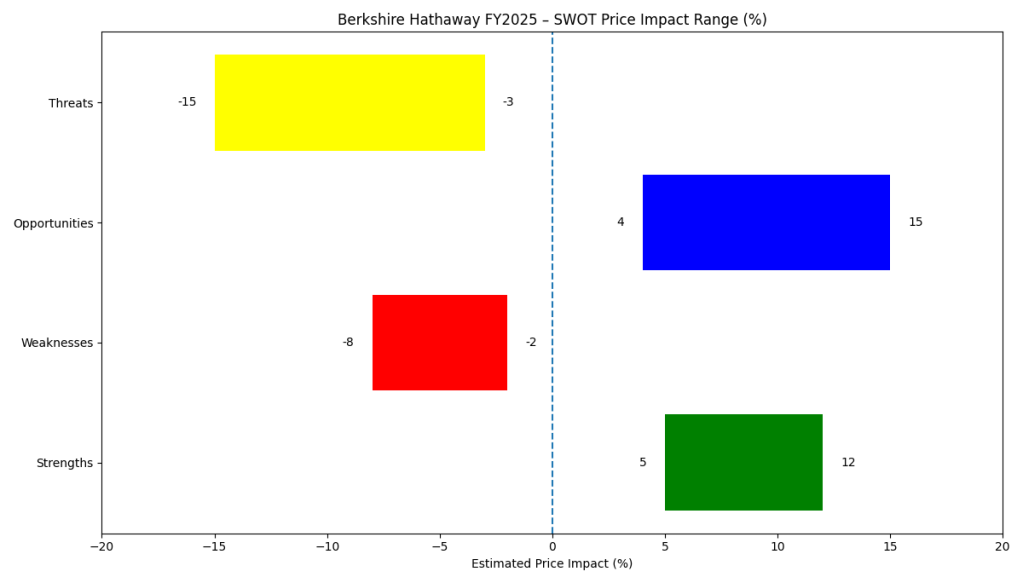
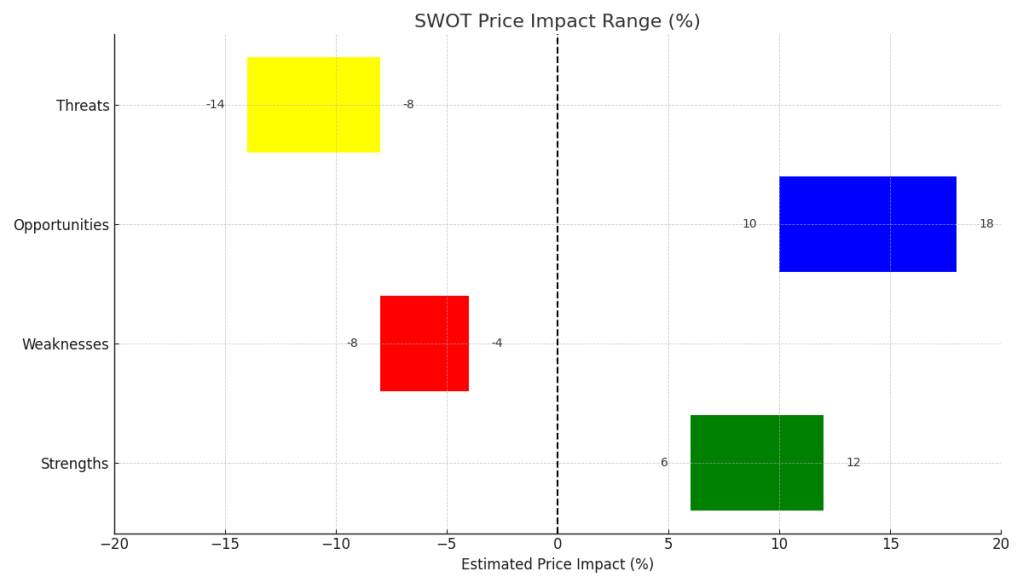
Strengths (+6% to +12%)

  • Record cash levels
  • Strong underwriting performance
  • Diversified, resilient businesses
  • Significant float growth

Weaknesses (–4% to –8%)

  • Sluggish revenue growth
  • No buybacks YTD
  • Heavy reliance on Apple

Opportunities (+8% to +15%)

  • Capital deployment potential
  • Treasury valuation upside
  • Insurance pricing cycle

Threats (–10% to –18%)

  • Succession transition
  • Market downturn exposure
  • Catastrophe risk
Berkshire Q3 2025 earnings SWOT analysis horizontal bar chart showing Strengths (+6 to +12%), Weaknesses (–8 to –4%), Opportunities (+10 to +18%), and Threats (–14 to –8%) with all labels outside the bars, a vertical dashed zero line, and x-axis from –20 to +20.

Valuation Scenarios (Bull / Base / Bear)

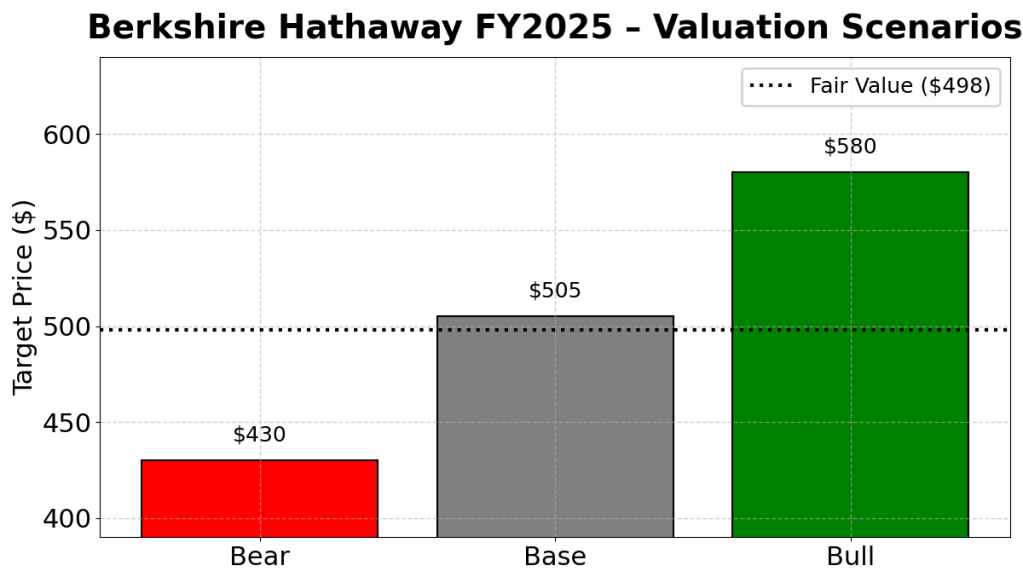
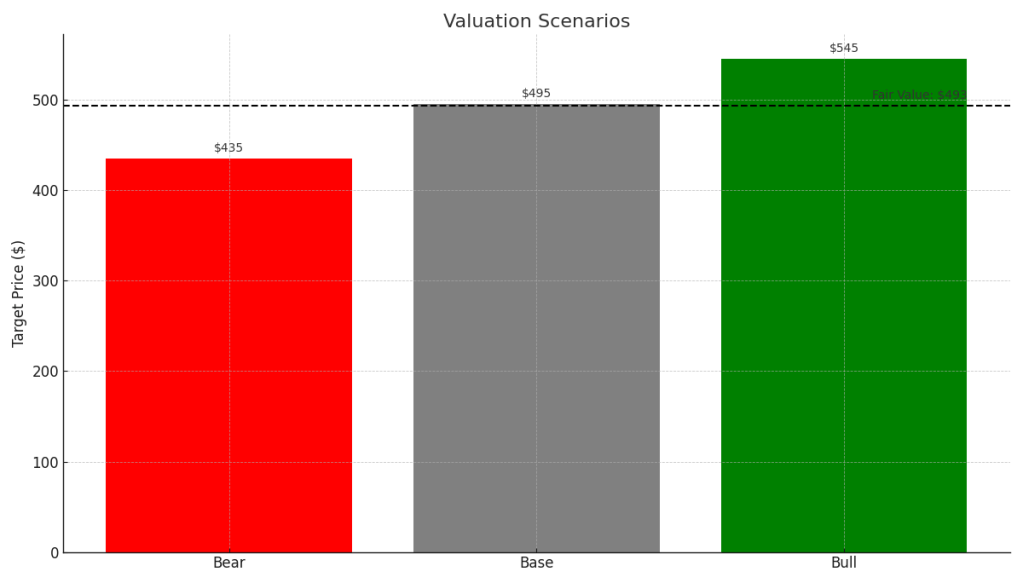
Bear Case — $435 (25%)

  • Uses mid-threat impact
  • No buybacks, leadership uncertainty
  • Market correction risk
    Fair value: $476 × (1 – 9%) ≈ $435

Base Case — $495 (50%)

  • Balanced strengths/weaknesses
  • Stable operating earnings
  • Treasury yield support
    Fair value: $476 × (1 + 4%) ≈ $495

Bull Case — $545 (25%)

  • Strong insurance profitability
  • Opportunistic capital deployment
  • Rate cuts boosting Treasury book
    Fair value: $476 × (1 + 14.5%) ≈ $545

Probability-Weighted Fair Value

= (0.25 × 435) + (0.50 × 495) + (0.25 × 545)
$493

Final Fair Value: $493

≈ 3.6% above current price → Fairly Valued

Valuation scenarios bar chart for Microsoft Q1 FY2026 showing Bear case at $435, Base case at $495, and Bull case at $545, with a dashed Fair Value line at $493 fully visible across the chart.

Verdict

Berkshire remains a fortress — high-quality, resilient, and disciplined. But with such a massive cash position and no buybacks, the market is waiting for a catalyst. Q3 shows strength, but until Berkshire deploys capital or signals undervaluation with buybacks, the stock likely stays range-bound.

For long-term value investors, Berkshire remains a low-risk compounder — but not yet a bargain.


Call to Action

If you found this analysis helpful, follow SWOTstock for more breakdowns of major earnings, fair-value scenarios, and investor-focused research. Share this post with another DIY value investor who follows Berkshire closely.


Disclaimer

This article is for informational and educational purposes only and is not investment advice. All analysis is based solely on Berkshire Hathaway’s official Q3 2025 financial report and management disclosures.


Berkshire’s Quiet Bet on Alphabet Reinforces the Value Case Behind the $100 B Quarter

Berkshire Hathaway revealed a US $4.3 billion investment in Alphabet Inc. during Q3 2025, buying approximately 17.8 million shares. This strategic move occurred as Alphabet achieved its first US $100 billion revenue quarter. Berkshire’s purchase reflects a value-focused approach amid a tech market rotation, emphasizing Alphabet’s solid fundamentals and growth potential.

Berkshire Hathaway has disclosed a new US $4.3 billion position in Alphabet Inc. (GOOGL), confirming that Warren Buffett’s conglomerate entered the stock during the third quarter of 2025 — the same period in which Alphabet reported its first-ever US $100 billion revenue quarter.

According to Berkshire’s latest 13-F filing, the company purchased roughly 17.8 million shares of Alphabet, making it one of Berkshire’s ten largest equity holdings. The move surprised market watchers who have long associated Berkshire’s tech exposure primarily with Apple, which the firm trimmed in the same quarter.


A Contrarian Entry at a Trillion-Dollar Scale

Berkshire’s timing stands out. Alphabet shares were trading around US $270 – 280 during Q3 2025 — only modestly above their estimated intrinsic value range. While other institutional investors were rotating out of mega-cap tech after two years of outperformance, Berkshire appears to have treated Alphabet as a value compounder rather than a momentum play.

For Buffett followers, the purchase echoes a familiar pattern: buying into a cash-rich franchise once its growth narrative collides with valuation discipline. Alphabet fits that mold neatly — a business generating more than US $80 billion in free cash flow annually, returning US $15 billion in quarterly buybacks, and maintaining over US $100 billion in cash reserves.


Fundamentals Back the Move

Alphabet’s Q3 2025 report, released October 29, underscored that growth and prudence can coexist in Big Tech.

  • Revenue: US $102.3 billion (+16 % YoY)
  • Operating Income: US $31.7 billion (+23 %)
  • EPS: US $2.87
  • Google Cloud: +34 % YoY, margin rising to 9 %
  • CapEx: Raised to US $91 – 93 billion for AI data-center expansion

CEO Sundar Pichai described the period as “a reflection of how AI is transforming every corner of our business,” while CFO Ruth Porat stressed “disciplined long-term investment.”

Those remarks align closely with Buffett’s own playbook — durable cash flow, reinvestment discipline, and capital allocation guided by intrinsic value rather than quarterly optics.


Reinforcing the “Still Underpriced” Thesis

Our prior SWOTstock analysis of Alphabet’s Q3 results placed fair value near US $284 per share, with the market trading just above that level post-earnings. Berkshire’s purchase suggests that even at these prices, long-term investors still see a margin of safety — particularly as Alphabet’s AI infrastructure spending begins to translate into productivity and monetization gains across Search, YouTube, and Cloud.

For value-oriented readers, the implication is clear: when Berkshire buys into a trillion-dollar tech name after a record quarter, it’s not chasing growth — it’s buying durability.


Market Reaction

The disclosure briefly lifted Alphabet shares in after-hours trading on Friday, as investors digested the significance of Berkshire’s first new mega-cap tech stake in years. Analysts now expect fresh comparisons between Alphabet’s AI capital discipline and Apple’s maturing growth profile, which Berkshire has been gradually reducing.

As of mid-November 2025, Alphabet trades around US $277, giving the stake a paper value near its initial cost — a rare instance where Buffett’s patience and Alphabet’s execution appear perfectly aligned.


Disclosure: This article is based on public filings and Alphabet’s official Q3 2025 financial results. It does not constitute investment advice.


Related Post

Berkshire Hathaway Q2 2025: Fortress Balance Sheet, Capital Inaction, and the Buffett‑to‑Abel Transition

Berkshire Hathaway’s Q2 2025 results show a cautious approach, with operating earnings of $11.16B down 4% YoY and a significant net income drop of 59% due to a Kraft Heinz writedown. Despite strong cash reserves of $344B, no buybacks occurred, raising investor concerns over capital deployment ahead of Buffett’s leadership transition to Greg Abel.

📌 TL;DR Summary:

Berkshire Hathaway reported Q2 2025 operating earnings of $11.16 B (–4% YoY) and a $3.8 B writedown on Kraft Heinz, dragging net income down 59%. Cash remains enormous at $344 B, but no buybacks were executed, leaving investors questioning capital deployment. Book value per share grew 6% YoY, but the stock trades near 1.45× book — above Buffett’s historical repurchase thresholds. For value investors, Berkshire remains a fortress‑like hold, but not an obvious bargain as the leadership transition to Greg Abel approaches.


🧾 Quarter Recap:

Berkshire Hathaway’s Q2 2025 earnings reflect disciplined caution with limited offensive moves.

  • Operating earnings: $11.16 B (–4% YoY).
  • Net income: $12.37 B (–59% YoY) due to a $3.8 B Kraft Heinz impairment.
  • Cash: $344 B, slightly down from Q1 but still near record highs.
  • Book value per share~$262, up 6% YoY and ~1% sequentially.
  • No share repurchases, for the second consecutive quarter.
  • Equity activity: Net seller of ~$3 B in stock.
  • Buffett’s discipline holds: As he wrote in the 2023 letter, “We only repurchase shares when we believe they are selling at a meaningful discount to intrinsic value.”

In Q1, we observed:

“Berkshire is signaling caution, not conviction — sitting on cash, avoiding buybacks, and waiting for real value to emerge.”

Q2 results confirm this stance — cash is stockpiled, but deployment remains elusive.


📌 Key Highlights:

  • BNSF Railway: Operating profit up ~19% to $1.47 B on freight volume growth.
  • Geico: Underwriting profit ~$1.8 B, with ~16.5% margin.
  • Insurance (reinsurance & P/C): Underwriting income declined 12%, with P&C reinsurance premiums down ~10%. Float rose to ~$174 B.
  • Consumer goods: Revenue fell ~5%, impacted by tariffs and slowing demand for brands like Fruit of the Loom.
  • FX losses: ~$877 M, pressuring underwriting results.
Line chart showing Berkshire Hathaway’s revenue and net income over the last five quarters: revenue remains relatively stable between $92B and $97B, while net income declines from about $30B in Q2 2024 to $12.37B in Q2 2025.

📈 Book Value & Valuation Context:

  • Book value per share: ~$262, up 6% YoY.
  • Price-to-book: ~1.45×, slightly below the 10‑year average of 1.5×.
  • Historical buyback threshold: Buffett previously authorized buybacks when shares traded under 1.2× book. At current levels (~1.45×), Berkshire remains above that range, which explains the lack of repurchases.

Value investor insight: Berkshire’s market price suggests it’s fully valued by Buffett’s own conservative yardstick.


🧠 SWOT Analysis with Price Impact Estimates:

Strengths (+$15 – $25/share)

  • Fortress balance sheet: $344 B in cash and $174 B in insurance float.
  • Operational resilience: BNSF and Geico continue to deliver.
  • Diversified revenue streams: Core industrials and energy shield against sector shocks.

Weaknesses (–$10 – $20/share)

  • Kraft Heinz writedown exposes underperforming legacy investments.
  • No share buybacks, signaling management sees limited margin of safety at current levels.
  • Underwriting softness and FX headwinds pressure insurance results.

Opportunities (+$10 – $20/share)

  • Capital deployment: $344 B cash can be deployed for opportunistic M&A or buybacks if valuations fall.
  • Rail consolidation: BNSF may benefit from strategic M&A moves in the sector.
  • Insurance cycle hardening: Potential for improved pricing in future quarters.

Threats (–$10 – $15/share)

  • Leadership transition: Buffett‑to‑Abel handoff raises uncertainty about future capital allocation.
  • Macro risks: Tariffs and FX volatility weigh on consumer and manufacturing units.
  • Equity portfolio volatility: GAAP fair‑value swings distort net income.

📊 SWOT Summary Table

SWOT summary table for Berkshire Hathaway Q2 2025 showing strengths, weaknesses, opportunities, and threats with estimated price impacts
Horizontal bar chart showing Berkshire Hathaway Q2 2025 SWOT price impact: Threats at approximately –12.5, Opportunities at +15, Weaknesses at –15, and Strengths at +20, with a vertical dashed line at zero.

💸 Valuation Scenarios:

We apply sum‑of‑parts (subsidiary cash flows + equity portfolio) and P/B benchmarking:

Valuation scenarios table for Berkshire Hathaway Q2 2025 showing bull, base, and bear cases with assumptions and implied BRK.B share prices

Probability‑Weighted Fair Value = (0.25 × 435) + (0.5 × 380) + (0.25 × 320) = $378.75/share.

Vertical bar chart showing Berkshire Hathaway Q2 2025 valuation scenarios: Bear case at $320, Base case at $380, and Bull case at $435, with a horizontal dashed line indicating the probability-weighted fair value of approximately $378.75.

📊 Peer Comparison Insight:


Berkshire Hathaway’s P/B ratio of 1.45 positions it above Markel (1.2) but far below the S&P 500 average of 4.2, reinforcing its standing as a value‑oriented conglomerate rather than a growth‑priced index constituent. Its ROE of 10% trails the S&P 500’s 14%, reflecting Berkshire’s conservative leverage and capital deployment posture, yet it still outpaces Markel’s 8%. The YTD return of 4% lags the S&P 500’s 6%, highlighting market skepticism about near‑term catalysts amid Buffett’s upcoming transition and limited capital actions. For DIY value investors, this underscores Berkshire’s role as a steady compounding hold rather than a momentum‑driven outperformer.

Horizontal bar chart comparing Berkshire Hathaway, Markel, and the S&P 500 in Q2 2025: Berkshire shows a P/B ratio of 1.45, ROE of 10%, and YTD return of 4%; Markel shows a P/B ratio of 1.2, ROE of 8%, and YTD return of 6%; S&P 500 shows a P/B ratio of 4.2, ROE of 14%, and YTD return of 6%.

🔑 Catalysts for Re‑rating and Market Reaction

Berkshire’s stock continues to trade like the fortress it is — steady but unspectacular — with a year‑to‑date gain of about 4%, trailing the S&P 500’s roughly 6% advance. The muted market response to Q2 earnings suggests that investors see the quarter as “business as usual”: strong balance sheet, reliable operating results, but little in the way of near‑term excitement. For the stock to re‑rate higher, investors are watching for clearer capital deployment signals — whether that’s buybacks at higher price‑to‑book levels, opportunistic large‑scale acquisitions, or a more aggressive investment approach under Greg Abel’s leadership once the Buffett transition is complete. A significant market downturn, which would give Berkshire the chance to deploy its $344 B cash pile into undervalued opportunities, also remains a potential catalyst for a re‑rating. Until then, the shares are likely to trade within a range that reflects their defensive compounding profile rather than breakout growth.


🧠 Verdict:

For value investors, Berkshire remains a defensive cornerstone: diversified, cash‑rich, and well‑positioned for opportunistic moves. But at ~1.45× book, shares are not trading at a margin of safety by Buffett’s standards. Until buybacks resume, M&A materializes, or valuations reset lower, this is a hold for long‑term compounding — not a bargain entry point.


📣 Call to Action:

Stay ahead of Berkshire’s next moves — from buybacks to the post‑Buffett era.
Subscribe to SWOTstock for deep‑dive analyses that cut through the headlines.


⚠️ Disclaimer:

This analysis is based solely on Berkshire Hathaway’s Q2 2025 public filings (Form 10‑Q, earnings release). It does not constitute financial advice. Perform your own due diligence or consult a licensed advisor before making investment decisions.


Leave a comment