🏦 JPMorgan Q2 2025 Earnings — A Value Anchor in a Rate-Driven Storm

PMorgan’s Q2 2025 earnings beat expectations with 21% ROTCE, strong trading revenue, and raised NII guidance. Read our full SWOT analysis, fair value breakdown, and how JPM compares to Citi and Wells Fargo.

📌 TL;DR

JPMorgan (NYSE: JPM) delivered a strong Q2 with a solid earnings beat and raised full-year guidance, returning $11B to shareholders. While the stock barely moved, long-term value remains intact. DIY investors should watch for dips below $285.


📆 Q2 2025 Recap — Earnings Beat, Capital Strength

JPMorgan’s Q2 2025 performance was a masterclass in disciplined execution. The bank delivered an 11% EPS beat, maintained a stellar 21% ROTCE, and raised its full-year NII guidance—despite a revenue drop tied to tough comps from the prior year. Business segments like investment banking and trading outperformed, while capital return to shareholders remained robust with $11B distributed in just one quarter. This level of consistency and balance is exactly what long-term value investors look for.

Earnings highlights (July 15 release):

  • 🧾 EPS: $4.96 (vs $4.48 est), +11% beat
  • 💰 Net income: $15.0B (or $14.2B excl. tax benefit)
  • 📉 Revenue: $45.7B, down 10% YoY (due to Visa gain comp)
  • 💸 Capital Return: $3.9B in dividends + $7.1B in buybacks
  • 📈 ROTCE: 21% (20% adjusted)

Corporate & Investment Bank (CIB):

  • Net income: $6.7B, +13% YoY
  • Dealmaking fees: $2.5B, +7% YoY
  • Markets revenue: +15%, led by fixed income

📊 FY NII guidance raised: $95.5B (previously ~$94B)

Line chart showing JPMorgan's revenue and net income over the past five quarters from Q2 2024 to Q2 2025, highlighting strong Q2 2025 earnings performance.

📉 Market Reaction — Earnings Beat, Flat Price

JPM closed at $286.55, down ~0.3% on earnings day.

Despite delivering an impressive earnings beat and raising its full-year NII guidance, JPMorgan’s stock barely budged—closing the day slightly lower. The muted reaction puzzled many, but it likely reflects broader market caution rather than company-specific weakness. Investors may be focusing on rising expense trends, margin pressure from anticipated rate cuts, or simply digesting mixed signals from the banking sector as a whole. In other words, the fundamentals impressed—but sentiment lagged behind. For long-term investors, that disconnect may represent an opportunity.

  • YoY revenue drop from one-offs
  • Core expenses rising 5% YoY
  • Margin pressure from rate cuts

🧠 Jamie Dimon cautioned on “geopolitical instability, unsustainable fiscal deficits, and central bank pressure.”


🧠 SWOT Analysis with Price Ranges

To make sense of JPMorgan’s positioning, we broke down the quarter using our dollar-anchored SWOT framework. This isn’t just a list of talking points—it’s a tool to map potential price impacts. Strengths like high ROTCE and capital discipline support the upside, while expense growth and macro risk could pull against it. The result? A snapshot of both opportunity and risk that’s grounded in the fundamentals, not speculation.
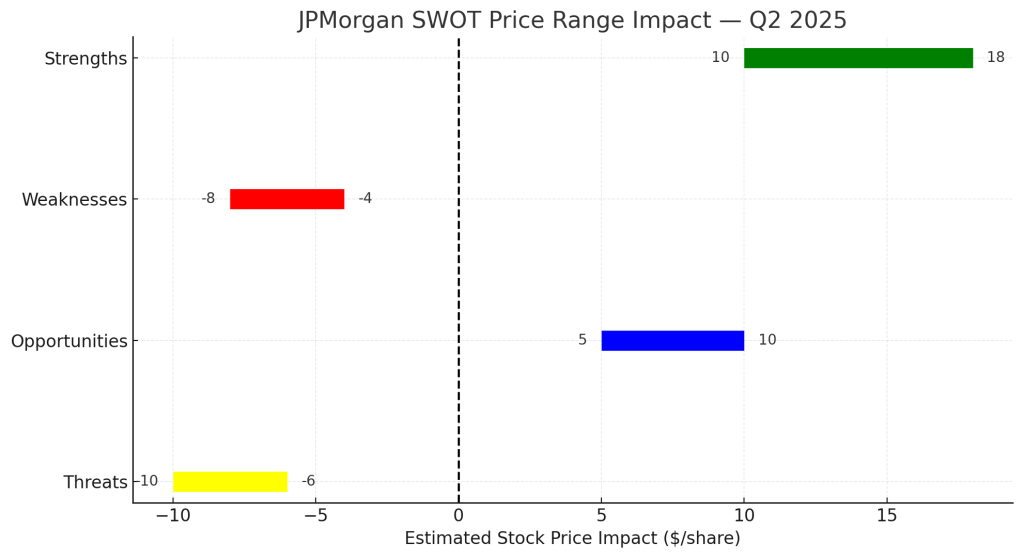
Horizontal bar chart showing JPMorgan's SWOT analysis with estimated stock price impact ranges for Q2 2025. Strengths and Opportunities show upside potential, while Weaknesses and Threats show downside risks.
SWOT table summarizing JPMorgan's strengths, weaknesses, opportunities, and threats for Q2 2025, with estimated stock price impact ranges for each factor.

📊 Valuation Scenarios

JPMorgan’s current share price sits just below our estimated fair value—but the path ahead depends on how macro and internal drivers unfold. In our model, we outline three scenarios: a bull case driven by continued earnings strength and compounding tech investments; a base case reflecting stable profitability; and a bear case factoring in rate compression and regulatory drag. We assign probabilities to each and arrive at a weighted fair value—offering a disciplined way to anchor expectations.

Vertical bar chart showing JPMorgan's bull, base, bear case target prices and current stock price for Q2 2025, with a dotted line indicating the fair value estimate.
Table showing JPMorgan’s Q2 2025 bull, base, and bear case price targets with associated probabilities and a calculated fair value estimate.

🔍 JPM vs Peers (Q2 2025 Snapshot)

What sets JPMorgan apart isn’t just the size of its balance sheet—but how efficiently it runs. Compared to Citi and Wells Fargo this quarter, JPM led in ROTCE, delivered solid beats, and even raised guidance. Meanwhile, peers either maintained or cut forecasts. The market’s muted response to JPM’s beat may have more to do with sector fatigue than actual fundamentals. The data tells a clearer story.

Comparison table of JPMorgan, Citigroup, and Wells Fargo showing Q2 2025 metrics including ROTCE, EPS surprise, NII guidance direction, and stock price reaction.

→ JPM’s valuation remains more attractive vs peers with stronger capital efficiency.


✅ Verdict — Value with a Margin of Safety

For value-focused investors, JPMorgan continues to check the boxes: high ROTCE, strong dividend yield, and durable earnings. The muted stock reaction creates an opening—not for hype-driven gains, but for steady compounding. With shares trading just below our fair value estimate, the risk-reward profile remains favorable. If your investing playbook includes buying quality on dips, JPM still earns a spot near the top of the list.

  • Strong ROTCE and stable capital return
  • Resilient fee-based businesses (trading, IB, payments)
  • Undervalued at current price with room for compounding

Buy range: Below $285
Fair value: $290–$295
Dividend yield: ~2.0%
5-Year Dividend CAGR: ~8.6%


📣 Why Subscribe to SWOTstock?

If you found this analysis useful, don’t just bookmark it—subscribe. At SWOTstock, we break down every major earnings report using only official numbers, structured insights, and investor-first language. No hype, no jargon. Just clear, actionable takeaways built for long-term thinkers. Whether you’re tracking your portfolio or building conviction, you’ll get the clarity you need—right when it matters most.


📬 Official-sourced only.
📉 No hype. Just facts.
📈 Fair value + SWOT + Visuals in every post.

👉 Subscribe now and get value investor reports delivered weekly.


⚠️ Disclaimer

This content is provided for informational and educational purposes only and does not constitute investment advice, a recommendation, or an offer to buy or sell any securities. All analysis is based solely on publicly available financial reports and official company statements. Always conduct your own research or consult with a licensed financial advisor before making investment decisions. The authors of this post may hold positions in the companies mentioned.


Leave a comment


Cisco Q3 FY2025: Dividend Still Solid, Value Emerging — But Is the Splunk Deal a Risk or Reward?

Cisco reported strong Q3 FY2025 results with revenue of $14.15 billion and an EPS of $0.96, beating expectations. The Splunk acquisition offers growth opportunities despite integration risks. The stock is fairly valued at ~$61, providing a 2.6% dividend yield, making it appealing for long-term investors, despite macroeconomic and competitive threats.

Key Takeaways for Income & Value Investors

Cisco (NASDAQ: CSCO) delivered a strong Q3 FY2025, beating expectations and reaffirming its role as a dividend staple. The completed Splunk acquisition adds risk—but also opportunity in cybersecurity and observability. At ~$61, the stock appears fairly valued, with solid yield, modest upside, and limited downside—making it attractive for long-term dividend investors.


Cisco Q3 2025 Earnings Summary

  • Revenue: $14.15 billion (+11% YoY)
  • Non-GAAP EPS: $0.96 (vs. $0.92 guidance)
  • GAAP EPS: $0.62
  • Operating cash flow: $5.2 billion
  • Dividend paid: $1.6 billion
  • Share repurchases: $1.5 billion
  • Free cash flow payout ratio: ~61%
  • Forward dividend yield: ~2.6%
  • Free cash flow yield: ~6.8% (on trailing FCF of ~$15B)
ine chart showing Cisco’s revenue growth and non-GAAP EPS trends over the last five quarters, highlighting consistent financial performance through Q3 FY2025.

Key Highlights This Quarter

  • AI Orders Surge: $600M+ in Q3, exceeding $1B fiscal YTD
  • Capital Return: $3.1B to shareholders (buybacks + dividends)
  • Splunk Acquisition: $28B deal now closed, expanding security + analytics
  • FY2025 Guidance Raised: Modest bump in revenue and earnings outlook
  • CFO Change: Mark Patterson to succeed Scott Herren in July

SWOT Analysis (Based on Cisco’s Official Earnings Report & Call)

Strengths

Cisco remains a cash flow powerhouse with predictable returns. It beat guidance, raised full-year forecasts, and maintained a consistent capital return policy. AI orders and secure networking sales accelerated.

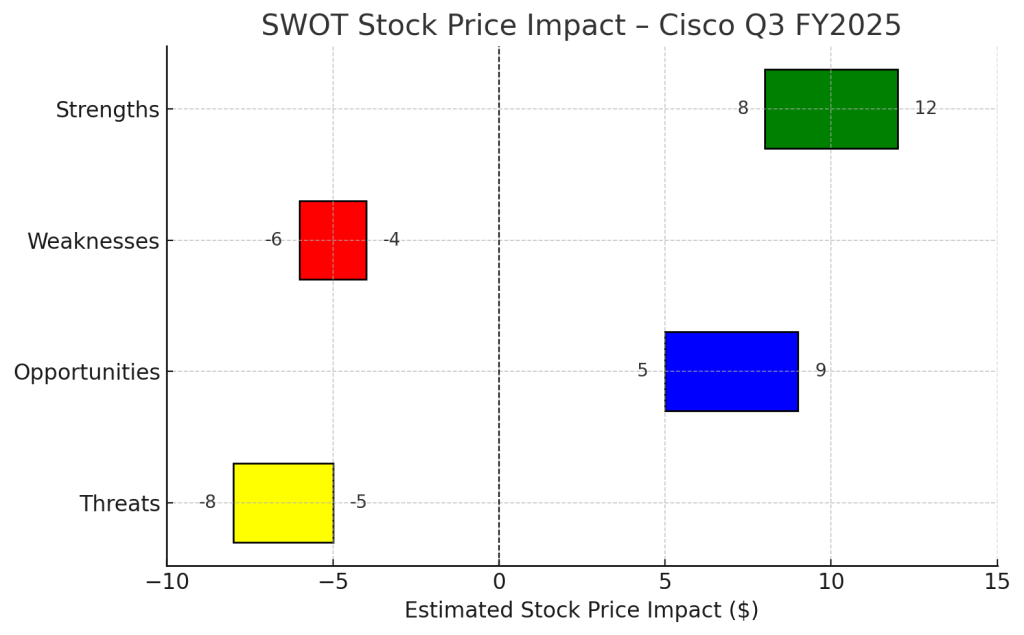
Estimated Stock Price Impact: +$8 to +$12

Weaknesses

The security portfolio underperformed, and the integration of Splunk introduces both cultural and execution risks. These could delay synergy realization or weigh on margins short-term.

Estimated Stock Price Impact: –$4 to –$6

Opportunities

Cisco’s software transition, fueled by Splunk, gives it greater recurring revenue potential. Emerging bets like quantum computing and AI-integrated infrastructure add long-term optionality.

Estimated Stock Price Impact: +$5 to +9

Threats

Enterprise IT spending remains vulnerable to macro pressures. Cisco also faces intense competition from hyperscalers and specialized security firms. The CFO transition may cause short-term strategic jitters.

Estimated Stock Price Impact: –$5 to –$8


SWOT Summary Table

SWOT CategoryKey DriverEst. Stock Price Impact
StrengthsEarnings beat, AI orders, dividend reliability+8 to +12
OpportunitiesSoftware shift, Splunk synergy, R&D expansion+5 to +9
WeaknessesSecurity miss, integration risk–4 to –6
ThreatsMacro exposure, competition, leadership change–5 to –8

Horizontal bar chart illustrating Cisco’s estimated stock price impact by SWOT category—Strengths, Weaknesses, Opportunities, and Threats—with clearly labeled ranges.

Cisco Stock Valuation Scenarios Based on FY2025 Guidance

ScenarioEPS (FY25E)P/E MultiplePrice TargetProbabilityWeighted Value
Base Case$3.7816x$60.4860%$36.29
Bull Case$3.9018x$70.2025%$17.55
Bear Case$3.6014x$50.4015%$7.56

Probability-Weighted Fair Value: ≈ $61.40
Current Price: $61.29


Dividend & Value Snapshot

FactorSWOTstock Assessment
Dividend Yield~2.6%, well-covered by FCF
Free Cash Flow TrendStrong ($5.2B this quarter)
Dividend Growth HistoryConsistent increases since 2011
Valuation vs. PeersCompetitive vs. IBM, Juniper, and Broadcom
Short-Term UpsideModerate if Splunk execution improves
Downside RiskLimited barring macro deterioration

Peer Comparison Snapshot

CompanyYieldP/E (fwd)Dividend GrowthBalance Sheet Strength
Cisco2.6%~16xConsistentVery Strong
IBM3.4%~15xModestModerate
Juniper2.9%~14xFlatModerate

Entry Strategy – Optional Price Zones

  • Buy Below $58: More favorable value with >3% yield
  • Hold Near $61: Fair value supported by FCF and guidance
  • Trim Above $65: Price may run ahead of fundamentals without improved security results

Verdict

At $61.29, Cisco is fairly valued. It offers:

  • A sustainable 2.6% dividend backed by robust FCF
  • Upside potential tied to AI, Splunk, and enterprise cloud adoption
  • Low downside risk for investors seeking capital preservation and steady income

This isn’t a deep value pick—but it’s a solid hold or add-on-dips candidate for dividend-focused portfolios.


Subscribe for No-Jargon, Real-Earnings Analysis

Get breakdowns tailored to real investors—no jargon, no hype.
Follow @SWOTstock or subscribe to our blog for structured, honest takes on earnings.


Disclaimer

This is not investment advice. All analysis is based solely on Cisco’s official financial report and earnings call transcript. Always do your own due diligence.


Leave a comment

Leave a comment


Occidental Petroleum Q1 2025 Earnings: Cash Flow Strength Meets Geopolitical Uncertainty

Occidental Petroleum’s Q1 2025 results show strong cash flow, rising production, and a dividend hike—but geopolitical risks and oil price volatility remain. This detailed analysis breaks down key highlights, SWOT insights, valuation scenarios, and whether OXY stock is undervalued. Perfect for investors seeking data-driven clarity.


Summary: Occidental Petroleum Q1 2025 Earnings at a Glance


Occidental Petroleum (NYSE: OXY) posted strong Q1 2025 results with $1.2B in free cash flow and a 9% dividend hike. Operational efficiency and debt repayment continue to strengthen the balance sheet. However, risks from geopolitical tensions, commodity price swings, and trade-related costs are rising. The stock appears slightly undervalued, but uncertainty clouds the upside.


Quarter Recap: Occidental’s Operational Muscle

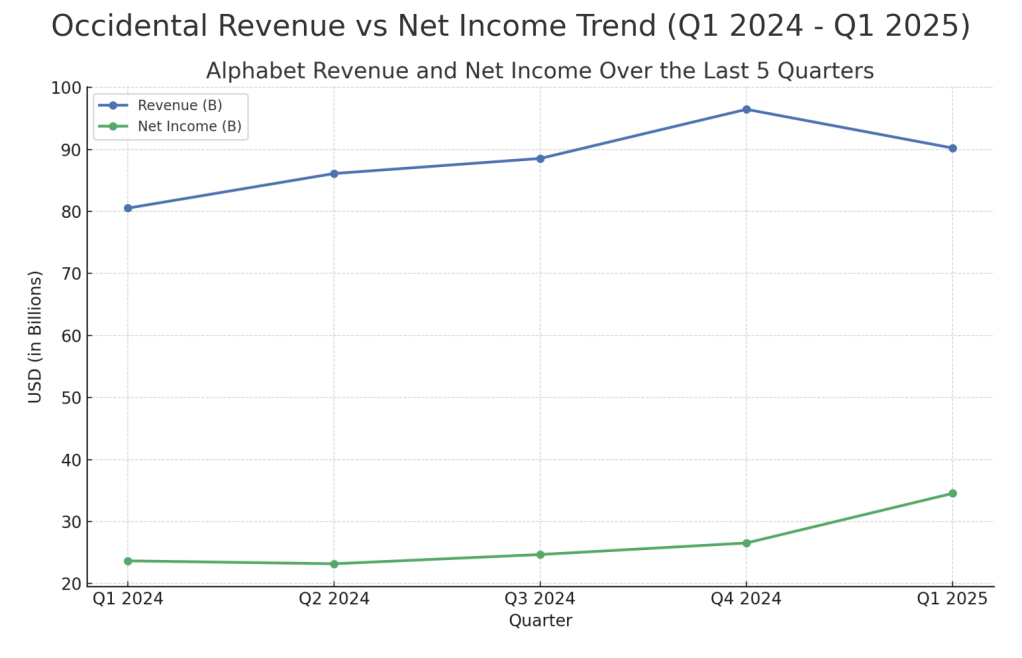
OXY reported Q1 2025 revenue of $6.84 billion and net income of $766 million. Adjusted EPS came in at $0.87, beating expectations. Production reached 1.391 million barrels of oil equivalent per day—up 19% year over year—driven by strong output from the Permian Basin.

Management struck a confident tone, emphasizing capital discipline, progress on carbon capture, and continued debt reduction. $2.3B in debt was repaid YTD, with free cash flow before working capital totaling $1.2B. Still, volatility in oil markets and uncertainty in global politics weighed on the call.


Occidental’s Key Financial Highlights

  • Revenue: $6.84B (+YoY, beat estimates)
  • Net income: $766M
  • Adjusted EPS: $0.87 (beat by $0.10)
  • Free Cash Flow: $1.2B (pre-WC)
  • Production: 1.391 Mboe/d (+19% YoY)
  • Debt Reduction: $2.3B paid YTD
  • Dividend: Raised 9% to $0.24/share
Line chart showing Occidental Petroleum’s revenue and net income growth over the last five quarters, highlighting strong cash generation in Q1 2025.

Strategic Context: How OXY Stacks Up

OXY’s earnings outperform many mid-cap peers and rival some larger producers in terms of cash efficiency. When compared to Chevron and ExxonMobil, Occidental maintains a leaner capital structure and more aggressive debt paydown. Additionally, its stake in Direct Air Capture (DAC) positions it as a forward-leaning ESG player.


SWOT Analysis: Occidental Petroleum Q1 2025

Let’s break it down using the SWOT framework—what’s working, what’s not, where the upside is, and what risks could derail the stock.

Strengths

  • Strong free cash flow ($1.2B) and operating cash flow ($3.0B pre-WC)
  • Production up 19% YoY
  • $2.3B in YTD debt reduction
  • Dividend hike of 9% reflects confidence
    Stock Impact Estimate: +$3 to +$5/share

Weaknesses

  • Midstream segment loss ($77M, mainly derivatives)
  • Margin pressure in OxyChem from lower PVC and caustic soda prices
    Impact Estimate: -$1 to -$2/share

Opportunities

  • Oman Block 53 extension (+800M BOE potential)
  • Permian drilling efficiency: 17% faster, 18% lower cost per well
  • Carbon Capture growth (DAC and CO2-EOR initiatives)
    Impact Estimate: +$4 to +$7/share

Threats

  • Oil price volatility
  • Tariffs, carbon regulations, and U.S.-China trade tension
  • Geopolitical risks (e.g., Russia–Ukraine conflict)
    Impact Estimate: -$4 to -$7/share

SWOT Summary Table

ElementDriversEst. Stock Impact
StrengthsFCF growth, debt paydown, dividend increase+3 to +5
WeaknessesMidstream losses, OxyChem margin pressure-1 to -2
OpportunitiesOman reserves, Permian efficiency, Carbon Capture+4 to +7
ThreatsOil price risk, geopolitics, carbon tariffs-4 to -7
    Horizontal bar chart displaying estimated stock price impact ranges for Occidental Petroleum’s strengths, weaknesses, opportunities, and threats.

Valuation Scenarios Based on Q1 2025 Outlook

ScenarioSummaryPrice TargetProbability
Bull CaseOil >$85, Oman extension secured, carbon tech monetized$5017.7%
Base CaseStable oil, solid production, modest growth$4462.1%
Bear CaseOil < $70, geopolitics worsen, OxyChem softens$3620.2%

Probability-weighted Fair Value: $43.45/share
Current Price: $41.44/share

Vertical bar chart comparing Occidental Petroleum’s bear, base, and bull stock valuation scenarios for Q1 2025.

Verdict: Slightly Undervalued, But Watch the Headlines

OXY continues to generate strong financial results and is aggressively improving its balance sheet. But as macro uncertainty rises, the margin of safety narrows. For long-term investors, the upside case is intact—yet near-term volatility should not be ignored.


Subscribe for More

Want weekly stock breakdowns like this one—with no jargon, just insight? Follow and subscribe to SWOTstock.


Disclaimer

This blog is based solely on Occidental Petroleum’s official Q1 2025 earnings report and call transcript. It does not constitute financial advice. Please do your own research before making any investment decisions.


Leave a comment