Morgan Stanley Q2 2025: Trading Strength Offsets IB Weakness, But Market Stays Cautious

Morgan Stanley reported strong Q2 2025 results, with $16.8B revenue and $2.13 EPS, surpassing expectations. Wealth Management added $59B in assets, while trading revenues increased. Despite a 5% drop in investment banking fees, the firm raised its dividend and initiated a $20B buyback, reflecting ongoing shareholder commitment. Shares fell post-announcement amid market caution.

TL;DR Summary

Morgan Stanley delivered a strong Q2 2025, with $16.8 B revenue and EPS of $2.13, both above expectations. Wealth Management inflows of $59 B and robust trading performance offset a 5% decline in investment banking fees. The firm also raised its dividend to $1.00/share (yielding ~2.8%) and approved a $20 B share buyback, underscoring its commitment to returning capital. Despite these positives, shares slipped ~1–2% post‑earnings, reflecting cautious sentiment around capital markets headwinds. Our fair value estimate remains ~$144, near current levels, with upside tied to a revival in dealmaking and continued strength in Wealth Management.


Quarter Recap

Morgan Stanley reported net revenues of $16.8 B, up 12% YoY, and EPS of $2.13, beating consensus by 7.6%. ROTCE reached 18.2%, reaffirming the firm’s profitability strength.

Wealth Management added $59 B in net new assets, partially offset by $22 B in tax-related outflows. Trading was a bright spot: equities revenue came in at ~$3.7 B (+23% YoY) and fixed income at ~$2.2 B (+9%). These gains helped offset investment banking fees, which fell ~5% YoY and remain below pre‑2022 levels.

Capital returns were a highlight: the board approved a quarterly dividend increase to $1.00/share (yielding ~2.8% at current prices) and a $20 B share repurchase program, beginning in Q3 2025.


Key Highlights

  • Revenue: $16.8 B (+12% YoY)
  • EPS: $2.13 (+7.6% above consensus)
  • ROTCE: 18.2%
  • Wealth Management: $59 B net new assets, offset by $22 B in tax outflows
  • Trading: Equities $3.7 B (+23%); Fixed income $2.2 B (+9%)
  • Investment Banking: Down ~5% YoY; still lagging pre‑2022 levels
  • Capital Returns: Dividend raised to $1.00/share (~2.8% yield)$20 B buyback approved
Line chart showing Morgan Stanley’s revenue and net income over the past five quarters, highlighting growth in Q2 2025.

Peer Comparison

Morgan Stanley’s steady, wealth-led approach continues to differentiate it. But when comparing to peers, Goldman Sachs grew investment banking revenue ~26% YoY, while Morgan Stanley saw a 5% decline. JPMorgan also outpaced MS in advisory and underwriting activity. This highlights a strategic trade‑off: Morgan Stanley prioritizes stable Wealth Management growth, sacrificing some upside in deal-driven businesses.

Bar chart comparing Morgan Stanley, Goldman Sachs, and JPMorgan for Q2 2025: Investment banking revenue change (%, orange bars) and wealth management inflows ($B, teal bars).

SWOT Analysis

Morgan Stanley’s Q2 shows why the market reacted cautiously: the firm delivered solid results, but investors remain concerned about weaker capital markets revenue and near-term growth visibility.

Strengths (+$4 to +$8):

  • Wealth inflows: $59 B new assets despite tax-related outflows
  • Trading strength: Equities +23%, Fixed Income +9% YoY
  • Capital returns: Dividend raised to $1/share (~2.8% yield) and $20 B buyback
  • Strong profitability: ROTCE at 18.2%, EPS beat of 7.6%

Weaknesses (−$3 to −$6):

  • Investment banking lag: −5% YoY vs Goldman’s +26%
  • Expense growth: Costs rising faster than some revenue lines
  • Client outflows: Tax outflows muted net inflow impact

Opportunities (+$3 to +$7):

  • Cross-selling E*TRADE clients within Wealth Management
  • Tech and AI investments to enhance operating leverage
  • Rebound in IPO/M&A could significantly lift investment banking revenues

Threats (−$4 to −$7):

  • Macro risks: Slowing economy could cut dealmaking & trading volumes
  • Regulatory pressures: Higher capital requirements could restrict buybacks
  • Competitive fee pressure: Margin erosion in Wealth Management & brokerage

Net SWOT price impact: −$7 to +$8 (implying short-term trading range between ~$136 and $151).


SWOT Table
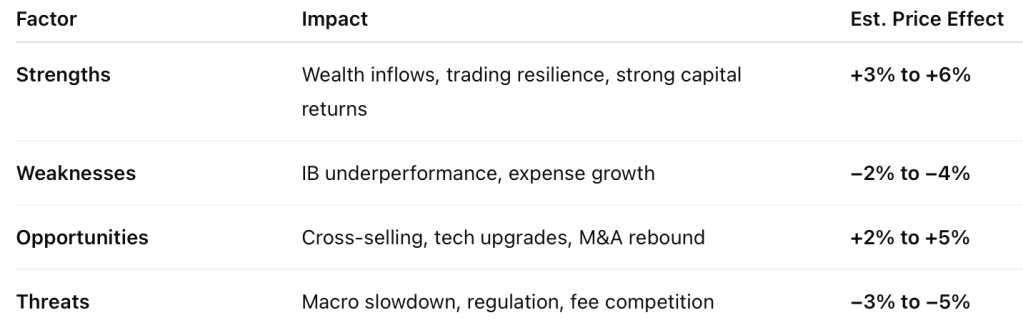
Morgan Stanley Q2 2025 SWOT analysis table showing strengths, weaknesses, opportunities, and threats with estimated stock price impact ranges.
Horizontal bar chart showing Morgan Stanley Q2 2025 SWOT price impact ranges with consistent label spacing and X-axis starting at -6%.

Valuation Scenarios

Current price: ~$143.56

  • Bull Case (30%):
    IB revenue rebounds +5%, WM inflows >$50 B/quarter, ROTCE >18%.
    Target: $162
  • Base Case (50%):
    Stable WM inflows, trading moderates, IB remains sluggish.
    Target: $144
  • Bear Case (20%):
    WM growth slows, trading revenue drops, regulatory capital costs rise.
    Target: $121

Probability‑weighted fair value:(0.3 × 162) + (0.5 × 144) + (0.2 × 121) = **$144.3**

Fair value: ~$144
Assessment: Fairly valued. Any upside depends on an M&A/IPO rebound and sustained asset growth in Wealth Management.

Bar chart showing Morgan Stanley Q2 2025 valuation scenarios: Bear case at $121, Base case at $144, Bull case at $162, with a dotted line indicating fair value at $144.3.

12‑Month Outlook

Looking ahead, Morgan Stanley’s fortunes will hinge on:

  • Capital markets recovery: IPO/M&A activity improving in 2026 could reaccelerate IB revenue.
  • Sustained Wealth inflows: Maintaining $50 B+/quarter will support fee growth and capital returns.
  • Regulatory clarity: New capital requirements could affect buyback pace.

Verdict

Morgan Stanley remains a defensive, shareholder-friendly play, with stable wealth-led earnings and enhanced capital returns. While near-term upside is capped by muted deal activity, long-term investors benefit from solid dividends, repurchases, and consistent profitability.


Call to Action

Are you bullish on Morgan Stanley’s wealth-first strategy? Drop your thoughts below, and subscribe for more SWOT-driven earnings breakdowns to help you invest smarter.


Disclaimer

This analysis is based solely on Morgan Stanley’s official Q2 2025 financial report and earnings call transcript. It is for informational purposes only and is not investment advice.

Leave a comment


Goldman Sachs and Morgan Stanley: A High-Stakes Earnings Season for Wall Street’s Finest

Preview the upcoming Q2 2025 earnings for Goldman Sachs and Morgan Stanley. Explore key themes, strategic differences, and what investors should watch as Wall Street’s top banks report.

TL;DR – Two Different Engines, One Market Test

As Goldman Sachs and Morgan Stanley prepare to report their second-quarter results, investors are watching closely to see how two of Wall Street’s most iconic firms are navigating a shifting macro environment. While Morgan Stanley has leaned into wealth management as its long-term growth pillar, Goldman continues to reposition itself after a retreat from consumer banking and a volatile stretch in investment banking. The upcoming earnings will offer a fresh look at which model is winning in 2025—and whether either name is undervalued relative to its forward potential.


Q1 Recap: Strategic Divergence on Full Display

In the first quarter of 2025, the divergence in strategy between these two institutions became increasingly evident. Goldman Sachs delivered better-than-expected results, driven largely by strength in its global markets division—particularly fixed income and commodities trading. While investment banking revenues remained muted, the firm’s Asset and Wealth Management segment showed encouraging growth, quietly contributing to earnings stability amid broader volatility.

Morgan Stanley, in contrast, leaned into its now-dominant wealth management franchise, which continues to anchor its earnings with more predictable, fee-based income. Trading revenues were healthy, though less volatile than Goldman’s, and investment banking activity remained sluggish. The integration of E*TRADE and Eaton Vance appears to be progressing, but margins continue to be scrutinized by analysts who want to see more operating leverage.

Both stocks have tracked broader market gains this year, aided by rising investor sentiment and increased risk appetite. However, the strong run-up in equity markets sets a higher bar for Q2 performance—and makes any shortfall more likely to trigger a valuation reset.


Q2 2025 Preview: Key Themes to Watch

📈 1. Investment Banking Activity and the M&A Pipeline

The long-awaited recovery in deal activity has been uneven, but early signs point to a modest thaw in M&A and equity underwriting markets. Investors will want to see whether either bank is capturing greater wallet share as clients cautiously return to the table. Goldman, with its deep advisory bench, may be positioned to benefit from any early rebound.

💼 2. Wealth Management Profitability and Scale

Morgan Stanley’s wealth business, now a cornerstone of its strategy, remains in focus—particularly operating margins and net new assets. Investors will look for signs that scale advantages from prior acquisitions are beginning to deliver incremental earnings leverage. Conversely, any slip in cost discipline or fee compression could raise concerns about future growth.

📊 3. Trading Performance and Market Volatility

With macro volatility subsiding somewhat in Q2, trading desks may face tougher year-over-year comps. Goldman’s exposure to fixed income and commodities could give it an edge in any remaining dislocations. Morgan Stanley’s more balanced exposure may serve it well in calmer markets, but could also limit upside if activity is muted.

🏦 4. Strategic Repositioning at Goldman

Goldman’s exit from its consumer ventures continues to unfold, and the second quarter may offer further updates on its plans to streamline operations and refocus capital. While these efforts have weighed on sentiment in the past, clarity and discipline in execution could turn the narrative more constructive.

💰 5. Capital Return and CET1 Management

Both firms are expected to comment on their capital return strategies following the latest Fed stress test results. Goldman has historically been more aggressive with buybacks, while Morgan Stanley may emphasize stability and capital preservation. Investors will weigh these decisions against current payout ratios and the firms’ risk-weighted asset profiles.


SWOT Analysis: Comparing Strategic Profiles

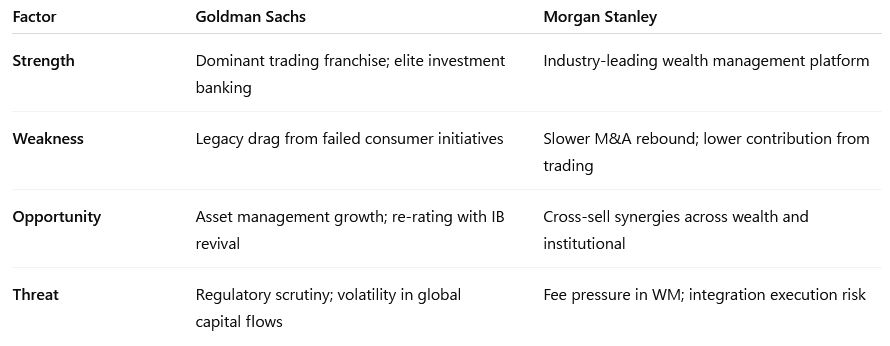
SWOT analysis table comparing Goldman Sachs and Morgan Stanley ahead of Q2 2025 earnings, highlighting strengths, weaknesses, opportunities, and threats for each firm.

Valuation in Context: Discounted for Uncertainty

From a valuation perspective, both firms trade at a discount to their historical averages, reflecting persistent questions around the pace of recovery in core businesses.

  • Goldman Sachs (GS) is currently trading at approximately 11.2x forward earnings, a discount that arguably reflects both the overhang from its consumer pivot and cyclical risk in trading and advisory.
  • Morgan Stanley (MS) commands a higher multiple, at around 13.3x forward earnings, underpinned by the predictability of its wealth franchise and a more balanced revenue base.

However, if investment banking activity accelerates meaningfully in the second half of the year, Goldman may be poised for a multiple re-rating. Conversely, if market volatility diminishes further, Morgan Stanley’s stable income streams may prove more defensive.


Bottom Line: Different Models, Same Market Test

As both firms head into Q2 earnings, the contrast between Goldman’s capital markets orientation and Morgan Stanley’s wealth-driven stability will once again be on full display. Investors will be looking not only for solid headline numbers, but for forward guidance that supports each firm’s strategic trajectory. Whether it’s Goldman’s return to its core strengths or Morgan Stanley’s steady ascent in fee-based income, the upcoming results could significantly shift investor sentiment—and relative valuations—for the rest of the year.


Stay Ahead of the Curve

📩 Subscribe to SWOTstock.com for full earnings recaps, updated SWOT profiles, and revised valuation scenarios for both Goldman Sachs and Morgan Stanley—posted immediately after earnings are released.


Disclaimer

This article is for informational purposes only and does not constitute financial advice or a recommendation to buy or sell any securities. Always perform your own due diligence or consult a licensed financial advisor before making investment decisions.


Leave a comment


JPMorgan vs. Citigroup: How Q1 Set the Tone for a Pivotal Q2 2025

Featured image displaying JPMorgan and Citi logos side by side on a blue background with “vs.” between them, representing a comparison of their Q1 2025 earnings performance.

TL;DR:
JPMorgan Chase (NYSE: JPM) and Citigroup (NYSE: C) kicked off 2025 with strong Q1 earnings, bolstered by solid trading performance and robust net interest income. But as Q2 earnings approach, both banks face persistent macroeconomic uncertainty, cautious client sentiment, and a potentially slower investment banking environment. Here’s how Q1 played out—and what investors should be watching this July.


Q1 Recap: Momentum With a Hint of Caution

U.S. megabanks are heading into Q2 earnings season on the back of a strong start to 2025. JPMorgan Chase and Citigroup delivered better-than-expected first-quarter results, supported by healthy interest income, strong trading activity, and improved cost discipline. Yet, under the surface, both management teams signaled caution—highlighting inflation, geopolitical risk, and client conservatism as emerging themes.

Let’s break down how each bank performed and what might lie ahead.


JPMorgan: Trading Desk Strength and Rate Tailwinds

JPMorgan reported Q1 net revenue of $46 billion, up 8% year-over-year, and net income of $14.6 billion, with earnings per share at $5.07, beating expectations. The strength came from two key engines:

  • Net interest income, which jumped to $23.4 billion thanks to favorable rate conditions and sustained loan growth.
  • Trading revenues, which surged 21% to $9.7 billion—fueled by a 48% jump in equities trading, a record quarter for that unit.

Investment banking fees rose 12%, signaling resilience in select M&A and debt market deals. However, credit provisions increased to $3.3 billion, suggesting a more conservative stance heading into a potentially rockier second half.

CEO Jamie Dimon struck a familiar note of pragmatism, warning about “considerable turbulence” from inflation, fiscal deficits, and geopolitical instability—even as those same forces have benefited JPM’s market-facing businesses.

Q2 Watchlist for JPM:

  • Can trading continue to outperform amid summer market activity?
  • Will loan growth in consumer and commercial lending remain resilient?
  • Are credit provisions hinting at broader credit concerns?

Citigroup: Cost Discipline and Trading Surprise

Citigroup also posted a solid Q1, with net income of $4.1 billion, up 21% from a year ago, and revenue of $21.6 billion. Earnings per share came in at $1.96, topping consensus. What stood out was the mix of trading performance and improved cost controls.

  • Markets revenue rose 12%, with equities trading jumping 23%.
  • Operating expenses declined 5%, aided by lower FDIC assessments and progress on Citi’s restructuring efforts.
  • RoTCE reached 9.1%, and the bank’s CET1 capital ratio stood at a strong 13.4%.

Still, Citi added $2.7 billion in credit provisions, increasing total reserves to $22.8 billion—a sign that management is not letting its guard down. CEO Jane Fraser struck a constructive tone, citing the U.S. economy’s relative resilience but emphasizing the need to remain cautious amid global uncertainty.

Q2 Watchlist for Citi:

  • Are cost control and digital investments delivering lasting operating leverage?
  • Will interest margins hold up if rates remain steady?
  • Can investment banking recover in a choppy macro environment?

JPMorgan vs. Citi: Diverging Strengths, Common Risks

While both banks had strong first quarters, they are navigating Q2 with different levers of strength.

Table comparing JPMorgan and Citigroup Q1 2025 performance across trading revenue, cost discipline, investment banking activity, and risk management. Highlights JPMorgan’s strength in equities trading and diversified earnings versus Citigroup’s progress in cost control and capital efficiency.

JPMorgan’s scale and diversified earnings base give it an edge in uncertain times, while Citigroup is gaining ground through cost cuts and capital efficiency. But both are facing the same headwinds: tighter client budgets, regulatory pressure, and slowing deal activity.


What to Expect in Q2 2025

Q2 earnings will likely test whether Q1 momentum is sustainable. Trading may stay strong if market volatility persists, but credit costs and weak investment banking pipelines could put pressure on profits.

Key themes to monitor:

  • Credit quality: Are rising reserves signaling trouble ahead?
  • Capital deployment: Will management remain cautious with buybacks and dividends?
  • Tech and efficiency: Are digital investments translating into real operating leverage?

Don’t overlook the earnings call commentary from Jamie Dimon and Jane Fraser—their tone will offer key signals about how megabanks view the second half of the year.


Verdict

JPMorgan remains the more defensive play, with a proven trading engine and diversified model. Citigroup is a potential turnaround story, showing credible progress on efficiency. Both face macro uncertainty, but also opportunity—especially if rate conditions stay supportive and markets remain active.

Retail investors should stay focused on margin resilience, capital trends, and credit provisioning as the next round of earnings unfolds.


Follow SWOTstock for JPMorgan and Citigroup Q2 earnings detail SWOT analysis and valuation scenarios.


Leave a comment