AMD Q4 FY2025 Earnings: Strong AI Execution, but Expectations Reset

AMD reported strong Q4 and FY2025 results, showcasing 34% revenue growth, led by data-center demand. Despite positive fundamentals, the stock declined due to lowered revenue guidance for Q1 FY2026 and concerns about AI profitability relative to Nvidia. Future prospects hinge on accelerated AI adoption and margins expansion.


TL;DR

AMD (AMD:NASDAQ) delivered a strong Q4 and full-year FY2025, with record revenue, accelerating data-center growth, and expanding margins. However, the stock sold off after earnings as investors recalibrated expectations around sequential growth, AI profitability, and Nvidia-relative positioning. At current levels, AMD looks roughly fairly valued, with upside hinging on faster-than-expected AI accelerator adoption.


Quarter Recap

Advanced Micro Devices closed FY2025 with momentum. Q4 revenue grew 34% year over year, driven primarily by data-center demand and continued EPYC share gains. AI accelerators contributed meaningfully, confirming AMD’s participation in the AI infrastructure build-out. That said, Q1 FY2026 guidance implied a sequential revenue decline, which became the focal point for post-earnings market reaction.


Key Highlights

  • Q4 revenue of $10.27B, up 34% YoY, with Data Center revenue at $5.4B (+39% YoY)
  • Full-year FY2025 revenue of $34.64B (+34% YoY)
  • Non-GAAP gross margin expanded to 57% in Q4
  • Q1 FY2026 revenue guidance of ~$9.8B ± $300M, implying a QoQ dip despite strong YoY growth
  • Continued execution on the Instinct AI accelerator roadmap, alongside steady EPYC CPU share gains

SWOT Analysis

AMD’s earnings confirmed strong execution, but also highlighted how elevated expectations now shape investor reactions. The stock is less sensitive to “beats” and more to the speed and profitability of AI scaling.

Strengths

  • Data Center momentum is broad and durable (+5% to +10%)EPYC CPUs and Instinct accelerators both contributed, reinforcing AMD’s relevance across the data-center stack.
  • Revenue scale and operating leverage improving (+4% to +8%)FY2025 marked a clear transition from cyclical recovery to scalable growth.
  • Diversified end-market exposure (+2% to +5%)PCs, gaming, embedded, and data center reduce dependence on a single demand cycle.

Weaknesses

  • AI margins trail Nvidia (-6% to -12%)AMD’s AI hardware is competitive, but software ecosystem and profitability still lag the market leader.
  • Sequential guidance optics (-4% to -8%)A QoQ revenue decline contrasts with expectations for uninterrupted AI acceleration.
  • China/export-control noise (-2% to -4%)MI308-related adjustments complicate margin transparency.

Opportunities

  • Instinct accelerator roadmap execution (+8% to +15%)Successful scaling of MI300-series successors could materially shift AMD’s AI narrative.
  • EPYC share gains vs. Intel (+5% to +10%)Incremental server CPU share gains have outsized financial impact.
  • Customer diversification beyond Nvidia (+4% to +8%)Hyperscalers seeking second-source suppliers position AMD as the primary beneficiary.

Threats

  • Nvidia’s ecosystem moat (-8% to -15%)CUDA and entrenched developer workflows remain a structural disadvantage.
  • AI expectations already priced in (-5% to -10%)Execution may not be enough to prevent multiple compression.
  • AI capex volatility (-4% to -7%)Any slowdown in hyperscaler spending would pressure AMD’s growth narrative.
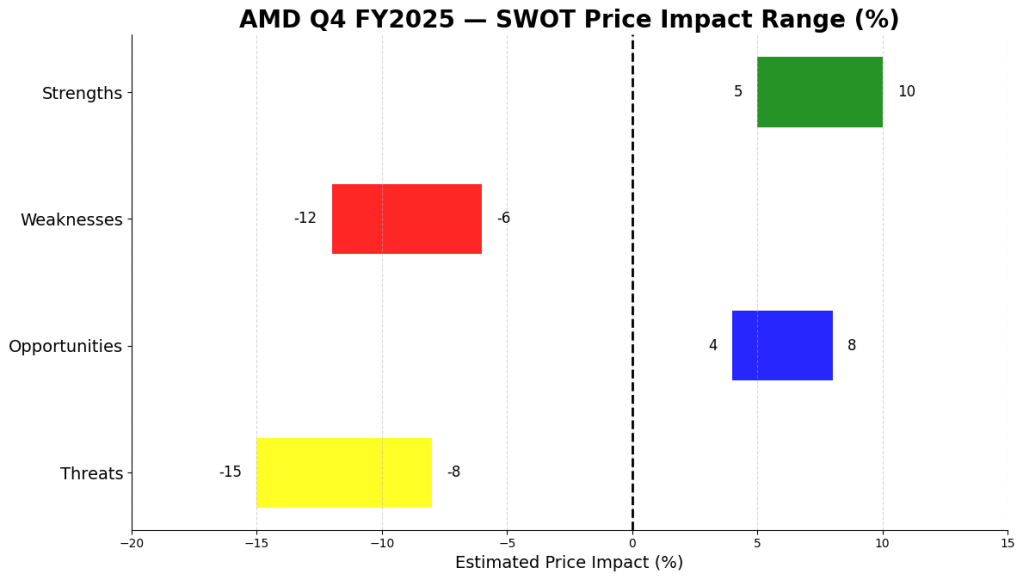
AMD Q4 FY2025 SWOT price impact chart showing estimated upside and downside percentage ranges across strengths, weaknesses, opportunities, and threats.
AMD Q4 FY2025 SWOT price impact range (%) — Strengths and opportunities are driven by data center and AI accelerator growth, while weaknesses and threats reflect margin pressure, competitive dynamics, and elevated market expectations.

Valuation Scenarios

AMD’s valuation hinges on how quickly AI revenue scales and how much margin expansion follows.

Bear Case

  • Slower AI adoption, modest margin gains
  • Implied downside: -25% to -30%

Base Case

  • Steady EPYC gains, gradual AI scaling
  • Implied range: -5% to +10%

Bull Case

  • Strong hyperscaler uptake of Instinct accelerators, accelerating margins
  • Implied upside: +25% to +35%

Probability-weighted fair value: approximately $247, suggesting the stock is near fair value today.
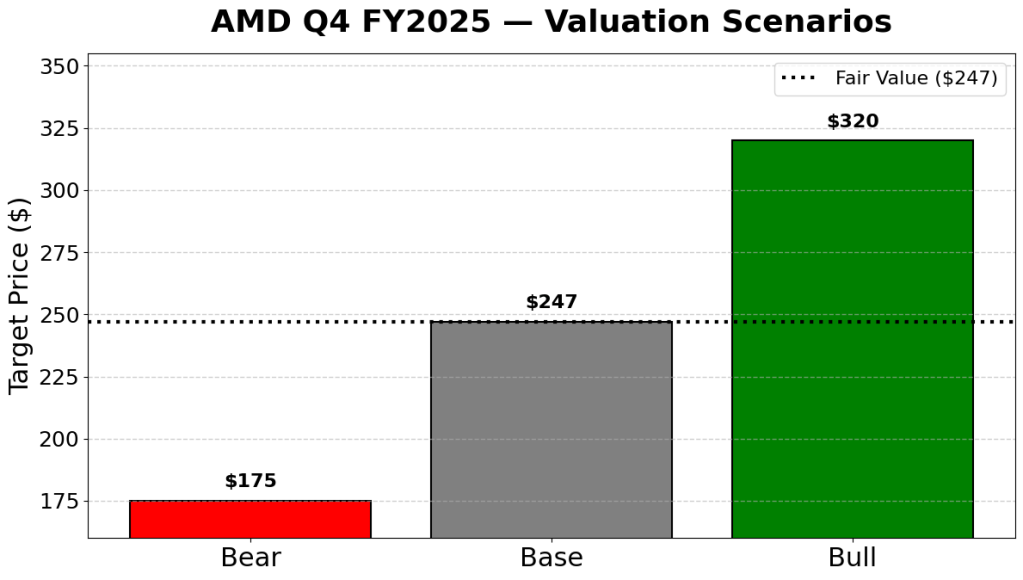
AMD Q4 FY2025 valuation scenarios chart showing bear, base, and bull target prices with a dotted fair value line at $247.
AMD Q4 FY2025 valuation scenarios — Bear, Base, and Bull price targets reflecting different AI adoption and margin expansion outcomes, with a probability-weighted fair value of $247.

Verdict

AMD remains a high-quality AI and data-center growth story, but the post-earnings sell-off shows the bar is rising. Near-term upside likely requires clear evidence of faster AI scaling and margin expansion, not just solid execution. Long-term investors may view pullbacks as opportunities, but expectations need to be reset.


Call to Action

If you found this analysis helpful, follow SWOTstock for more earnings breakdowns that cut through headlines and focus on what really drives valuation.


Disclaimer

This article is for informational and educational purposes only and does not constitute investment advice. Always conduct your own research or consult a financial professional before making investment decisions.

American Express Q4 2025: Premium Growth Holds — But Is the Stock Fully Priced?

American Express reported strong Q4 2025 results, highlighting robust premium spending and cardmember engagement. Despite growth in revenue and earnings, higher expenses posed challenges. Management remains optimistic about future growth but acknowledges valuation concerns. The stock is deemed fair to slightly expensive, with better opportunities expected during market downturns.

TL;DR Summary

  • American Express (AXP:NYSE) delivered another solid quarter, driven by resilient premium spending and strong cardmember engagement.
  • Management guided to continued revenue and EPS growth in 2026, but higher investment and normalizing credit costs remain a headwind.
  • At current levels, the stock looks fair to slightly expensive, with better risk–reward on pullbacks.

Quarter Recap

American Express Company reported Q4 2025 and full-year results that were fundamentally strong, yet met with a cautious market response. Revenue growth remained healthy, supported by Travel & Entertainment spending and a premium customer mix, while earnings landed slightly below expectations due to higher expenses. Management emphasized that credit trends are normalizing rather than deteriorating and reiterated confidence in the long-term earnings trajectory.


Key Highlights

  • Revenue grew at a double-digit pace year over year, reflecting continued strength in premium consumer spending.
  • Full-year earnings reached a record level, supported by fee income and cardmember engagement.
  • Credit performance remained within management’s expected range, consistent with a return to pre-pandemic loss patterns.
  • Ongoing investments in rewards, marketing, and technology weighed modestly on near-term margins.
  • Capital returns through buybacks and dividends remain a core part of the shareholder story.

SWOT Analysis

American Express continues to stand out as a high-quality financial franchise with a differentiated premium model. However, valuation sensitivity has increased as investors focus more on cost discipline and credit normalization rather than pure top-line growth.

Strengths

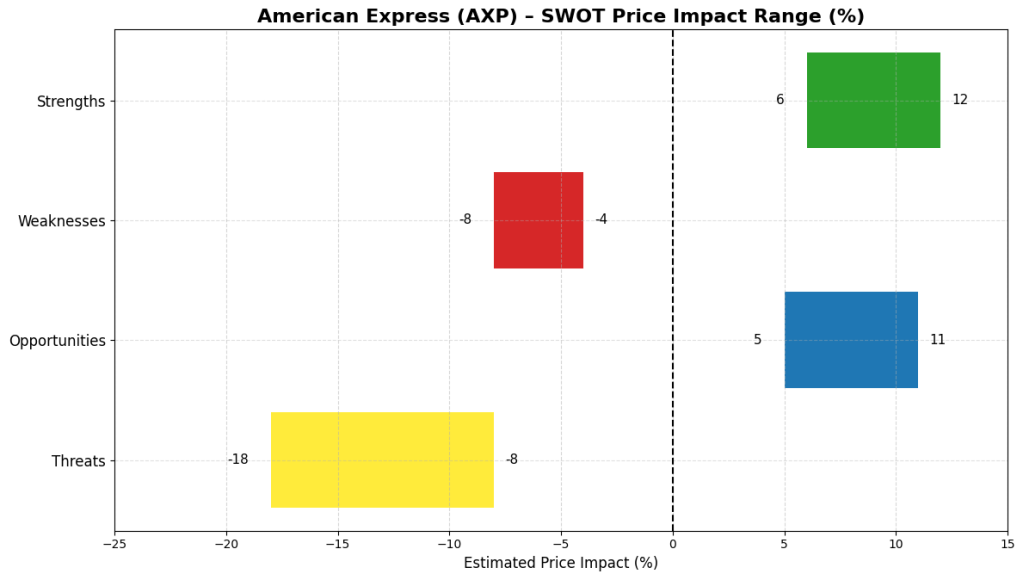
  • Affluent customer base with resilient Travel & Entertainment spending, supporting earnings durability (+6% to +12%).
  • Sticky membership model with annual fees and rewards, driving strong lifetime value and pricing power (+4% to +9%).
  • Clear medium-term growth outlook anchored by management’s 2026 guidance (+5% to +10%).

Weaknesses

  • Elevated marketing and reward investments can pressure margins and lead to small EPS misses (−4% to −8%).
  • Combined network, issuing, and credit exposure makes earnings more sensitive to credit normalization (−3% to −7%).

Opportunities

  • Continued acquisition of Millennials and Gen Z customers enhances long-term earnings power (+5% to +11%).
  • Premium product refreshes can lift engagement, fees, and spending per cardmember (+3% to +8%).

Threats

  • Regulatory scrutiny and policy headlines can weigh on sentiment even without immediate financial impact (−6% to −15%).
  • A macro slowdown could dampen Travel & Entertainment spend and accelerate credit costs (−8% to −18%).
American Express SWOT price impact chart showing estimated upside and downside ranges from strengths, weaknesses, opportunities, and threats after Q4 2025 earnings.
American Express (AXP) SWOT analysis visualizing estimated stock price impact ranges from key strengths, weaknesses, opportunities, and threats based on Q4 2025 earnings.

Valuation Scenarios

Using management’s 2026 EPS guidance and a range of reasonable valuation multiples, the stock’s upside and downside can be framed as follows.

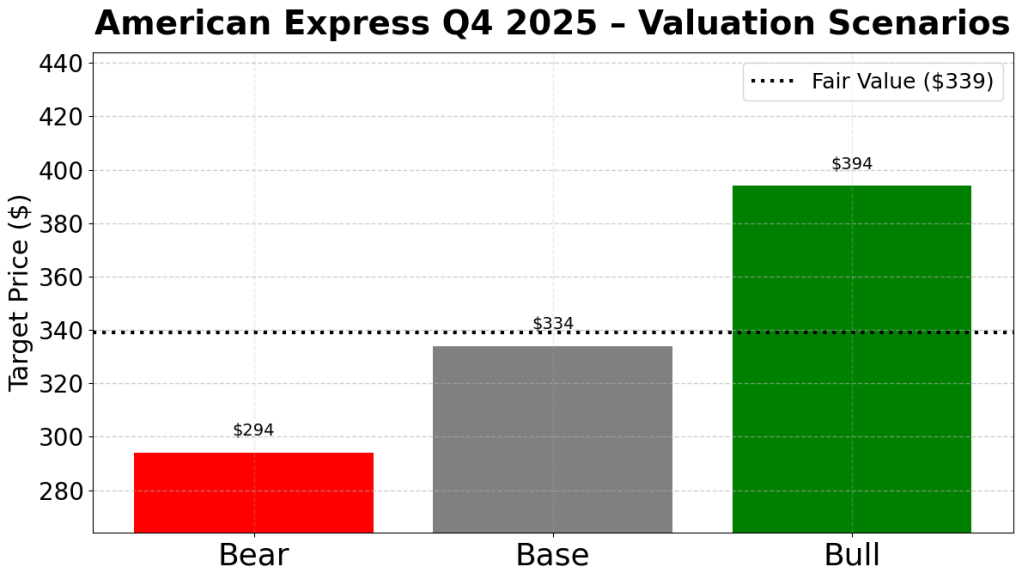
Bear Case

  • EPS at the low end of guidance with multiple compression.
  • Implied value around $294, reflecting credit and cost concerns.

Base Case

  • Midpoint EPS with a normalized premium multiple.
  • Implied value around $334, assuming steady execution and controlled investments.

Bull Case

  • High-end EPS with multiple expansion driven by premium growth re-rating.
  • Implied value around $394, assuming strong affluent spending and operating leverage.

Probability-weighted fair value

  • Combining these scenarios yields a fair value estimate of around $340.
American Express valuation scenarios chart showing bear, base, and bull price targets with a probability-weighted fair value after Q4 2025 earnings.
American Express (AXP) valuation scenarios illustrating bear, base, and bull price targets and the probability-weighted fair value based on Q4 2025 earnings.

Verdict

American Express remains a best-in-class consumer finance franchise with durable growth drivers and strong capital returns. However, at current prices, much of that quality is already reflected in the stock. For value-oriented investors, the shares look fair to slightly expensive, with a more attractive entry point likely emerging during periods of market volatility or macro-driven pullbacks.


Call to Action

If you’re tracking high-quality financial stocks through the cycle, follow SWOTstock for clear, earnings-driven analysis that separates long-term fundamentals from short-term noise.


Disclaimer

This article is for informational and educational purposes only and does not constitute investment advice. Investors should conduct their own research and consider their financial situation and risk tolerance before making investment decisions.


ASML Q4 2025: Record AI Orders, But Is the Stock Pricing Perfection?

ASML recorded €13.2B in new bookings in Q4 2025, driven by AI semiconductor demand, pushing its backlog to nearly €39B. However, the stock trades above calculated fair value, emphasizing reliance on High-NA EUV adoption and sustained AI capital expenditure. Valuation risks and geopolitical threats could impact future returns.

TL;DR Summary

ASML just reported record bookings driven by AI-related semiconductor demand, reinforcing its role as the critical infrastructure supplier to advanced chip manufacturing. However, the stock is already trading well above our calculated fair value, meaning future returns now depend on High-NA EUV adoption and sustained AI capex growth exceeding already-lofty expectations.


Quarter Recap

ASML delivered a strong Q4 2025 report, with revenue reaching €9.7B and gross margins holding above 52%, a rare level of profitability for capital equipment companies. The headline number was bookings: €13.2B in new orders, more than doubling expectations and pushing backlog to nearly €39B. Management guided 2026 revenue to €34–39B, signaling continued demand from AI-driven chip investments.

This quarter confirmed that ASML is no longer a purely cyclical semiconductor equipment supplier; it is increasingly viewed as a structural AI infrastructure enabler.


Key Highlights

• Record quarterly bookings driven by EUV demand

• Strong margin stability above 50%

• Backlog provides multi-quarter revenue visibility

• 2026 guidance above prior expectations

• Services and installed base growing as recurring revenue stream


SWOT Analysis

ASML sits at the center of the AI semiconductor supply chain. The business shows structural strengths, but valuation risk is becoming more relevant as expectations rise.

Strengths

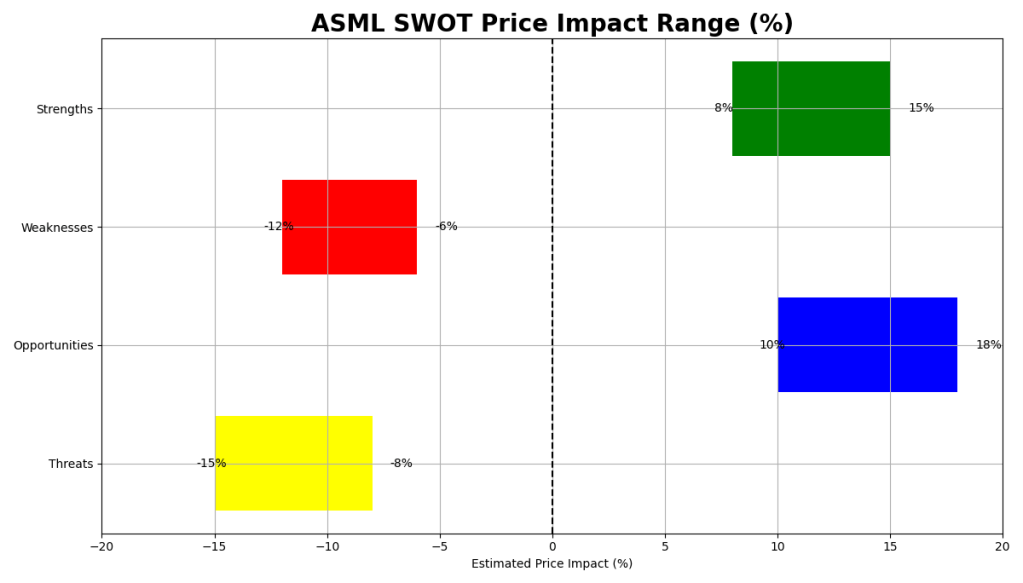
• EUV monopoly with pricing power → +8% to +15% price impact

• Record bookings visibility → +6% to +10%

• High gross margins (~52%) → +4% to +7%

• Large backlog reducing cyclical risk → +5% to +9%

Weakness

• Heavy reliance on few mega customers → –5% to –9%

• Long lead times cause revenue timing swings → –3% to –6%

• Elevated valuation multiples → –6% to –12%

Opportunities

• High-NA EUV adoption cycle → +10% to +18%

• AI data center chip demand → +7% to +14%

• Services growth from installed base → +4% to +8%

Threats

• China export restrictions → –7% to –13%

• Semiconductor capex downturn risk → –8% to –15%

• Geopolitical supply chain risks → –4% to –8%

ASML SWOT price impact chart showing strengths (+8% to +15%), opportunities (+10% to +18%), weaknesses (–12% to –6%), and threats (–15% to –8%) with a zero baseline, illustrating potential valuation drivers and risks after the latest earnings.
ASML SWOT price impact ranges: Structural strengths from EUV monopoly and AI demand provide upside potential, while valuation risk, customer concentration, and export restrictions represent key downside factors.

Valuation Scenarios

ASML’s valuation reflects its position as a toll collector on advanced chip manufacturing rather than a traditional cyclical equipment maker.

Bear Case

AI spending slows, High-NA adoption delayed, and multiples compress.

→ –20% to –30% downside

Base Case

Steady AI demand, gradual High-NA ramp, stable margins.

→ +10% to +18% upside

Bull Case

Accelerated AI infrastructure buildout and faster High-NA adoption.

→ +30% to +45% upside

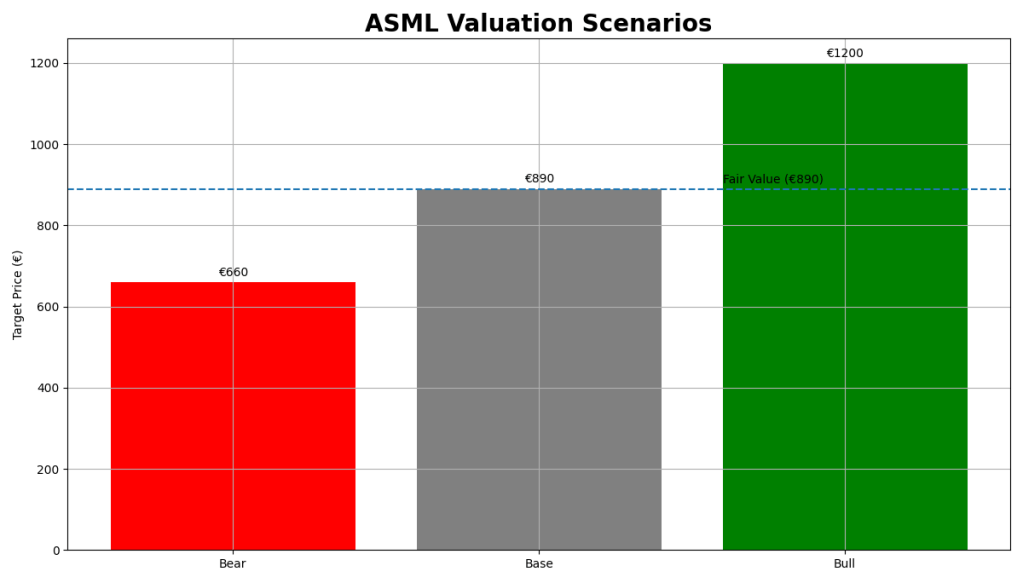
Probability-weighted expected return: ~+10–12%

ASML valuation scenarios chart showing Bear case at €660, Base case fair value at €890, and Bull case at €1200, with a dashed fair value line illustrating potential upside and downside based on AI demand and semiconductor cycle assumptions.
ASML valuation scenarios: The base case fair value centers around €890, with downside risk if AI spending slows and upside potential if High-NA EUV adoption and global AI infrastructure investment accelerate.

Verdict

ASML remains one of the most strategic companies in the global technology supply chain. However, with shares trading well above our fair value estimate of €880–900 (≈ $1,040–1,065), the stock appears priced for a strong AI expansion scenario. Investors are now paying for execution perfection.


Call to Action

Follow SWOTstock for structured, fundamentals-driven breakdowns that cut through earnings hype and focus on valuation, risk, and long-term positioning.


Disclaimer

This analysis is for informational purposes only and does not constitute investment advice. Investors should conduct their own research and consider risk tolerance before making investment decisions.