Adobe Q4 FY2025 — AI Adoption Strengthens, ARR Hits New Highs, and The Stock Barely Moves

Adobe reported a solid Q4 FY2025, with revenue rising 10% YoY to $6.19 billion and surpassing $25 billion in ARR. Despite strong financials, the stock slipped 0.8% post-results, reflecting high investor expectations around AI monetization. The company remains a robust subscription model with a fair value around $520 per share.

TL;DR Summary

Adobe (NASDQ: ADBE) closed FY2025 with another strong quarter: revenue rose 10% YoY to $6.19B, ARR surpassed $25B, and AI features across Creative Cloud and Document Cloud continued driving higher engagement. Yet the stock slipped just –0.8% after hours, reflecting investor expectations for stronger AI monetization and cautious sentiment around the $1.9B Semrush acquisition. Adobe remains a premium-quality subscription business, and our fair value stands at $520, supported by durable ARR growth, strong free cash flow, and early—but accelerating—AI upside.


Quarter Recap

Adobe reported its Q4 FY2025 results on December 11, highlighting a company that continues to compound ARR while transitioning deeper into AI-enhanced creative and productivity workflows. Revenue grew 10% YoY to $6.19B, beating expectations, and non-GAAP EPS came in at $5.50. Digital Media ARR and Document Cloud momentum remained strong, and Experience Cloud delivered stable growth ahead of planned integration with Semrush. Free cash flow reached $3.16B for the quarter and over $10B for the full year.

Despite the strong numbers, Adobe’s share price slipped approximately 0.8% after hours. This muted reaction was driven by high expectations, the need for clearer AI monetization signals, and continued caution around software multiples during a volatile macro backdrop.


Key Highlights

  • Revenue of $6.19B, up ~10% YoY; above consensus.
  • Non-GAAP EPS of $5.50; exceeded analyst expectations.
  • Digital Media and Document Cloud ARR both saw solid double-digit growth.
  • Free cash flow reached $10B+ for FY25 — reinforcing balance sheet strength.
  • AI adoption continued accelerating across Creative Cloud and Acrobat.
  • Announced $1.9B acquisition of Semrush to deepen Experience Cloud capabilities.
  • FY2026 guidance targets ~10%+ ARR growth, with expanding AI-driven workflows.

SWOT Analysis

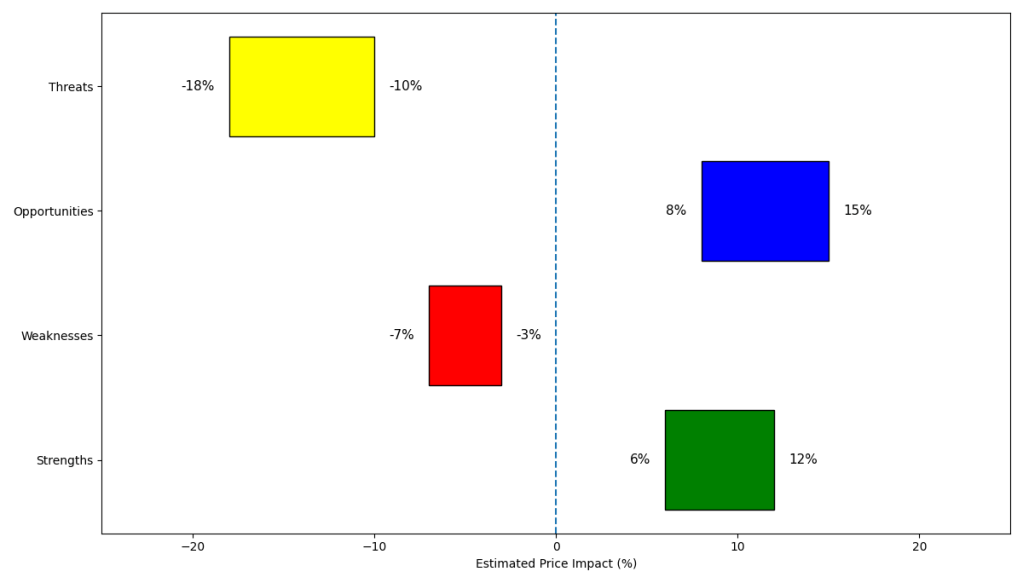
Adobe enters FY2026 with solid momentum, supported by durable ARR, growing AI adoption, and strong cash generation. Still, the market remains cautious as it weighs valuation, competition, and the pace of AI monetization. Below is a clear, investor-ready SWOT with quantitative price impacts.

Strengths (+6% to +12%)

  • Record ARR growth across Creative Cloud, Document Cloud, and Experience Cloud reinforces subscription durability.
  • AI tools such as Firefly and Acrobat AI Assistant deepen product engagement and increase switching costs.
  • Robust free cash flow provides flexibility for buybacks and acquisitions.
  • Consistent revenue and EPS beats reflect disciplined execution.

Weaknesses (–3% to –7%)

  • Premium valuation multiples make the stock sensitive to any growth deceleration.
  • AI monetization still lacks explicit revenue attribution, creating uncertainty.
  • Experience Cloud faces rising competition in enterprise marketing and analytics.
  • Muted stock reaction shows investor expectations were already high.

Opportunities (+8% to +15%)

  • Monetization of Firefly and enterprise AI workflows can drive incremental ARR.
  • Acrobat AI Assistant is positioned to become a major enterprise productivity catalyst.
  • Semrush integration offers new cross-sell and retention opportunities in Experience Cloud.
  • AI-driven automation may support future price increases and margin expansion.

Threats (–10% to –18%)

  • Competitive pressure from Canva, Figma, and emerging AI-native design tools.
  • Slowing enterprise budgets could affect Experience Cloud bookings.
  • Regulatory scrutiny around AI training and creative rights could create material risk.
  • If AI momentum does not translate into revenue, valuation multiples may compress.
SWOT price impact range chart for Adobe Q4 FY2025 showing strengths, weaknesses, opportunities, and threats with estimated stock price impact from –25% to +25%.

Valuation Scenarios

Adobe’s valuation hinges on ARR durability, AI monetization success, and execution in Experience Cloud. Here are the scenario-based outcomes and how each target is derived.

Bear Case — $455 (25% probability)

  • ARR growth slows below 10%.
  • AI engagement does not translate into meaningful pricing expansion.
  • Experience Cloud bookings lag amid cautious enterprise spending.
  • EPS multiple contracts toward ~18× forward earnings.

Base Case — $525 (50% probability)

  • ARR grows ~10%+ inline with FY26 guidance.
  • AI features deliver moderate, steady uplift to engagement and retention.
  • Semrush integration supports Experience Cloud without margin drag.
  • EPS multiple stabilizes around ~20–22×.

Bull Case — $580 (25% probability)

  • Firefly, Acrobat AI Assistant, and enterprise workflows accelerate AI monetization.
  • Creative Cloud pricing power increases with minimal churn.
  • Semrush drives stronger-than-expected Experience Cloud expansion.
  • EPS multiple expands toward ~24–25×.

Probability-Weighted Fair Value

= (0.25 × 455) + (0.50 × 525) + (0.25 × 580)

~$520 per share

Valuation scenarios chart for Adobe Q4 FY2025 showing bear, base, and bull price targets with probability weights and a dashed fair value line at $520.

Verdict

Adobe’s Q4 results reaffirm the strength of its subscription engine and show that AI adoption is meaningfully increasing engagement. Yet investors are demanding clearer proof of monetization before rewarding the stock with higher multiples. For Type 1 tech-savvy growth investors, Adobe remains a high-quality compounder with manageable execution risk, strong cash flow, and emerging AI tailwinds. At around $520 fair value, the stock appears reasonably priced relative to forward fundamentals.


Call to Action

If you want deeper earnings-season insights, follow SWOTstock for clear, fact-based analysis built directly from official reports and transcripts. No noise, no hype — just the truths that matter for long-term investors.


Disclaimer

This analysis is for informational purposes only and is not financial advice. All conclusions are based solely on Adobe’s official filings and earnings call commentary.


Dell Q3 FY2025 — AI Servers Accelerate, PCs Drag, and the Stock Finds Its Fair Value

Dell’s Q3 FY2025 results showcased strong AI server demand, with revenue at $23.6B and a 9% increase in operating income. However, PC sales dropped 12%, causing a 6% stock decline post-earnings. Value investors may find it appealing as it trades near a fair value of $101, with potential growth linked to the 2026 AI PC refresh cycle.

TL;DR Summary

Dell delivered a mixed but stable Q3 FY2025 as AI servers continued to surge while the PC business remained weak. Revenue came in slightly light, yet strong ISG momentum and solid free cash flow pushed the stock from $125.92 to roughly $130 after hours. Management guided to better margins in Q4, reinforcing the view that Dell is entering a more stable phase as AI infrastructure demand grows. Our fair value estimate stands at $135, with upside tied to ISG mix improvement and the 2026 AI PC refresh cycle.


Quarter Recap

Dell reported Q3 FY2025 results on November 25, 2025, showing a company in transition. Revenue dipped modestly year over year, but ISG continued to deliver meaningful AI-driven strength. CSG remained a drag as PC shipments declined, though management noted early signs of stabilization. Free cash flow held up well, and Dell reiterated its commitment to capital returns through buybacks. Investors reacted positively, pushing the stock up about 3% in after-hours trading.


Key Highlights

  • AI servers were the standout again, driving growth in ISG and building a multi-quarter backlog.
  • PC revenue declined double digits, pressuring overall margins.
  • Management expects sequential margin improvement in Q4 as mix normalizes.
  • Free cash flow remained resilient, anchoring Dell’s valuation.
  • APEX and recurring-revenue models continued to gain traction, though still a smaller contributor.

SWOT Analysis

Dell’s investment case sits at the intersection of a cyclical PC recovery and a structurally expanding AI infrastructure market. The company’s cash flow profile and strong enterprise relationships give value-focused investors a stable foundation, while ISG’s AI momentum provides upside optionality. Below is the SWOT snapshot with estimated price impacts.

Strengths (+6% to +12%)

  • AI server demand accelerating with solid backlog visibility
  • Strong free cash flow supporting continued buybacks
  • Deep enterprise relationships and scale as AI workloads expand
  • Improving Q4 margin outlook based on mix normalization

Weaknesses (–4% to –8%)

  • PC revenue remains in decline, dragging blended margins
  • ISG profitability still volatile due to mix-shift in AI servers
  • Guidance remains conservative, capping near-term sentiment

Opportunities (+8% to +15%)

  • 2026 enterprise AI PC refresh cycle
  • Growing on-prem AI infrastructure demand
  • Higher-margin recurring revenue through APEX
  • Margin expansion potential as AI server costs normalize

Threats (–10% to –18%)

  • Hyperscaler spending cycles remain uneven
  • Potential margin compression from rapid AI mix growth
  • Macro uncertainty affecting corporate capex
  • Competitive pricing pressure across ISG
SWOT price-impact range chart for Dell Q3 FY2025 showing Strengths (+6% to +12%), Weaknesses (–8% to –4%), Opportunities (+10% to +18%), and Threats (–14% to –8%), displayed as horizontal color-coded bars with a vertical zero reference line.

Valuation Scenarios

Our valuation models focus on Dell’s cash flow durability, ISG margin trajectory, and the timing of a PC recovery. We outline three scenarios below, each grounded in Dell’s official Q3 financials and management commentary.

Bear Case — $118

  • AI server growth slows; ISG margins stay volatile
  • PC recovery delayed beyond FY2026
  • Lower EBITDA and discounted cash flow assumptions

Base Case — $134

  • AI server demand remains strong; ISG margins stabilize
  • CSG begins to recover in late 2026
  • Mid-cycle EBITDA multiple applied

Bull Case — $152

  • Accelerating AI infrastructure adoption drives ISG margin uplift
  • Faster AI PC refresh cycle boosts CSG
  • Higher FCF and premium EBITDA multiple

Probability-Weighted Fair Value

  • Bear (25%): 118
  • Base (50%): 134
  • Bull (25%): 152

Final Fair Value: $135

Valuation scenarios chart for Dell Q3 FY2025 showing Bear ($118), Base ($134), and Bull ($152) price targets in colored vertical bars with a dashed fair-value line at $135.

Verdict

Dell’s Q3 results reaffirmed the company’s position as a cash-generating value story with meaningful AI-driven upside. While PCs remain soft, ISG’s momentum and solid Q4 guidance signal a path toward a more balanced and profitable FY2026. At current levels, Dell appears fairly valued around $135, with favorable risk-reward for long-term investors seeking stable cash flow and measured AI exposure.


Call to Action

If you find this breakdown helpful, follow SWOTstock for more AI-focused earnings analysis, valuation updates, and investor-friendly insights across the U.S. equity market.


Disclaimer

This article is for informational purposes only and does not constitute financial advice. All analysis is based solely on official company filings, earnings reports, and management commentary. Investors should conduct their own due diligence or consult a financial advisor before making investment decisions.


Berkshire Hathaway Q3 2025 — Earnings Strength, Record Cash, and a Market That Shrugged

Berkshire Hathaway reported strong Q3 2025 earnings, with $13.5B in operating profits and a record cash reserve of $381B. Despite excellent insurance gains, the stock’s reaction was muted, reflecting cautious investor sentiment and no share buybacks. The outlook remains stable, but without capital deployment, the stock appears fairly valued.

TL;DR Summary

Berkshire delivered one of its strongest operating quarters in years: $13.5B in operating earnings (+34% YoY)$30.8B in net income, and a record $381B cash pile. Insurance posted exceptional underwriting profits and float grew to $176B. Yet the stock barely reacted on Nov 3 — reflecting Buffett’s continued caution, no buybacks, and heavy cash positioning. Berkshire looks fairly valued, with modest upside if capital deployment improves.


Quarter Recap

Berkshire reported Q3 2025 earnings on Saturday, November 1. The results showcased the strength of its core businesses:

  • Operating earnings surged to $13.485B, driven by rebounding insurance profitability.
  • Net income came in at $30.796B, boosted by mark-to-market investment gains.
  • Insurance underwriting delivered $2.369B in profit — nearly triple YoY.
  • Berkshire Hathaway Energy earned $1.489B; BNSF generated $1.449B.
  • The company ended the quarter with $305B in U.S. Treasury bills and $381.7B in total cash and equivalents — a historic record.

Despite these results, Berkshire again did not repurchase shares and was a net seller of equities during the quarter — a message that did not go unnoticed by the market.


Key Highlights

1. A Massive Cash Wall
Berkshire now holds one of the largest cash positions in its history — a sign of both discipline and a lack of compelling opportunities.

2. Insurance Delivered Its Best Quarter in Years
Underwriting profit and investment income both rose sharply, supported by higher rates and disciplined pricing.

3. Apple Exposure Remains High
Apple continues to dominate the equity portfolio, though Berkshire reduced its position earlier in the year.

4. No Buybacks in 2025
Management chose not to repurchase shares for the first nine months — a strong signal that Buffett does not view Berkshire as undervalued at current levels.

5. Market Reaction Was Muted
On Nov 3 (first trading day after earnings), BRK.B closed near $476, showing almost no reaction to the strong quarter — reflecting cautious investor sentiment and the sense that Berkshire is in a holding pattern.


SWOT Analysis

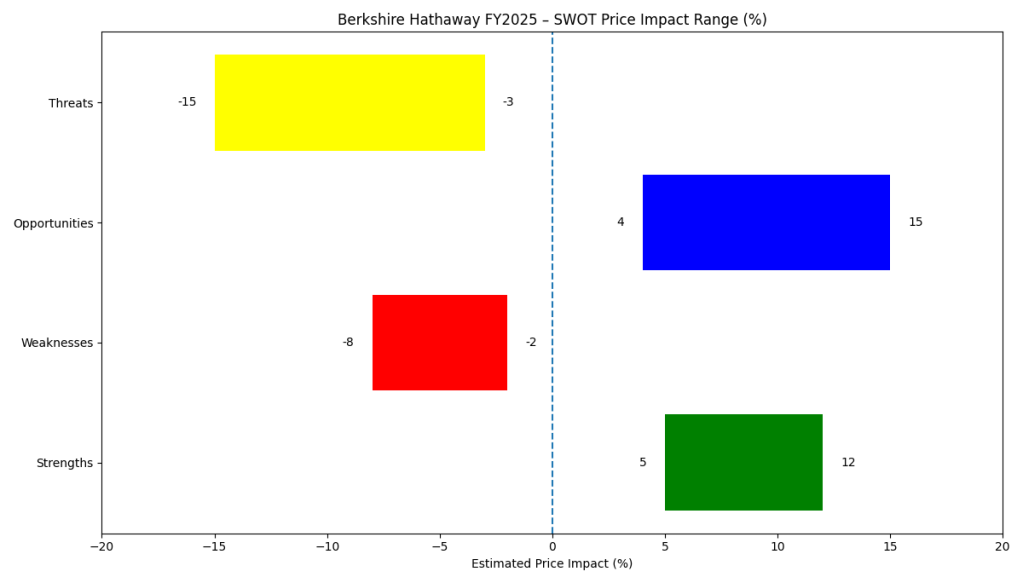
Strengths (+6% to +12%)

  • Record cash levels
  • Strong underwriting performance
  • Diversified, resilient businesses
  • Significant float growth

Weaknesses (–4% to –8%)

  • Sluggish revenue growth
  • No buybacks YTD
  • Heavy reliance on Apple

Opportunities (+8% to +15%)

  • Capital deployment potential
  • Treasury valuation upside
  • Insurance pricing cycle

Threats (–10% to –18%)

  • Succession transition
  • Market downturn exposure
  • Catastrophe risk
Berkshire Q3 2025 earnings SWOT analysis horizontal bar chart showing Strengths (+6 to +12%), Weaknesses (–8 to –4%), Opportunities (+10 to +18%), and Threats (–14 to –8%) with all labels outside the bars, a vertical dashed zero line, and x-axis from –20 to +20.

Valuation Scenarios (Bull / Base / Bear)

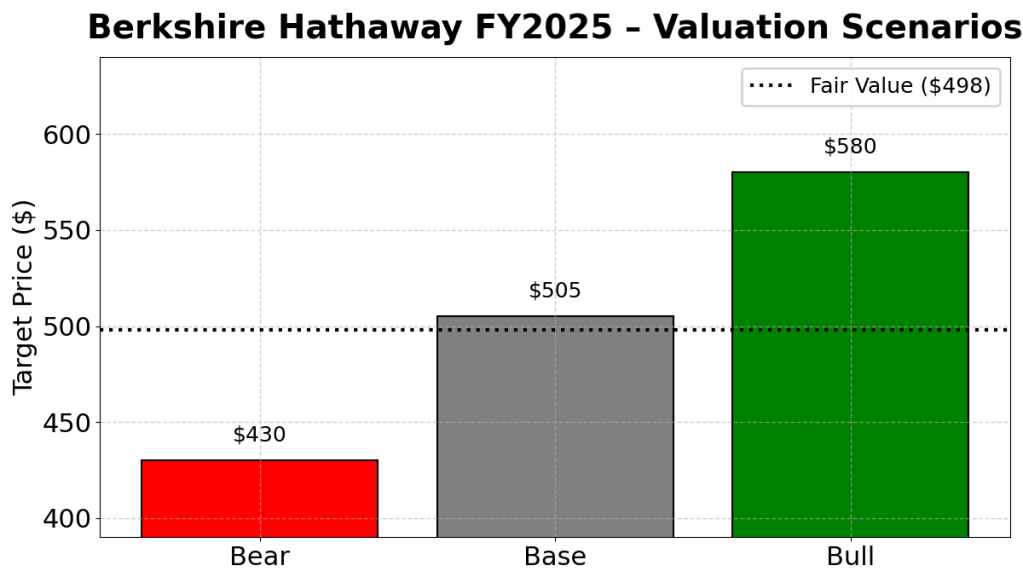
Bear Case — $435 (25%)

  • Uses mid-threat impact
  • No buybacks, leadership uncertainty
  • Market correction risk
    Fair value: $476 × (1 – 9%) ≈ $435

Base Case — $495 (50%)

  • Balanced strengths/weaknesses
  • Stable operating earnings
  • Treasury yield support
    Fair value: $476 × (1 + 4%) ≈ $495

Bull Case — $545 (25%)

  • Strong insurance profitability
  • Opportunistic capital deployment
  • Rate cuts boosting Treasury book
    Fair value: $476 × (1 + 14.5%) ≈ $545

Probability-Weighted Fair Value

= (0.25 × 435) + (0.50 × 495) + (0.25 × 545)
$493

Final Fair Value: $493

≈ 3.6% above current price → Fairly Valued

Valuation scenarios bar chart for Microsoft Q1 FY2026 showing Bear case at $435, Base case at $495, and Bull case at $545, with a dashed Fair Value line at $493 fully visible across the chart.

Verdict

Berkshire remains a fortress — high-quality, resilient, and disciplined. But with such a massive cash position and no buybacks, the market is waiting for a catalyst. Q3 shows strength, but until Berkshire deploys capital or signals undervaluation with buybacks, the stock likely stays range-bound.

For long-term value investors, Berkshire remains a low-risk compounder — but not yet a bargain.


Call to Action

If you found this analysis helpful, follow SWOTstock for more breakdowns of major earnings, fair-value scenarios, and investor-focused research. Share this post with another DIY value investor who follows Berkshire closely.


Disclaimer

This article is for informational and educational purposes only and is not investment advice. All analysis is based solely on Berkshire Hathaway’s official Q3 2025 financial report and management disclosures.