🔋 AMD Q3 2025 — AI Growth Kicks Into High Gear, but Valuation Catches Up

AMD reported record Q3 2025 earnings with a 36% revenue increase to $9.25 billion and a gross margin of 54%. Data Center sales grew 22%, while Client & Gaming surged 73%. Despite strong results, stock dipped due to export-control concerns. Q4 revenue guidance is between $9.3-$9.9 billion.

🧭 TL;DR Summary

Advanced Micro Devices (AMD:NASDAQ) posted record Q3 2025 results: revenue up 36 % y/y to $ 9.25 billion, non-GAAP EPS $ 1.20, and gross margin 54 %.
Data Center sales jumped 22 %, Client & Gaming soared 73 %, while Embedded declined 8 %.
Guidance for Q4 calls for $ 9.3 – 9.9 billion revenue—yet the stock dipped ≈ 4 % after hours as investors digested export-control headwinds and lofty expectations.


🧾 Quarter Recap

AMD’s Q3 marked a clear inflection in its AI and compute franchise.
CEO Lisa Su described the quarter as “a step-up in our growth trajectory as our rapidly scaling data-center AI business drives significant revenue and earnings growth.”
Gross margin improved two points y/y to 52 % (GAAP) and 54 % (non-GAAP), underscoring richer product mix led by EPYC CPUs and Instinct GPUs.
Operating income more than doubled to $ 1.27 billion.

Segment breakdown:

  • Data Center: $ 4.34 b (+ 22 %) — 5th Gen EPYC and Instinct MI350 ramp.
  • Client + Gaming: $ 4.05 b (+ 73 %) — Ryzen and console demand rebound.
  • Embedded: $ 0.86 b (– 8 %) — soft industrial & networking orders.

Management guided Q4 revenue $ 9.3 – 9.9 b (midpoint $ 9.6 b), excluding China-bound MI308 GPU shipments awaiting approval.


🌟 Key Highlights

  1. AI acceleration: Instinct MI350 shipments ramping, with MI308 awaiting export clearance.
  2. Margin expansion: Gross margin 54 % shows strong mix shift to high-end compute.
  3. Balanced growth: Client & Gaming offset softer Embedded demand.
  4. Cautious guidance: China restrictions = headwind, but secular AI TAM tailwinds intact.

🧩 SWOT Analysis (with Price-Impact Ranges)

Strengths (+ 7 – 15 %)
High-margin AI and server products drive sustainable earnings growth. Data Center + Client momentum supports multiple expansion.

Weaknesses (– 6 – 12 %)
Exposure to export controls and volatile PC cycle; Embedded softness limits diversification.

Opportunities (+ 10 – 22 %)
Next-gen MI350 and Zen 5 launches could unlock share gains vs NVIDIA and Intel; AI server TAM expands through 2026.

Threats (– 8 – 18 %)
Regulatory uncertainty (China exports), intense AI competition, macro slowdown risk.

AMD Q3 2025 SWOT price impact chart showing strengths, weaknesses, opportunities, and threats with colored horizontal bars from –45 to +55 dollars, indicating potential stock price impact ranges.

💸 Valuation Scenarios

  • Bull Case (35 % probability)
    • 2026 E EPS ≈ $ 6.50
    • P/E multiple ≈ 40×
    • Target Price: $ 260 – 300 (+ 20 %)
    • Thesis: Strong AI GPU and EPYC share gains, China shipments resume, margin expansion continues.
  • Base Case (50 % probability)
    • 2026 E EPS ≈ $ 5.50
    • P/E multiple ≈ 35×
    • Target Price: $ 230 – 250 (± 0 %)
    • Thesis: Balanced growth across Data Center and Client, modest Embedded recovery, stable margins.
  • Bear Case (15 % probability)
    • 2026 E EPS ≈ $ 4.50
    • P/E multiple ≈ 30×
    • Target Price: $ 180 – 200 (– 20 %)
    • Thesis: AI spending slows, export restrictions persist, competition pressures gross margin.

🎯 Probability-weighted fair value: $ 242 – 255 per share — roughly aligned with current post-earnings price, indicating AMD is fairly valued with moderate upside if AI acceleration outperforms.💸 Valuation Scenarios
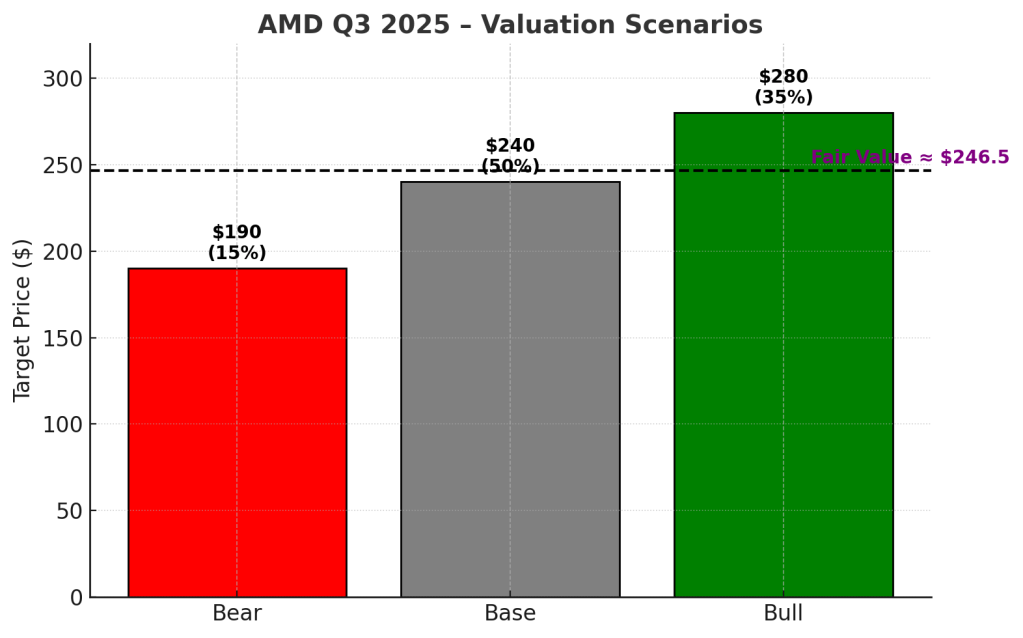
AMD Q3 2025 valuation scenarios chart showing Bear, Base, and Bull cases with target prices of $190, $240, and $280, and a dashed line marking fair value around $246.

🧠 Verdict

AMD Q3 2025 shows AI execution is translating into profits. The stock’s valuation now reflects that success.
Short-term pullbacks from export or competitive news could offer better entries, but long-term investors still have a clear AI compounder.

Call: ⚖️ Hold / Accumulate on Weakness
Fair Value: $ 242 – 255 per share


🗣️ Call to Action

If you’re an AI-infrastructure-focused investor, keep AMD on your watchlist for pullbacks below $ 240.
The next earnings cycle will reveal whether the MI350 and Zen 5 ramps translate into market-share inflection.


⚠️ Disclaimer

This analysis is based solely on AMD’s official Q3 2025 financial report and earnings call. It is not investment advice. Please conduct your own due diligence before making investment decisions.


💼 JPMorgan Q3 2025 Earnings — The Fortress Bank Tightens Its Grip on Stability

JPMorgan Chase’s Q3 2025 results showcase strong performance with EPS of $5.07 and a net income of $13.7 billion. Investment banking surged 25%, and AI efficiencies are enhancing operations. The stock, currently at $308, appears undervalued with a fair value of $328, making it a solid choice for long-term investors.

TL;DR Summary

JPMorgan Chase (JPM:NYSE) once again proved why it’s considered Wall Street’s fortress.
Third-quarter earnings beat expectations, investment banking is rebounding, and AI-driven efficiency is quietly reshaping operations.
At around $308 per share, the stock looks slightly undervalued with a fair value near $328 — steady upside for long-term value investors.


Quarter Recap

On October 14, 2025, JPMorgan reported EPS $5.07 on $46.4 billion in revenue, up about 9 percent year over year.
Net income reached $13.7 billion, with ROTCE 24 percent and ROE 20 percent, both exceptional for a global bank.
The company raised its full-year net interest income guidance to roughly $93 billion (excluding Markets), signaling confidence in margin stability.

CEO Jamie Dimon described the U.S. economy as “resilient but still pressured,” while emphasizing that AI adoption is already driving measurable productivity gains across fraud detection, operations, and client service.


Key Highlights

  • Investment banking surged 25 percent year over year, led by stronger M&A and equity underwriting.
  • Net interest income continued to climb, supported by robust consumer deposits.
  • Wealth and asset management hit record levels: $4.7 trillion AUM with $80 billion in net inflows.
  • Capital strength: CET1 ratio rose to 14.3 percent; management plans ≈ $30 billion in dividends and buybacks.
  • Credit quality: Card loss rates normalized to ~2.6 percent — still well below pre-pandemic levels.

Market response was positive: the stock climbed roughly 3 percent to $310 following the release, as investors rewarded its steady execution.


SWOT Analysis (12-Month Price-Impact View)

Strengths (+ $15 to + $25)

  • Industry-leading ROE (20 %) and ROTCE (24 %) sustain premium valuation.
  • Fortress capital position (CET1 14.3 %) supports $30 B capital return program.
  • AI and automation enhance efficiency and risk controls.
  • Diversified revenue mix limits cyclicality across business lines.

Weaknesses (– $10 to – $18)

  • Deposit costs rising faster than loan yields — NII growth plateau ahead.
  • Consumer credit losses slowly normalizing.
  • Technology and compliance investments pressure short-term margins.

Opportunities (+ $8 to + $20)

  • Revival in deal-making and capital markets fees.
  • Continued wealth inflows boost recurring revenues.
  • Efficiency gains from AI could add ~3 % EPS growth through 2026.

Threats (– $12 to – $20)

  • Potential U.S. slowdown reducing loan demand.
  • Basel III Endgame rules may tighten capital buffers.
  • Global market volatility could curb trading income.
A bar graph illustrating the SWOT analysis for JPMorgan Chase's Q3 2025 price impact range, featuring four colored bars representing strengths, weaknesses, opportunities, and threats, with corresponding estimated price impact values.
SWOT analysis of JPMorgan’s price impact range for Q3 2025, highlighting strengths, weaknesses, opportunities, and threats.

Valuation Scenarios

  • Bull (+ 20 %) → $370
    • Net interest income stays high, AI efficiency adds ~3 % to EPS, and P/B expands to 1.9×.
  • Base (+ 5 %) → $325
    • Stable credit costs and moderate growth support 1.7× P/B multiple.
  • Bear (– 10 %) → $277
    • Economic soft landing turns shaky; credit loss > 3 %, multiple compresses to 1.5×.

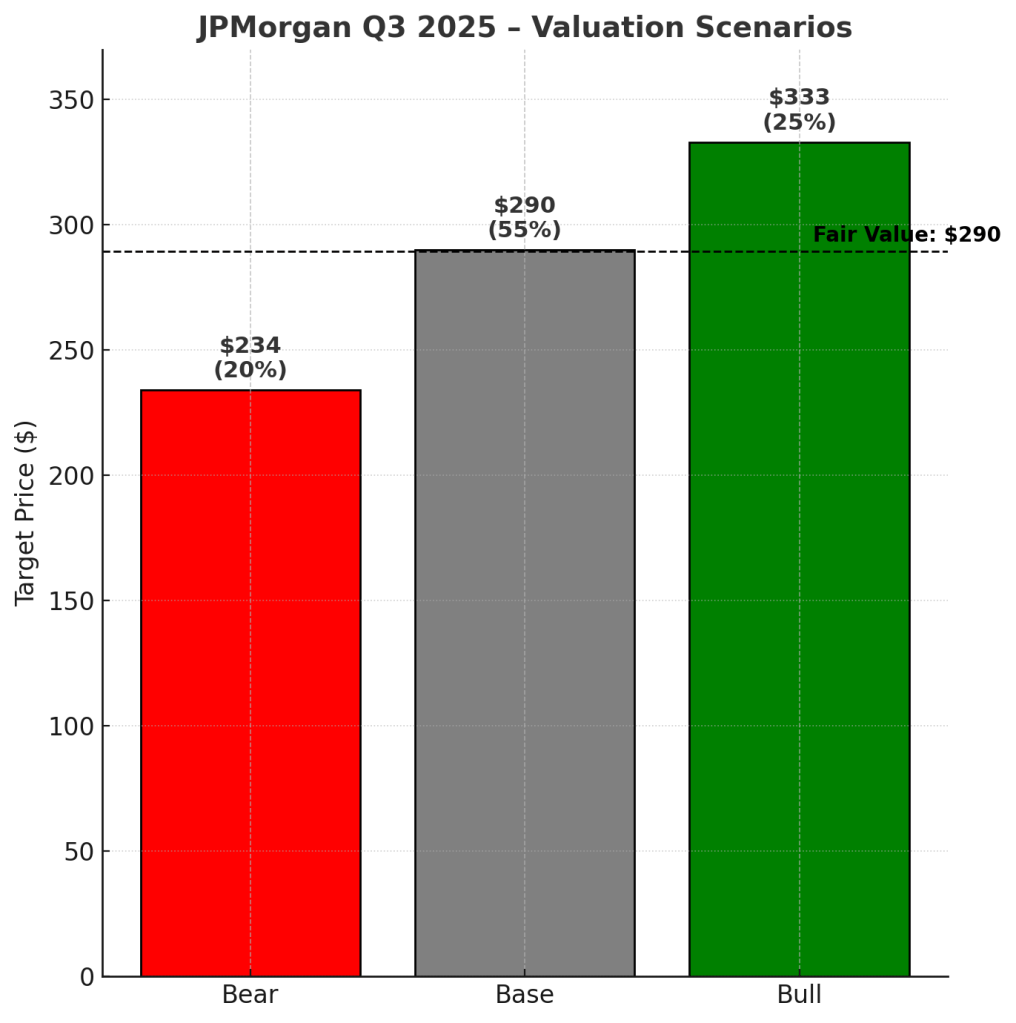
Probability-weighted fair value: ≈ $328 per share, implying a 6–7 % upside from the current $308.

Bar chart illustrating valuation scenarios for JPMorgan in Q3 2025, with target prices for Bear ($234), Base ($290), and Bull ($333), highlighting the fair value at $290.
JPMorgan Q3 2025 Valuation Scenarios: Bear, Base, and Bull target prices with fair value highlighted.

Fair Price Assessment

The valuation rests on JPMorgan’s own fundamentals — not sentiment.
At 24 percent ROTCE and 1.7× book value, shares reflect fortress-level returns with room for modest re-rating.
AI efficiency and buybacks should sustain mid-single-digit EPS growth, keeping the fair price range between $315 and $340.


Verdict

JPMorgan is the definition of a fortress value stock — disciplined, diversified, and resilient.
It won’t outpace Silicon Valley, but its consistency and capital strength make it a cornerstone holding for long-term DIY value investors.
If you’re seeking steady dividends and defensive growth in an uncertain rate environment, this remains one of the best-managed banks in the world.


Call to Action

Track how AI efficiency unfolds across JPMorgan’s business lines in the coming quarters.
If those gains compound like its interest income, the “fortress bank” might quietly build its next growth engine.


Disclaimer

This analysis is for informational purposes only and is based solely on JPMorgan Chase’s official Q3 2025 financial report and earnings call transcript.
It does not constitute investment advice or a recommendation to buy or sell securities.