
TL;DR – Two Different Engines, One Market Test
As Goldman Sachs and Morgan Stanley prepare to report their second-quarter results, investors are watching closely to see how two of Wall Street’s most iconic firms are navigating a shifting macro environment. While Morgan Stanley has leaned into wealth management as its long-term growth pillar, Goldman continues to reposition itself after a retreat from consumer banking and a volatile stretch in investment banking. The upcoming earnings will offer a fresh look at which model is winning in 2025—and whether either name is undervalued relative to its forward potential.
Q1 Recap: Strategic Divergence on Full Display
In the first quarter of 2025, the divergence in strategy between these two institutions became increasingly evident. Goldman Sachs delivered better-than-expected results, driven largely by strength in its global markets division—particularly fixed income and commodities trading. While investment banking revenues remained muted, the firm’s Asset and Wealth Management segment showed encouraging growth, quietly contributing to earnings stability amid broader volatility.
Morgan Stanley, in contrast, leaned into its now-dominant wealth management franchise, which continues to anchor its earnings with more predictable, fee-based income. Trading revenues were healthy, though less volatile than Goldman’s, and investment banking activity remained sluggish. The integration of E*TRADE and Eaton Vance appears to be progressing, but margins continue to be scrutinized by analysts who want to see more operating leverage.
Both stocks have tracked broader market gains this year, aided by rising investor sentiment and increased risk appetite. However, the strong run-up in equity markets sets a higher bar for Q2 performance—and makes any shortfall more likely to trigger a valuation reset.
Q2 2025 Preview: Key Themes to Watch
📈 1. Investment Banking Activity and the M&A Pipeline
The long-awaited recovery in deal activity has been uneven, but early signs point to a modest thaw in M&A and equity underwriting markets. Investors will want to see whether either bank is capturing greater wallet share as clients cautiously return to the table. Goldman, with its deep advisory bench, may be positioned to benefit from any early rebound.
💼 2. Wealth Management Profitability and Scale
Morgan Stanley’s wealth business, now a cornerstone of its strategy, remains in focus—particularly operating margins and net new assets. Investors will look for signs that scale advantages from prior acquisitions are beginning to deliver incremental earnings leverage. Conversely, any slip in cost discipline or fee compression could raise concerns about future growth.
📊 3. Trading Performance and Market Volatility
With macro volatility subsiding somewhat in Q2, trading desks may face tougher year-over-year comps. Goldman’s exposure to fixed income and commodities could give it an edge in any remaining dislocations. Morgan Stanley’s more balanced exposure may serve it well in calmer markets, but could also limit upside if activity is muted.
🏦 4. Strategic Repositioning at Goldman
Goldman’s exit from its consumer ventures continues to unfold, and the second quarter may offer further updates on its plans to streamline operations and refocus capital. While these efforts have weighed on sentiment in the past, clarity and discipline in execution could turn the narrative more constructive.
💰 5. Capital Return and CET1 Management
Both firms are expected to comment on their capital return strategies following the latest Fed stress test results. Goldman has historically been more aggressive with buybacks, while Morgan Stanley may emphasize stability and capital preservation. Investors will weigh these decisions against current payout ratios and the firms’ risk-weighted asset profiles.
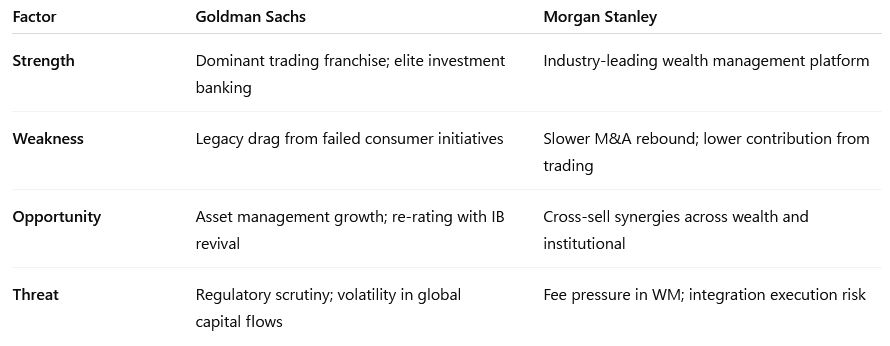
SWOT Analysis: Comparing Strategic Profiles
Valuation in Context: Discounted for Uncertainty
From a valuation perspective, both firms trade at a discount to their historical averages, reflecting persistent questions around the pace of recovery in core businesses.
- Goldman Sachs (GS) is currently trading at approximately 11.2x forward earnings, a discount that arguably reflects both the overhang from its consumer pivot and cyclical risk in trading and advisory.
- Morgan Stanley (MS) commands a higher multiple, at around 13.3x forward earnings, underpinned by the predictability of its wealth franchise and a more balanced revenue base.
However, if investment banking activity accelerates meaningfully in the second half of the year, Goldman may be poised for a multiple re-rating. Conversely, if market volatility diminishes further, Morgan Stanley’s stable income streams may prove more defensive.
Bottom Line: Different Models, Same Market Test
As both firms head into Q2 earnings, the contrast between Goldman’s capital markets orientation and Morgan Stanley’s wealth-driven stability will once again be on full display. Investors will be looking not only for solid headline numbers, but for forward guidance that supports each firm’s strategic trajectory. Whether it’s Goldman’s return to its core strengths or Morgan Stanley’s steady ascent in fee-based income, the upcoming results could significantly shift investor sentiment—and relative valuations—for the rest of the year.
Stay Ahead of the Curve
📩 Subscribe to SWOTstock.com for full earnings recaps, updated SWOT profiles, and revised valuation scenarios for both Goldman Sachs and Morgan Stanley—posted immediately after earnings are released.
Disclaimer
This article is for informational purposes only and does not constitute financial advice or a recommendation to buy or sell any securities. Always perform your own due diligence or consult a licensed financial advisor before making investment decisions.


 SWOT Stock - Smart Investing Made Simple
Leave a comment