Accenture Q2 FY2026 Earnings: Strong AI Demand, But Still Waiting for Growth Acceleration

Accenture reported solid Q2 FY2026 results with record bookings of $22.1 billion and raised its revenue growth guidance to 4–7%. However, revenue growth remains mid-single digits, and GAAP margins compressed. The stock price is near its fair value, with future performance dependent on executing AI strategies rather than just demand narratives.

TL;DR Summary

Accenture (ACN:NYSE) delivered a solid quarter with record bookings and raised guidance, confirming strong enterprise AI demand. However, revenue growth remains in the mid-single digits, and margin pressure suggests AI investments are still in the build phase. The stock is trading close to its probability-weighted fair value, meaning future upside depends on execution—not narrative.


Quarter Recap

Accenture reported Q2 FY2026 results that reflect strong execution but measured growth. Revenue reached $18.0 billion, growing 7% in U.S. dollars and 4% in local currency. Adjusted EPS came in at $3.59, up 10% year over year, while GAAP EPS declined 4%.

The most notable metric was bookings, which hit a record $22.1 billion for a second quarter, indicating strong forward demand. The company also raised its full-year revenue growth guidance to 4–7%, reinforcing confidence in its pipeline.

However, margin trends were mixed. Adjusted operating margin improved slightly, but GAAP margins declined, reflecting continued investment in AI capabilities.


Key Highlights

  • Revenue: $18.0B (+7% USD, +4% local currency)
  • Adjusted EPS: $3.59 (+10% YoY)
  • GAAP EPS: $3.19 (-4% YoY)
  • Record bookings: $22.1B
  • Raised FY2026 revenue growth guidance: 4–7%
  • Free cash flow: $2.68B
  • Share repurchases: $1.7B

SWOT Analysis

Accenture’s results reinforce its position as a high-quality execution platform for enterprise transformation and AI adoption. The company is seeing strong demand and improving visibility, but the market is still waiting for clear evidence that this demand can translate into sustained revenue acceleration and margin expansion.


Strengths

  • Record bookings ($22.1B) → strong forward revenue visibilityEstimated impact: +6% to +10%
  • Raised FY2026 guidance (4–7%) → improving confidenceEstimated impact: +4% to +7%
  • Balanced model (Consulting + Managed Services)Estimated impact: +3% to +6%
  • Positioned as enterprise AI orchestrator across ecosystemsEstimated impact: +5% to +12% (long-term)

Weaknesses

  • Revenue growth still mid-single digit (4% local currency)Estimated impact: -5% to -10%
  • GAAP margin compression (-70bps)Estimated impact: -3% to -6%
  • GAAP EPS decline (-4% YoY)Estimated impact: -3% to -5%

Opportunities

  • AI bookings converting into revenue accelerationEstimated impact: +10% to +20%
  • Early-stage enterprise AI adoption cycleEstimated impact: +8% to +15%
  • Large deal momentum (41 clients >$100M bookings)Estimated impact: +5% to +10%

Threats

  • AI commoditization (clients internalizing capabilities)Estimated impact: -8% to -15%
  • Hyperscalers capturing more value chainEstimated impact: -5% to -12%
  • Macro-driven IT spending volatilityEstimated impact: -6% to -10%
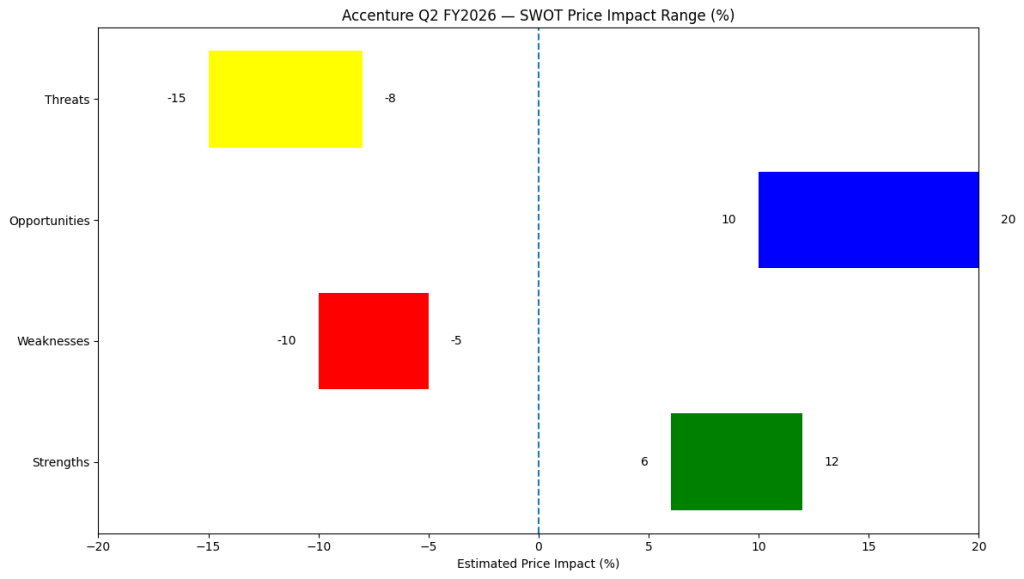
Horizontal SWOT chart showing Accenture Q2 FY2026 estimated stock price impact ranges, with strengths and opportunities in positive territory and weaknesses and threats in negative ranges on a -20% to +20% scale.
SWOT price impact ranges for Accenture’s Q2 FY2026 earnings, highlighting the balance between strong AI-driven demand and ongoing growth and margin constraints.

Valuation Scenarios

Accenture is currently being valued as a stable, high-quality operator with AI exposure, but not yet as a high-growth AI beneficiary. The key variable remains whether strong bookings can translate into sustained revenue acceleration.


Bear Case — $170 to $180

If revenue growth remains around 4–5% and AI demand takes longer to convert into revenue, while margins remain under pressure, the stock could see multiple compression toward traditional consulting peers.


Base Case — $195 to $210

If Accenture delivers within its updated 4–7% growth guidance and AI contributes incrementally without significantly accelerating growth, the stock is likely to remain around current levels with modest upside.


Bull Case — $230 to $260

If AI bookings translate into revenue acceleration above 8–10% and margins expand through operating leverage, Accenture could be re-rated as a leading AI execution platform.


Probability-weighted fair value

Based on the scenario analysis:

  • Bear case (25%): ~$175
  • Base case (50%): ~$202
  • Bull case (25%): ~$245

👉 Estimated fair value: ~$206

At a current price of around $203, Accenture is trading very close to its probability-weighted fair value, suggesting that the market is already pricing in its current level of execution.
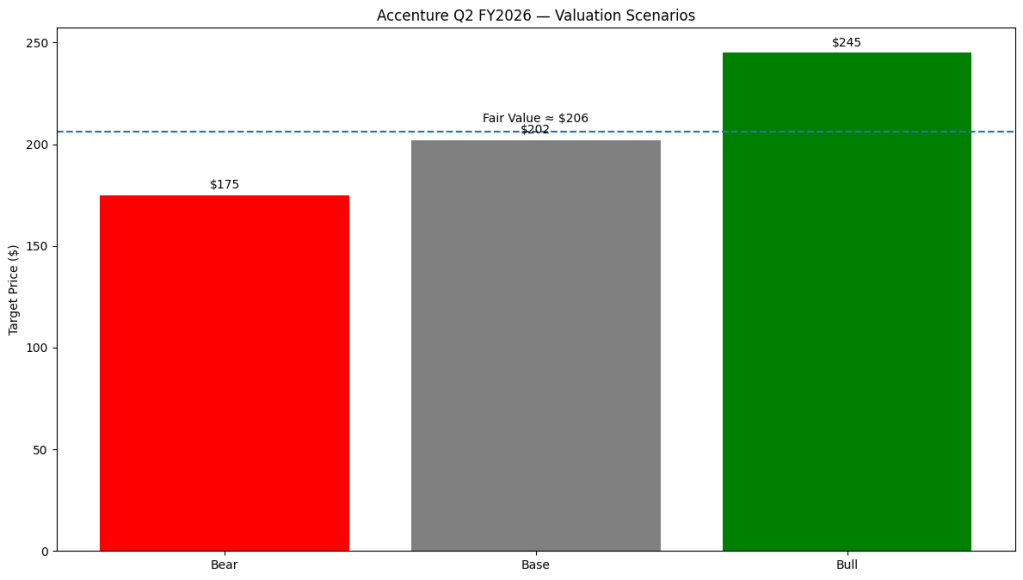
Bar chart showing Accenture Q2 FY2026 valuation scenarios with bear case at $175, base case at $202, and bull case at $245, including a dashed fair value line at approximately $206.
Accenture Q2 FY2026 valuation scenarios showing bear, base, and bull price targets, with a probability-weighted fair value of approximately $206 based on execution and AI growth assumptions.

Verdict

Accenture continues to execute well, supported by strong demand and improving guidance. However, the market is still waiting for clear evidence that AI demand can drive sustained revenue acceleration.

At current levels, the stock appears fairly valued. This shifts the investment case from valuation-driven upside to execution-driven upside.

For now, Accenture remains a “show-me” story—a high-quality compounder with AI optionality, but not yet a full AI re-rating.


Call to Action

If you want more breakdowns like this—focused on how earnings translate into real price impact—follow SWOTstock for SWOT analysis on major companies.


Disclaimer

This analysis is for informational purposes only and does not constitute financial advice. Always conduct your own research before making investment decisions.

Vertiv Q4 2025 Earnings: AI Infrastructure Momentum Is Real — But Is the Stock Ahead of It?

Vertiv reported strong Q4 2025 results with 23% revenue growth, a 252% increase in orders, and a $15 billion backlog, demonstrating solid AI infrastructure demand. Despite rising expectations and high valuation sensitivity, the company’s operational momentum and expanding margins present a favorable risk-reward profile for growth investors at prices around $150.

TL;DR Summary

Vertiv (VRT:NYSE) delivered a strong Q4 2025 with 23% revenue growth, massive order acceleration (+252% YoY), and a $15B backlog that reinforces AI infrastructure demand. Margins expanded and free cash flow remained robust.

However, expectations are now extremely high.

Using management’s official 2026 EPS guidance of ~$6.02 and a disciplined 25x multiple, fair value sits near $150 per share. Investors must now decide: is Vertiv an AI compounder — or an expectations trap?


Quarter Recap

Vertiv closed FY2025 with clear operational momentum.

Q4 net sales reached $2.88B, up roughly 23% year-over-year. Adjusted EPS came in at $1.36, while GAAP EPS was $1.14. The key driver was demand — not cost cutting.

Organic orders surged approximately +252% YoY, pushing backlog to nearly $15B. That backlog is critical. It provides visibility into 2026 and reflects hyperscaler and AI-related infrastructure demand.

Full-year 2025 revenue reached $10.23B, and adjusted EPS was $4.20. Operating cash flow exceeded $2.1B, and adjusted free cash flow totaled $1.89B.

Balance sheet leverage remains modest at approximately 0.5x net leverage.

Management guided for 2026:

  • Revenue: $13.25B – $13.75B
  • Adjusted EPS: $5.97 – $6.07
  • Operating margin: 22–23%
  • Free cash flow: $2.1B – $2.3B

This implies continued double-digit top-line growth and ~40%+ earnings growth at midpoint.


Key Highlights

• Revenue growth remains strong at 23% YoY

• Orders exploded +252% YoY

• Book-to-bill near 2.9x

• Backlog ~$15B

• Adjusted operating margin 23.2%

• 2026 EPS guidance midpoint ~$6.02

The real story is demand visibility, not just quarterly earnings.


SWOT Analysis

Vertiv is no longer being evaluated as a recovery industrial. It is being priced as a structural AI infrastructure enabler. That changes the risk profile entirely.

Strengths

• Massive order acceleration and backlog visibility

Estimated price impact: +10% to +18%

• Margin expansion and operational leverage

Estimated price impact: +6% to +10%

• Strong free cash flow and low leverage

Estimated price impact: +4% to +8%

Weaknesses

• GAAP EPS slight miss vs expectations

Estimated price impact: –4% to –7%

• High embedded expectations in valuation

Estimated price impact: –8% to –15% if growth moderates

Opportunities

• AI data-center density shift (liquid cooling, high power racks)

Estimated price impact: +15% to +25% over 12–24 months

• 2026 guidance execution driving multiple support

Estimated price impact: +10% to +20%

Threats

• Hyperscaler capex cyclicality

Estimated price impact: –12% to –20%

• Competitive margin pressure

Estimated price impact: –6% to –12%

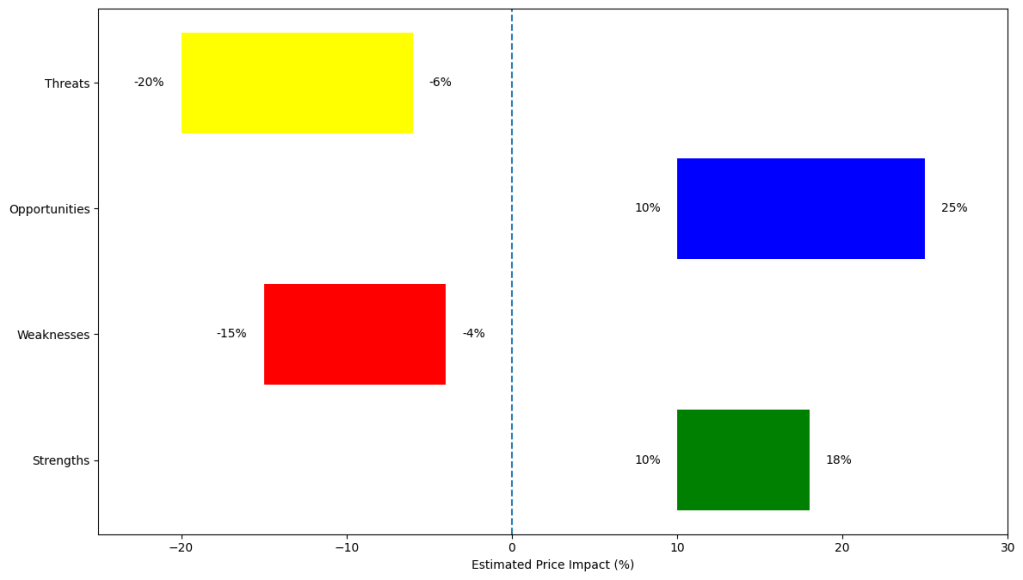
Horizontal SWOT price impact chart for Vertiv Q4 2025 earnings showing estimated stock price impact ranges: Strengths +10% to +18%, Opportunities +10% to +25%, Weaknesses –15% to –4%, and Threats –20% to –6%, with X-axis ranging from –25% to +30%.
Vertiv Q4 2025 SWOT analysis showing estimated price impact ranges across strengths, weaknesses, opportunities, and threats, reflecting AI infrastructure demand, backlog strength, and valuation sensitivity.

Valuation Scenarios

Vertiv guided to approximately $6.02 adjusted EPS for FY2026. Valuation sensitivity now revolves around multiple sustainability.

Bear Case

EPS: $5.80

Multiple: 22x

Price Target: $128

Base Case

EPS: $6.02

Multiple: 27x

Price Target: $163

Bull Case

EPS: $6.30

Multiple: 32x

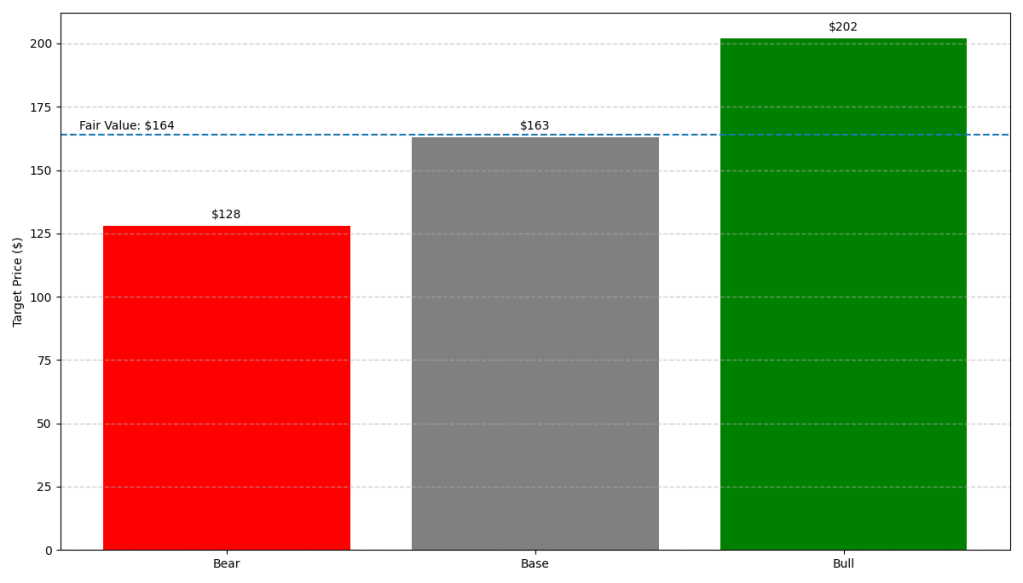
Price Target: $202

Probability-Weighted Fair Value

Fair value ≈ $164

Disciplined fair value using only management guidance and a conservative 25x multiple: ~$150

Vertical valuation scenarios chart for Vertiv Q4 2025 earnings showing Bear case price target of $128, Base case $163, Bull case $202, with a dashed fair value line at $164.
Vertiv Q4 2025 valuation scenarios illustrating Bear ($128), Base ($163), and Bull ($202) price targets based on 2026 EPS guidance, with a probability-weighted fair value of approximately $164.

Verdict

Vertiv is executing.

Demand is real. Backlog is strong. Margins are expanding.

The risk is no longer operational — it’s valuation compression if AI capex momentum slows or if execution stumbles even slightly.

At prices near or below $150, the stock offers a reasonable risk-reward profile for growth investors.

Above that range, it becomes increasingly expectation-driven.


Call to Action

If you found this breakdown helpful, follow SWOTstock for disciplined earnings analysis that separates fundamentals from narrative.

We focus on what the numbers say — not what the hype suggests.


Disclaimer

This analysis is for informational purposes only and does not constitute financial advice. Always conduct your own research before making investment decisions.

Coca-Cola (KO) Q4 2025 Earnings: Steady Compounder or Fully Priced Defensive?

Coca-Cola reported stable Q4 and full-year 2025 results, with modest revenue growth and solid EPS. Guidance for 2026 points to mid-single-digit revenue growth and high-single-digit EPS growth. Valuation remains crucial, with fair value estimated between $60–$64. Investors must weigh the stock’s durability against its premium pricing.

TL;DR Summary

Coca-Cola delivered stable Q4 and full-year 2025 results, but nothing that changes the long-term thesis. Revenue slightly missed expectations, EPS was solid, and 2026 guidance points to mid-single-digit organic growth and high-single-digit EPS growth.

For DIY value investors, this remains a quality compounder — but valuation discipline matters. My fair value estimate sits around $60–$64, suggesting limited upside unless growth accelerates.


Quarter Recap

The Coca-Cola Company reported Q4 and full-year 2025 earnings on February 10, 2026.

Key takeaways from the quarter:

  • Q4 revenue grew modestly year-over-year but slightly missed consensus expectations
  • Global unit case volume increased ~1%
  • Net income rose modestly, reflecting stable margins
  • Full-year organic revenue growth was around ~5%
  • 2026 guidance calls for ~4–5% organic revenue growth and ~7–8% adjusted EPS growth

Nothing broke. Nothing accelerated dramatically either.

This is exactly what Coca-Cola has become: a steady, predictable, cash-flow-driven business.


Key Highlights

  • Volume resilience: Global volumes still growing despite mature markets
  • Pricing power intact: Revenue growth supported by pricing and mix
  • Margin stability: Operating discipline preserved profitability
  • Defensive profile maintained: Cash flow strength supports dividends and capital returns
  • Guidance steady, not exciting: Mid-single-digit organic growth outlook

The market reaction was mildly negative — largely due to the revenue miss and lack of upside surprise.


SWOT Analysis

Coca-Cola remains one of the most durable consumer franchises globally. However, valuation is the key variable. For a Type 2 value investor, the debate is not about survival — it is about growth durability versus multiple compression.

Strengths

  • Global brand dominance and pricing powerEstimated price impact: +5% to +10%
  • Strong free cash flow and dividend profileEstimated price impact: +4% to +8%
  • Stable operating marginsEstimated price impact: +3% to +6%

Weaknesses

  • Low organic volume growth (~1%)Estimated price impact: -3% to -6%
  • Premium valuation relative to growth rateEstimated price impact: -5% to -10%
  • Currency exposure from global footprintEstimated price impact: -2% to -5%

Opportunities

  • Expansion of zero-sugar and premium offeringsEstimated price impact: +4% to +9%
  • Emerging market per-capita consumption growthEstimated price impact: +5% to +12%
  • Operational acceleration under new leadershipEstimated price impact: +2% to +6%

Threats

  • Sugar taxes and regulatory pressuresEstimated price impact: -4% to -8%
  • Consumer trade-down in weaker macroEstimated price impact: -3% to -7%
  • Commodity cost volatilityEstimated price impact: -2% to -6%
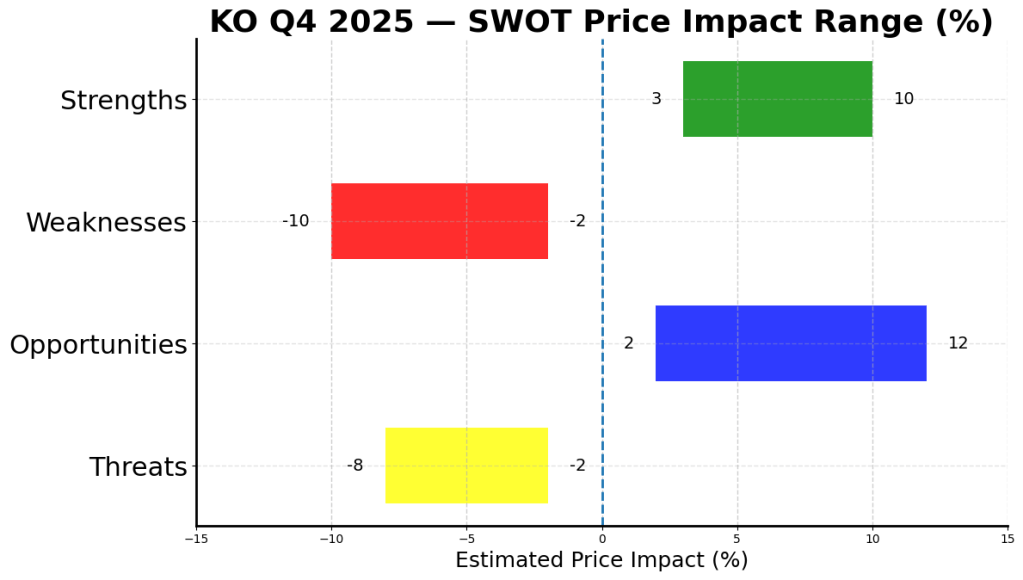
SWOT price impact range chart for Coca-Cola (KO) Q4 2025 earnings showing estimated stock price impact ranges: Strengths +3% to +10%, Weaknesses -10% to -2%, Opportunities +2% to +12%, and Threats -8% to -2%, with X-axis starting at -15%.
Coca-Cola (KO) Q4 2025 SWOT price impact analysis. Strengths and Opportunities provide upside support of up to +10–12%, while valuation risk and growth limitations create downside exposure of -8% to -10%. Estimated fair value remains near current trading levels, suggesting limited multiple expansion without growth acceleration.

Valuation Scenarios

Coca-Cola is not a high-growth stock. It is a defensive compounder. That means valuation depends primarily on earnings durability and acceptable multiple range.

Assumptions:

  • 2025 adjusted EPS ≈ $2.60
  • 2026 expected EPS ≈ $2.80 (midpoint growth assumption)
  • Historical defensive P/E range: 20x–26x

Bear Case

  • Growth slows to ~3%
  • Multiple compresses to ~20x
  • Target price ≈ $52
  • Probability: 30%

Base Case

  • Organic growth ~4–5%
  • Multiple stabilizes around ~23x
  • Target price ≈ $60
  • Probability: 50%

Bull Case

  • EPS growth accelerates to ~9–10%
  • Multiple expands to ~25x
  • Target price ≈ $65
  • Probability: 20%

Probability-Weighted Fair Value

Estimated fair value: ~$58–$62

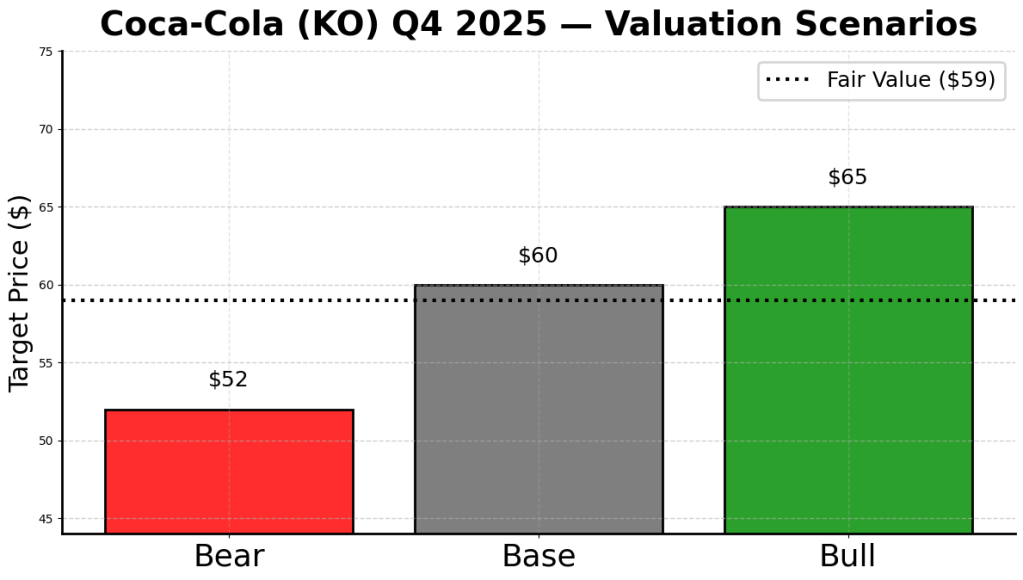
Valuation scenarios chart for Coca-Cola (KO) Q4 2025 showing Bear case target price of $52, Base case $60, and Bull case $65, with a dotted fair value line at $59.
Coca-Cola (KO) Q4 2025 valuation scenarios. The Bear case assumes multiple compression and slower growth ($52), the Base case reflects steady compounding ($60), and the Bull case assumes modest acceleration and premium valuation ($65). Probability-weighted fair value is approximately $59, indicating limited upside without growth acceleration.

Verdict

Coca-Cola remains one of the safest consumer franchises globally. But at today’s valuation, investors are paying for stability, not acceleration.

For value investors:

  • Below $58 → Attractive entry
  • Around $60 → Fair value
  • Above $65 → Fully priced defensive

This is no longer a turnaround story. It is a disciplined compounding story.


Call to Action

If you are a DIY value investor, the key question is simple:

Are you buying durability at a reasonable price — or paying a premium for safety?

Follow SWOTstock for structured, valuation-driven analysis on quality businesses.


Disclaimer

This analysis is for informational and educational purposes only and does not constitute investment advice. Always conduct your own research and consult a financial professional before making investment decisions.