Cisco Q1 FY 2026 – AI Demand Lifts Guidance, But Valuation Looks Full

Cisco’s fiscal 2026 began strongly, with revenue up 8% to $14.9 billion and non-GAAP EPS up 10% to $1.00. Management raised guidance due to AI orders and Splunk integration. Despite this, Cisco trades above historic valuation levels at $74, making it less attractive for value investors seeking bargains.

🧭 TL;DR Summary

Cisco (CSCO:NASDAQ) delivered a strong start to fiscal 2026: revenue rose 8 % to $14.9 billion and non-GAAP EPS jumped 10 % to $1.00. Management raised full-year guidance on accelerating AI-network orders and early progress integrating Splunk. Yet, after the 6 – 8 % post-earnings surge, Cisco trades well above its historic valuation range. For value investors, it remains a reliable dividend engine—but hardly a bargain at $74.


📅 Quarter Recap

  • Revenue: $14.9 billion (+8 % YoY)
  • GAAP EPS: $0.72 (+6 %)  Non-GAAP EPS: $1.00 (+10 %)
  • Gross Margin: 65.5 % (GAAP) / 68.1 % (non-GAAP)
  • Operating Cash Flow: $3.2 billion (–12 % YoY)
  • Shareholder Returns: $2 billion buybacks + $0.41 dividend
  • Guidance: FY 2026 revenue ≈ $60.6 billion; non-GAAP EPS $4.08 – 4.14

AI-driven switching orders, stronger software renewals, and Splunk integration boosted confidence, while recurring subscription revenue rose to 44 % of total sales—proof that Cisco’s transformation is gaining traction.


🔍 Key Highlights

  • AI Infrastructure Momentum: Backlog > $1 billion in AI network orders.
  • Subscription Strength: Security + observability software sustain recurring growth.
  • Margin Discipline: Gross margins above 65 % despite input inflation.
  • Capital Returns: Consistent buybacks and ~2 % dividend yield signal balance-sheet strength.
  • Execution Watch: Operating cash flow fell 12 %, and analysts seek clearer AI-revenue disclosure before assigning higher multiples.

💪 SWOT Analysis (with estimated price impact ranges)

Strengths (+8 % to +12 %)
Cisco’s expanding recurring-revenue base and tight cost control anchor earnings stability. Its balance sheet is debt-light and supports steady buybacks and dividends—attributes valued by income investors.

Weaknesses (–5 % to –8 %)
Hardware still drives over 40 % of sales, leaving results exposed to ordering cycles. Operating cash flow slid 12 %, reflecting inventory timing and working-capital drag. Without transparent AI-revenue reporting and faster cash-conversion, valuation upside is hard to justify.

Opportunities (+10 % to +15 %)
AI-infrastructure spending offers a fresh growth lane. The Silicon One platform and Splunk integration can unlock new data and security use cases, while Hypershield subscriptions could lift software margins 1 – 2 points. Execution on these fronts may re-rate Cisco toward 15× earnings.

Threats (–7 % to –10 %)
Rivals such as Arista, Palo Alto Networks, and Juniper’s Mist unit are capturing AI-network share faster. Cisco’s portfolio breadth can appear complex to customers seeking simpler cloud-native solutions. Macro slowdown or AI-capex pause would test both hardware and optics segments.

Horizontal bar chart titled ‘Cisco Q1 FY 2026 – SWOT Price Impact Range ($)’. The chart shows estimated price impact ranges for Strengths (+8 to +12, green), Weaknesses (–8 to –5, red), Opportunities (+10 to +15, blue), and Threats (–10 to –7, yellow). Vertical dashed line at zero with horizontal axis from –20 to 20 dollars, representing balanced upside and downside factors.

📈 Valuation Scenarios (Based on FY 2026 Guidance)

Bull Case (~30 % probability)

  • AI network revenue grows +10 %, software margins expand 100 bps.
  • EPS ≈ $4.20, 15× multiple → fair value ≈ $63.
  • Requires strong backlog conversion and clear AI execution proof.

Base Case (~50 %)

  • 6 % steady growth, EPS ≈ $4.10, 14× multiple → fair value ≈ $57.
  • Most probable path given guidance and macro conditions.

Bear Case (~20 %)

  • Flat revenue and AI order delays, EPS ≈ $3.80, 12× multiple → fair value ≈ $46.
  • Reflects execution or macro slippage.

Weighted Fair Value: ≈ $58 per share (~8 % below current $74 price).

Bar chart titled ‘Cisco Q1 FY 2026 – Valuation Scenarios’. The Bear case shows $46 (20 %, red bar), the Base case shows $57 (50 %, gray bar), and the Bull case shows $63 (30 %, green bar). A horizontal dashed line marks the probability-weighted fair value at approximately $56.6, labeled in purple text.

🔭 Forward Checkpoints to Monitor

  • Q2 AI-network bookings growth and conversion rate.
  • Recurring revenue as % of total (45 % target watch).
  • Cash-flow recovery trend and Splunk synergy delivery.
  • Competitive pricing in Ethernet and optics segments.

💡 Verdict

Cisco’s AI story is credible but largely priced in. At ~18× forward earnings, shares sit above their five-year average. Cash generation remains solid and the dividend safe, yet the margin of safety is thin after the rally.

  • Fair Price: ≈ $58 / share
  • Buy-Under Level: ≈ $55
  • Action: Hold for income; wait for a pullback before adding.

📣 Call to Action

Dividend investors should keep Cisco on their watchlist but avoid chasing momentum. Add on weakness below $55 to lock in a better yield and valuation margin.


⚖️ Disclaimer

This analysis is based solely on Cisco Systems’ official Q1 FY 2026 financial report and earnings call materials. It is for informational purposes only and not investment advice. Always verify figures with official sources and consider personal risk tolerance before investing.


💼 JPMorgan Q3 2025 Earnings — The Fortress Bank Tightens Its Grip on Stability

JPMorgan Chase’s Q3 2025 results showcase strong performance with EPS of $5.07 and a net income of $13.7 billion. Investment banking surged 25%, and AI efficiencies are enhancing operations. The stock, currently at $308, appears undervalued with a fair value of $328, making it a solid choice for long-term investors.

TL;DR Summary

JPMorgan Chase (JPM:NYSE) once again proved why it’s considered Wall Street’s fortress.
Third-quarter earnings beat expectations, investment banking is rebounding, and AI-driven efficiency is quietly reshaping operations.
At around $308 per share, the stock looks slightly undervalued with a fair value near $328 — steady upside for long-term value investors.


Quarter Recap

On October 14, 2025, JPMorgan reported EPS $5.07 on $46.4 billion in revenue, up about 9 percent year over year.
Net income reached $13.7 billion, with ROTCE 24 percent and ROE 20 percent, both exceptional for a global bank.
The company raised its full-year net interest income guidance to roughly $93 billion (excluding Markets), signaling confidence in margin stability.

CEO Jamie Dimon described the U.S. economy as “resilient but still pressured,” while emphasizing that AI adoption is already driving measurable productivity gains across fraud detection, operations, and client service.


Key Highlights

  • Investment banking surged 25 percent year over year, led by stronger M&A and equity underwriting.
  • Net interest income continued to climb, supported by robust consumer deposits.
  • Wealth and asset management hit record levels: $4.7 trillion AUM with $80 billion in net inflows.
  • Capital strength: CET1 ratio rose to 14.3 percent; management plans ≈ $30 billion in dividends and buybacks.
  • Credit quality: Card loss rates normalized to ~2.6 percent — still well below pre-pandemic levels.

Market response was positive: the stock climbed roughly 3 percent to $310 following the release, as investors rewarded its steady execution.


SWOT Analysis (12-Month Price-Impact View)

Strengths (+ $15 to + $25)

  • Industry-leading ROE (20 %) and ROTCE (24 %) sustain premium valuation.
  • Fortress capital position (CET1 14.3 %) supports $30 B capital return program.
  • AI and automation enhance efficiency and risk controls.
  • Diversified revenue mix limits cyclicality across business lines.

Weaknesses (– $10 to – $18)

  • Deposit costs rising faster than loan yields — NII growth plateau ahead.
  • Consumer credit losses slowly normalizing.
  • Technology and compliance investments pressure short-term margins.

Opportunities (+ $8 to + $20)

  • Revival in deal-making and capital markets fees.
  • Continued wealth inflows boost recurring revenues.
  • Efficiency gains from AI could add ~3 % EPS growth through 2026.

Threats (– $12 to – $20)

  • Potential U.S. slowdown reducing loan demand.
  • Basel III Endgame rules may tighten capital buffers.
  • Global market volatility could curb trading income.
A bar graph illustrating the SWOT analysis for JPMorgan Chase's Q3 2025 price impact range, featuring four colored bars representing strengths, weaknesses, opportunities, and threats, with corresponding estimated price impact values.
SWOT analysis of JPMorgan’s price impact range for Q3 2025, highlighting strengths, weaknesses, opportunities, and threats.

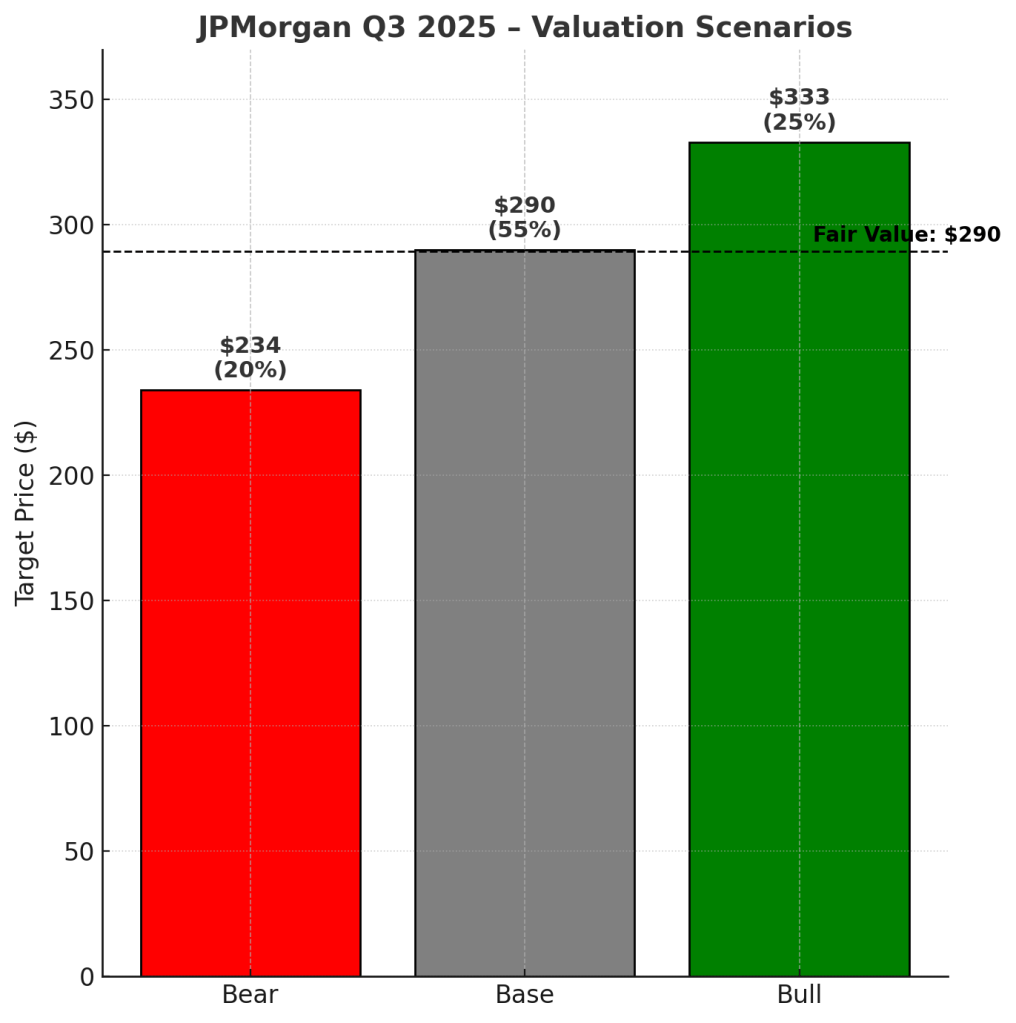
Valuation Scenarios

  • Bull (+ 20 %) → $370
    • Net interest income stays high, AI efficiency adds ~3 % to EPS, and P/B expands to 1.9×.
  • Base (+ 5 %) → $325
    • Stable credit costs and moderate growth support 1.7× P/B multiple.
  • Bear (– 10 %) → $277
    • Economic soft landing turns shaky; credit loss > 3 %, multiple compresses to 1.5×.

Probability-weighted fair value: ≈ $328 per share, implying a 6–7 % upside from the current $308.

Bar chart illustrating valuation scenarios for JPMorgan in Q3 2025, with target prices for Bear ($234), Base ($290), and Bull ($333), highlighting the fair value at $290.
JPMorgan Q3 2025 Valuation Scenarios: Bear, Base, and Bull target prices with fair value highlighted.

Fair Price Assessment

The valuation rests on JPMorgan’s own fundamentals — not sentiment.
At 24 percent ROTCE and 1.7× book value, shares reflect fortress-level returns with room for modest re-rating.
AI efficiency and buybacks should sustain mid-single-digit EPS growth, keeping the fair price range between $315 and $340.


Verdict

JPMorgan is the definition of a fortress value stock — disciplined, diversified, and resilient.
It won’t outpace Silicon Valley, but its consistency and capital strength make it a cornerstone holding for long-term DIY value investors.
If you’re seeking steady dividends and defensive growth in an uncertain rate environment, this remains one of the best-managed banks in the world.


Call to Action

Track how AI efficiency unfolds across JPMorgan’s business lines in the coming quarters.
If those gains compound like its interest income, the “fortress bank” might quietly build its next growth engine.


Disclaimer

This analysis is for informational purposes only and is based solely on JPMorgan Chase’s official Q3 2025 financial report and earnings call transcript.
It does not constitute investment advice or a recommendation to buy or sell securities.


Louisiana-Pacific: Siding Powers Ahead as OSB Drags — Is This a Buy on Weakness?

Louisiana-Pacific (LPX) reported Q2 2025 earnings with strong siding performance, revenue of $755M, but missed EPS expectations due to OSB weakness. Siding now constitutes 88% of EBITDA, reflecting the company’s shift from commodity reliance. Despite macro challenges, LPX presents value for investors, maintaining a stable dividend and strong liquidity.

TL;DR

Louisiana-Pacific (LPX) reported Q2 2025 results showing record siding performance but an OSB-driven EPS miss. With siding now ~88% of EBITDA, the company’s transformation away from commodity cyclicality is well underway. At ~$90.81, LPX trades near our tariff-adjusted bear-case range, offering potential value for patient investors despite macro and policy headwinds.


Quarter Recap

In Q2 2025, LPX generated $755M in revenue (–$60M YoY). Siding Solutions grew 11% to $460M in sales, achieving record EBITDA of $125M with ~27% margins. OSB revenue fell $101M, with margins collapsing to ~8%. Adjusted EPS of $0.99 missed consensus by ~$0.09, mainly due to OSB weakness. Liquidity remains strong at $1.1B with no revolver debt, and the dividend of $0.28/share was maintained.


Key Highlights

Siding’s resilience, paired with OSB’s deep pricing trough, defined Q2’s results. LPX continued to shift its earnings mix toward siding, enhancing margin stability.

Highlights:

  • Record Siding EBITDA: $125M, +11% YoY sales, +8% volume, +2% price/mix.
  • OSB Weakness: $19M EBITDA vs. ~$130M a year ago.
  • Segment Mix Shift: Siding share of EBITDA up from ~47% in 1H24 to ~76% in 1H25.
  • Capex Discipline: FY25 cut by $60M to $350M.
  • Dividend: $0.28/share, ~1.2% yield, payout ratio ~28%.
  • Buyback: $177M authorization remaining.

SWOT Analysis with Price Impacts

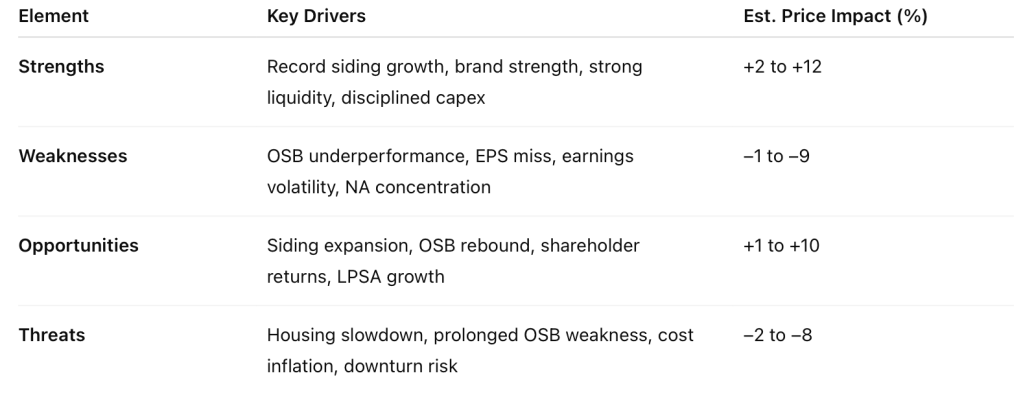
LPX’s strengths lie in siding-led growth, brand equity, and a strong balance sheet. Weaknesses remain in OSB’s commodity exposure and concentrated North American footprint. Opportunities include further siding penetration, eventual OSB recovery, and international expansion. Threats are led by housing softness, tariff risk, and cost inflation.


SWOT Summary

SWOT analysis table for Louisiana-Pacific (LPX) Q2 2025 showing strengths, weaknesses, opportunities, and threats with estimated stock price impact ranges in percentages.
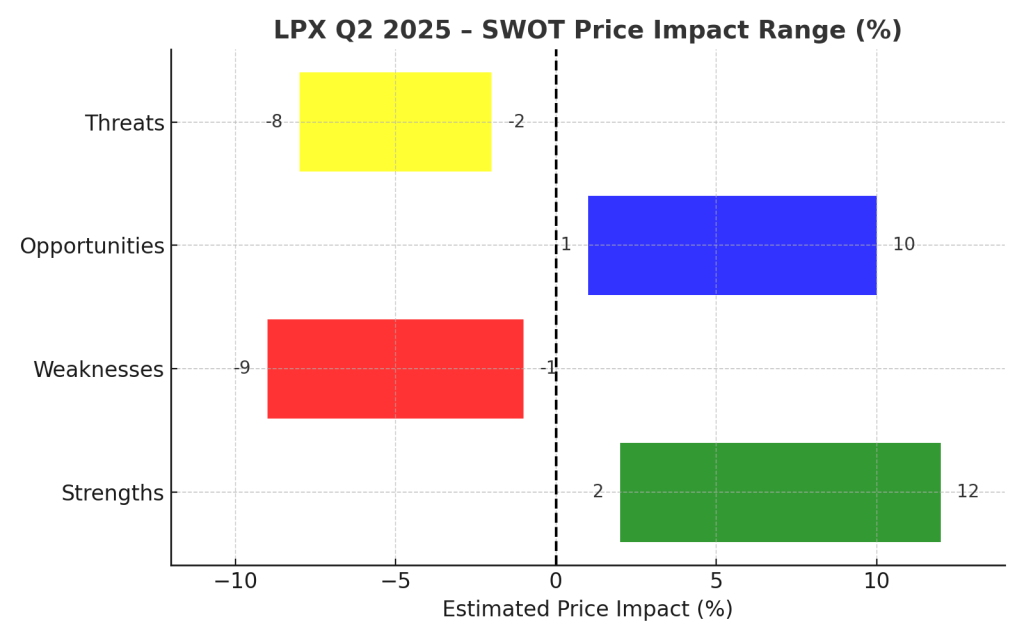
Louisiana-Pacific (LPX) Q2 2025 SWOT analysis price impact chart showing estimated stock price change ranges for each category: Strengths (+2% to +12%), Weaknesses (–9% to –1%), Opportunities (+1% to +10%), and Threats (–8% to –2%), with a zero-percent reference line for context.

Valuation Scenarios – Narrative + Table

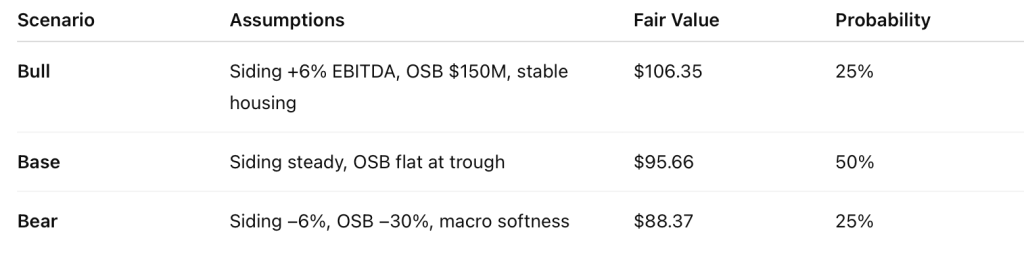
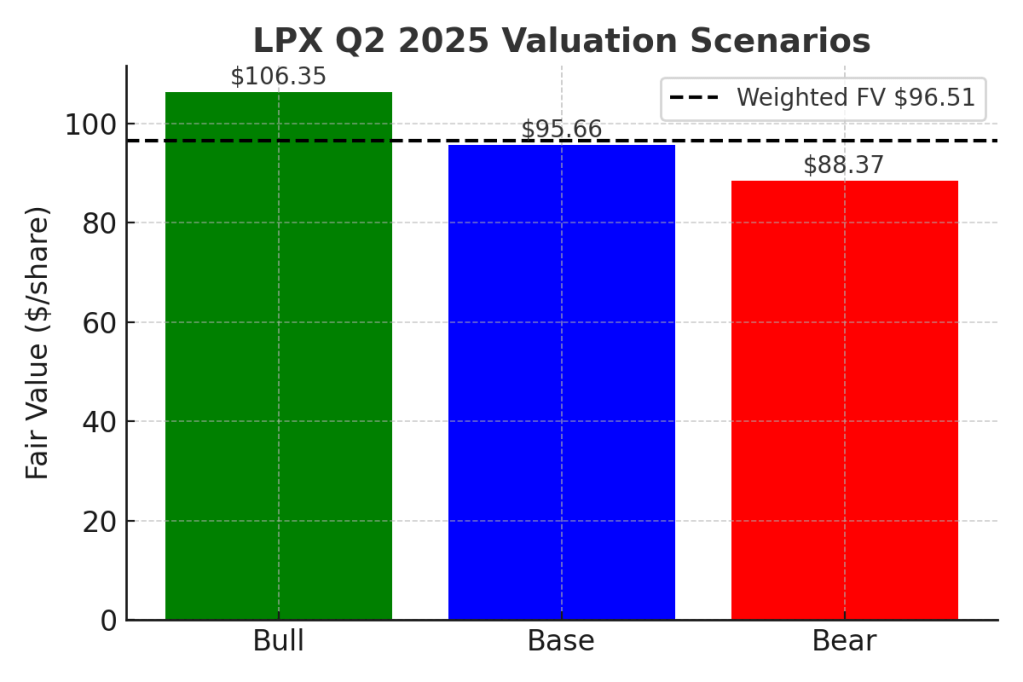
We model three 12-month outcomes based on SWOT drivers:

Valuation scenarios table for Louisiana-Pacific (LPX) Q2 2025 showing bull, base, and bear case assumptions, fair value estimates, and probability weightings.
Bar chart of Louisiana-Pacific (LPX) Q2 2025 valuation scenarios showing bull case at $106.35, base case at $95.66, and bear case at $88.37 per share. A dotted horizontal line marks the probability-weighted fair value at $96.50, illustrating potential stock price outcomes under different market conditions.

Probability-Weighted Fair Value

(0.25×106.35)+(0.50×95.66)+(0.25×88.37)≈96.51(0.25×106.35)+(0.50×95.66)+(0.25×88.37)≈96.51

Fair Value Estimate~$96.50/share (12-month outlook, excluding severe tariff shocks)

Verdict – Buy/Hold/Sell with Reasoning

For Value Investors, LPX is slightly undervalued on a macro-adjusted basis. The siding transformation is delivering stable margins, OSB is a smaller earnings contributor, and the dividend appears safe. Tariff and macro risks remain, but current pricing offers a margin of safety.
ActionHold/Add on dips at $88–90, target $96–100 over 12 months.


Call to Action

Want more building-product stock breakdowns with segment-level insight and AI-optimized formats? Subscribe to SWOTstock for in-depth valuations and macro risk analysis.


Disclaimer

This analysis is for informational purposes only and is not financial advice. Based solely on LPX’s Q2 2025 official filings, earnings call, and management commentary. Investing in equities involves risk, including loss of principal.


Leave a comment