Berkshire Hathaway FY2025: Still a Compounding Machine — But Is There Enough Margin of Safety?

Berkshire Hathaway’s FY2025 results showed a slight decline in operating earnings and increased insurance volatility, yet the company holds a record cash position of over $370B. With disciplined capital allocation under CEO Greg Abel, the stock trades near its intrinsic value at around $500 per share, offering limited margin of safety for value investors.

TL;DR Summary

Berkshire Hathaway’s FY2025 results showed softer operating earnings and insurance volatility, yet the balance sheet has never been stronger. With over $370B in cash and disciplined capital allocation under Greg Abel, the long-term compounding story remains intact. However, at around $500 per BRK.B share, the stock appears close to fair value. For DIY value investors, the key question is no longer quality — it’s margin of safety.


Quarter Recap

Berkshire Hathaway reported FY2025 results in late February 2026. Operating earnings declined modestly year-over-year, reflecting weaker insurance underwriting and investment writedowns. GAAP net income was more volatile due to mark-to-market adjustments in the equity portfolio.

Despite softer earnings, Berkshire ended the year with a record cash position exceeding $370B. Share repurchases remained limited, and the company was a net seller of equities during much of the year.

This was also the first full annual report under CEO Greg Abel, marking a formal transition from the Buffett era while maintaining the same capital allocation philosophy.


Key Highlights

• Operating earnings declined modestly year-over-year

• Insurance underwriting results weakened in Q4

• Cash & equivalents reached record levels (~$370B+)

• No major acquisition deployed despite large liquidity

• Leadership transition to Greg Abel formally underway

• Equity portfolio remains concentrated in high-quality holdings


SWOT Analysis

Berkshire is not an earnings-momentum stock. It is a capital allocator built for long-term compounding. FY2025 did not break the story — but it did test investor patience. For value investors, durability matters more than quarterly growth.


Strengths

• Massive cash position providing downside protection and acquisition optionality

Estimated Price Impact: +5% to +12%

• Diversified operating businesses (insurance, rail, energy, manufacturing)

Estimated Price Impact: +4% to +8%

• Long-standing capital allocation discipline now reinforced under Abel

Estimated Price Impact: +3% to +7%

• High-quality equity portfolio generating dividends and embedded gains

Estimated Price Impact: +4% to +10%


Weaknesses

• Insurance earnings volatility and catastrophe exposure

Estimated Price Impact: -3% to -8%

• Slower organic growth relative to high-growth market leaders

Estimated Price Impact: -2% to -6%

• Leadership transition uncertainty in post-Buffett era

Estimated Price Impact: -3% to -7%


Opportunities

• Large-scale acquisition during market downturn

Estimated Price Impact: +8% to +15%

• Improvement in insurance pricing cycle

Estimated Price Impact: +4% to +9%

• Opportunistic share buybacks below intrinsic value

Estimated Price Impact: +5% to +10%


Threats

• Major insurance catastrophe event

Estimated Price Impact: -6% to -15%

• Significant equity portfolio drawdown

Estimated Price Impact: -5% to -12%

• Prolonged inability to deploy excess cash effectively

Estimated Price Impact: -3% to -8%
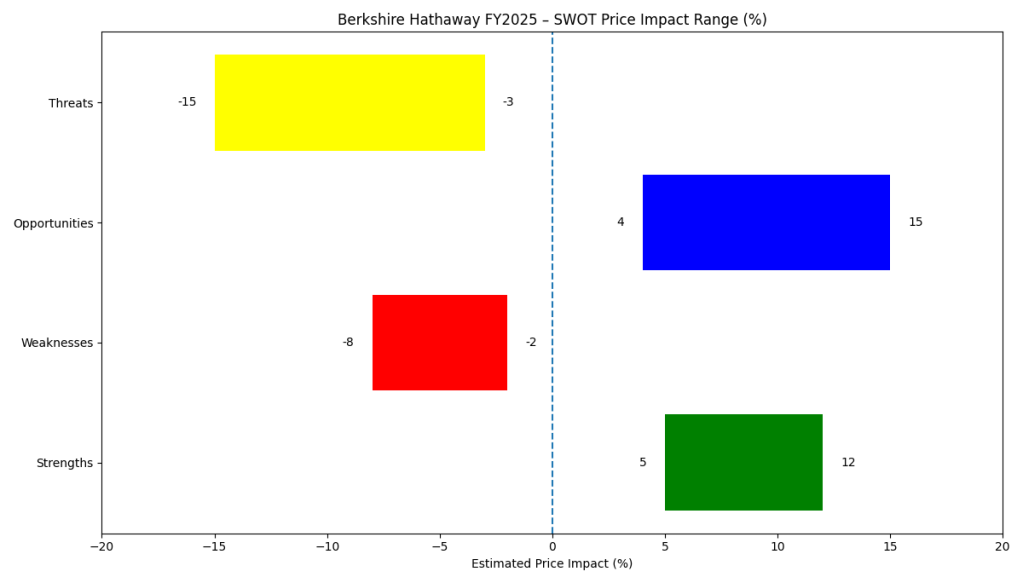
Horizontal SWOT price impact bar chart for Berkshire Hathaway FY2025 showing full percentage ranges: Strengths (+5% to +12%), Opportunities (+4% to +15%), Weaknesses (-8% to -2%), and Threats (-15% to -3%), with a vertical dashed zero line.
Berkshire Hathaway FY2025 SWOT price impact ranges highlight asymmetric downside risk from insurance volatility (-15%) versus upside potential from capital deployment and earnings normalization (+15%).

Valuation Scenarios (based on BRK.B)

Berkshire should be valued on normalized operating earnings rather than GAAP net income due to mark-to-market volatility. Using conservative assumptions aligned with Buffett-style valuation discipline:


Bear Case

Flat or declining operating earnings

14× earnings multiple

No major capital deployment

Implied Price Target: $430

Probability: 30%


Base Case

4–6% operating earnings growth

16× earnings multiple

Gradual capital deployment

Implied Price Target: $505

Probability: 50%


Bull Case

8–10% earnings growth

Successful large acquisition

18× earnings multiple

Implied Price Target: $580

Probability: 20%


Probability-Weighted Fair Value:

≈ $498
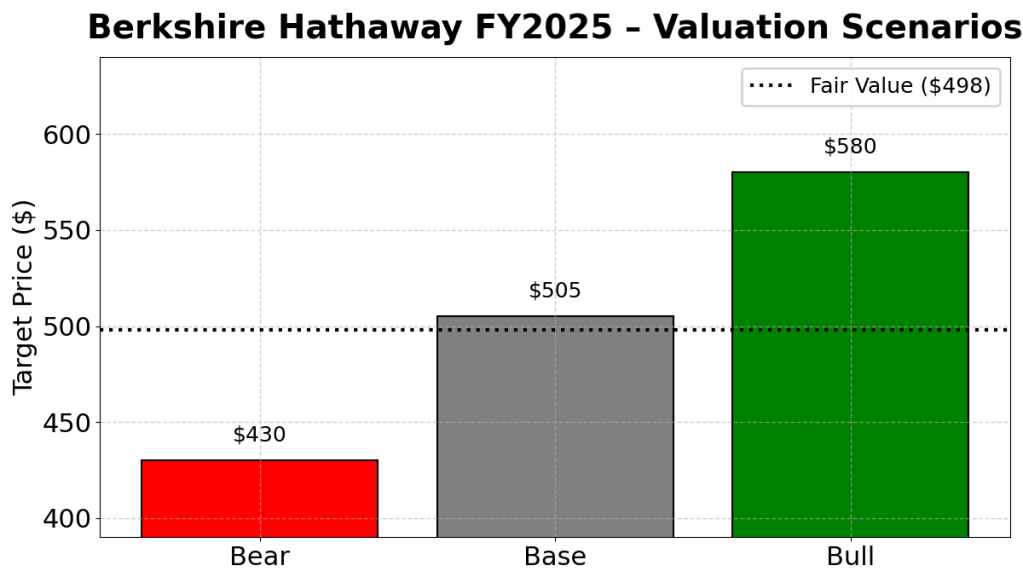
Vertical valuation scenarios bar chart for Berkshire Hathaway FY2025 showing Bear case at $430 (red), Base case at $505 (gray), and Bull case at $580 (green), with a dotted fair value line at $498.
Berkshire Hathaway FY2025 valuation scenarios range from $430 in a bear case to $580 in a bull case, with a probability-weighted fair value estimate of approximately $498 per share.

Verdict

Berkshire Hathaway remains one of the highest-quality capital allocators in the world. The balance sheet strength is extraordinary, and the business model remains durable.

However, at roughly $500 per BRK.B share, the stock trades close to intrinsic value under conservative assumptions. There is limited margin of safety unless earnings growth accelerates or a large acquisition creates incremental intrinsic value.

For DIY value investors, Berkshire is still a core compounding vehicle — but not a deep bargain today.


Call to Action

If you are building a long-term value portfolio, ask yourself:

Are you buying Berkshire for safety, or for upside?

Follow SWOTstock for structured, investor-focused earnings analysis grounded in intrinsic value logic — not headlines.


Disclaimer

This article is for informational purposes only and does not constitute investment advice. Investors should conduct their own research and consider their financial circumstances before making investment decisions.
Intuit Q2 FY2026 Earnings: Strong Growth, Softer Guidance — Is the AI Tax Giant Mispriced?

Intuit reported a strong Q2 FY2026 with 17% revenue growth, meeting full-year guidance despite weakened near-term profit expectations affecting stock prices. Trading around $400 per share, its valuation is considered low for its growth potential. Analysts are debating whether market fears over AI disruptions are warranted or an overreaction.

TL;DR Summary

Intuit (INTU:NASDAQ) delivered solid Q2 FY2026 results with 17% revenue growth and reaffirmed full-year guidance. However, softer near-term profit expectations pressured the stock.

At roughly $400 per share, Intuit trades around 17x forward EPS — a valuation typically reserved for slower software companies. Based on management’s official guidance and structural economics, fair value appears closer to the $620–$690 range.

The key question: Is the market pricing in real structural risk — or overreacting to temporary guidance noise?


Quarter Recap

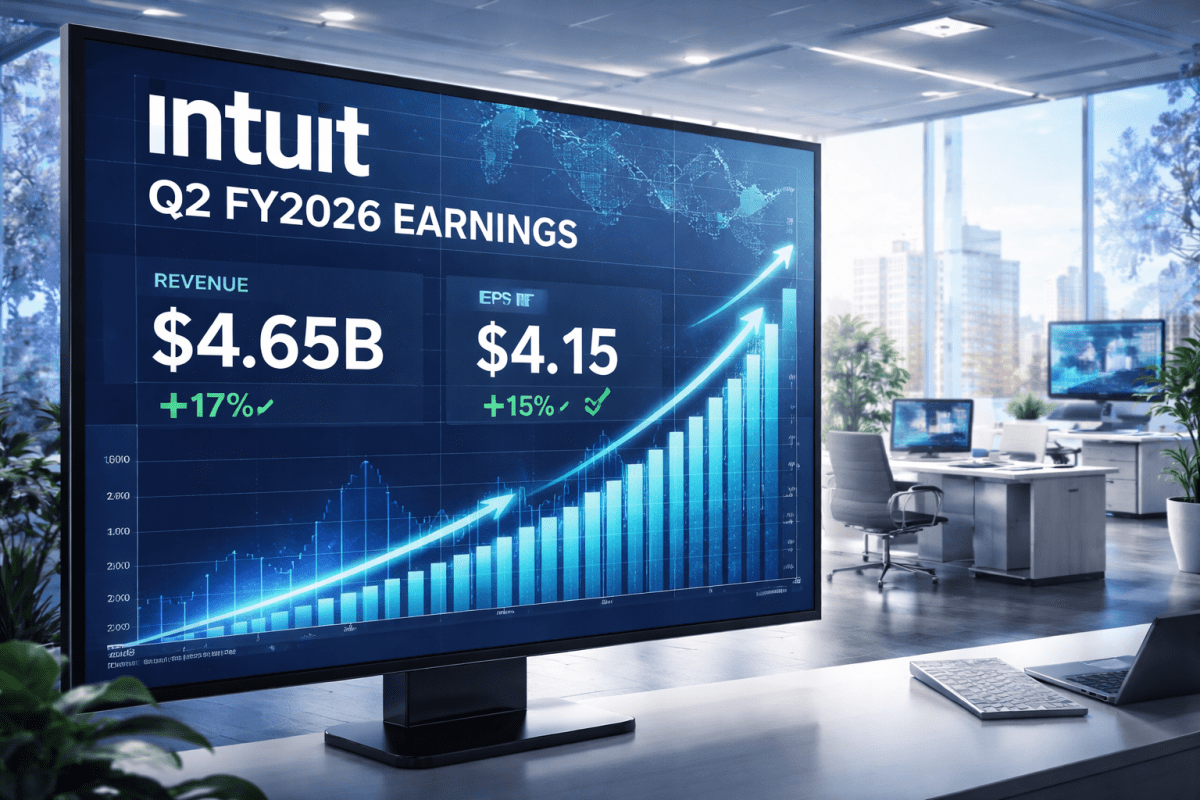
Intuit reported fiscal Q2 2026 revenue of approximately $4.65 billion, up 17% year-over-year. Non-GAAP EPS came in around $4.15, reflecting strong operating leverage.

Management reiterated full-year FY2026 guidance of roughly $21.0–$21.2 billion in revenue, implying 12–13% annual growth. Non-GAAP EPS guidance stands near $23.

The earnings headline was solid. The stock’s weakness was tied more to cautious short-term profit expectations related to tax-season investments than to any structural slowdown.


Key Highlights

  • Revenue growth remains double-digit at scale
  • High recurring subscription base continues expanding
  • Gross margins remain around 80%
  • Operating leverage intact
  • AI initiatives (Intuit Assist and ecosystem automation) positioned as growth accelerators
  • FY2026 revenue and EPS guidance reaffirmed

Nothing in the official release suggests moat erosion or structural decay.


SWOT Analysis

Intuit remains a high-margin ecosystem platform with durable recurring revenue. However, valuation compression reflects investor uncertainty around AI disruption and SMB macro sensitivity.

Strengths

  • Recurring subscription ecosystem (QuickBooks, TurboTax, Credit Karma)→ Estimated price impact: +8% to +12%
  • ~80% gross margins and operating leverage→ Estimated price impact: +5% to +8%
  • Cross-sell opportunities across SMB financial stack→ Estimated price impact: +6% to +10%

Weaknesses

  • Tax-season concentration and earnings seasonality→ Estimated price impact: -4% to -7%
  • Premium historical valuation leaves little room for short-term misses→ Estimated price impact: -6% to -10%
  • Integration risk from prior acquisitions→ Estimated price impact: -3% to -5%

Opportunities

  • AI-driven ARPU expansion via Intuit Assist→ Estimated price impact: +10% to +18%
  • Margin expansion through automation and scale→ Estimated price impact: +5% to +9%
  • Mid-market expansion beyond core SMB→ Estimated price impact: +6% to +12%

Threats

  • AI disruption in tax preparation and bookkeeping→ Estimated price impact: -8% to -15%
  • SMB macro slowdown→ Estimated price impact: -6% to -12%
  • Regulatory changes affecting tax complexity→ Estimated price impact: -5% to -10%
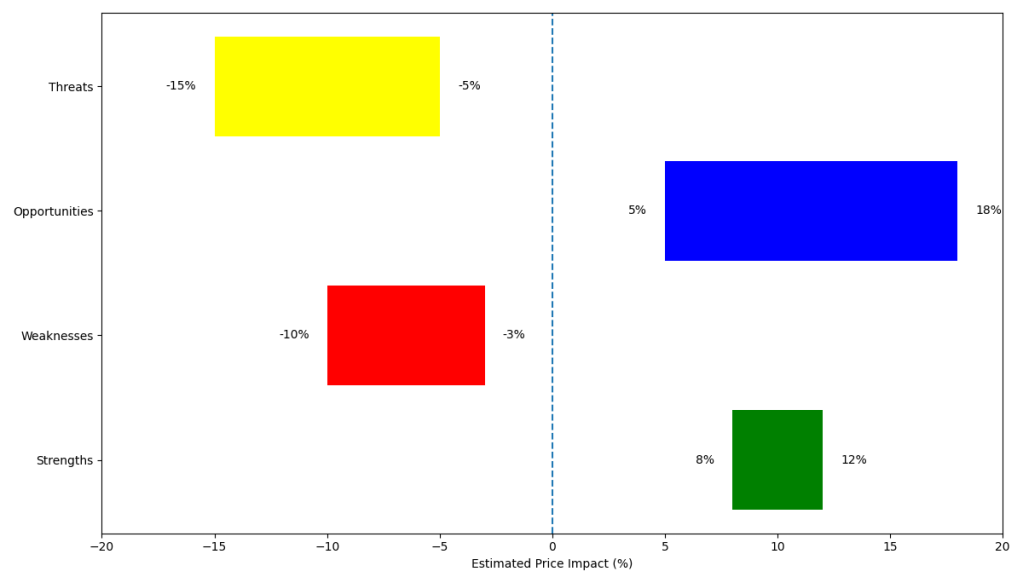
SWOT chart for Intuit Q2 FY2026 showing estimated price impact ranges: Strengths +8% to +12%, Weaknesses -10% to -3%, Opportunities +5% to +18%, and Threats -15% to -5%, with a vertical zero reference line and color-coded bars.
SWOT price impact range for Intuit Q2 FY2026, illustrating estimated upside from strengths and AI-driven opportunities versus downside risks from macro, valuation, and potential AI disruption factors.

Valuation Scenarios

Using FY2026 midpoint EPS guidance of ~$23:

Bear Case

  • Growth slows toward high single digits
  • AI monetization underwhelms
  • Forward multiple compresses to 25x

25 × $23 = $575

Probability: 25%


Base Case

  • Revenue growth sustained at 12–14%
  • AI supports retention but no explosive expansion
  • Multiple stabilizes around 27–30x

27–30 × $23 = $621–$690

Probability: 50%


Bull Case

  • AI meaningfully increases ARPU and operating leverage
  • EPS growth accelerates toward mid-teens
  • Multiple expands to ~34x

34 × $23 = $782

Probability: 25%


Probability-Weighted Fair Value

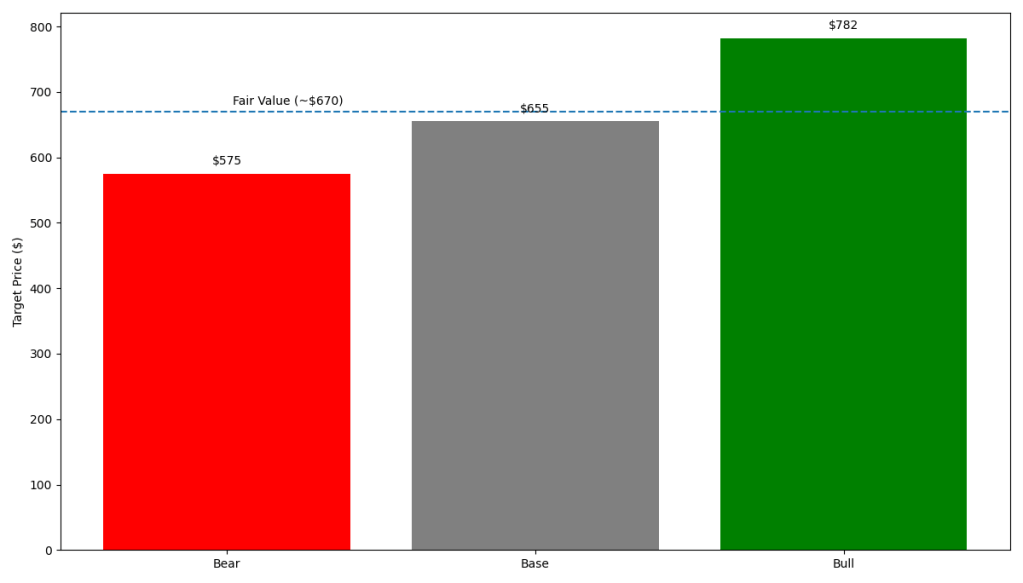
Approximately $655–$685 range, midpoint near $670.

Valuation scenarios chart for Intuit Q2 FY2026 showing Bear case target of $575, Base case $655, and Bull case $782, with a dashed fair value line around $670.
Valuation scenario analysis for Intuit Q2 FY2026, illustrating bear, base, and bull price targets with a probability-weighted fair value of approximately $670.

Verdict

At roughly $390 per share, Intuit trades closer to a cyclical software multiple than to a durable compounding platform.

Management guidance does not indicate structural deterioration. The current price implies significant embedded risk.

For long-term growth investors who believe Intuit can maintain double-digit revenue growth and defend its ecosystem through AI enhancement, the risk-reward profile appears asymmetrically positive.

The debate is not about whether Intuit is high quality.

It is about whether the market is overpricing disruption risk.


Call to Action

If you found this analysis useful, follow SWOTstock for structured earnings breakdowns that combine qualitative moat analysis with valuation discipline.

Next up: Should Intuit be valued like a mature tax software company — or like a platform AI compounder?


Disclaimer

This analysis is for informational purposes only and does not constitute investment advice. All figures are based on official company reports and guidance. Investors should conduct their own due diligence before making investment decisions.


Vertiv Q4 2025 Earnings: AI Infrastructure Momentum Is Real — But Is the Stock Ahead of It?

Vertiv reported strong Q4 2025 results with 23% revenue growth, a 252% increase in orders, and a $15 billion backlog, demonstrating solid AI infrastructure demand. Despite rising expectations and high valuation sensitivity, the company’s operational momentum and expanding margins present a favorable risk-reward profile for growth investors at prices around $150.

TL;DR Summary

Vertiv (VRT:NYSE) delivered a strong Q4 2025 with 23% revenue growth, massive order acceleration (+252% YoY), and a $15B backlog that reinforces AI infrastructure demand. Margins expanded and free cash flow remained robust.

However, expectations are now extremely high.

Using management’s official 2026 EPS guidance of ~$6.02 and a disciplined 25x multiple, fair value sits near $150 per share. Investors must now decide: is Vertiv an AI compounder — or an expectations trap?


Quarter Recap

Vertiv closed FY2025 with clear operational momentum.

Q4 net sales reached $2.88B, up roughly 23% year-over-year. Adjusted EPS came in at $1.36, while GAAP EPS was $1.14. The key driver was demand — not cost cutting.

Organic orders surged approximately +252% YoY, pushing backlog to nearly $15B. That backlog is critical. It provides visibility into 2026 and reflects hyperscaler and AI-related infrastructure demand.

Full-year 2025 revenue reached $10.23B, and adjusted EPS was $4.20. Operating cash flow exceeded $2.1B, and adjusted free cash flow totaled $1.89B.

Balance sheet leverage remains modest at approximately 0.5x net leverage.

Management guided for 2026:

  • Revenue: $13.25B – $13.75B
  • Adjusted EPS: $5.97 – $6.07
  • Operating margin: 22–23%
  • Free cash flow: $2.1B – $2.3B

This implies continued double-digit top-line growth and ~40%+ earnings growth at midpoint.


Key Highlights

• Revenue growth remains strong at 23% YoY

• Orders exploded +252% YoY

• Book-to-bill near 2.9x

• Backlog ~$15B

• Adjusted operating margin 23.2%

• 2026 EPS guidance midpoint ~$6.02

The real story is demand visibility, not just quarterly earnings.


SWOT Analysis

Vertiv is no longer being evaluated as a recovery industrial. It is being priced as a structural AI infrastructure enabler. That changes the risk profile entirely.

Strengths

• Massive order acceleration and backlog visibility

Estimated price impact: +10% to +18%

• Margin expansion and operational leverage

Estimated price impact: +6% to +10%

• Strong free cash flow and low leverage

Estimated price impact: +4% to +8%

Weaknesses

• GAAP EPS slight miss vs expectations

Estimated price impact: –4% to –7%

• High embedded expectations in valuation

Estimated price impact: –8% to –15% if growth moderates

Opportunities

• AI data-center density shift (liquid cooling, high power racks)

Estimated price impact: +15% to +25% over 12–24 months

• 2026 guidance execution driving multiple support

Estimated price impact: +10% to +20%

Threats

• Hyperscaler capex cyclicality

Estimated price impact: –12% to –20%

• Competitive margin pressure

Estimated price impact: –6% to –12%

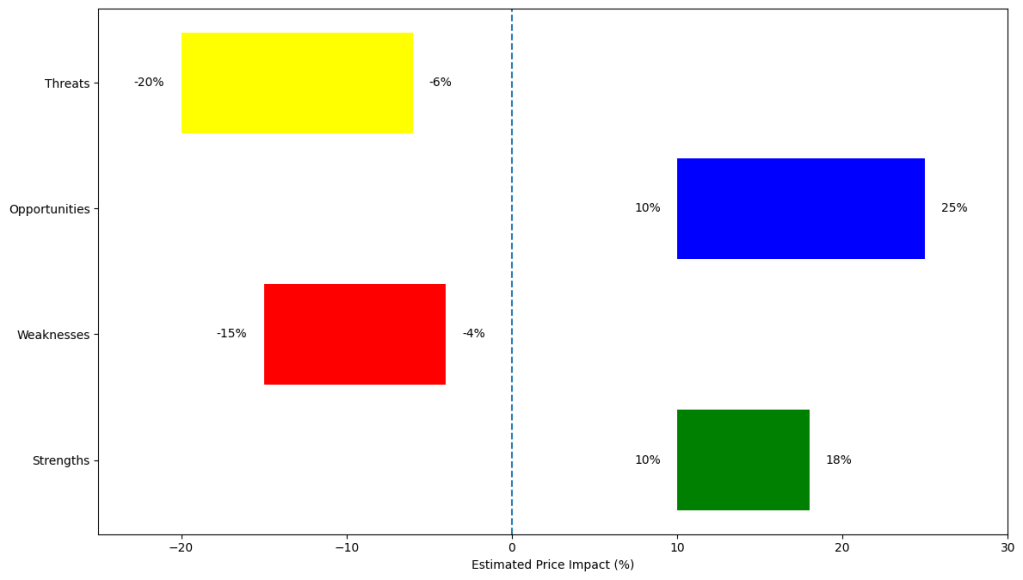
Horizontal SWOT price impact chart for Vertiv Q4 2025 earnings showing estimated stock price impact ranges: Strengths +10% to +18%, Opportunities +10% to +25%, Weaknesses –15% to –4%, and Threats –20% to –6%, with X-axis ranging from –25% to +30%.
Vertiv Q4 2025 SWOT analysis showing estimated price impact ranges across strengths, weaknesses, opportunities, and threats, reflecting AI infrastructure demand, backlog strength, and valuation sensitivity.

Valuation Scenarios

Vertiv guided to approximately $6.02 adjusted EPS for FY2026. Valuation sensitivity now revolves around multiple sustainability.

Bear Case

EPS: $5.80

Multiple: 22x

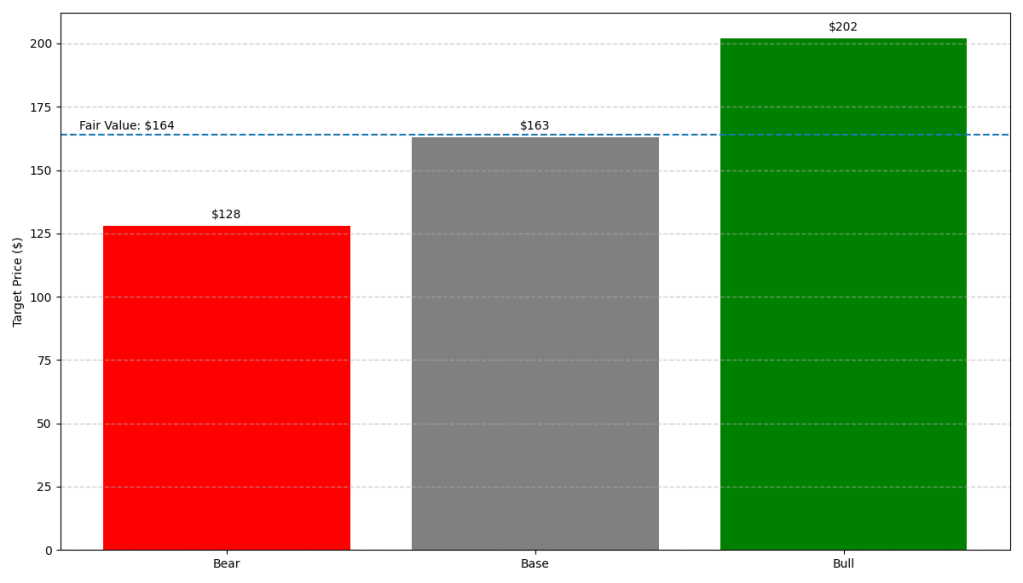
Price Target: $128

Base Case

EPS: $6.02

Multiple: 27x

Price Target: $163

Bull Case

EPS: $6.30

Multiple: 32x

Price Target: $202

Probability-Weighted Fair Value

Fair value ≈ $164

Disciplined fair value using only management guidance and a conservative 25x multiple: ~$150

Vertical valuation scenarios chart for Vertiv Q4 2025 earnings showing Bear case price target of $128, Base case $163, Bull case $202, with a dashed fair value line at $164.
Vertiv Q4 2025 valuation scenarios illustrating Bear ($128), Base ($163), and Bull ($202) price targets based on 2026 EPS guidance, with a probability-weighted fair value of approximately $164.

Verdict

Vertiv is executing.

Demand is real. Backlog is strong. Margins are expanding.

The risk is no longer operational — it’s valuation compression if AI capex momentum slows or if execution stumbles even slightly.

At prices near or below $150, the stock offers a reasonable risk-reward profile for growth investors.

Above that range, it becomes increasingly expectation-driven.


Call to Action

If you found this breakdown helpful, follow SWOTstock for disciplined earnings analysis that separates fundamentals from narrative.

We focus on what the numbers say — not what the hype suggests.


Disclaimer

This analysis is for informational purposes only and does not constitute financial advice. Always conduct your own research before making investment decisions.