
TL;DR Summary
Bank of America (BAC:NYSE) delivered an impressive second quarter, reporting strong revenue and earnings growth driven by broad-based contributions across Consumer Banking, Wealth Management, Global Banking, and Global Markets. More importantly, the company’s core banking franchise continued to strengthen through growing net interest income, stable credit quality, and robust capital generation.
While the market initially reacted cautiously before the shares recovered during the trading session, our independent analysis suggests the quarter reinforced the long-term investment thesis rather than fundamentally changing it. We estimate a probability-weighted fair value of approximately $64 per share, indicating the stock is modestly undervalued but not yet a “fat pitch.”
Quarter Recap
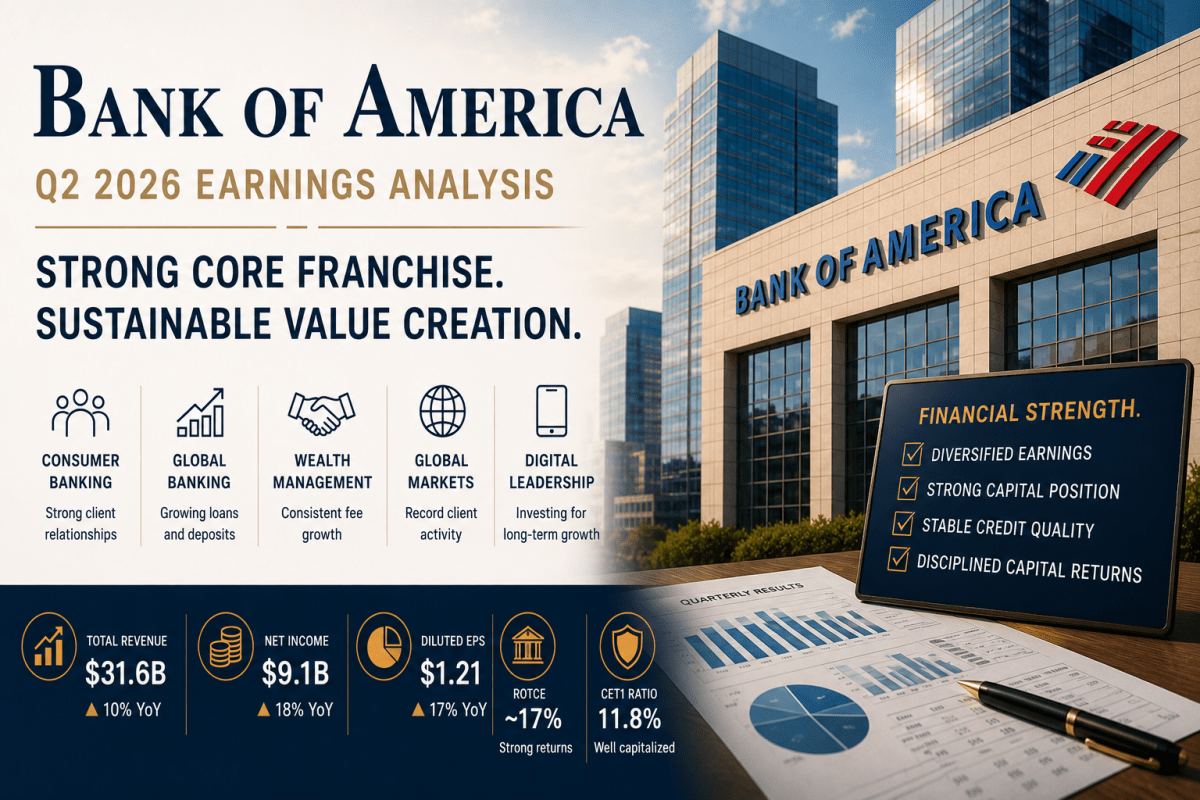
Bank of America reported another strong quarter that highlighted the resilience of its diversified business model. Revenue reached $31.6 billion, while net income increased to $9.1 billion, resulting in diluted earnings per share of $1.21.
Unlike quarters where performance depends heavily on one business segment, Q2 demonstrated strength across multiple earnings engines. Consumer Banking continued to benefit from healthy client activity, Wealth Management generated steady fee income, Global Banking experienced improved commercial engagement, and Global Markets delivered strong client-driven trading results.
Perhaps more importantly for long-term investors, management reaffirmed confidence in net interest income growth and reported stable credit quality, suggesting that the company’s earnings strength extends beyond short-term market activity.
Key Highlights
- Revenue increased to $31.6 billion.
- Net income reached $9.1 billion.
- Diluted EPS increased to $1.21.
- Net interest income continued to grow, with management expecting full-year results toward the upper end of previous guidance.
- ROTCE remained around 17%, demonstrating efficient capital utilization.
- Consumer and commercial credit quality remained stable.
- Capital ratios continued to support dividends, share repurchases, and future growth investments.
SWOT Analysis
Bank of America’s latest quarter reinforces the strength of one of the largest banking franchises in the United States. The company continues to benefit from a diversified earnings base, disciplined capital management, and a stable deposit franchise. However, banking remains inherently cyclical, and investors should continue monitoring interest rates, credit quality, and economic conditions.
Strengths
- Diversified earnings franchise (+8% to +12%)
- Strong contributions from Consumer Banking, Wealth Management, Global Banking, and Global Markets reduce dependence on any single business segment.
- Growing core net interest income (+6% to +10%)
- Continued NII growth reinforces the recurring earnings power of the core banking business.
- Excellent profitability and capital efficiency (+5% to +8%)
- ROTCE around 17% demonstrates strong returns on shareholder capital.
- Strong capital position (+3% to +6%)
- Healthy capital supports continued dividends, share repurchases, and resilience during economic downturns.
- Stable credit quality (+2% to +5%)
- No evidence of broad-based deterioration in the loan portfolio.
Weaknesses
- Interest-rate sensitivity (-6% to -10%)
- Future earnings remain influenced by changes in interest rates and deposit pricing.
- Cyclical capital markets businesses (-4% to -8%)
- Trading and investment banking revenues naturally fluctuate with market conditions.
- Moderate long-term growth profile (-3% to -6%)
- As a mature banking franchise, growth is expected to remain steady rather than rapid.
Opportunities
- Continued investment banking recovery (+5% to +9%)
- Improved corporate activity could further expand fee income.
- Digital banking and AI productivity (+4% to +7%)
- Ongoing technology investments should improve efficiency while strengthening customer relationships.
- Higher shareholder returns (+3% to +6%)
- Strong capital generation creates additional flexibility for dividends and share repurchases.
Threats
- Economic slowdown and higher credit losses (-8% to -15%)
- A recession would reduce loan demand while increasing credit costs.
- Margin compression from lower interest rates (-6% to -10%)
- Lower net interest income would reduce recurring earnings.
- Regulatory changes (-3% to -7%)
- Higher capital requirements could reduce future returns on equity.
Valuation Scenarios
Although Q2 demonstrated strong operating momentum, valuation should reflect both the quality of the franchise and the cyclical nature of banking. Rather than assuming today’s earnings represent either a permanent peak or a temporary anomaly, we evaluate three possible scenarios.
Bear Case — $52 (25%)
Assumes weaker net interest income, softer capital markets activity, modestly higher credit costs, and a lower valuation multiple.
Base Case — $64 (50%)
Assumes stable net interest income, healthy credit quality, continued profitability, and valuation multiples consistent with historical norms.
Bull Case — $74 (25%)
Assumes sustained earnings growth, continued strength across multiple business segments, accelerating shareholder returns, and modest valuation expansion.
Probability-Weighted Fair Value
Combining these scenarios produces a probability-weighted fair value of approximately $64 per share.
Verdict
Bank of America continues to demonstrate why it remains one of the highest-quality banking franchises in the United States. Its diversified earnings base, strong deposit franchise, disciplined capital allocation, and healthy balance sheet provide resilience across different economic environments.
Importantly, this conclusion is based primarily on the company’s official financial disclosures rather than market narratives or analyst opinions.
Following the earnings release, the market initially responded cautiously before the shares recovered later in the trading session. Our independent assessment suggests that investors ultimately recognized the quality of the quarter while continuing to evaluate the sustainability of future earnings.
At current prices, Bank of America appears modestly undervalued relative to our estimated intrinsic value of approximately $64 per share. While the valuation is attractive for long-term investors, it does not yet provide the wide margin of safety typically associated with a “fat pitch.”
Call to Action
Did you reach the same conclusion after reading Bank of America’s earnings report?
Do you believe the market is correctly valuing the company’s long-term earnings power, or is there still upside that investors have yet to recognize?
Share your thoughts in the comments, and follow SWOTstock for independent earnings analysis based on official company disclosures rather than market consensus.
Disclaimer
This article is intended for educational and informational purposes only and should not be considered financial advice or a recommendation to buy or sell any security. The analysis is based primarily on Bank of America’s official financial disclosures and management commentary, supplemented by independent valuation reasoning. Investors should conduct their own research and consider their individual financial circumstances before making investment decisions.

