Microsoft Q1 FY2026 — AI Demand Outruns Supply as Azure Surges 29%

Microsoft’s Q1 FY2026 results highlight strong performance, including a 15% revenue growth to $65.7 billion and a 29% surge in Azure, driven by AI adoption. Operating income rose 18%, emphasizing margin strength despite high capex. The stock increased by over 4%, reflecting confidence in Microsoft’s enterprise AI leadership with a fair value estimate of $453 per share.

TL;DR Summary

Microsoft (MSFT:NASDAQ) delivered another powerful AI-driven quarter, with Azure accelerating to 29% growth and Copilot adoption scaling across enterprise workloads. Operating income rose faster than revenue, confirming strong margin leverage even amid elevated AI datacenter spending. The stock jumped over 4% after earnings, reflecting confidence that Microsoft remains the most durable platform for enterprise AI. Our fair value estimate is $453 per share, slightly above current levels.


Quarter Recap

Microsoft’s Q1 FY2026 results showcased a company benefitting from the early waves of enterprise AI adoption while managing the heavy capex load required to stay ahead of demand. Revenue grew 15% to $65.7 billion, supported by broad-based strength across cloud, productivity, and personal computing. Azure was the standout, accelerating to 29% YoY growth as AI workloads—training, inference, and agent-based tasks—continue to scale. Operating income rose 18% to $28.3 billion, showing that Microsoft is leveraging its size and product mix to offset surging datacenter investments. Earnings per share came in at $3.05, ahead of expectations, driven by robust cloud profitability and disciplined spending.


Key Highlights

  • Azure +29% YoY, driven by AI infrastructure and inference workloads
  • Copilot adoption accelerating across Office, GitHub, and Dynamics
  • Operating income +18% YoY, showing durable profitability
  • Management reiterated: “AI demand continues to exceed supply”
  • Datacenter and GPU capex remains elevated through FY2026
  • Stock jumped +4.4% after Q1 results

SWOT Analysis

Microsoft’s Q1 FY2026 results reinforced its position as the leading enterprise AI ecosystem. Azure’s accelerating growth, combined with expanding Copilot monetization, offers a unique blend of scale, stickiness, and margin durability. Yet, high AI capex and growing competition across cloud and AI infrastructure remain key risks to monitor.

Strengths (+6% to +12%)

  • AI infrastructure leadership with Azure +29% YoY
  • Rapid Copilot monetization across Microsoft 365, GitHub, and Dynamics
  • High enterprise switching costs and long-term retention
  • Operating income growing faster than revenue

Weaknesses (–4% to –8%)

  • Heavy, multi-year datacenter and GPU capex
  • Strategic dependence on OpenAI technology stack
  • Enterprise budget pressure from rising AI software costs
  • Ongoing regulatory scrutiny in the US and EU

Opportunities (+10% to +18%)

  • Copilot becoming the default enterprise AI agent
  • Azure gaining share as AWS growth slows
  • AI PC upgrade cycle expected in 2026
  • Higher-tier subscriptions in security and developer tools

Threats (–8% to –14%)

  • Risk of AI capacity oversupply compressing hyperscaler margins
  • Cloud and AI competition from AWS, Google Cloud, Oracle
  • Rising adoption of open-source AI models
  • Geopolitical tech restrictions affecting supply chains
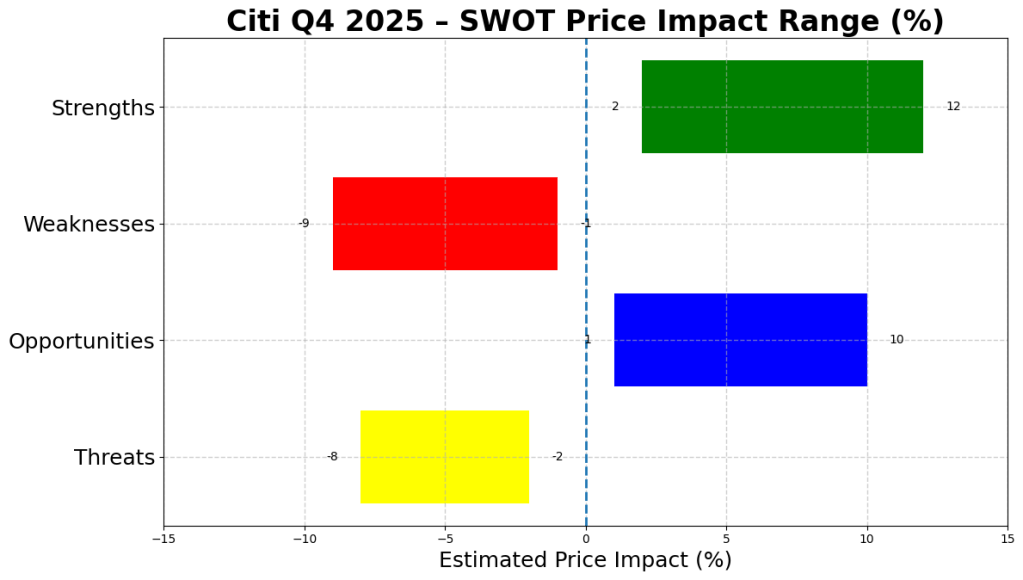
Microsoft Q1 2026 SWOT analysis chart showing estimated stock price impact ranges for strengths, weaknesses, opportunities, and threats, with a horizontal bar layout and x-axis starting from –20.

Valuation Scenarios

Our valuation framework incorporates Microsoft’s AI momentum, Azure growth trajectory, and margin durability to model a Bear, Base, and Bull scenario. Each scenario includes explicit growth and margin assumptions tied to EPS and forward multiples.

Bear Case — $385 (25%)

  • Azure growth slows to mid-20%
  • AI monetization ramps slower than expected
  • Margins compressed by elevated capex
  • Valuation: 25× forward EPS of ~$15.40 → $385

Base Case — $455 (50%)

  • Azure steady at ~27–29%
  • Strong enterprise AI adoption
  • Stable operating margins
  • Valuation: 29× forward EPS of ~$15.70 → $455

Bull Case — $515 (25%)

  • Azure growth surpasses 30%
  • Copilot becomes core enterprise AI layer
  • Higher-margin subscription mix expands
  • Valuation: 32× forward EPS of ~$16.10 → $515

Probability-Weighted Fair Value

→ $453 per share

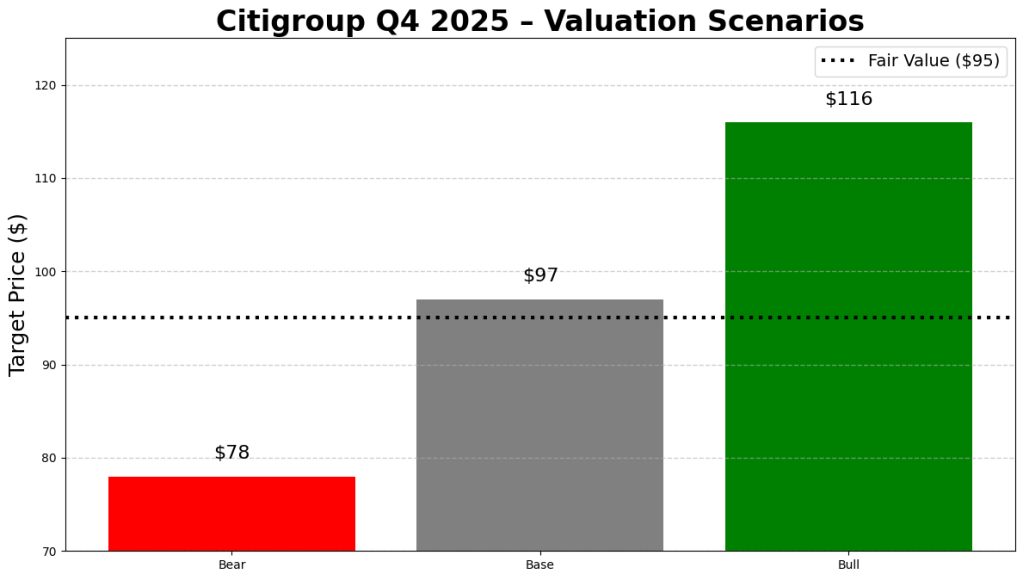
Microsoft Q1 2026 valuation scenarios chart showing Bear, Base, and Bull price targets with a dashed fair value line at $453, displayed in red, gray, and green vertical bars.

Verdict

Microsoft remains the most structurally advantaged enterprise AI platform. Azure’s acceleration to 29% growth validates the demand narrative, and early Copilot adoption shows enterprises are already willing to pay for AI productivity gains. The biggest risk remains the scale of AI-related capex, but so far profitability is holding up strongly. With a probability-weighted fair value of $453, Microsoft remains slightly undervalued for long-term AI-focused investors.


Call to Action

If you found this analysis helpful, follow SWOTstock for more AI-focused quarterly breakdowns of the world’s most important companies. We cover earnings, valuation scenarios, and management commentary in a simple, investor-friendly format.


Disclaimer

This analysis is for informational and educational purposes only and does not constitute financial advice. Investing involves risk, including potential loss of principal. Please conduct your own research or consult a qualified financial professional before making investment decisions.


Meta Q3 2025 — AI Momentum, Ad Strength, and a $505 Fair Value

Meta’s Q3 2025 report showed strong results, with AI enhancements driving user engagement and advertising success on Facebook and Instagram. Stock surged +7.7%, affirming confidence in future earnings. Key points included improved cost management, narrowing Reality Labs losses, and an optimistic outlook for 2026, maintaining a fair value estimate of $505 per share.

TL;DR Summary

Meta delivered a strong Q3 2025, with AI ranking models boosting engagement and ad yield across Facebook and Instagram. Management highlighted that “AI continues to be the primary driver of incremental time spent,” and capex is stabilizing after two years of heavy investment. The stock jumped +7.7% as results reinforced confidence in Meta’s 2026 earnings trajectory. Our fair value estimate remains $505 per share.


Quarter Recap

Meta’s third quarter demonstrated a well-balanced combination of product and financial execution. Advertising remained robust, driven by stronger pricing and an uptick in Reels engagement. Management emphasized that “Reels is now contributing positively to overall revenue growth,” confirming the format’s successful maturation.

Operating discipline also played a meaningful role in the quarter. CFO Susan Li noted that “the largest wave of AI infrastructure investment is now behind us,” which reassured investors concerned about multi-year capex drag. Reality Labs continued to operate at a loss, but management highlighted improved efficiency, saying “we’re seeing meaningful progress in reducing the cost structure of our AR/VR portfolio.”

Together, these factors contributed to the stock’s sharp post-earnings move.


Key Highlights

  • AI-driven engagement increased time spent across apps; management reiterated “AI ranking improvements remain one of the biggest drivers of ad performance.”
  • Advertising trends improved heading into the Q4 holiday season.
  • Capex expected to stabilize; CFO confirmed “2026 capex growth will be significantly more measured compared to prior years.”
  • Reality Labs losses narrowed on better cost controls.
  • Market responded with a +7.7% surge after results.

SWOT Analysis

Meta’s competitive edge lies in its ability to compound engagement, monetization, and AI-enabled product velocity. Management’s commentary reinforced this dynamic, noting that “AI is improving every major surface of the Family of Apps,” setting up continued momentum into 2026.

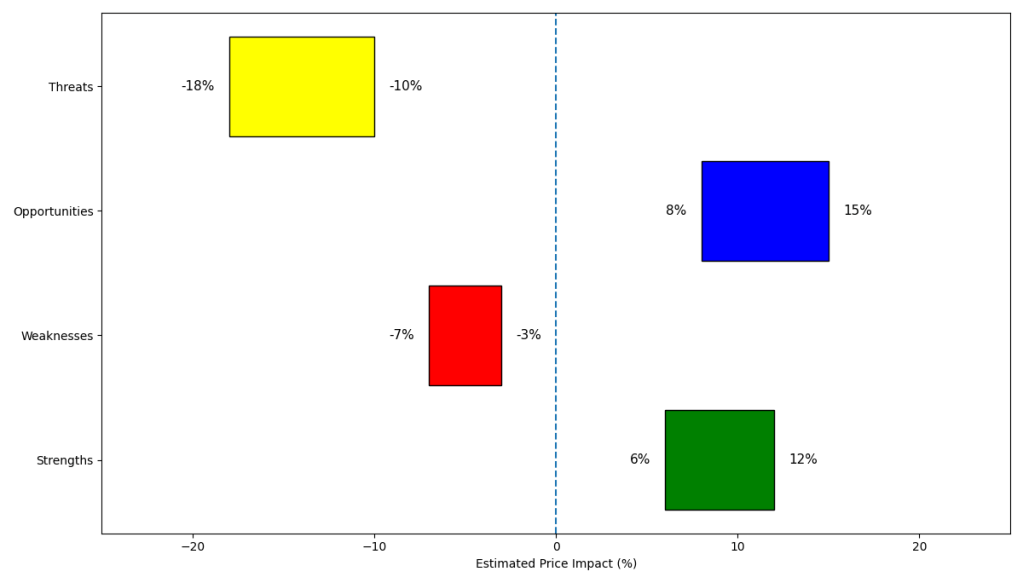
Strengths (+8% to +15%)

  • AI-driven ranking systems improving engagement and ad yield.
  • Massive 3.4B+ global daily active users.
  • Margin expansion supported by cost discipline.
  • Llama ecosystem adds strategic AI optionality.

Weaknesses (–6% to –12%)

  • Heavy reliance on ads as the primary revenue source.
  • Reality Labs remains a multi-year drag on profitability.
  • Regulation and safety compliance add structural costs.
  • High capex slows free cash flow near-term.

Opportunities (+10% to +18%)

  • Messaging monetization—WhatsApp and Messenger ads still early-day.
  • Generative AI-powered features improving content creation and engagement.
  • Ray-Ban Meta showing early AR/VR traction.
  • Retail and SMB ad recovery accelerating into 2026.

Threats (–10% to –20%)

  • Fierce competition from TikTok and YouTube.
  • Regulatory challenges in the EU and U.S.
  • Hardware adoption uncertainty.
  • Emerging market volatility affecting ad budgets.
META Q3 2025 SWOT analysis chart showing estimated stock price impact ranges for strengths, weaknesses, opportunities, and threats from –20% to +18%.

Valuation Scenarios

Management’s commentary around costs, engagement, and AI infrastructure aligns well with our modeled ranges. As Zuckerberg noted, “We’re entering a more efficient phase of our AI investments,” supporting a healthier earnings trajectory.

Bear Case — $420 (Prob. 25%)

  • Formula: $18.50 EPS × 22.7×
  • Slower ad growth; monetization plateaus
  • Elevated capex persists
  • Slight margin compression
  • Reality Labs losses widen

Base Case — $510 (Prob. 50%)

  • Formula: $19.80 EPS × 25.8×
  • Strong engagement; Reels + messaging push up monetization
  • Margin expansion from cost discipline
  • Stabilizing capex
  • AI ranking improvements continue to enhance ad yield

Bull Case — $580 (Prob. 25%)

  • Formula: $20.70 EPS × 28×
  • Strong retail ad cycle
  • Messaging monetization ramps
  • Faster cost improvement in Reality Labs
  • Strong AI-driven ad performance

Probability-Weighted Fair Value: $505

META Q3 2025 valuation scenarios chart showing Bear ($420), Base ($510), and Bull ($580) target prices with a fair value line at $505.

Verdict

Meta’s Q3 performance reinforces the company’s position as the most scaled and monetization-efficient AI-driven social platform. With engagement and ad yield rising, capex stabilizing, and incremental AI products rolling out across apps, the long-term setup remains attractive. Our fair value of $505 per share offers a balanced, grounded view for long-term growth investors.


Call to Action

If you enjoy these breakdowns, follow SWOTstock on LinkedIn and explore more analyses at SWOTstock.com.


Disclaimer

This content is for informational purposes only and is not investment advice. Investors should conduct their own research or consult a licensed financial advisor.


Amazon Q3 2025 — AWS Re-Accelerates, Ads Surge, and AI Capex Sets the Stage for 2026

Amazon’s Q3 2025 results showed strong revenue growth at $180.2 billion, with AWS increasing by 18% and advertising up 20%. Operating income rose 29%, driven by logistics efficiencies. While high AI infrastructure investments present near-term challenges, management remains confident in long-term profitability, estimating a fair value of $216 per share.

TL;DR Summary

Amazon delivered a strong Q3 with accelerating AWS growth, booming advertising revenue, and expanding retail margins. While heavy AI infrastructure investments continue to shape near-term cash flow, management’s commentary signals high confidence in long-term returns. Our fair value sits around $215/share, anchored by official financials and steady earnings momentum.


Quarter Recap

Amazon’s Q3 2025 results highlighted a business firing on multiple cylinders. Revenue came in at $180.2 billion, rising 12% year over year on a constant-currency basis. AWS saw renewed momentum with 18% growth, driven by AI training and inference workloads scaling beyond early pilot phases. The advertising segment grew an impressive 20%, outperforming other major digital-ad platforms and reinforcing Amazon’s strength as a retail media leader. Retail profitability continued improving as the company expanded its regionalized fulfillment model, which has meaningfully reduced transportation costs and enabled record levels of fast delivery. Operating income climbed 29%, powered by both AWS leverage and ongoing logistics efficiencies. Management emphasized that AI infrastructure demand is “stronger than supply,” setting the stage for sustained cloud growth into 2026.


Key Highlights

  • Revenue reached $180.2B, up 12% YoY ex-FX.
  • AWS accelerated to 18% YoY growth.
  • Advertising expanded 20% YoY, outpacing Meta and Alphabet.
  • Operating income rose 29% YoY on stronger margins.
  • Trailing 12-month operating cash flow grew 18% YoY.
  • Capex elevated due to AI chips and datacenter expansion.
  • Retail logistics efficiencies strengthened North America margins.
  • Management signaled strong Q4 momentum entering the holiday season.

SWOT Analysis

Amazon’s Q3 performance reaffirmed its dual identity as both an AI-infrastructure builder and a highly efficient global retailer. While AWS and Advertising push margins higher, AI-related capex introduces near-term cost pressure. Below is the structured SWOT summary with estimated price-impact ranges for each factor.

🟩 Strengths (+5% to +12%)

  • AWS growth re-accelerated to 18% YoY, confirming strong AI workload demand.
  • Retail logistics efficiency continues improving margins through regional fulfillment.
  • Advertising surged 20% YoY, expanding Amazon’s high-margin revenue mix.
  • Strong operating cash flow (+18% TTM) supports massive AI infrastructure build-out.

🟥 Weaknesses (–4% to –9%)

  • AI infrastructure capex remains very high as Trainium2 and datacenter expansion scale.
  • International segment profitability still lags despite solid revenue growth.
  • Growing analyst concerns that margins may peak in late 2026.
  • Limited disclosure on AWS margins keeps long-term leverage uncertain.

🟦 Opportunities (+8% to +15%)

  • AI chips (Trainium2, Inferentia) strengthen Amazon’s competitive position in cloud AI.
  • Prime Video’s ad-tier ramp unlocks a fast-growing high-margin ad channel.
  • Enterprise AI adoption transitioning from pilots to deployment boosts AWS utilization.
  • “Buy with Prime” and logistics-as-a-service expand total addressable market.

🟨 Threats (–7% to –14%)

  • Cloud pricing pressure from Microsoft and Google intensifying around AI workloads.
  • Regulatory scrutiny across antitrust, advertising, and marketplace operations.
  • Global supply-chain constraints could slow AWS datacenter build-out.
  • Retail macro uncertainty may limit unit growth into 2026.
Amazon Q3 2025 SWOT analysis chart showing estimated stock price impact ranges for strengths, weaknesses, opportunities, and threats, with horizontal bars and a zero-percent reference line.

Valuation Scenarios

Using Amazon’s official Q3 results and management commentary, these valuation scenarios outline how earnings and multiples may evolve as AWS, Advertising, and Retail continue driving profitability. All calculations anchor to FY2026 earnings potential and Amazon’s historical valuation range during similar growth regimes.

🔴 Bear Case — $175/share (20%)

  • AWS slows toward 12% YoY growth in 2026.
  • Retail margin expansion stalls due to cost inflation.
  • Applying 22× on ~$8.00 FY26 EPS → ~$176.

⚪ Base Case — $215/share (55%)

  • AWS grows 15–17% YoY, supported by AI infrastructure demand.
  • Advertising scales as a third core profit engine.
  • Retail margins continue gradual improvement.
  • Applying 27× on ~$8.00 FY26 EPS → ~$216.

🟢 Bull Case — $250/share (25%)

  • AWS accelerates above 20% YoY from enterprise AI deployment.
  • Prime Video advertising outperforms expectations.
  • Retail unit economics exceed guidance.
  • Applying 30×+ on ~$8.30 FY26 EPS → ~$249.

⭐ Probability-Weighted Fair Value

20% × 175 + 55% × 215 + 25% × 250 = ~216
Final fair value estimate: ~$216/share

Amazon Q3 2025 valuation scenarios chart showing Bear, Base, and Bull price targets with a dashed fair-value line at $216.

Verdict

Amazon’s Q3 results reinforce the company’s position as a long-term compounder powered by AI infrastructure, high-margin advertising, and increasingly efficient retail operations. AWS re-acceleration, combined with sustained cash-flow growth, provides strong visibility into earnings through 2026. While elevated capex and regulatory pressure remain risks, Amazon’s foundational drivers appear robust. At ~mid-$190s pre-earnings levels, the stock offered a compelling setup toward our ~$216 fair value.


Call to Action

If you want more breakdowns of mega-cap tech earnings, SWOT analyses, and fair-value models, follow SWOTstock for updates ahead of the next major reporting cycle.


Disclaimer

This analysis is for informational purposes only and is not investment advice. All estimates reflect public information from Amazon’s official financial results and management commentary.