Morgan Stanley Q2 2025: Trading Strength Offsets IB Weakness, But Market Stays Cautious

Morgan Stanley reported strong Q2 2025 results, with $16.8B revenue and $2.13 EPS, surpassing expectations. Wealth Management added $59B in assets, while trading revenues increased. Despite a 5% drop in investment banking fees, the firm raised its dividend and initiated a $20B buyback, reflecting ongoing shareholder commitment. Shares fell post-announcement amid market caution.

TL;DR Summary

Morgan Stanley delivered a strong Q2 2025, with $16.8 B revenue and EPS of $2.13, both above expectations. Wealth Management inflows of $59 B and robust trading performance offset a 5% decline in investment banking fees. The firm also raised its dividend to $1.00/share (yielding ~2.8%) and approved a $20 B share buyback, underscoring its commitment to returning capital. Despite these positives, shares slipped ~1–2% post‑earnings, reflecting cautious sentiment around capital markets headwinds. Our fair value estimate remains ~$144, near current levels, with upside tied to a revival in dealmaking and continued strength in Wealth Management.


Quarter Recap

Morgan Stanley reported net revenues of $16.8 B, up 12% YoY, and EPS of $2.13, beating consensus by 7.6%. ROTCE reached 18.2%, reaffirming the firm’s profitability strength.

Wealth Management added $59 B in net new assets, partially offset by $22 B in tax-related outflows. Trading was a bright spot: equities revenue came in at ~$3.7 B (+23% YoY) and fixed income at ~$2.2 B (+9%). These gains helped offset investment banking fees, which fell ~5% YoY and remain below pre‑2022 levels.

Capital returns were a highlight: the board approved a quarterly dividend increase to $1.00/share (yielding ~2.8% at current prices) and a $20 B share repurchase program, beginning in Q3 2025.


Key Highlights

  • Revenue: $16.8 B (+12% YoY)
  • EPS: $2.13 (+7.6% above consensus)
  • ROTCE: 18.2%
  • Wealth Management: $59 B net new assets, offset by $22 B in tax outflows
  • Trading: Equities $3.7 B (+23%); Fixed income $2.2 B (+9%)
  • Investment Banking: Down ~5% YoY; still lagging pre‑2022 levels
  • Capital Returns: Dividend raised to $1.00/share (~2.8% yield)$20 B buyback approved
Line chart showing Morgan Stanley’s revenue and net income over the past five quarters, highlighting growth in Q2 2025.

Peer Comparison

Morgan Stanley’s steady, wealth-led approach continues to differentiate it. But when comparing to peers, Goldman Sachs grew investment banking revenue ~26% YoY, while Morgan Stanley saw a 5% decline. JPMorgan also outpaced MS in advisory and underwriting activity. This highlights a strategic trade‑off: Morgan Stanley prioritizes stable Wealth Management growth, sacrificing some upside in deal-driven businesses.

Bar chart comparing Morgan Stanley, Goldman Sachs, and JPMorgan for Q2 2025: Investment banking revenue change (%, orange bars) and wealth management inflows ($B, teal bars).

SWOT Analysis

Morgan Stanley’s Q2 shows why the market reacted cautiously: the firm delivered solid results, but investors remain concerned about weaker capital markets revenue and near-term growth visibility.

Strengths (+$4 to +$8):

  • Wealth inflows: $59 B new assets despite tax-related outflows
  • Trading strength: Equities +23%, Fixed Income +9% YoY
  • Capital returns: Dividend raised to $1/share (~2.8% yield) and $20 B buyback
  • Strong profitability: ROTCE at 18.2%, EPS beat of 7.6%

Weaknesses (−$3 to −$6):

  • Investment banking lag: −5% YoY vs Goldman’s +26%
  • Expense growth: Costs rising faster than some revenue lines
  • Client outflows: Tax outflows muted net inflow impact

Opportunities (+$3 to +$7):

  • Cross-selling E*TRADE clients within Wealth Management
  • Tech and AI investments to enhance operating leverage
  • Rebound in IPO/M&A could significantly lift investment banking revenues

Threats (−$4 to −$7):

  • Macro risks: Slowing economy could cut dealmaking & trading volumes
  • Regulatory pressures: Higher capital requirements could restrict buybacks
  • Competitive fee pressure: Margin erosion in Wealth Management & brokerage

Net SWOT price impact: −$7 to +$8 (implying short-term trading range between ~$136 and $151).


SWOT Table
Morgan Stanley Q2 2025 SWOT analysis table showing strengths, weaknesses, opportunities, and threats with estimated stock price impact ranges.
Horizontal bar chart showing Morgan Stanley Q2 2025 SWOT price impact ranges with consistent label spacing and X-axis starting at -6%.

Valuation Scenarios

Current price: ~$143.56

  • Bull Case (30%):
    IB revenue rebounds +5%, WM inflows >$50 B/quarter, ROTCE >18%.
    Target: $162
  • Base Case (50%):
    Stable WM inflows, trading moderates, IB remains sluggish.
    Target: $144
  • Bear Case (20%):
    WM growth slows, trading revenue drops, regulatory capital costs rise.
    Target: $121

Probability‑weighted fair value:(0.3 × 162) + (0.5 × 144) + (0.2 × 121) = **$144.3**

Fair value: ~$144
Assessment: Fairly valued. Any upside depends on an M&A/IPO rebound and sustained asset growth in Wealth Management.

Bar chart showing Morgan Stanley Q2 2025 valuation scenarios: Bear case at $121, Base case at $144, Bull case at $162, with a dotted line indicating fair value at $144.3.

12‑Month Outlook

Looking ahead, Morgan Stanley’s fortunes will hinge on:

  • Capital markets recovery: IPO/M&A activity improving in 2026 could reaccelerate IB revenue.
  • Sustained Wealth inflows: Maintaining $50 B+/quarter will support fee growth and capital returns.
  • Regulatory clarity: New capital requirements could affect buyback pace.

Verdict

Morgan Stanley remains a defensive, shareholder-friendly play, with stable wealth-led earnings and enhanced capital returns. While near-term upside is capped by muted deal activity, long-term investors benefit from solid dividends, repurchases, and consistent profitability.


Call to Action

Are you bullish on Morgan Stanley’s wealth-first strategy? Drop your thoughts below, and subscribe for more SWOT-driven earnings breakdowns to help you invest smarter.


Disclaimer

This analysis is based solely on Morgan Stanley’s official Q2 2025 financial report and earnings call transcript. It is for informational purposes only and is not investment advice.


Leave a comment


Goldman Sachs Q2 2025: Resilient Earnings, Bigger Payouts, and Competitive Edge Among Peers

Goldman Sachs reported Q2 2025 earnings with EPS of $10.91 and revenue of $14.58 billion, exceeding expectations. The bank raised its dividend by 33%, repurchased $3 billion in stock, and maintained strong capital ratios. Despite some cyclical weaknesses, it shows potential for growth in advisory services and wealth management.

TL;DR — What You Need to Know

Goldman Sachs posted EPS of $10.91 on $14.58 billion revenue, beating expectations. The bank raised its quarterly dividend by 33% and repurchased nearly $3 billion in stock, returning over $4 billion to shareholders. With a book value per share of ~$349.7 and a CET 1 ratio of 14.5%, Goldman’s capital position remains strong. Our probability‑weighted fair value: ~$731, slightly above the current share price of ~$724.


Quarter Recap

Goldman Sachs delivered net revenues of $14.58 billion in Q2 2025, up 15% YoY, driven by a strong rebound in trading and advisory revenues. Net earnings came in at $3.72 billion, translating to EPS of $10.91, ahead of consensus expectations.

Assets under supervision hit a record $3.29 trillion, growing by $120 billion in a single quarter. Book value per share now stands at ~$349.7, with a CET 1 capital ratio of 14.5%, providing a robust buffer against market and regulatory risks.

CEO David Solomon noted that Goldman’s pipeline for advisory work is “healthy and diversified across sectors,” while CFO Denis Coleman pointed to anticipated deal flow from technology, healthcare, and energy, supporting investment banking revenues in H2.


Key Highlights

  • Revenue beat: $14.58 B (+15% YoY) on strong trading and advisory results.
  • EPS: $10.91 vs. consensus of ~$9.7–$9.8.
  • ROE: 12.8%, up sharply from 2023 lows.
  • Dividend hike: From $3 → $4 per share (+33%), starting Q3 2025.
  • Share repurchases: Nearly $3 billion in buybacks, for total shareholder return over $4 billion this quarter.
  • Capital strength: Book value per share: ~$349.7CET 1 ratio: 14.5%.
  • Record AUS: $3.29 T, enhancing fee‑based stability.
Line chart showing Goldman Sachs revenue and net income for the past five quarters, highlighting Q2 2025 revenue at $14.58 billion and net income at $3.72 billion.

Peer Comparison: Goldman vs JPMorgan vs Morgan Stanley

Peer comparison table showing Goldman Sachs versus JPMorgan and Morgan Stanley for Q2 2025, including ROE, forward P/E ratio, dividend yield, and book value per share.

Goldman trades at a discounted P/E compared to JPM and MS but offers a smaller dividend yield, which is now improving with its 33% payout increase.

Grouped bar chart comparing Goldman Sachs, JPMorgan, and Morgan Stanley for Q2 2025 across three metrics: ROE (%, green), forward P/E ratio (blue), and dividend yield (%, orange).

Dividend Growth in Context

Goldman’s dividend hike to $4/share marks one of its largest increases in a decade, reflecting confidence in sustainable earnings.

Bar chart showing Goldman Sachs quarterly dividend per share from 2020 to 2025, highlighting an increase from $2.0 in 2020 to $4.0 in 2025 following a 33% hike.

At current prices, the yield is ~2.2%, moving closer to peers like Morgan Stanley (3.1%) and JPMorgan (2.6%).


SWOT Analysis (with Price Impact)

Strengths (+$15–$25 impact)

  • Robust revenue growth: 15% YoY, with strong trading and M&A advisory.
  • Capital returns: 33% dividend hike and $3 B in buybacks signal capital efficiency.
  • Book value & capital buffer: $349.7 BVPS, CET 1 at 14.5%.
  • Improved ROE: 12.8%, showing recovery from post‑pandemic lows.

Weaknesses (–$8–$12 impact)

  • Reliance on trading: Equities revenue is cyclical and market-dependent.
  • Subdued consumer banking: Marcus platform still underperforming.
  • Rising expenses: Operating costs up 6% YoY, with more spend on tech and compliance.

Opportunities (+$10–$18 impact)

  • M&A & capital markets revival: Advisory pipeline in tech, energy, and healthcare indicates momentum in H2 2025.
  • Wealth management growth: Record AUS positions Goldman for fee expansion.
  • Technology leverage: AI and automation investments could boost efficiency.

Threats (–$12–$20 impact)

  • Macro headwinds: Tariffs, election‑year volatility, and slower global growth may hurt client activity.
  • Speculative market behavior: Management flagged rising “retail‑driven trading excesses” as a systemic risk.
  • Regulatory tightening: Basel III and other potential capital rules could cap returns.

SWOT Summary Table

Horizontal bar chart showing estimated price impact of SWOT factors for Goldman Sachs Q2 2025 with closer label placement for negative values: Threats (-16), Opportunities (+14), Weaknesses (-10), Strengths (+20), and a vertical line at zero.

Valuation Scenarios (Price Targets)

  • Base Case (50% probability): $725
    Assumes mid‑single‑digit revenue growth in H2, steady trading, and continued buybacks/dividends.
  • Bull Case (30% probability): $780
    Assumes a robust M&A rebound, sustained trading momentum, and controlled expense growth.
  • Bear Case (20% probability): $670
    Assumes a slowdown in advisory and trading, plus stricter capital requirements.

Probability‑Weighted Fair Value:

(0.5×725)+(0.3×780)+(0.2×670)=730.5(0.5×725)+(0.3×780)+(0.2×670)=730.5

→ Fair Value: ≈ $731


How This Compares to Other Valuations

Community-based models (e.g., Simply Wall St) place fair value between $594–$701. Our $731 target reflects a higher confidence in Goldman’s capital efficiency, pipeline strength, and capital return policy—but also assumes macro risks remain manageable.


Vertical bar chart showing Goldman Sachs Q2 2025 valuation scenarios: Bear case $670, Base case $725, Bull case $780, with a dotted line indicating Fair Value at $731.

Verdict

At $731, for value investors, it offers:

  • Resilient earnings in a diversified revenue base,
  • Stronger capital returns (higher dividends + buybacks),
  • Attractive capital buffers supporting stability.

Compared to peers, Goldman trades at a discounted valuation but offers lower yield, which is now improving. For income-focused investors who value both stability and growth in payouts, Goldman looks like a steady hold with modest upside.


Call to Action

Do you see Goldman’s trading and advisory strength continuing into H2? Are you adding bank stocks to your portfolio this year? Share your thoughts in the comments or join the conversation on our LinkedIn page.


Disclaimer

This analysis is based solely on Goldman Sachs’ official Q2 2025 financial report and earnings call. It is for informational purposes only and does not constitute financial advice.


Leave a comment


Bank of America Q2 2025: Earnings Beat, Dividend Growth Ahead, and a Fair Value Play for Income Investors

TL;DR

Bank of America posted Q2 2025 EPS of $0.89, topping expectations, driven by record net interest income and robust trading revenue. Management reaffirmed NII guidance toward $15.5–$15.7 billion and announced an 8% dividend hike (raising forward yield to ~3.2%). While credit risks in commercial real estate and macro uncertainties persist, BAC remains fairly valued near $48, making it a steady, income‑oriented choice for DIY value investors.


Quarter Recap

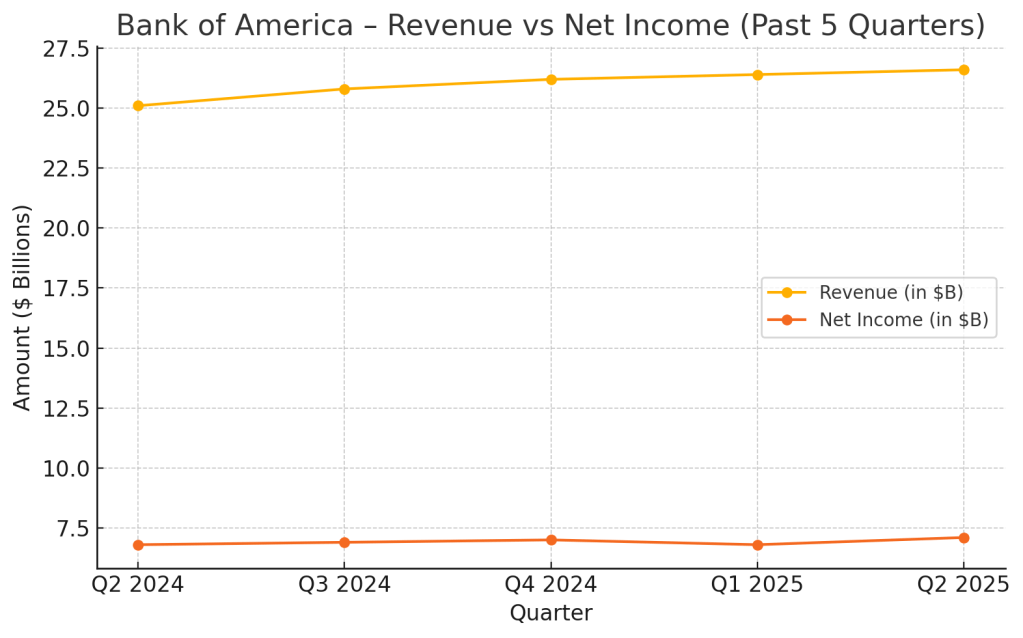
In Q2 2025, Bank of America reported revenue of $26.6 billion (+4% YoY) with net interest income (NII) reaching $14.8 billion — a record high. Net income rose to $7.1 billion (EPS $0.89), beating estimates by 3 cents.

Management highlighted:

  • Efficiency progress: Non‑interest expenses dropped ~$600 million QoQ, with a target to reach ~60% efficiency ratio.
  • Deposit strength: 8th straight quarter of deposit growth, with average checking balances rising from $6K to $9.2K YoY.
  • Credit costs: Provisions increased to ~$1.6 billion, mainly from office‑related CRE loans.
  • Trading resilience: Markets revenue rose ~15% YoY, with management expecting a 13‑quarter growth streak to continue.
  • Shareholder returns: $7.3 billion in Q2 (dividends + buybacks) and an 8% dividend increase announced for Q3.

Key Highlights

  • EPS: $0.89 (+7% YoY), beat by 3 cents
  • Revenue: $26.6 billion (+4% YoY)
  • Net Interest Income: $14.8 billion (record)
  • Efficiency: Expenses down $600 million QoQ; targeting ~60% ratio
  • Dividend: 8% hike brings forward yield to ~3.2%
  • Asset quality: Net charge‑offs of $1.5 billion; provisions up to $1.6 billion
  • Deposits: 8th consecutive quarter of growth
Line chart showing Bank of America revenue and net income over the past five quarters, highlighting Q2 2025 growth in both metrics.

SWOT Analysis

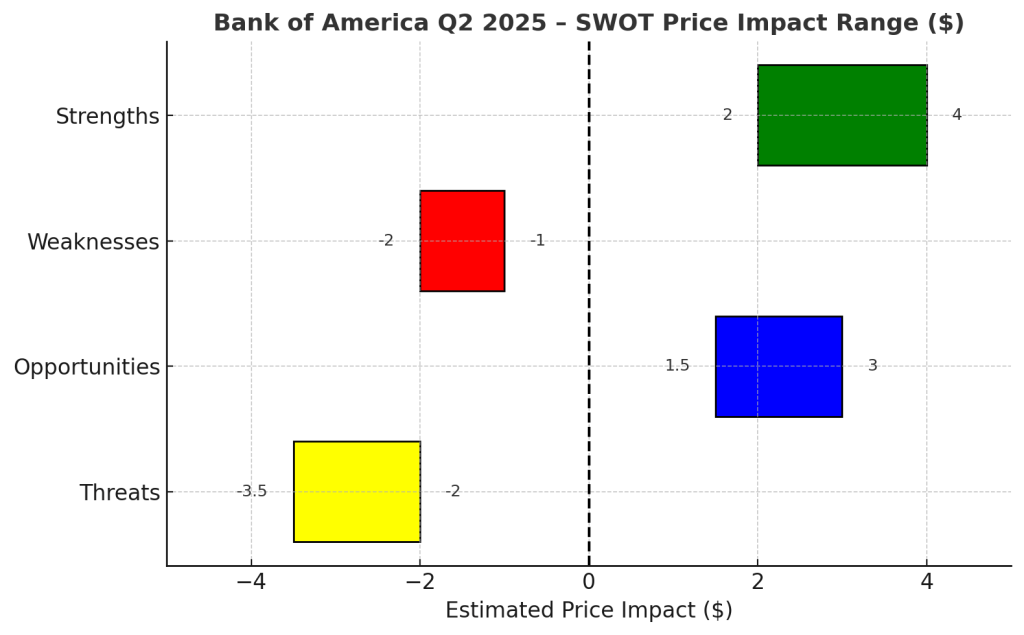
  • Strengths (+$2 – 4 impact):
    Record NII, diversified revenue streams, improving efficiency, and a dividend hike reflecting capital confidence.
  • Weaknesses (−$1 – 2 impact):
    Slower revenue growth than peers, elevated CRE‑related losses, and a still‑high expense base.
  • Opportunities (+$1.5 – 3 impact):
    AI & digital investments, sustained deposit momentum, expanding trading revenue, and higher dividend yield enhancing total return.
  • Threats (−$2 – 3.5 impact):
    Tariff‑driven macro risks, potential Fed rate cuts compressing NII, and rising credit costs in commercial real estate.

Net price impact: ≈ +$1.0–1.5/share vs. pre‑earnings levels, supporting the current range.


SWOT Summary Table

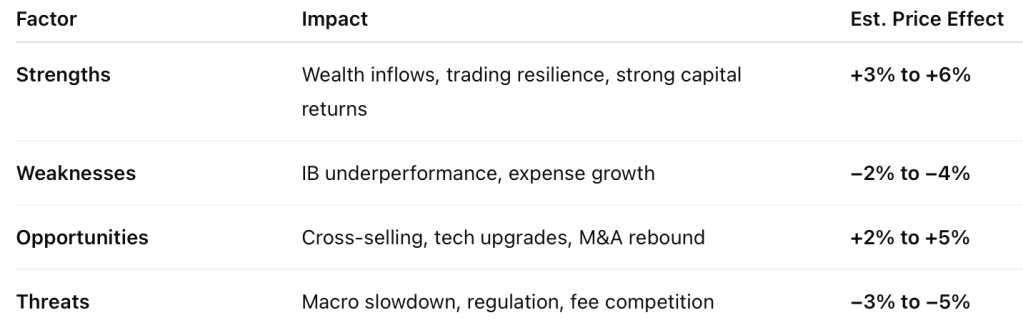
Bank of America Q2 2025 SWOT price impact analysis table showing strengths, weaknesses, opportunities, and threats with estimated stock price impacts.
Bar chart showing Bank of America Q2 2025 SWOT price impact ranges: strengths (+2 to +4), weaknesses (−1 to −2), opportunities (+1.5 to +3), and threats (−2 to −3.5), with X-axis starting at −5.

Valuation Scenarios

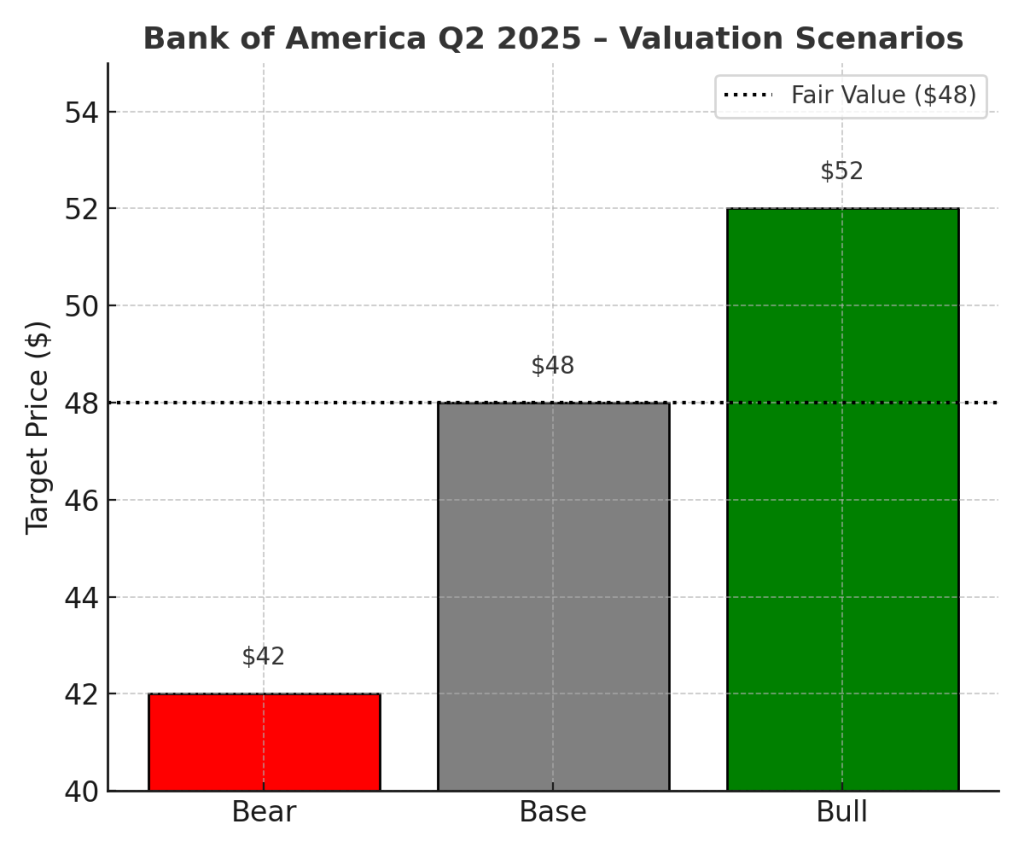
To frame a realistic outlook for Bank of America’s stock, we modeled three scenarios based on management’s guidance, Q2 results, and macro risks. The Base Case assumes steady EPS growth, stable net interest income, and controlled expenses, keeping the stock near its current range. The Bull Case reflects a scenario where trading revenue momentum accelerates, the efficiency ratio improves faster toward the 60% target, and net interest income benefits from a slower‑than‑expected pace of Fed rate cuts. Conversely, the Bear Case factors in higher commercial real estate charge‑offs and a compressed margin environment from rapid rate cuts. These scenarios give a clear range of plausible outcomes for value investors, balancing potential upside with key risks.

Bank of America Q2 2025 valuation scenarios table showing bull case at $52, base case at $48, and bear case at $42 with probability-weighted fair value of $48.

Probability‑Weighted Fair Value:(0.5 × 48) + (0.3 × 52) + (0.2 × 42) ≈ $48

Bar chart showing Bank of America Q2 2025 valuation scenarios: Bear case at $42, Base case at $48, and Bull case at $52, with a dotted line for the $48 fair value.

Dividend Growth Snapshot

Bank of America’s 8% dividend hike for Q3 2025 raises the quarterly payout from $0.24 to $0.26 per share, pushing the forward yield to roughly 3.2% at current prices. This increase continues the bank’s consistent multi‑year trend of dividend growth, reflecting management’s confidence in earnings stability and capital strength. Combined with $7.3 billion in share buybacks during Q2, this makes BAC a compelling choice for income‑focused investors who prioritize reliable cash returns and long‑term capital appreciation.

  • Q2 dividend: $0.24/share → Q3: $0.26/share
  • 8% increase = forward yield of ~3.2% at $48/share

Peer Comparison

When compared to its large‑cap U.S. banking peers, Bank of America sits in the middle of the pack. At a price‑to‑book ratio of ~1.3× and forward P/E around 13×, it trades cheaper than JPMorgan (P/B ~1.6×, P/E ~12×) but at a premium to Citigroup (P/B ~0.8×, P/E ~9×). Dividend yield at ~3.2% (post‑hike) makes BAC more attractive than JPMorgan (~2.8%) but still below Citi’s ~4%. This positioning reflects its balanced profile: steadier than Citi, but with less growth momentum than JPMorgan — a mix that appeals to value‑oriented investors seeking income without extreme risk exposure.

Peer comparison table for Bank of America Q2 2025 versus JPMorgan and Citigroup, showing price-to-book, price-to-earnings, and dividend yield metrics.

Verdict

At ≈$48/share, BAC trades close to our fair value estimate. For DIY value investors, it offers steady dividendsaggressive buybacks, and a resilient balance sheet. While upside is modest without macro support, the dividend hikeand sustained trading & deposit growth make it a hold‑to‑accumulate for long‑term portfolios.


Call to Action

Do you hold Bank of America or other bank stocks? Comment below — is BAC your top pick for steady income, or do you prefer peers like Citi or JPMorgan?


Disclaimer

This analysis is for informational purposes only and based solely on Bank of America’s official Q2 2025 financial report and earnings call. It does not constitute financial advice. Please consult a licensed advisor before making investment decisions.