
Morgan Stanley Q4 2025 Earnings: Investment Banking Is Back, but Is the Stock Fully Priced?

Morgan Stanley’s Q4 2025 earnings surpassed expectations, driven by investment banking recovery and stable wealth management. The firm achieved record profits, with an estimated fair value of $180 per share, indicating limited upside post-rally. Despite strengths in diversified revenue, the stock appears fairly valued against market risks and economic conditions.

TL;DR Summary

  • Morgan Stanley (MS:NYSE) delivered a strong Q4 2025, driven by a sharp rebound in investment banking and steady wealth management growth.
  • Full-year profitability and returns remain well above cost of capital, reinforcing MS as a high-quality franchise.
  • However, after a post-earnings rally, the stock looks close to fair value rather than clearly cheap.
  • Fair value estimate: around $180 per share, implying limited upside at current levels unless the deal cycle stays strong.

Quarter Recap

Morgan Stanley reported Q4 2025 results that clearly exceeded market expectations. Net revenues rose meaningfully year-over-year, with earnings boosted by a recovery in advisory and underwriting activity. Wealth Management continued to provide a stable backbone, while Institutional Securities re-accelerated as capital markets activity improved into year-end.

The earnings release confirmed that FY2025 was a record year for the firm in terms of revenues and earnings, validating the long-term strategy of building a more balanced, fee-driven business alongside cyclical market activities.


Key Highlights

  • Q4 net revenues: $17.9B, up solidly year-over-year
  • Q4 EPS: $2.68
  • FY2025 EPS: $10.21 (record)
  • ROTCE: ~22%, firmly above historical averages
  • CET1 capital ratio: ~15%, supporting dividends and buybacks
  • Wealth Management revenues: $8.4B in Q4, reflecting durable fee income
  • Investment Banking revenues: sharply higher year-over-year, signaling a deal-cycle rebound

SWOT Analysis

Morgan Stanley’s Q4 results highlight the strength of its integrated model: a resilient wealth management base combined with cyclical upside from investment banking. The following SWOT translates these drivers into estimated valuation impacts.

Strengths

  • High-quality earnings power and profitability driven by diversified businesses and ~22% ROTCE. (Estimated impact: +6% to +12%)
  • Wealth Management scale and stickiness, with large fee-based assets providing earnings stability. (+5% to +10%)
  • Clear rebound in investment banking, supporting upside to normalized earnings. (+4% to +9%)
  • Strong capital position (CET1 ~15%), enabling consistent capital returns. (+2% to +5%)

Weakness

  • Earnings remain market-sensitive, particularly in trading and underwriting. (−2% to −6%)
  • Rising technology and execution costs, which could pressure margins if they become structural. (−2% to −5%)
  • Isolated credit noise, including CRE-related charge-offs, reminds investors of tail risks. (−1% to −3%)

Opportunities

  • Sustained deal-cycle recovery could keep Institutional Securities returns elevated. (+4% to +10%)
  • Further shift toward fee-based wealth revenues enhances durability and valuation quality. (+3% to +8%)
  • Operating leverage, as incremental revenues flow through at higher margins. (+2% to +6%)

Threats

  • A reversal in capital markets sentiment could quickly compress revenues and multiples. (−6% to −15%)
  • Regulatory or capital rule changes that reduce returns on equity. (−3% to −8%)
  • Cost inflation becoming structural, limiting valuation re-rating. (−2% to −7%)
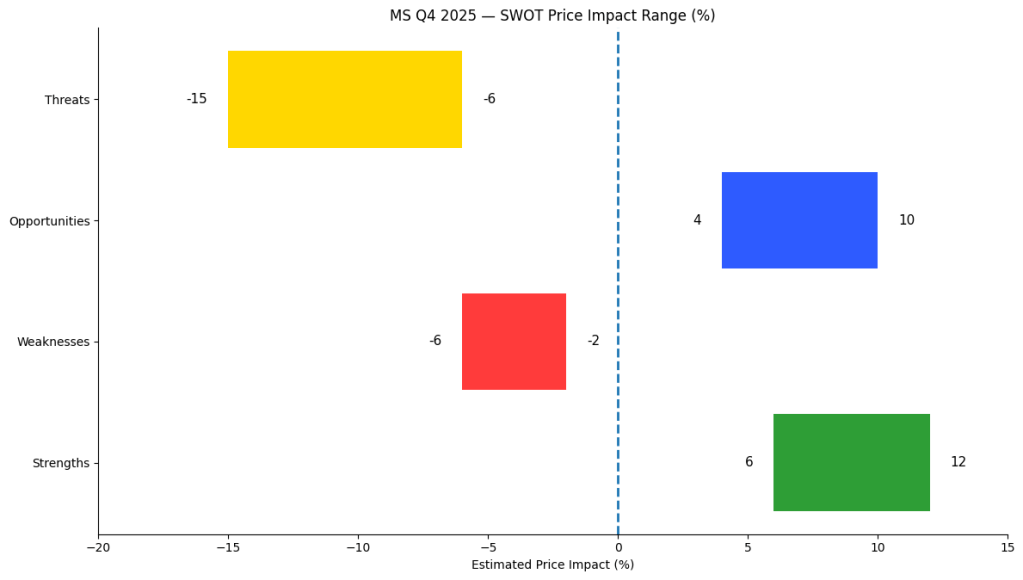
SWOT price impact chart for Morgan Stanley Q4 2025, illustrating strengths, weaknesses, opportunities, and threats with estimated share price impact ranges from −20% to +15%.
Morgan Stanley Q4 2025 SWOT analysis showing estimated price impact ranges. Strengths and opportunities reflect investment banking recovery and wealth management durability, while weaknesses and threats capture market cyclicality and downside risks.

Valuation Scenarios

For Morgan Stanley, valuation is best anchored on tangible book value and returns on equity. With tangible book value per share around $50, different P/TBV multiples reflect how much premium the market assigns to a ~20%+ ROTCE franchise.

Bear case (~$160)

  • Deal activity cools and market conditions soften.
  • Valuation compresses toward a more conservative quality-bank multiple.

Base case (~$180)

  • Wealth Management remains stable and investment banking normalizes.
  • MS sustains premium returns without further multiple expansion.

Bull case (~$200)

  • Deal momentum persists and the integrated-firm narrative strengthens.
    • Market assigns a top-tier multiple to durable earnings power.

Probability-weighted fair value: ~$180 per share.
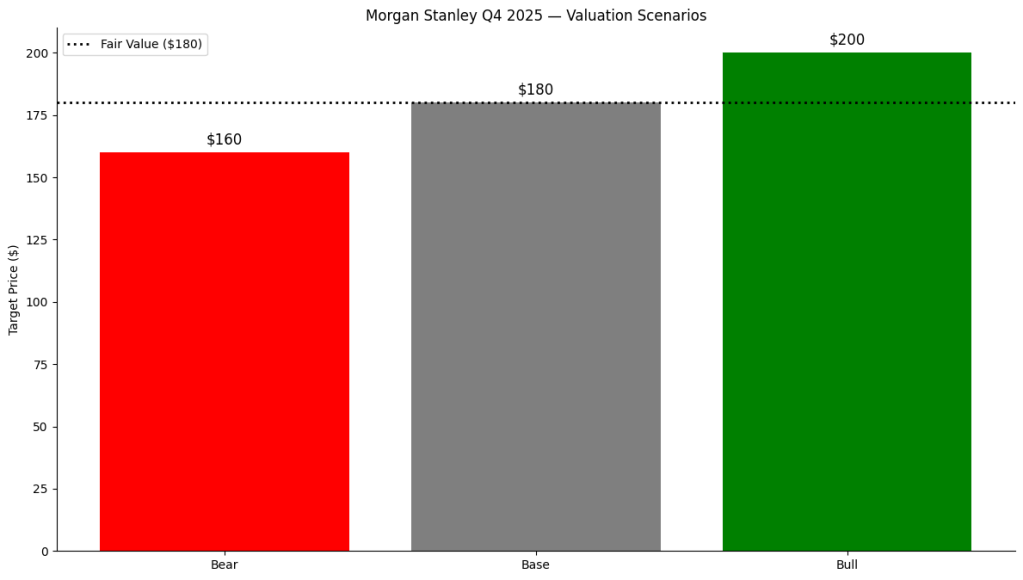
Valuation scenarios chart for Morgan Stanley Q4 2025 with three bars showing bear case at $160, base case at $180, and bull case at $200, alongside a dotted fair value line at $180.
Morgan Stanley Q4 2025 valuation scenarios showing bear, base, and bull price targets. The probability-weighted fair value centers around $180 per share, highlighting limited upside after the post-earnings rally.

Verdict

Morgan Stanley remains a best-in-class financial franchise, and Q4 2025 confirms that its diversified model works when markets recover. However, after the post-earnings rally, the stock appears fairly valued rather than obviously undervalued.

For long-term, value-oriented investors:

  • Above ~$190: upside looks limited unless the deal cycle stays unusually strong.
  • Around ~$180: valuation is reasonable for a high-quality compounder.
  • Below ~$165: the stock would begin to offer a more compelling margin of safety.

Call to Action

If you found this breakdown useful, follow SWOTstock for clear, fundamentals-driven earnings analysis that cuts through the noise and focuses on valuation, risk, and long-term returns.


Disclaimer

This article is for informational purposes only and does not constitute investment advice. All analysis is based on publicly available company disclosures. Investors should conduct their own research or consult a financial professional before making investment decisions.

Citigroup Q4 2025: Execution Is Improving, But the Valuation Still Depends on Delivery

Citigroup’s Q4 2025 results indicate improvement in core businesses despite profitability challenges due to restructuring costs. While investment banking fees rebounded and net interest income rose, returns on tangible equity remain below targets. The stock, anchored to tangible book value, offers potential upside if management executes consistently, appealing to patient value investors.

TL;DR Summary

Citigroup’s (NYSE: C) Q4 2025 results show real progress in core businesses like Services and Banking, but reported returns are still weighed down by restructuring costs and one-time items. The stock remains anchored to tangible book value, making this a classic execution-driven value story. Upside exists if management delivers on its 10–11% RoTCE target, but patience is required.


Quarter Recap

Citigroup reported Q4 2025 earnings that reflect a bank still in transition. Reported profitability declined year over year due largely to a Russia-related exit charge, but underlying operating trends were more constructive. Revenue held up across key businesses, investment banking activity rebounded sharply, and management emphasized that major geopolitical overhangs are now largely behind the company.


Key Highlights

  • Net income of approximately $2.47 billion, impacted by a sizable one-time Russia exit loss
  • Reported EPS of $1.19, with underlying performance stronger when adjusting for notable items
  • Investment banking fees rose sharply year over year, signaling a recovery in deal activity
  • Net interest income increased year over year, supported by higher average rates
  • CET1 capital ratio of 13.2%, comfortably above regulatory requirements
  • Tangible book value per share of $97.06 provides a clear valuation anchor

SWOT Analysis

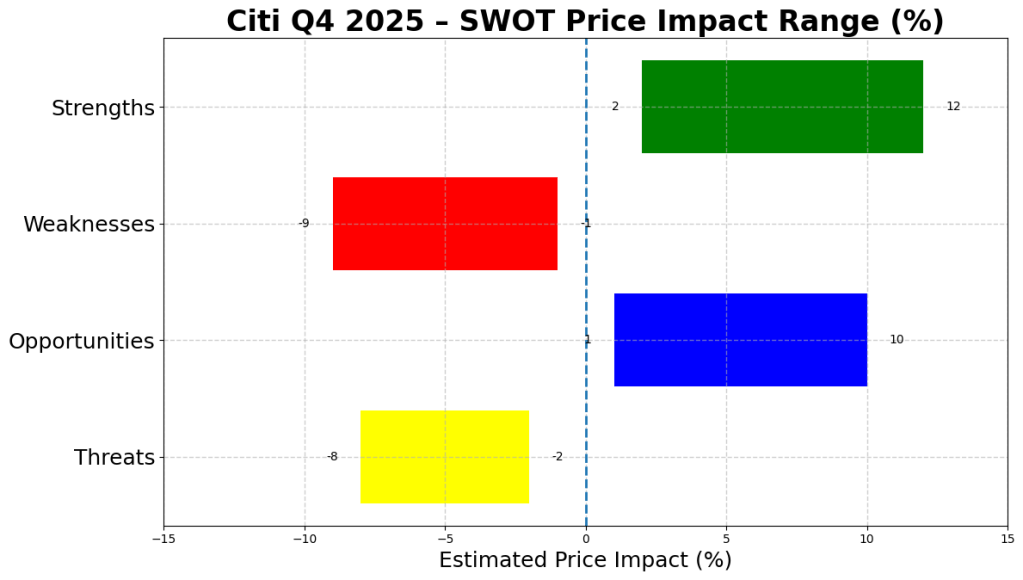
Citigroup’s investment case remains centered on whether management can convert improving operating trends into sustainably higher returns on tangible equity. The quarter reinforced both the opportunity and the risks embedded in that thesis.

Strengths

  • Services and institutional businesses continue to scale, improving the quality and durability of earnings (estimated price impact: +4% to +10%)
  • Strong rebound in investment banking fees highlights Citi’s relevance in large, complex transactions (+3% to +8%)
  • Capital strength and ongoing share buybacks provide downside support and optionality (+4% to +9%)
  • Clear tangible book value base gives value investors a concrete reference point (+2% to +6%)

Weaknesses

  • Reported RoTCE remains well below management’s 10–11% target, limiting valuation re-rating (−6% to −12%)
  • Expense growth and a high efficiency ratio continue to pressure near-term profitability (−4% to −10%)
  • Earnings remain vulnerable to one-time items during the restructuring phase (−2% to −6%)

Opportunities

  • Achieving the stated RoTCE target could justify a meaningful re-rating toward tangible book value or above (+8% to +18%)
  • Operating leverage from simplification and productivity initiatives could improve margins over time (+4% to +12%)
  • Excess capital above regulatory requirements supports continued capital return (+3% to +9%)

Threats

  • A turn in the credit cycle could quickly erode earnings and capital flexibility (−6% to −15%)
  • Rate and macro sensitivity remain meaningful, particularly for net interest income (−3% to −10%)
  • Execution risk persists if cost reductions fail to materialize as planned (−5% to −12%)
Citigroup Q4 2025 SWOT price impact chart showing estimated percentage upside and downside from strengths, weaknesses, opportunities, and threats for value investors.
Citigroup Q4 2025 SWOT price impact range. Estimated upside and downside drivers based on management commentary and valuation sensitivity around tangible book value.

Valuation Scenarios

For Citi, valuation is best framed using price-to-tangible book value, as returns on tangible equity are the primary driver of long-term multiple expansion. With TBVPS at $97.06, the range of outcomes depends largely on execution.

Bear Case

  • Assumes sub-par returns persist and credit or expense pressures rise
  • Valuation at ~0.8× tangible book
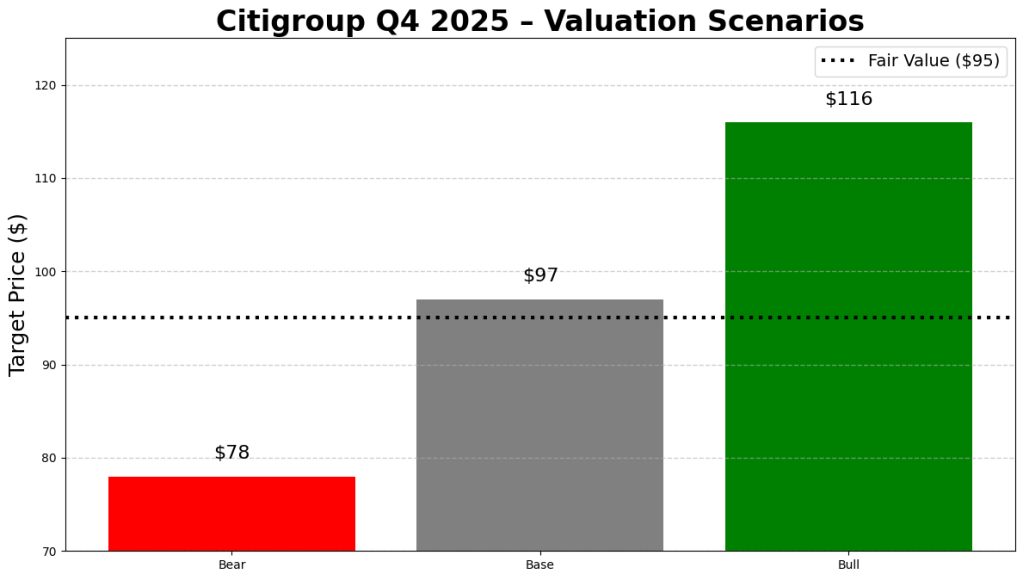
  • Implied value: ~$78

Base Case

  • Assumes steady progress toward management’s RoTCE target without full re-rating
  • Valuation at ~1.0× tangible book
  • Implied value: ~$97

Bull Case

  • Assumes credible delivery of 10–11% RoTCE with visible operating leverage
  • Valuation at ~1.2× tangible book
  • Implied value: ~$116

Probability-weighted fair value: approximately $95

Citigroup Q4 2025 valuation scenarios chart showing bear, base, and bull target prices with a dashed fair value line for value investors.
Citigroup Q4 2025 valuation scenarios. Bear, base, and bull price targets derived from tangible book value multiples and return-on-tangible-equity assumptions, with probability-weighted fair value highlighted.

Verdict

Citigroup remains a value investor’s execution bet. The stock is no longer distressed, but it is not yet priced for success. If management delivers on returns and expense discipline, today’s valuation leaves room for upside. If execution stalls, the stock risks remaining range-bound around tangible book value. For patient investors, Citi offers asymmetry — but not certainty.


Call to Action

If you’re tracking large U.S. banks from a value perspective, follow SWOTstock for earnings-driven breakdowns that focus on fundamentals, valuation discipline, and execution — not hype.


Disclaimer

This article is for informational purposes only and does not constitute investment advice. All analysis is based on publicly available company disclosures and reflects estimates and opinions at the time of writing. Investors should conduct their own research before making investment decisions.