NVIDIA Q1 FY2026: AI Revenue Soars, but China Risk Lingers

NVIDIA’s Q1 FY2026 earnings show record AI revenue and rising risks from China export bans. See full breakdown, SWOT, and valuation scenarios.

TL;DR Summary

NVIDIA (NASDAQ: NVDA) delivered record-breaking Q1 revenue powered by AI infrastructure demand, but a $4.5B China-related inventory charge exposed its vulnerability to export regulations. Strong outlook continues, but geopolitical risks cap near-term upside.

Quarter Recap

NVIDIA reported a stellar Q1 FY2026 with $44.06 billion in revenue, up 69% year-over-year, driven primarily by its Data Center segment which surged to $39.1 billion. The company’s full-stack AI platform, from Blackwell GPUs to CUDA software, continues to lead the industry.

However, a $4.5 billion inventory charge—triggered by U.S. export restrictions on H20 chips to China—cut into GAAP gross margin, bringing it down to 61.0%. Without this one-off, margins would have reached 71.3%.

CEO Jensen Huang maintained a confident tone, citing global momentum for AI compute and strong enterprise demand. Q2 guidance sits at $45 billion in revenue, despite an expected $8 billion China shortfall.

Line chart showing NVIDIA's revenue and net income growth from Q1 FY25 to Q1 FY26, highlighting consistent financial expansion.

What Changed Since Last Quarter

  • Revenue jumped 18% from Q4 FY2025’s $37.98B
  • China export losses increased and led to a $4.5B inventory charge
  • Blackwell ramp-up continued, now complemented by global AI partnerships
  • Margins would have improved sequentially if not for the export charge

Key Highlights

  • Revenue: $44.06B (+69% YoY, +18% QoQ)
  • Data Center Revenue: $39.1B (+73% YoY)
  • Gaming Revenue: $3.8B (+42% YoY)
  • Gross Margin (ex. H20 charge): 71.3%
  • Inventory Charge: $4.5B related to H20 China restrictions
  • Q2 Outlook: $45B revenue, ~$8B loss from China bans

Segment Revenue Breakdown

NVIDIA’s Q1 FY2026 results show that its Data Center business has become the overwhelming growth engine, with Gaming rebounding and smaller segments contributing steadily.
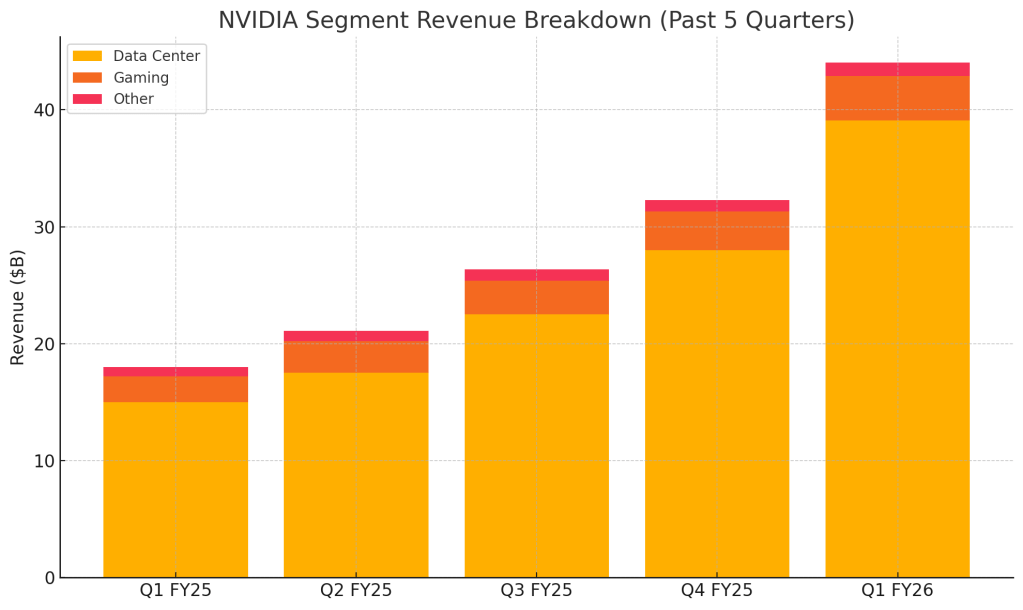
Stacked bar chart showing NVIDIA’s segment revenues, highlighting growth in Data Center and Gaming over 5 quarters.

SWOT Analysis with Price Impact

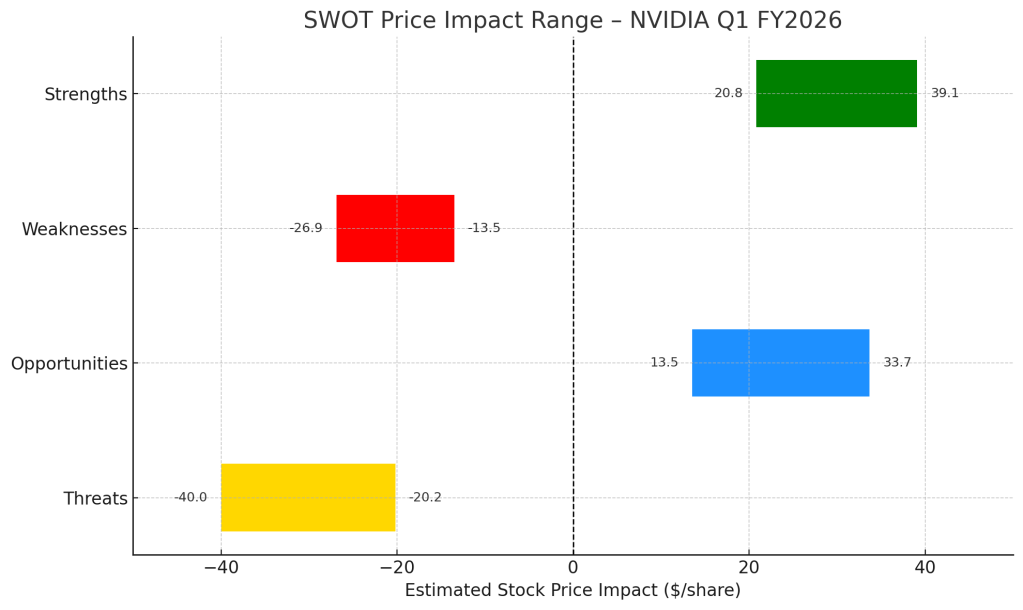
Horizontal bar chart showing estimated stock price impact for each SWOT factor, ranging from –$40 to +$40 per share.

Strengths

NVIDIA’s dominance in AI infrastructure remains unchallenged. Its platform—from Blackwell chips to CUDA and software libraries—continues to see record enterprise demand.
Price Impact: +15% to +30%

Weakness

The $4.5B write-down tied to H20 inventory for China highlights dependency on export-sensitive products.
Price Impact: –10% to –20%

Opportunities

New AI alliances with Saudi Arabia, UAE, and Taiwan, along with platform expansion via NIM (Inference Microservices), open large future markets.
Price Impact: +10% to +25%

Threats

China restrictions are set to cost $8B in Q2 revenue. Further geopolitical escalation may erode future sales or strain global operations.
Price Impact: –15% to –30%

SWOT Summary
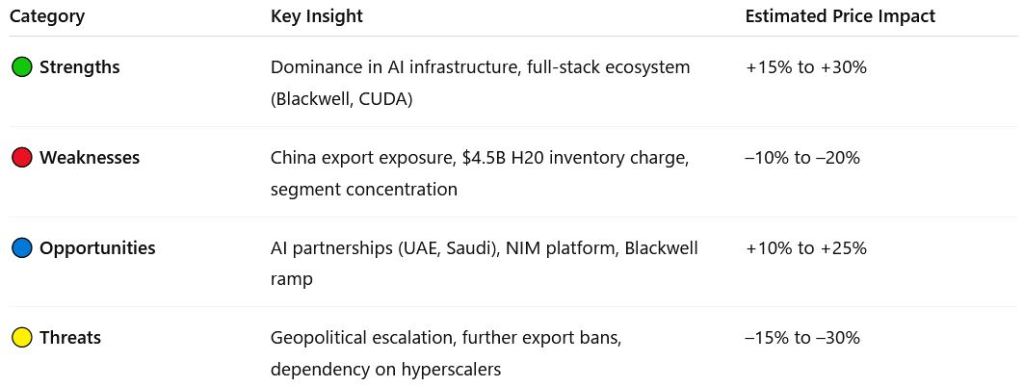
Table summarizing NVIDIA’s Q1 FY2026 SWOT analysis with strengths in AI leadership, weaknesses in China exposure, opportunities in global AI expansion, and threats from geopolitical risks, each with estimated stock price impacts.

What’s NVIDIA Worth After Q1 FY2026?

To value NVIDIA after its blockbuster Q1 FY2026 earnings, we consider three realistic scenarios for its forward earnings power—each reflecting a different blend of AI infrastructure growth, export risks, and margin execution.
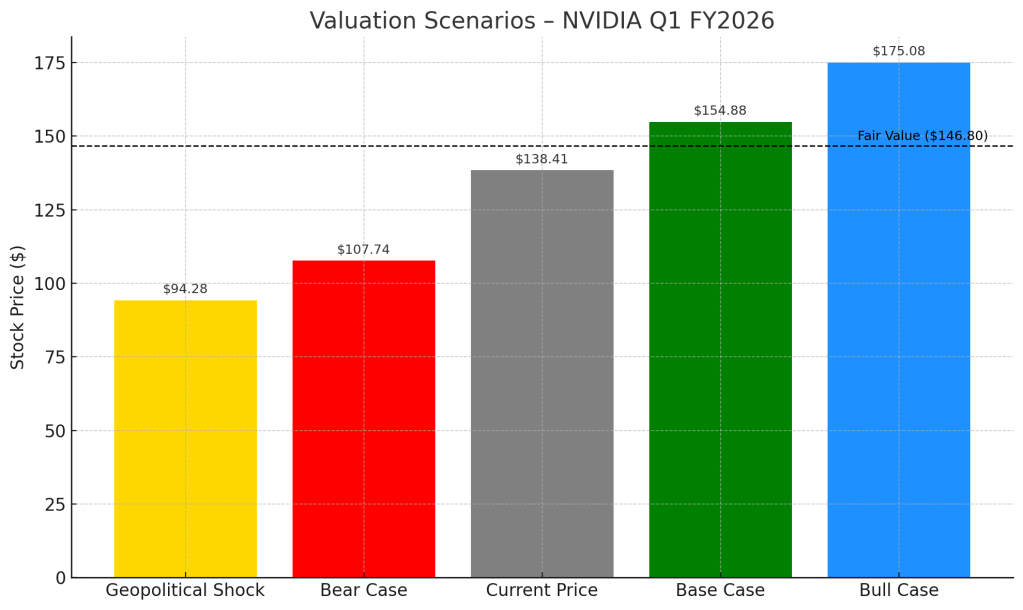
Bar chart showing valuation scenarios from worst case ($94.28) to bull case ($175.08) with fair value line at $146.80.

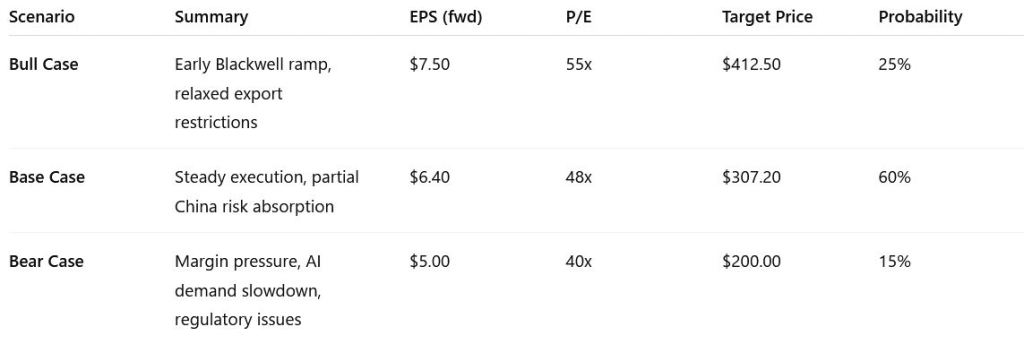
Bull Case – $412.50/share (25% probability)

In the most optimistic scenario, NVIDIA ramps Blackwell faster than expected and U.S. export restrictions ease, allowing China sales to partially recover. Enterprise demand for generative AI compute remains red-hot globally, lifting both volumes and pricing. If earnings rise to $7.50 per share and the market awards a 55x multiple (consistent with high-growth AI comps), the stock could reach $412.50. While aggressive, this case reflects NVIDIA’s AI platform expanding into global infrastructure—and we assign it a 25% probability.

Base Case – $307.20/share (60% probability)

The base case assumes NVIDIA continues executing well, with growth sustained in the U.S., Middle East, and Asia-Pacific (excluding China). Blackwell adoption progresses on schedule, but China restrictions persist. Margins remain strong, but headline volatility lingers. We estimate forward EPS at $6.40 and apply a P/E of 48x—slightly below peak valuation—yielding a $307.20 price target. This scenario reflects the most likely outcome given current guidance and market conditions.

Bear Case – $200.00/share (15% probability)

In a downside case, AI capex moderates, China-related risks escalate, and competitors gain share in inference or custom silicon. NVIDIA faces pricing pressure or slower enterprise uptake. If forward EPS falls to $5.00 and valuation compresses to 40x, the stock could be re-rated to $200. While less likely in the near term, we assign this outcome a 15% probability due to macro and geopolitical uncertainties.

Valuation Scenarios Summary

Table comparing NVIDIA’s bull, base, and bear case stock valuations for Q1 FY2026, including EPS estimates, P/E multiples, target prices, and probabilities.

Fair Value Estimate: $308.95

Weighted across all three outcomes, our fair value estimate for NVIDIA is $308.95 per share—more than double its current price of ~$133.59 (as of June 2025). That implies significant long-term upside, especially if export risks stabilize and Blackwell adoption broadens globally.


(0.25 × $412.50) + (0.60 × $307.20) + (0.15 × $200.00) = $308.95


What to Watch Next Quarter

  • Ramp-up of Blackwell shipments outside China
  • Progress on AI factory partnerships in UAE and Saudi Arabia
  • Margin recovery trends
  • Policy developments in U.S.-China tech export restrictions

Verdict

NVIDIA remains the cornerstone of AI infrastructure. Q1 FY2026 reaffirms its growth engine, but investors should watch for regulatory headwinds. For growth stock investors, it’s a strong hold and a potential buy on dips.


Call to Action

📬 Like this kind of breakdown?
Subscribe to SWOTstock for clear, official-report-based earnings breakdown.


Disclaimer

This article is based entirely on NVIDIA’s Q1 FY2026 financial report, earnings call transcript, and management statements. It does not constitute investment advice.


Leave a comment


NVIDIA Q1 FY2025: AI Boom Powers Revenue—but Is the Stock Already Fully Priced?

NVIDIA Q1 FY2025 earnings breakdown: record AI revenue, $28B guidance, SWOT analysis, valuation scenarios, and risks—no hype, just official data.


Quick Summary: Record Growth, Rising Risks

NVIDIA (NASDAQ: NVDA) crushed expectations with $26B in revenue and bold Q2 guidance, driven by unmatched AI infrastructure demand. The company’s product roadmap is solid, but geopolitical risks and premium valuation mean the stock may be running ahead of execution—at least in the near term.


Quarter Recap: $26B Now, $28B Next?

NVIDIA reported $26.0 billion in revenue for Q1 FY2025—up 262% YoY and 18% QoQ—led by Data Center strength. Net income surged to $14.9 billion, while gross margin expanded to 76%. The company projects $28 billion in revenue next quarter, indicating strong confidence in near-term demand.

CEO Jensen Huang called this the beginning of a new era of “AI factories.” NVIDIA’s Hopper platform continues to scale, and Blackwell is next in line—set to launch in second-half FY2025, with early production ramping in Q2.

However, the quarter wasn’t flawless: NVIDIA disclosed a $5.5 billion charge tied to H20 chips restricted under U.S. export controls. China’s contribution is now under pressure, and rising op-ex shows execution isn’t without trade-offs.

Why it matters: NVIDIA is leading the AI infrastructure race—but it’s also navigating global friction and expectations priced for perfection.


Q1 FY2025 Key Metrics (Official Results)

  • Revenue: $26.0B (+18% QoQ, +262% YoY)
  • Net Income: $14.9B (+628% YoY)
  • Non-GAAP EPS: $6.12
  • Gross Margin: 76%
  • Data Center: $22.6B (+427% YoY)
  • Gaming: $2.6B (–8% QoQ)
  • Q2 Guidance: Revenue ~$28B
  • Operating Expenses: $3.5B (+39% YoY)
  • Cash & Equivalents: $31.4B
  • 10-for-1 Stock Split: Effective June 7
  • Dividend: +150% increase (post-split)

Revenue vs Net Income (Last 5 Quarters)

Line chart showing NVIDIA's quarterly revenue and net income growth over the last five quarters, highlighting Q1 FY2025 surge in AI-driven profits

SWOT: What’s Driving NVIDIA—and What Could Break It

Let’s use the SWOT framework to break down what’s going well, what’s lagging, what’s coming, and what could derail NVIDIA’s momentum.

Horizontal bar chart displaying estimated stock price impact of SWOT factors for NVIDIA Q1 FY2025: strengths, weaknesses, opportunities, and threats

Strengths

NVIDIA is the undisputed AI infrastructure leader. Gross margins are elite. Blackwell and Hopper platforms position the company for continued dominance through 2025.

Price impact: Supports +$20 to +25/share if growth holds.

Weaknesses

Gaming sales declined, operating expenses jumped, and product cycle execution has some lags. These aren’t dealbreakers, but they tighten the margin for error.

Impact: –$4 to –6/share downside from earnings pressure.

Opportunities

Blackwell chips are set to ramp late FY2025 and enable trillion-parameter scale models. NVIDIA also sees long-term demand from sovereign AI and enterprise. Q2 guidance of $28B confirms near-term visibility.

Potential upside: +10 to +15/share if Blackwell ramps as expected.

Threats

U.S. export restrictions caused a $5.5B charge on H20 chips. Further geopolitical or regulatory changes could cut off high-margin international revenue. Valuation already prices in near-flawless execution.

Downside risk: –8 to –10/share if regulations worsen or growth slows.


Before the Valuation—Let’s Talk Risk

Top Risks to Watch:

  • Further China/US tension could block additional revenue channels.
  • Overreliance on AI infrastructure capex may face slowdown if macro weakens.
  • Valuation compression risk if NVIDIA misses a quarter or delays rollout.

This context helps weigh the bull vs bear case more realistically.


Valuation Scenarios: What’s Fair Value Now?

Based on Q2 guidance, current margins, and roadmap execution, here’s our valuation model:

Vertical bar chart illustrating NVIDIA's Q1 FY2025 stock valuation scenarios including bull case, base case, and bear case with forward EPS and price estimates

Table comparing NVIDIA’s Q1 FY2026 stock valuation scenarios across bull, base, and bear cases. Includes projected EPS, P/E multiples, target prices, and probability weights, with a weighted average fair value estimate of $308.95 against a current stock price of ~$130.

Weighted Average Fair Value

(0.25 × $412.50) + (0.60 × $307.20) + (0.15 × $200.00) = $308.95

Current Stock Price: ~$129 (as of May 14, 2025)
→ Appears to be undervalue


Peer Check: How Does NVIDIA Stack Up?

CompanyData Center RevenueYoY GrowthAI Strategy
NVIDIA$22.6B+427%Infrastructure
AMD$2.3B (est.)+80%GPU + CPU
Intel~$3.0B (DCG)~FlatCPUs only
AWS/Azure$20–25B+ (Infra)VariesCloud AI buyers

NVIDIA remains the dominant supplier to the AI arms race, while others are buyers or partial players.


Verdict: Is NVIDIA Still a Buy After Q1?

NVIDIA’s quarter was flawless—almost too flawless. If Blackwell hits and Q2 guidance holds, the stock still has room. But the bar is now extremely high, and geopolitical/regulatory risks are real.

Call: Hold if you own. Consider adding on dips or consolidation.


Don’t Chase Headlines—Understand the Fundamentals

Stop relying on social media hype.
Subscribe now for clean, no-jargon breakdowns using only official data—delivered right after earnings.

Also check out our recent breakdowns of AMD Q1 2025, Palantir Q1 2025, Meta Q1 2025 and Alphabet Q1 2025 for more actionable insights.


Disclaimer

This article is based only on NVIDIA’s official Q1 FY2025 financial report and earnings call. No third-party commentary was used. This content is for informational purposes only and not investment advice.


Leave a comment


Follow us on Instagram: @SWOTstock